
In 2021/22, Joe Root’s English visitors lost the Ashes in Australia after three Tests. It took Australia 5115 deliveries to win three Tests. This was a modern record for the Ashes in Australia. The 2001 Australians hold the overall modern record, needing only 3991 balls of cricket to wrap up the Ashes 3-0 after the first three matches in England that year. Ben Stokes’ team have lost the Ashes in only 4719 balls in 2025/26.
In so many ways, the 2025/26 Ashes were to the 2021/22 Ashes what the 2023/24 England tour of India was to the 2020/21 England tour of India - promised more, and ended up being worse. England have been negative in the 2025/26 Ashes. This is not a charge which could be laid at their door in the 2021/22 series.
In 2021/22, the current Australian quick bowlers were four years younger, and England were basically just outgunned. These two series wins have come without Josh Hazlewood who played in only one of the eight Tests. Hazlewood has collected 168 Test wickets in Australia at 22.7 each, and averages just over four wickets per match there. But at least England tried to compete in 2021/22. They always played four specialist bowlers plus Ben Stokes (who was also four years younger) on that tour.
Four years later, they started out that way at Perth. Gus Atkinson, Jofra Archer, Brydon Carse, Mark Wood and Ben Stokes featured in England’s XI and bowled Australia out for 132. But the Australian attack in Australia is formidable in terms of both quality and depth. Australia’s reserve fast bowlers are not playing Test cricket for Australia because Josh Hazlewood, Pat Cummins and Mitchell Starc - three all time great fast bowlers - are. In another era, Scott Boland would probably play a lot more than his 17 Tests by age 37. What’s more, Australia never make the mistake of playing fewer than four specialist wicket takers.
After that first Test at Perth, England took the same wrong lesson which they did from their 2021/22 tour of Australia - that their problem was with their batting. It wasn’t. It was just that their bowling was not as good as Australia’s. In the 2025/26 series after Perth England chose to play negatively, replacing the injured Mark Wood with the off-spinning all rounder Will Jacks. Jacks is a part-time off-spinner who averages 70 balls (or 11.4 overs) per match in first class cricket. In the 2nd and 3rd Test, Jacks conceded 4/246 in 50.3 overs.
The problem was not that Jacks conceded nearly 250 runs in 2 Tests (including 212 at the Adelaide Oval), it was that he did this by design, as one of England five main bowlers (of which the injury prone Ben Stokes was another). This deficit has the added effect of forcing the three frontline bowlers to bowl at times when they would otherwise not have to bowl.
Much of the focus after England’s defeat remains on England’s batting. This is due to a basic misunderstanding about the nature of the Test match contest. The Australian bowlers don’t miss their lines and length as much as England’s. England’s strategy of going with genuine pace is still workable. Even if Brydon Carse has been expensive, he has still collected a wicket every 35 balls (for 29 runs apiece). England have the bowling to threaten Australia and compete with Australia. It’s just that they have chosen to not play it.
But this is hardly news. England did the same thing in India in 2023-24. They brought only four spinners on a tour on which their head coach expected to play (going by a press interview he gave) three or even four if necessary in the eleven. When two of those four were injured, they didn’t replace them with anyone.
With Nathan Lyon, Josh Hazlewood and Pat Cummins missing from the Boxing Day Test, England’s method of hedging with Will Jacks at number eight as the lone spinner in a five man attack (of which Ben Stokes is one bowler) has a better chance of working. But this is only because the quality of the Australian bowling will have dropped, and because they will probably need a spinner a lot more at the MCG than they did at Perth.
The strange thing about this series is that to anyone who has watched England and Australia and every other team in Test cricket in the last seven years or so, this result comes as no surprise. This is a great Australian team. But in England it is continually underrated. This was the case before the 2023 Ashes in England, and it is the case today. Stuart Broad called it the weakest Australian team since 2010. Bazball is as much a personality cult, as it is an approach to risk taking with the bat in Test cricket. England’s bazballers have lost in India and Pakistan and won in New Zealand on their recent away tours since the previous Ashes.
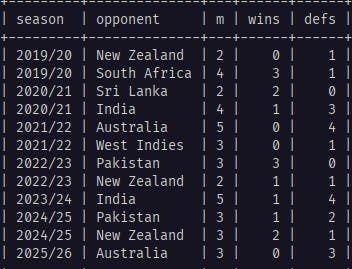
The Ashes to Ashes cycle is, it appears, what matters to English cricket fans and certainly to the English cricket press. But even here, England’s record read 2 series wins and 4 defeats on six tours in the three away seasons leading up to the Bazball era. In the three seasons of the Bazball era so far, it reads 2 wins, 3 defeats and 1 draw.
For the most part, this is because Bazball has had little to say about bowling and little interest in it. Apart from the fact that England responded to falling 1-0 behind at Perth by weakening (and reducing) their bowling, it was telling that on the 3rd day at Perth, after England trimmed the first innings deficit to 85 runs, Jofra Archer bowled only 10 of England’s 66 overs in the 3rd innings. Ben Stokes bowled none. England bowled 27 overs of part time off-spin. Will Jacks and Joe Root were so poor, that three Australian left handers collected 1/129 in 151 balls against them on that afternoon. Contrast that with Mitchell Starc (he will be 36 years old in a month) who made 77(141) to stretch Australia’s first innings to 511 in Brisbane, and then bowled 11 of Australia’s 34 overs in the remainder of that day.
Test matches are not decided by individual deliveries. The English batting has not been irresponsible or poor. They have come up against a attack of great quality, class and depth. Their approach of taking chances, and being less selective than Test batters traditionally are about attacking shots, is reasonable. Trying to loft a four over the infield, or reverse-sweeping the off-spinner against the break, doesn’t become a riskier option just because there have already been two fours in the over. If anything, it is arguably riskier if a player who doesn’t normally loft over the infield or play the reverse-sweep tries it uncharacteristically.
Test matches are invariably won by the stronger, deeper bowling attack. That’s what has happened in the 2025/26 Ashes. It has required less effort from Australia in 2025/26 than it did in 2021/22. Australia scored 37.2 runs per wicket in the 2025/26 Ashes, to 36.3 runs per wicket in the first three Tests of the 2021/22 series. They’ve collected a wicket every 40.9 balls in 2025/26, to one every 44.3 balls in 2021/22. Their wickets have cost them 7 runs more (18.7 to 25.8 runs per wicket), but in exchange for getting their wickets 9% faster, that’s a deal any team will gladly take.
Australia have won the Ashes because they’re currently in an all time great era. England have lost the Ashes for the same reason. They’ve made things worse for themselves (much as India did by picking the extra batter at number eight in Australia in 2024/25) by making a fatally negative choice by picking Will Jacks at number eight. It says much about the coverage of the Ashes in the English press that amidst all the usual psychobabble, the various English coaches and players who have appeared before the press have not been asked about this negative choice.
Australia won’t mind it one bit.
Comments
Nothing yet. Say the first thing.
Sign in to join the conversation.