
If you ask progressive creators why they started making political content, they often describe a sense of responsibility to fill in a gap in information: the genocide in Gaza, misinformation during Covid, underreported ICE occupations in their cities. Many of them share the experience of losing work because they spoke about these issues publicly, making them hyper aware that their political opinions will have financial repercussions.
Ad spending correlates with friendlier coverage of the spender and harsher coverage of their opponent. Haley Stevens’ campaign received over $60 million in ad buys from outside spenders, while El-Sayed’s outside support totaled $4.6 million, adding up to a gap of 13-to-1 in outside spending.
When that gap translates to hostile interview after hostile interview, misleading mailers, and endless attack ads, voters are hindered from a fully-informed vote. It shouldn’t be a surprise that progressive creators will roll up their sleeves to amplify the truth.
Throughout the Michigan Senate primary, Haley Stevens’s campaign and its surrogates worked to make “podcast” and “influencer” sound like disqualifiers. They claimed Abdul El-Sayed was a guy chasing his “next book or podcast deal” and ran a campaign that was supported by “coastal elite” influencers.
Ironically, Haley Stevens and Abdul El-Sayed both received coastal support. The top three states from which campaign contributions came are Michigan, California, and New York.
While it is true that El-Sayed had a lot of support from content creators across the country, the outcome of the election proved that his support was not limited to “coastal elites”. The campaign had spent a year and a half campaigning and building relationships across Michigan through hundreds of events, and no army of influencers can make up for relationships that don’t exist.
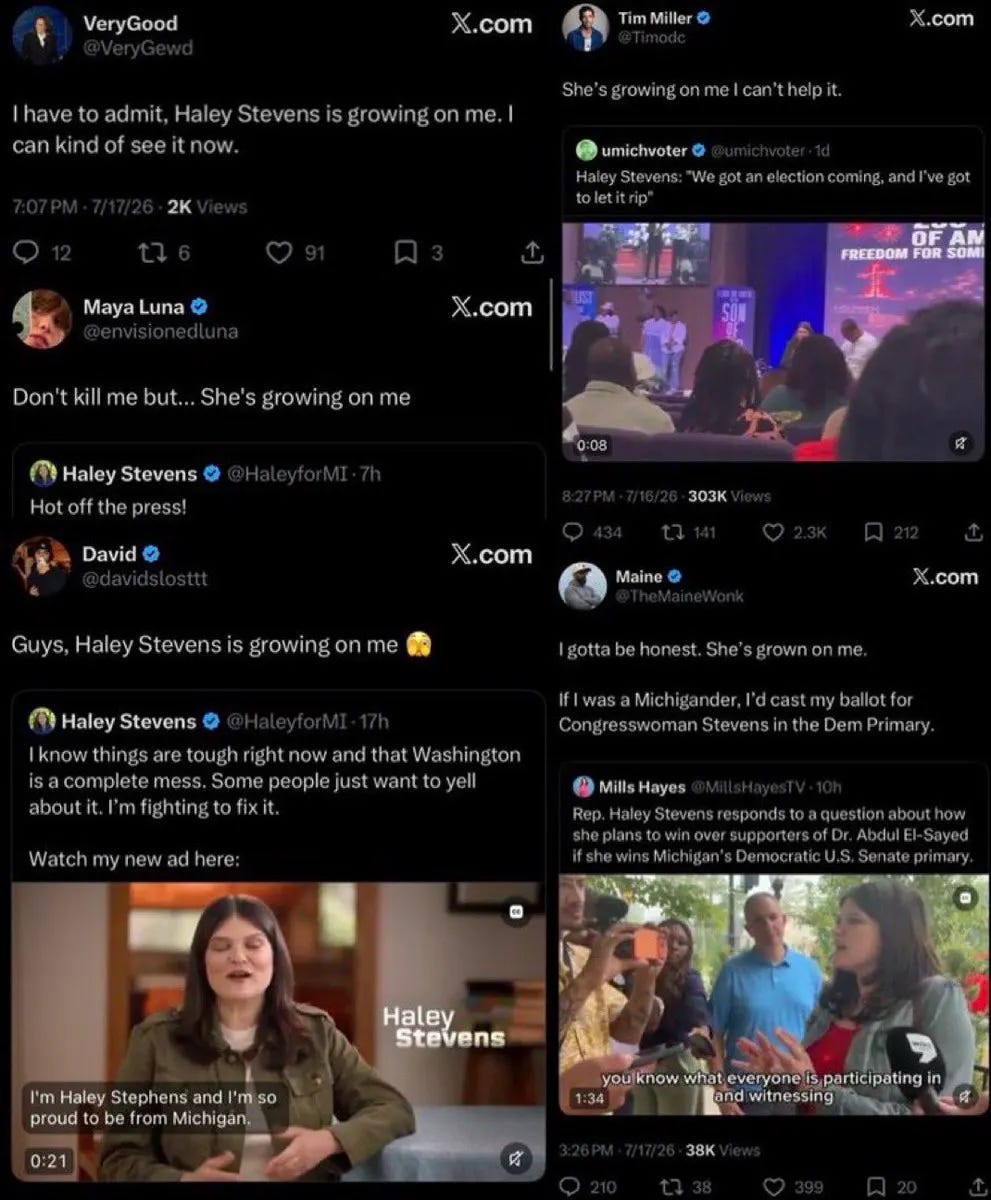
Stevens’ public messaging implied that winning campaigns don’t use influencers. But when a wave of suspiciously similar videos from small accounts began flooding the algorithms and political influencers almost unanimously declared Stevens was “growing on me”, MS NOW found that creators were offered $1,500 to post pro-Stevens content without disclosures.
For example, “Jennopalis,” was caught filming what looked like a palm tree while presenting herself as a Michigander. Someone thought influencer content was worth paying for in secret. Organic creator support was working for El-Sayed while the Stevens campaign struggled to build the real version fast enough or with the same excitement.
On the flipside, creators voluntarily supported El-Sayed’s campaign. The support and content remained organic, not driven by a paycheck, but by genuine support and the desire to join a community and platform up against tens of millions in outside spending.
In March, Mallory McMorrow attacked El-Sayed for inviting Twitch streamer Hasan Piker to a campus rally. That controversy was followed by a 13-point jump in El-Sayed’s name recognition.
The intention may have been for the backlash to hurt Abdul El-Sayed’s chances, but it actually put El-Sayed’s name in front of people who hadn’t heard of him. As it turned out, the disproportionate attack paled in comparison to the thing voters actually cared about: AIPAC’s influence, corporate money in politics, and the affordability crisis many are facing.
As Hasan Piker later summarized, mainstream media and local institutions can no longer be the gatekeepers in American politics.
Attention brought on by influencers acts as a microscope that will reveal whether the candidate and campaign can survive scrutiny, turning the campaign into a bigger target that makes every weakness more visible, not less.
There’s also a real tension in bringing influencers into a campaign: if a candidate is genuinely strong, voters are entitled to ask why that candidate needs people who don’t live in the state to make the case for them.
Creators can only act as a force multiplier on top of something that already exists, like a candidate with a real record, a campaign with local relationships, and volunteers who were doing the work before being accelerated into the spotlight.
Reaching for influencers before that infrastructure exists cannot save a campaign that is already set up to fail.
Before any national attention, the campaign built infrastructure with local creators by inviting them to events and starting a local group chat. Distill Social, For the Girls GR, Momma Wears Dad Jeans, Hear Me Out On This, the Head in the Office podcast, and many others across the state built relationships with the campaign and with each other.
As progressive out-of-state creators watched attack ads and bad-faith interviews accelerate alongside outside spending on Stevens’ behalf, they volunteered their platforms and joined the creator infrastructure.
They hosted phone bank takeovers, amplified clips and content that accurately represented the campaign’s platform, and even went door-knocking on election day. They also used their reach to lift two other candidates in Michigan: Donavan McKinney and Will Lawrence.
Ultimately, local creators were attracted to the campaign because they are everyday Michiganders who wanted their neighbors to vote with an accurate representation of the candidates, not by tens of millions in spending. Their personal stake in the race and relationships with their audiences was a critical foundation to the creator infrastructure.
Abdul El-Sayed had a winning platform with real grassroots support and a vision people could buy into. This is what attracted progressive creators. And once that vision was amplified, it also attracted voters.
No posts
Comments
Nothing yet. Say the first thing.
Sign in to join the conversation.