
Drawing was something I’ve been doing as long as I can remember. I drew all the time. My friends said when I grew up I was going to be a professional “drawer” (not to be confused with a cabinet drawer.)
I wanted to improve my skills, so I bought a very popular book on drawing called “Drawing on the Right Side of the Brain,” by Betty Edwards. I was intrigued by the concept of the right hemisphere of the brain being the creative side. Betty’s book promised to develop that right hemisphere to make me a better drawer.
I read the first few chapters and did the exercises, which were pretty lame, but I wanted to give her a chance to prove herself.
Then came chapter 3. The exercise for this chapter was to draw from life without ever looking at what was happening on the paper.
The book went into the waste bin.
I continued to struggle with drawing, even after I got a job at an animation studio.
My job was in production, but one morning I discovered a stack of rough animation that was ready to be handed out to artists to be “cleaned up”. I was not the supervisor, nor was I on that team.
Motivated by my brash belief in my abilities as a drawer, early one morning I took a scene from the pile and started to clean it up. It was a scene of Mickey Mouse, who is a deceptively hard character to draw, but I was very pleased with my work. This wasn’t as hard as I thought.
When the Clean Up Supervisor, Stan Sommers, came in, he kindly looked at my work and said, “You’re not quite ready to clean up animation,” and he proceeded to shred my work.
Then he asked, “You’re in production. Do you want to be an animator?”
“Of course! That’s why I’m here.”
“Okay, well, you’ll have to take some drawing classes,” he said as he started writing on one of my nice Mickey drawings. “You need to study life drawing from Steve Huston at Art Center College of Art and Design. They have evening and weekend classes. And take Glenn Vilppu’s drawing classes at The Animation Guild. Take every class they teach.”
Then he gave me a stern warning: “Do not take any other classes from any other instructors. Only take classes from Steve and Glenn, or you’re wasting your time.”
I took the classes, and within 6 months, I was working on the animation cleanup team. Within a year, I became the Clean Up Supervisor.
The point is not my success. The point is that having the right instruction gives you the drawing skills and know-how to be a team player in this industry.
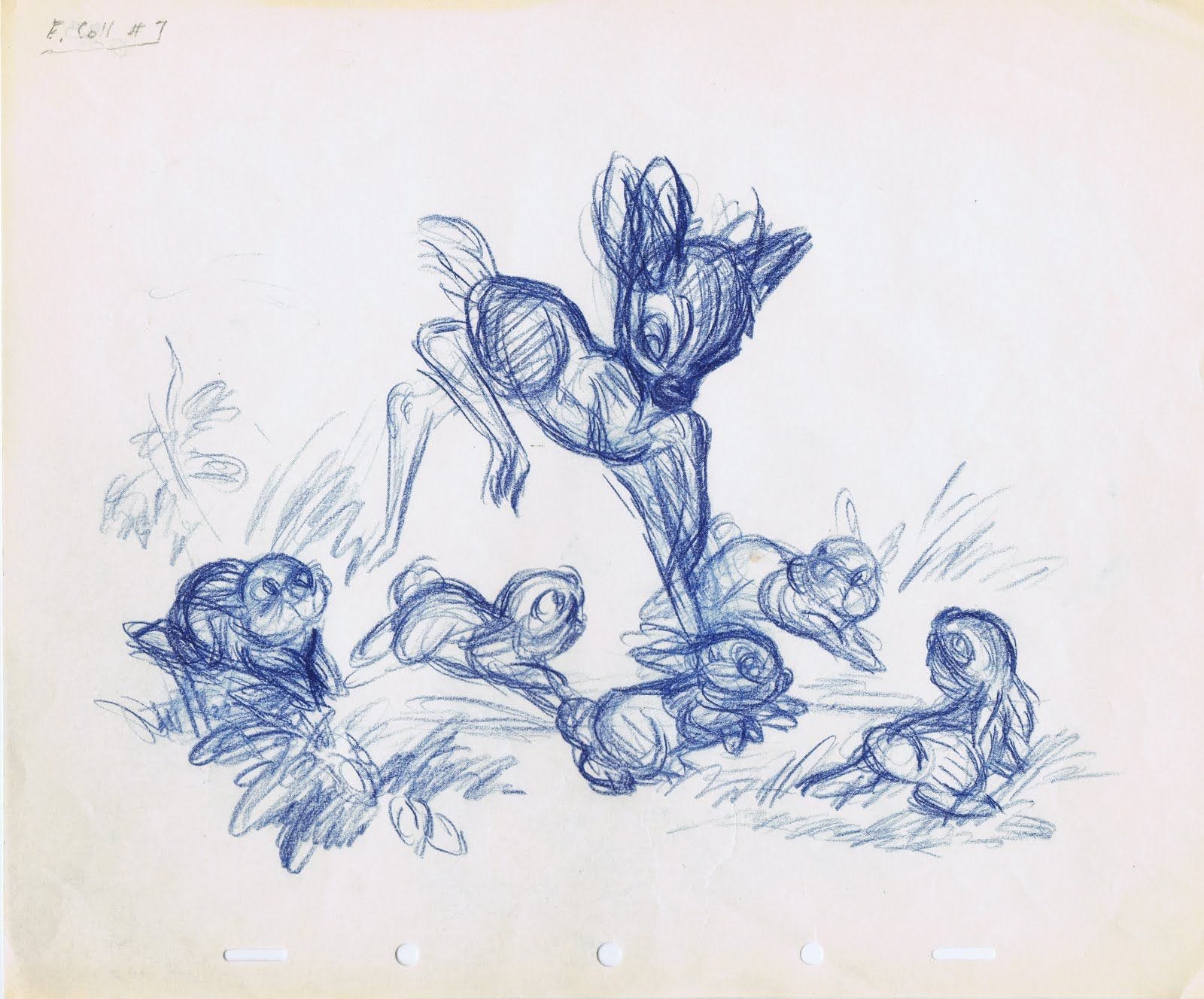
Disney Animator Van Kaufman talks about the animators who worked at Disney in the 1940s. He said there were the animators who worked on Dumbo, and then there were the animators who worked on Bambi, like Frank Thomas1 and Ollie Johnston. The Bambi animators were in a league of their own. They “could draw, they knew what they were doing.”2
I wanted to be a Bambi level animator who knew what I was doing when I drew.
Seek out great teachers who know what they’re doing and study with them.
That’s the gift Stan Sommers gave me.
Those 5 months in that first semester revolutionized my life as an artist. My drawing skills skyrocketed, and I felt in control of the world.
It’s one thing to draw.
It’s another thing to draw and know what you’re doing.
IF YOU ENJOYED THIS it comes from 101 DAYS OF ANIMATION
The image is a drawing by Frank Thomas for the Walt Disney movie Bambi
from “Walt’s People: Volume 24”, Ed. Didier Gehz, page 22
Comments
Nothing yet. Say the first thing.
Sign in to join the conversation.