
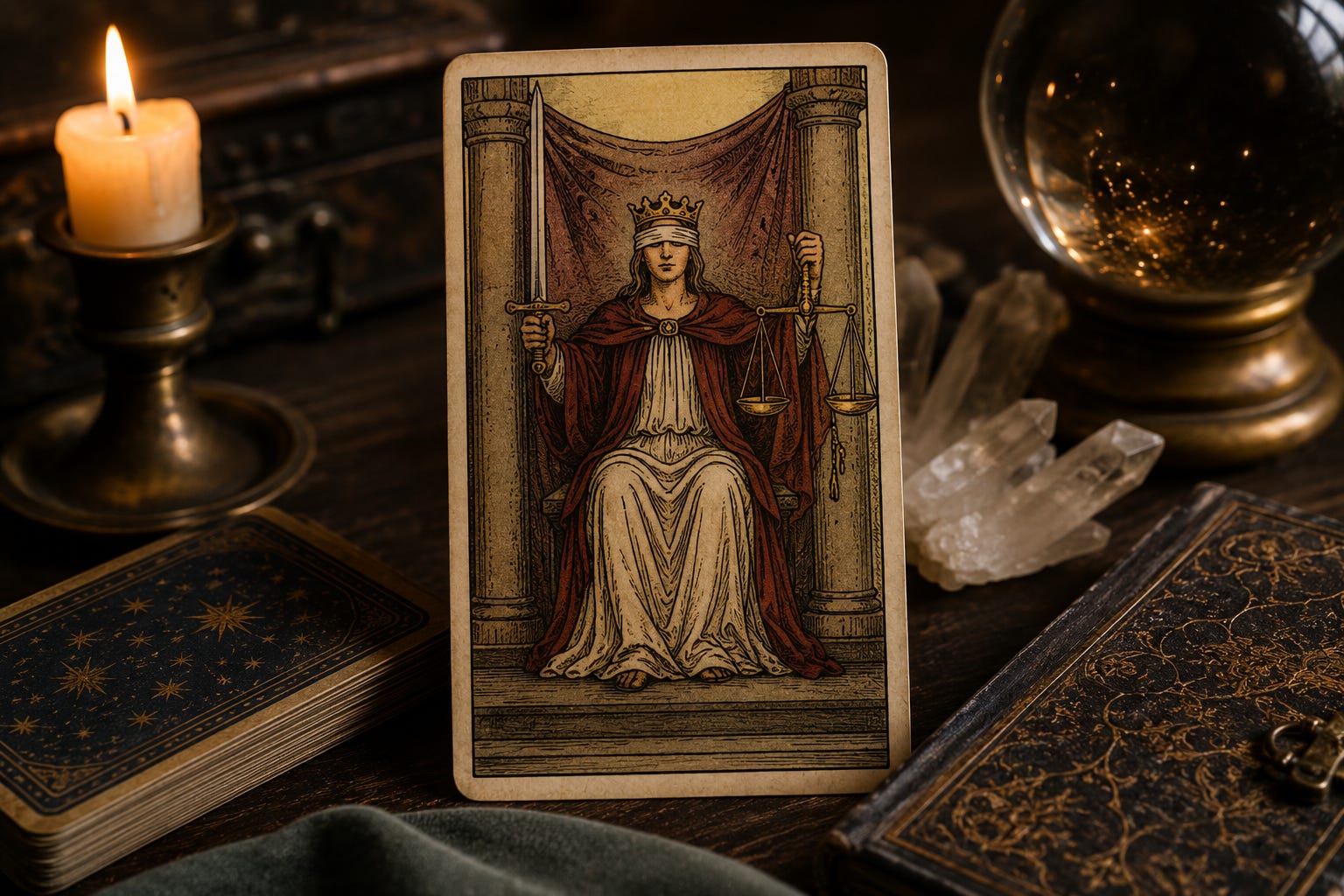
When it comes to the tarot, the Justice card is all about wishful thinking. When it pops up in a reading, people often breathe a sigh of relief, their eyes lighting up with excitement.
“Finally, karma is coming,” they think, feeling a spark of hope.
“They’re going to get what they deserve,” they reassure themselves, imagining some kind of payback for those who’ve wronged them.
“The universe will make things right,” they declare, lost in the moment, believing that justice isn’t just something we want—it’s bound to happen.
But the truth is a bit more complicated. The Justice card isn’t about getting revenge or quick payback; it’s about understanding consequences—how actions lead to reactions.
These outcomes don’t always happen the way we expect or on our timeline. Finding balance can be a bit unpredictable and might show up in surprising ways, reminding us that justice has its own timing.
It’s comforting to think that, over time, life will balance itself out. The idea that good people will eventually get what they deserve, that those who cause harm will face the music, and that injustices will eventually be corrected gives us a sense of hope. It’s nice to believe that the struggles we’ve gone through haven’t gone unnoticed.
But the reality often tells a different story. Sometimes, we’re left with silence when we really need apologies, and real change feels far away for those who could use it the most.
There are times when people who have caused chaos not only carry on but actually seem to do just fine, leaving us feeling frustrated. This gap between what we hope for and what we see can be one of the toughest parts of life to deal with.
The Justice card often shows a more complicated and unsettling reality than we tend to acknowledge at first. Think about it for a second.
You’ve got the school bully, who terrorized the playground, growing up and apparently doing great—landing a solid job, starting a family, and living a life that looks picture-perfect from the outside.
Then there are those coworkers who manipulate everyone around them for their own benefit, climbing the corporate ladder and getting rewarded for their sneaky tactics.
Look at the dishonest business owner who bends the rules and plays fast and loose with ethics, raking in the money, while the honest and hardworking person gets laid off and is left questioning why life is so unfair.
And what about the dedicated parent who puts everything into their family, only to deal with chronic health issues that serve as a harsh reminder of all that sacrificing?
There are so many people trying to do the right thing but end up picking up the pieces of their lives after someone else’s careless choices cause chaos.
However, this doesn’t take away from the importance of kindness and integrity. It reveals a tough truth: life doesn’t always play out like a legal battle.
Consequences aren’t neatly packaged and handed out on a schedule for everyone to see and judge.
We all want a world where justice is straightforward; where good is rewarded and bad is punished. Sometimes that wish comes true, but a lot of the time, it leads to disappointment.
If we get stuck expecting perfect justice before moving on, we risk being emotionally chained to those who have hurt us.
The Justice card reminds us to separate our search for fairness from our need to keep living and thriving, no matter what’s going on around us.
This is another thing that often leads to misunderstandings about the card. Justice isn’t about making guarantees or promises; it’s more about a basic principle that guides our actions.
Every choice we make matters, and what we decide has significance. And the outcomes of those choices are important too. But it’s key to understand that consequences don’t always show up right away.
They can stay under the surface for a while. And when they finally do show up, they might come in ways we don’t immediately recognize.
For example, living a life filled with dishonesty can result in shallow connections that lack real depth or authenticity.
On the flip side, being unkind can keep someone from truly understanding trust in their relationships.
Many of these consequences go unnoticed by everyone else and are only clear to the person experiencing them.
In the end, the card isn’t telling us to look at other people’s balance sheets Instead, it encourages us to take a good look at our own lives and choices.
When we hear the word “Justice,” it’s easy to think about others—the ones who lied, the people who twisted things in their favor, or the ones who broke your trust, maybe even the ones who always seem to get away with things.
But here’s the kicker: Justice also asks us to take a moment and think about our own choices moving forward.
This isn’t about blaming you for what’s happened. You’re not at fault for those past experiences.
Eventually, there comes a point in every tough situation where you get to decide what you do next.
Justice isn’t just about what others should face; it’s a push for self-reflection and taking responsibility. It’s about figuring out what actions you need to own from here on out, guiding you toward healing and personal growth.
This is the moment when honesty shows just how complicated it can be Sometimes, the raw truth doesn’t just back up what we’ve been through; it can throw our stories into a bit of a twist.
It can push us to face some hard truths about ourselves and the choices we’ve made.
We stuck around in situations that weren’t good for us way too long.
We ignored the signs that told us to back off.
We held on to the hope that someone would change into the person we wanted them to be, even when they kept showing us something different.
We put our own well-being on the back burner just to keep things smooth, often forgetting our own needs.
It’s important to realize that recognizing these truths isn’t about beating ourselves up. Instead, it’s about being more aware of ourselves, which is a key step in really understanding who we are.
These ideas are totally different. Real justice doesn’t include shame in the mix. What it’s really after is clarity—an honest and clear picture of what’s happened.
A lot of people often mix up justice and revenge, thinking they’re the same thing. But they’re actually pretty different.
Revenge keeps you stuck on what others have done and the consequences they face, trapping you in a loop of bitterness and anger. However, and this is a big however, you absolutely do not need to forgive those who deliberately harmed you as well, but I won’t get into that too much right now.
But, on the flip side, justice encourages you to look inward. It asks an important question: “Who are you becoming because of this?”
In the end, it doesn’t really matter whether the other person changes, shows regret, or faces any real consequences for what they did. Your life keeps moving forward, regardless. Waiting for their story to wrap up in a way that satisfies you can hold you back from writing the next chapter of your own life.
One important lesson that comes from the struggle to survive is our ongoing search for meaning, even when everything feels chaotic and tough. We really want to believe that, eventually, every bit of pain will come with an explanation. We cling to the hope that one day all the scattered fragments of our experiences will come together to create a clear story.
Sometimes, against all odds, things suddenly make sense, and we find that elusive understanding. But there are also times when it feels like the universe has nothing to say, leaving us to wrestle with questions that have no answers. This emotional push and pull is a key theme I explore in my upcoming book, *Survival Isn’t Victory*.
I want to shed light on the idea that just because we go through tough times doesn’t mean we’ll find the closure we’re so desperate for. Life often requires us to keep moving forward, even when we don’t get the resolution we thought we deserved. This can be one of the hardest truths we face.
The Essence of Justice
Justice isn’t about getting back at someone, and it doesn’t promise perfect fairness. Instead, it offers something deeper and more significant:
Accountability, pushing us to recognize our actions and their consequences
Discernment, helping us figure out the tricky line between right and wrong
Integrity, guiding us to stick to our values even when it’s not easy
Perspective, letting us take a step back and see the bigger picture of our choices and their effects
The courage to make tough decisions based on reality rather than sticking to what we wish would happen
Justice reminds us that while we might not control every outcome in life, we do have the power to shape who we become as we deal with those situations. Every experience and challenge gives us a chance to define our character in the face of hardship.
Justice isn’t just about hoping life will eventually be fair. It pushes us to ask ourselves: “What will you do with the truths you’ve already learned?”
Fairness can feel like a moving target, often out of our hands and influenced by all sorts of situations. But our integrity—our moral values and the principles we stick to—are totally within our control. In many cases, that’s what we can truly rely on to guide our choices and actions.
If you’re up for discussions that go beyond basic tarot readings—like survival, identity, resilience, human behavior, and the complex stuff that doesn’t fit into neat spiritual boxes—check out The Grey Area Unfiltered. Each week, I dive into these tricky topics and share new insights during our podcasts that drop every Tuesday at 12 PM ET.
Sometimes, the most meaningful act of justice isn’t about celebrating someone else’s failure. Instead, it comes from choosing to not let their choices dictate your own path.
No posts
Comments
Nothing yet. Say the first thing.
Sign in to join the conversation.