
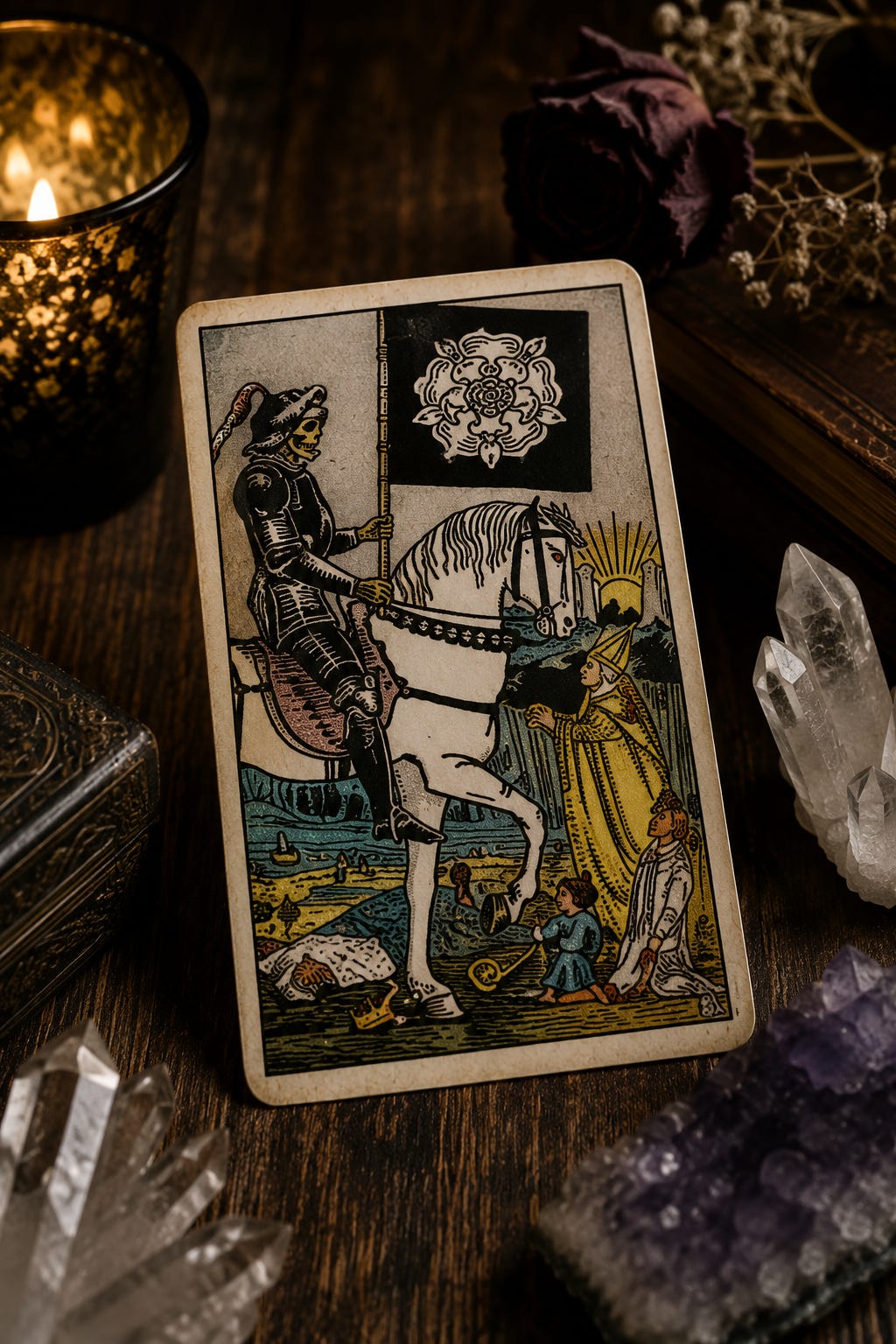
No tarot card freaks people out quite like Death. As soon as it shows up, tension fills the air. People often wonder, “Does this mean someone’s dying?”
Usually, the answer is no.
Then the pendulum swings the other way. People scramble to reassure you. They say things like:
”It just means transformation!”
”It’s a fresh start!”
”Don’t sweat it—amazing things are coming!”
But honestly, I think that view skips over the toughest part of the card. Death isn’t just about change. It’s about dealing with grief.
We really enjoy diving into the idea of starting new chapters in life—like diving into jobs that get us excited, building relationships that make us feel connected, exploring new sides of ourselves, and chasing after opportunities that light our passions.
But it’s important to remember that every new beginning comes with a goodbye. Endings aren’t always fun; sometimes they’re really tough.
Even if we’re moving on from something toxic, we’re still letting go of a part of our past that we’re used to.
When most folks think about grief, death usually comes to mind.
But grief is a lot more widespread than that.
We grieve:
The career we thought we’d land
The marriage we dreamed of
The healthy body we used to have
The childhood we missed out on
The person we thought we’d turn into
The future we expected that just didn’t happen
None of those losses get a funeral, but they can hurt just as much.
The Death card really hits home for a lot of us. As we go through life, we spend years crafting who we are, often sticking to labels that give us meaning and a sense of belonging.
We might say, “I’m the caregiver,” finding our worth in how well we look after others.
Or, “I’m the successful one,” tying our value to our achievements and accolades.
Maybe we think, “I’m the people pleaser,” bending over backward to make sure everyone else is happy.
We could claim, “I’m the fixer,” getting our fulfillment from helping those in trouble.
Or we might call ourselves, “I’m the strong one,” carrying heavy loads with determination, even when it takes a toll on us.
Then, out of nowhere, life nudges us to step into a new version of ourselves.
This change isn’t about failing or not being enough; it’s more about realizing that the identities we once had just don’t fit anymore.
When this transformation hits, it can feel like we’re losing a part of who we are, and it brings up a wave of sadness as we say goodbye to that old self.
That’s what it is—a heartfelt farewell to a version of us that’s no longer right, kicking off a pretty daunting journey toward figuring out who we’ll become next.
Change often seems more intimidating not because of the unknown that lies ahead, but because we’re so aware of what we’re leaving behind. Even identities that bring us pain can feel like a snug, if stifling, blanket. They’re comfortable in their familiar ways, like that old path we all know too well.
These identities give us some predictability in a chaotic world, helping us make sense of our experiences and feelings.
Then there’s the Death card, which stands for transformation and raises a pretty unsettling question:
Who do you become when you let go of the person you’ve been fighting to survive for so long?
This isn’t an easy question to tackle. It digs deep into who we are and forces us to face our fears and insecurities. A lot of people end up avoiding this question, often spending their whole lives dodging the uncomfortable truths it brings up.
One thing about modern spirituality that really gets to me is how everyone’s obsessed with the butterfly. People rave about how beautiful it is when a butterfly flies, its bright colors, and how gracefully it moves.
But no one really talks about the complicated journey that happens inside the chrysalis. Sure, we hear all the time about reinvention, and people love sharing stories of transformation like they’re awards.
But they usually skip over the messy emotions that come with such a big change. Like the confusion that makes you question everything you thought you knew. Or the loneliness that creeps in during those quiet moments, weighing you down.
Then there’s the uncertainty that looms over you, making every next step feel risky. And let’s not forget the grief that hits when you realize you have to let go of who you were to welcome who you might become.
These days, transformation is treated like it’s some kind of art piece, all pretty and inspiring. But the truth about real transformation? It often feels anything but beautiful when you’re right in the thick of it.
It’s a messy ride with surprises at every turn. Disorientation can feel like your new normal, blurring your sense of direction. In those lonely times, it feels like you’re all alone in this huge sea of change.
And sometimes, it takes years for the fog to lift and for you to really get what’s shifted inside you.
One of the main ideas in my upcoming book, Survival Isn’t a Victory, is that just surviving something doesn’t mean you’ve really moved on from it.
A lot of people survive... but then they keep living like the danger is still there. They hold onto their defenses. stay on high alert, and cling to the identity that survival forced upon them.
The Death card prompts you to consider if that identity is still doing you any good...
Or is it just holding you back from truly living.
It’s not about easy changes, instant healing, or guaranteed happiness.
What it really offers is something tougher. It gives you the green light to stop being the person you had to become in order to survive. And that can be scary.
Because sometimes, that survival identity takes over our whole sense of self.
Death isn’t asking: “What are you losing?” It’s asking: “What are you still dragging along that doesn’t belong in your life anymore?”
Because often, the toughest goodbye isn’t to someone else. It’s letting go of the version of yourself that kept you alive long enough to become who you’re meant to be next.
And maybe that’s the biggest twist of the Death card. The end isn’t the focus. It’s about making space for what comes next.
If you’re interested in diving into topics beyond traditional tarot—like survival, identity, grief, resilience, and the tough truths that shape us—I cover these on The Grey Area Unfiltered, with new podcast episodes dropping every Tuesday at 12 PM ET.
Sometimes, the bravest thing we can do isn’t starting over. It’s allowing something old to finish.
No posts
Comments
Nothing yet. Say the first thing.
Sign in to join the conversation.