
I recently reecived early access to MiniMax H3, the latest video model in the Hailuo line, and what makes it interesting is not simply the quality of the video it produces.
H3 brings the multimodal workflow we have started to see from models like Seedance 2.0. You can give it storyboards, character sheets, reference images, video, and audio, and it uses all of that context to generate a finished clip with synchronized picture, dialogue, and sound effects.
But MiniMax also did something almost nobody does with a video model this capable: it released the base model weights.
That means you can download H3 from Hugging Face and run it on your own machine. You can generate locally, iterate without paying for every attempt, and keep more of your production pipeline under your own control.
That combination is what makes H3 worth paying attention to.
Here is what happened when I spent a day testing it and where I think H3 fits into a working production stack.
At a high level, H3 is MiniMax’s omni-modal video model. It is the same model the Hailuo app calls Hailuo 3.0.
It understands text, images, video, and audio, and it generates video with native synchronized sound. Clips can run from 4 to 15 seconds at 24 FPS, up to 2K resolution, with dialogue supported in 11 languages.
The other thing worth understanding up front is that H3 treats reference material as instruction.
Give it a character sheet, and it holds the character. Give it a storyboard, and it follows the shot order. You can include up to nine images, three video clips, and three audio clips in a single generation.
That behavior is what makes everything below interesting.
For what it is worth, the first third-party evaluation I have seen, from Artificial Analysis, ranked H3 number one for instruction-based video editing and in the top three for text-to-video and image-to-video with audio.
There are no official benchmarks yet, not that we really care about them anyway. The production environment is the only test that truly matters.
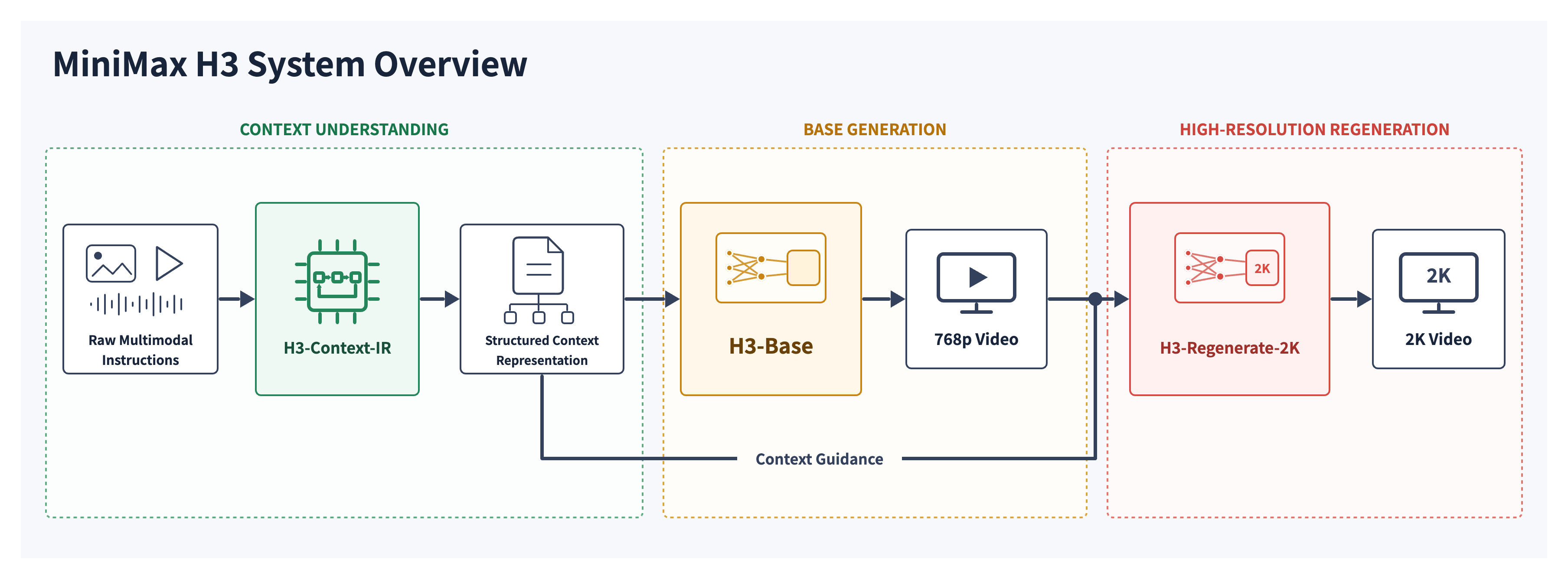
H3 is not one model. It is a three-part system, and only one part is currently open.
H3-Base is the open piece. It is a 33B model, the weights are live on Hugging Face, and it generates 768p video with audio.
You can run it locally.
ComfyUI added native support on day one, and the model also runs through diffusers, vLLM, and SGLang. The download is around 42.5 GB if you grab only the checkpoint you need, and people are already running it on a 12 GB card using offloading.
The other two parts are still API-only.
H3-Context-IR is the layer that reads your messy collection of references and turns them into something the model can follow.
H3-Regenerate-2K takes the 768p result up to 2K.
That 2K step is not a bolt-on upscaler. It regenerates the shot using the original context, so fine details are pulled from your actual references instead of being guessed during the upscale.
Both currently run through MiniMax’s API. MiniMax says the 2K module will be released later, and sparse-attention inference is also planned for a future update.
Open and local gets you 768p video with audio today. The full 2K pipeline still touches MiniMax’s servers.
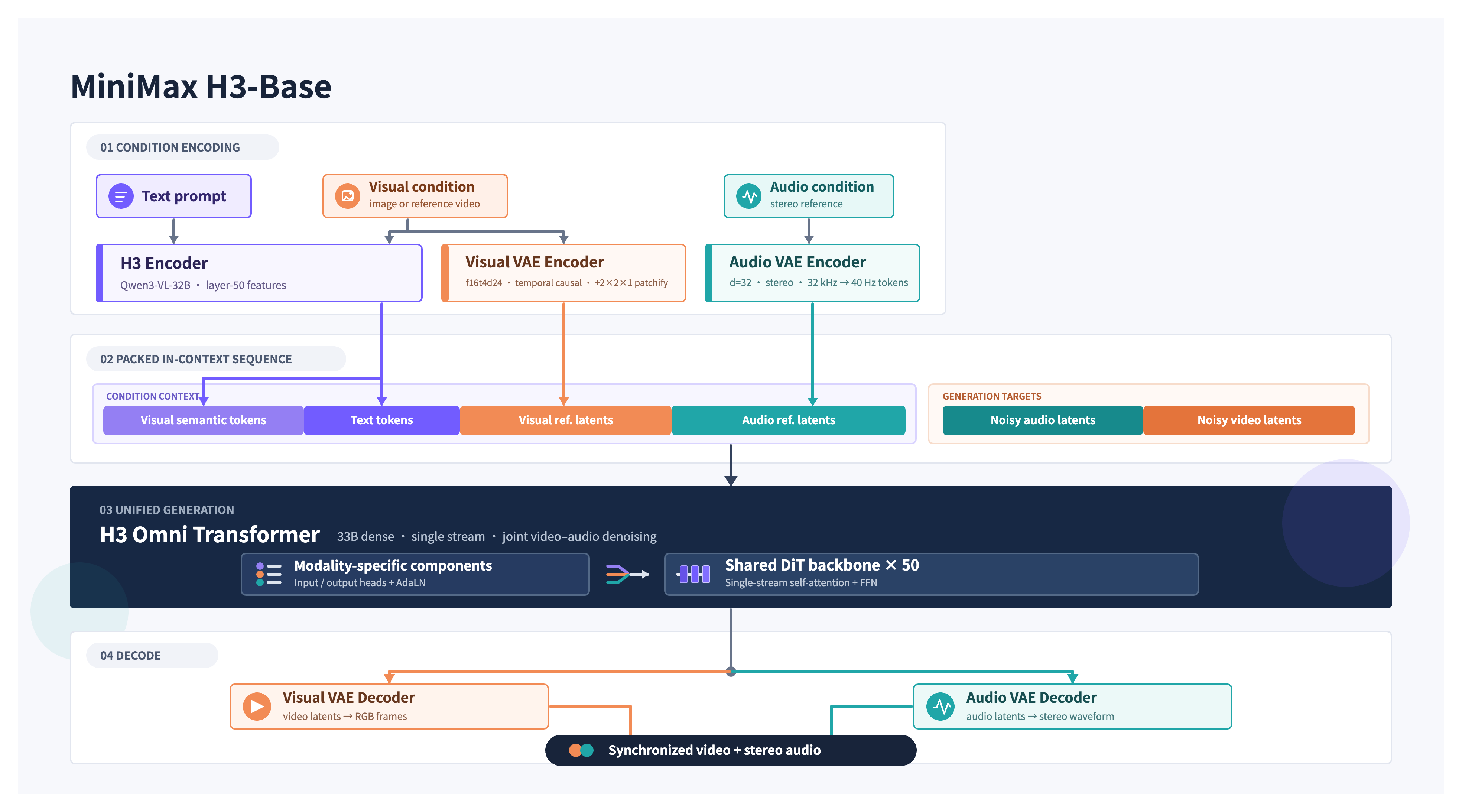
If your read was that we are at the low-resolution stage now, with higher resolution coming later, that is exactly right.
One more thing. Read this part yourself before building anything commercial with the model.
Currently, H3 ships under MiniMax’s own community license, not a standard open-source license like MIT or Apache. Commercial use is possible, but you have to display the MiniMax H3 name in your product. If you are a company that crosses $20 million in revenue, there is a licensing fee.
The license also includes a territory clause limiting where it applies, and early interpretations suggest it may exclude some major regions.
I am obviously not a lawyer. If you are in the US or EU and considering H3 for client work, open the LICENSE file and the license Q&A on the model page and read them first.
What I gave it: a six-shot storyboard I had already built for another project, plus three character sheets.
Me, my friend, and an anime character.
That was it. Four images and a short prompt:
Comments
Nothing yet. Say the first thing.
Sign in to join the conversation.