
“If you can’t promote, market, or sell... you’ll end up working for someone who can.”
Nick Tribe
The economy you were trained for doesn’t exist anymore.
For decades, the deal was rather simple. You go to school, get a degree, follow the “rules”, and if you’re lucky, a gatekeeper lets you in.
It didn’t really matter what you wanted to do.
Someone else bigger than you decided your path.
If you were a musician, you needed a label to support your creative process, take care of distribution, and promoting you.
If you were a writer, you needed a publisher to help you with editing, printing, and making sure your book was properly placed among bookstores.
If you were someone with an idea, you needed funding to physically develop your product or service and to reach people that would buy your stuff.
That deal is dying. Some would say it’s already dead.
AI is automating the “safe” jobs. The degree that used to guarantee interviews now guarantees debt. The corporate ladder is being replaced by a conveyor belt that moves faster every year and throws people off without warning.
But here’s what most people miss while they’re panicking about the old world falling apart: a new one is being built. And the people building it don’t look anything like the winners of the last economy because they’re not the ones with the best credentials.
They’re the ones who figured out how to take what’s in their head and turn it into something the market will pay for.
They didn’t have the right last name, the right degree, or the right connections.
Nobody pulled them into a room and said ‘let me make some calls for you.’
But they noticed something that most people didn’t.
The same economy that killed the old playbook also created a new one.
➤ You don’t need a label to release music anymore. You need a laptop, a smartphone, and a distribution account.
➤ You don’t need a publisher to sell a book. You need a manuscript and an audience who gives a shit.
➤ You don’t need a VC, bank, or an investor to start a company. You need a landing page, a Stripe account, and something worth buying.
So they made a choice. Instead of begging for a seat at someone else’s table, they built their own. They learned to package what they know, promote it to the people who need it, and close the sale without a middleman taking 80% of the cut.
Today, DJs can fill rooms without a label, a manager, or an agent.
Today, founders can now get customers without VC funding.
Today, writers can build careers without a publisher’s stamp of approval.
Today, consultants can land clients without a McKinsey logo on their LinkedIn.
The list goes on, but you get the point.
These people cracked something that most never do. It’s not a secret. It’s not even that complicated, once you get it.
But it is the single most important skill in the new economy.
They learned how to sell what they create.
Not “sell” in the sleazy, used-car-salesman way. Sell as in package their thinking, put it in front of the right people, and make the transaction happen. That’s it. That’s the whole game.
Those who learn this will dominate the next decade.
Those who don’t will spend that same decade working for someone who did.
This manifesto is about making sure you end up on the right side of that equation.
Now, before I share my thoughts on how this works, let’s make sure you should keep reading. This manifesto is not for everyone, and I’d rather lose you now than waste your time pretending otherwise.
⚙️ You’re a ghost in your own field. You’ve got the talent. Maybe even the portfolio. But the people writing checks don’t know your name. Meanwhile, someone with half your skill is getting the gig, the deal, the feature — and you’re sitting there wondering what they have that you don’t. I’ll save you the suspense: it’s not talent. It’s the ability to sell.
⚙️ You’re the engine, but someone else is driving. You work for an agency, a label, a platform, or a boss. You produce most of the value. They keep most of the money. You’ve thought about going independent, but you don’t know how to get customers on your own. So you stay. And the tax you pay for that “security” is the majority of what you’re worth.
⚙️ You’ve got attention but no income. Followers, likes, maybe even a growing audience. But your bank account hasn’t gotten the memo. You’re starting to suspect that posting more content isn’t the answer, and you’re right. Attention without a bridge to revenue is just a performance with no box office.
⚙️ You think selling is beneath you. Somewhere along the way, you were told that good work “speaks for itself.” That promoting yourself is desperate or cringe. Meanwhile, people with a fraction of your ability are making ten times what you make. The only difference is they’re not afraid to put a price on their value. You are.
⚙️ Your income dies when you stop working. No systems. No leverage. If you’re not actively grinding, the money stops. Every year feels like running faster on the same treadmill, and you’re starting to get tired.
⚙️ You’re one decision away from zero. One algorithm change. One client leaving. One “restructuring” email. Your entire livelihood depends on something you don’t control, and that thought keeps you up at night more than you’d like to admit.
If any of that hit a nerve, good.
You’re exactly who I wrote this for.
Let’s keep going.
If you’re still reading, you’re probably curious.
But you probably know nothing about me, so you might also be skeptical.
After all, this could just be another newsletter. Another voice. Another guy on the internet who thinks he’s figured something out.
You’ve seen enough of those to know most aren’t worth your time. Fair enough.
So let me skip the part where I try to impress you.
You won’t find rented Lamborghinis here. There will be no screenshots of dashboards that could’ve been made in Canva, and no rags-to-riches story designed to make you emotional so you stop thinking clearly.
Here’s what I will tell you.
I’m writing this for two selfish reasons. You deserve to know both.
» Reason 1: I’m tired of watching the loudest idiots win.
I’ve seen talented people get ignored while someone with half their skill builds a fortune. The only difference is that one of them learned how to promote, market, and sell. The other one believed the work should “speak for itself.” That’s not a talent gap. That’s a skills gap. This manifesto is my attempt to close it.
» Reason 2: I want your money.
Here’s the plan. I want you to eventually pay for my newsletter, where I break down the frameworks, playbooks, and behind-the-scenes of everything I do. But for my plan to work, I have to earn it first. I have to be the most useful person in your inbox. I have to prove that I can bridge the gap between your creativity and the marketplace better than anyone else you’re reading right now.
If I do that, paying me will feel like the obvious next step, because the math of the investment will do the talking for me.
Consider this the demonstration.
Let’s keep going.
Let me paint you a picture.
There’s a bedroom producer right now with a melody in his head that could define a generation. But he’s never going to release it. Not because it’s not good enough, but because he has no idea how to get it in front of people. He’ll keep tweaking that track for another six months, convince himself it’s “not ready,” and eventually give up and get a “real job.” The world will never hear a single note.
There’s a consultant sitting on years of expertise that companies would pay a fortune for. But she doesn’t have the network, warm intros, or a fancy agency behind her. So she’s billing $50/hour on some freelance platform while someone with half her knowledge charges $10,000 a project because that person knows how to position, pitch, and close.
There’s a writer filling notebooks with ideas that could change how people think. But no publisher has returned his emails, no agent has opened his PDF, and the writing he posted on social media didn’t take off yet. So the work sits in a folder somewhere, collecting dust.
These people don’t have a talent problem.
They have a completely different problem, and most of them don’t even know what it is.
They can create. They just can’t sell what they create.
And because they can’t, they need to either find someone else who does it for them — and takes the lion’s share — or drop entirely, which is what most people do.
We’ve all seen this movie.
The DJ with mediocre music who headlines the festival because he knows the right promoters. The writer with average ideas who gets the book deal because she has the “right” agent. The consultant who gives basic advice but charges $10k because he’s plugged into a high-net-worth network. The founder with a worse product who gets the funding because he went to the right school and shook the right hands at the right dinner.
These people aren’t winning because they’re more talented. They’re winning because they control the part of the game that most creatives are allergic to: the business side.
In other words: they’re what I like to call Insiders.
An Insider doesn’t need to be the best. They just need to own the bridge between talent and money. And as long as talented people refuse to build that bridge themselves, the Insiders will keep charging rent on it.
That’s how the game has worked for decades.
Labels take the cut because the artist can’t fill the room alone.
Agencies take the margin because the freelancer can’t land the client.
Publishers take the deal because the writer can’t reach the audience.
The Insider’s entire business model depends on one thing: you not learning how to do what they do.
So what happens when you learn it anyway?
That’s where this gets interesting.
My name is Nick Tribe.
I’m a DJ, producer, and entrepreneur. And I spent the last few years obsessing over a single question:
How do you build a career from your creativity without handing the keys to someone else?
Everywhere I looked, there was a roadblock in front of me.
I had the music, but no manager, label, or connections.
I had ideas, but no followers, publisher, or platform.
I had ambition, but no path to follow.
I was consistently staring at the gap between what I could create and what I could actually earn from it.
So I started studying. I consumed everything I could find on promotion, persuasion, sales, and entrepreneurship. I looked at the people with the most freedom, the most income, and the most control over their time. DJs, founders, consultants, creators — across every industry I could get my hands on.
I was looking for a spark of genius. Some rare gift that separated the winners from everyone else. What I found was much more boring. And much more powerful.
They all knew how to promote, market, and sell.
Every single one of them. It didn’t matter what they were selling or what industry they were in. That skill set was the common thread.
The conclusion was so obvious it almost felt stupid:
“If you can’t promote, market, or sell... you’ll end up working for someone who can.”
That changed everything for me.
Because once I learned those three skills, I stopped being a “component” in someone else’s machine.
I could launch my own projects. Build my own audience. Create opportunities instead of waiting in line for them. The gatekeepers only had power as long as I was afraid of the business side of my brain.
That’s what a Creative Øutsider is.
Not “outsider” as an insult. As a choice.
A Creative Øutsider is someone who possesses real talent and zero interest in letting someone else monetize it for them.
You’re the DJ who doesn’t need the label. The founder who doesn’t need the VC’s permission. The writer who doesn’t need the publisher’s stamp. The consultant who doesn’t need the agency’s logo.
Not because those things are worthless.
But because you’ve built something better: the ability to reach buyers yourself.
And that ability comes down to three skills.
Marketing, Promotion, & Sales.
So let’s talk about those.
Look at this image.
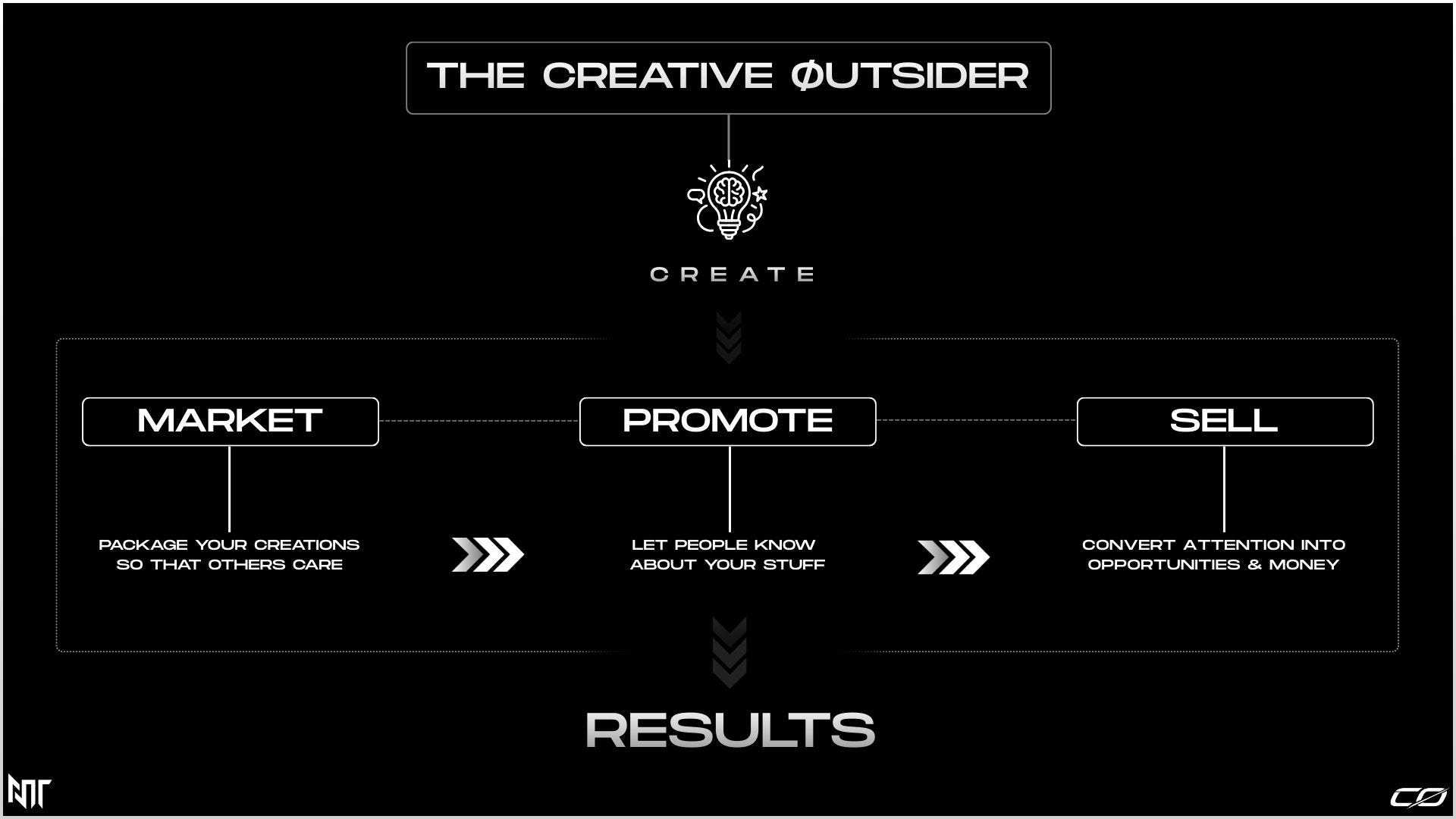
This is the anatomy of a creative.
At the top, you have your creations. Your music. Your code. Your writing. Your ideas. This is the stuff you already know how to do, the thing that makes you a creative in the first place.
At the bottom, you have your results. The income, the freedom, the career, the impact or whatever it is you’re actually trying to build.
Now look at the space in between.
That gap is where most creatives spend their entire career stuck.
They keep polishing what’s at the top (making the music better, the writing sharper, the product more refined) and they wonder why nothing changes at the bottom.
It’s not because the work isn’t good enough.
It’s because there’s no bridge connecting the two.
That bridge has three parts. Three skills. Three pillars.
Marketing is packaging your creations so that others care.
Promotion is letting people know about your stuff.
Sales is converting that attention into opportunities and money.
Most creatives spend 100% of their time in the “Create” zone.
They obsess over the craft. They make the light brighter and brighter. And that’s admirable, but it’s not where you build your advantage.
Your advantage lives in the bridge. In your ability to take what you’ve created and move it through all three pillars until it produces a result.
Skip one, and the whole thing collapses.
Great packaging with no promotion means nobody sees it. Massive visibility with no sales means you’re performing for free. A killer close with no marketing means you’re selling something nobody understands.
All three. That’s the game.
Let’s start with the first one.
Marketing is probably one of the most misunderstood words in the English language.
Most people confuse it with advertising, manipulation, or “posting on social media.”
It’s none of those things.
Here’s how I think about it:
Marketing is the act of packaging for relevance.
Your mind produces raw value. But raw value is invisible, heavy, and impossible to sell. You can’t hand someone a bucket of “talent” and expect a check. The world doesn’t pay for what it can’t understand.
Marketing is the container you put your talent in so the marketplace can actually see it, value it, and buy it. You’re taking what’s in your head — a “creative nothing” — and turning it into a “commercial something.”
Let me make this concrete.
➤ If you’re a DJ, your creation is a track, a mashup, or a set. Your marketing is the cover art that stops the scroll, the title with the right keywords, the distribution strategy that gets it in front of ears that actually matter — not just your friends.
➤ If you’re a coder, your creation is the code. Your marketing is the landing page that doesn’t look like it was built in 1998, the video that explains the “why” in 60 seconds, and the strategy that puts your tool in front of a business owner who’s already frustrated with the problem you solve.
➤ If you’re a writer, your creation is the manuscript. Your marketing is the cover design that makes someone stop and stare, the social media hooks that build tension before launch, the positioning that makes your book the obvious choice in its category.
See the pattern?
The creation is what you make.
The marketing is how you wrap it so the world gives a damn.
Most creatives spend 100% of their time polishing the creation and 0% designing the packaging. They make the light brighter and brighter, but never build the lamp. Then they wonder why nobody can see it.
If you’re just “making stuff” without thinking about how it’s titled, positioned, and wrapped, you’re a hobbyist.
When you start obsessing over the packaging as much as the product, you become dangerous.
If Marketing is the art of packaging for relevance, Promotion is the delivery system.
You’ve wrapped your talent in a container the world can understand.
Great. Now what? If nobody sees it, it doesn’t exist.
Most creatives think they’re “promoting” when they post a link to their work on a Tuesday afternoon and hope for the best. That’s not promotion. That’s a prayer. And prayers don’t scale.
Promotion is the high-velocity distribution of your package to the people who are actually holding the checks.
This pillar was the hardest one for me to swallow.
For a long time, promoting myself felt wrong. It felt “dirty.”
And that discomfort kept me broke.
Part of the reason for this phenomenon is because we’ve been conditioned for invisibility since we were five years old.
The school system is designed to reward compliance. Sit still. Follow instructions. Wait to be called on. If you raise your hand too much, you’re “annoying.” If you show off your work, you’re “arrogant.” The “A” students are the quiet ones who do what they’re told and wait for the teacher to notice.
That conditioning doesn’t disappear when you leave school. It follows you into your career and it whispers the same thing over and over: do good work, and someone will find you.
But the market isn’t a classroom. There is no teacher scanning the room for hidden talent. In the real world, silence is a death sentence.
I had to kill the “good student” inside of me to let the Creative Øutsider survive.
Let me give you a formula that helped me more than any promotion tactic ever could.
Value × Attention = Opportunity
Simple math. Anything multiplied by zero is zero.
So if your Attention is zero, your Opportunity is also zero. Doesn’t matter how valuable your track, your code, or your writing is. If it’s sitting in a dark room, it has no commercial weight.
Now let me ask you something uncomfortable that’s meant to be challenging.
Are you really sure that the people at the top of your industry are the most talented on Earth?
Or are they just the best…the world currently knows?
Somewhere in a village right now, there’s a kid with a connection to a football that makes Messi look average. But he has no scouts, no camera, and no way to prove it. To history, he doesn’t exist.
There’s a producer in a bedroom with a melody that could define a decade. But if he never learns to put it in front of people, he’ll burn out, get a day job, and the world will never hear a single note.
There’s a chance the greatest writer alive isn’t on any bestseller list. She’s sitting in a cubicle filling a private journal with masterpieces that’ll be tossed in a dumpster the week after she dies.
One of the most dangerous myths that kills creatives at scale is the belief that “quality wins the game”.
Insiders love this one. They preach it from stages, podcast mics, and award ceremonies. Focus on the craft. If the work is good enough, the universe will provide.
Bullsh*t.
We love the story of the bedroom producer who was “miraculously discovered” by some visionary A&R exec. The writer who sent 27 manuscripts into the void before landing the deal. The founder who lost everything until some angel investor swooped in.
These stories are lottery tickets.
They make for great headlines, but they are not a sustainable business strategy.
For every one that makes the news, thousands of equally talented people never amounted to anything.
The greatest trick the Insiders ever pulled was convincing the most talented people on Earth that promoting themselves was beneath the art.
Being the “best kept secret” is just a fancy way of saying you’re losing.
F*ck that.
Stop waiting for the miracle.
Build the machine that promotes your work instead.
Most creatives are terrified of the word “sales.”
They treat it like a contagious disease.
Like the moment they ask someone for money, they’ve betrayed their art.
They’ve been brainwashed by a “starving artist” culture that says if your work is truly brilliant, the world should find you and shower you with unprompted riches.
That’s a fantasy.
It’s also the fastest way to stay broke, bitter, and irrelevant.
Let’s be clear about what sales actually is, because most people have it wrong.
Marketing is how you package your value.
Promotion is how you get it seen.
Sales is how the money changes hands.
It’s the moment where attention becomes a transaction.
Without it, the first two pillars are just expensive decoration.
You can have the best packaging in the world.
You can get a million eyeballs on your work.
But if you can’t convert that into someone reaching for their wallet, you don’t have a business.
You have a hobby with good PR.
So why do creatives freeze at this step?
For most of them, because they’re still waiting for a middleman.
A manager to book the shows. An agent to land the deal. A publisher to handle “the business side.” A platform to do the selling for them. They want someone else to be the “bad guy” — the one who names the price, handles the objection, and closes the deal.
And the moment you delegate that to someone else, you’ve handed them the keys to your life.
They decide what you’re worth.
They decide when you work.
They decide how much of your own profit you get to keep.
That’s not a partnership.
That’s a toll booth on your own highway.
Sales isn’t about being pushy, manipulative, or “salesy.”
It’s about building a system where the buyer convinces themselves.
Think about the last time you bought something you were excited about.
Nobody had to pressure you. Nobody had to “overcome your objections.” You saw it, you understood the value, and you thought: how do I pay for this?
That’s what good sales looks like. It’s not arm-twisting. It’s engineering a situation where paying you feels like the obvious next step.
Let me make this real.
If you’re a DJ and you had the ability to consistently put 200 people in a room… would you still need a booking agent to decide your worth? You’d have leverage. You’d name your price. Promoters would come to you.
If you’re a coder and you could consistently turn strangers into paying customers for your software…would you still be grinding at a job you hate? You’d have a business. You’d have options. You’d have freedom.
If you’re a writer and you could move a reader so deeply that they reach into their pocket to buy your next book before it’s even finished…would you still be waiting for a publisher to tell you you’re good enough?
The answer is obvious. And so is the lesson.
Sales isn’t the dirty part of being a creative. It’s the part that sets you free.
Without it, your marketing is just window dressing. Your promotion is just noise. And your creativity is just an expensive, self-indulgent hobby that funds someone else’s lifestyle.
When you master the ability to sell — paired with marketing and promotion — you stop asking for permission. You stop waiting in line. You stop hoping someone notices.
You become the person who doesn’t need to be discovered, because you already know how to make the cash register ring yourself.
That’s a Creative Øutsider.
You’ve read the map.
You’ve seen the gap between what you create and the results you want.
You’ve seen the three skills that bridge it.
And if I’ve done my job correctly, you now understand something that most creatives never figure out:
Your talent is probably not the bottleneck.
Your ability to package it, promote it, and sell it is the real bottleneck.
Now here’s the uncomfortable part.
Knowing this unfortunately changes nothing.
Reading this manifesto, nodding along, and maybe even highlighting a few lines doesn’t move the needle.
The only thing that matters is what you do next.
The way I see it, you really only have two options.
The first option is to go back to what you were doing before. Keep polishing the craft. Keep posting and hoping. Keep telling yourself that if the work is good enough, someone will eventually notice. Maybe they will. Maybe you’ll be the one lottery ticket that hits. But the odds are brutal, and deep down, you already know that. This is the path most people take. It’s not the smartest one, but the most comfortable one. You don’t have to learn anything new. You don’t have to feel awkward. You just keep doing what you’ve always done and hope for a different result.
You know what they call that.
The second option is harder. Scarier, even. You accept that the game has changed and that talent alone isn’t enough for someone in your position. You stop waiting for someone to discover you, and you start building the machine that makes discovery irrelevant. You learn to package your ideas so that people actually care. You learn to promote your work so the right people see it. You learn to close the sale so that attention turns into income.
It’s uncomfortable at first. Every Creative Øutsider will tell you that.
The first time you put a price on your work, it feels weird. The first time you promote yourself, you’ll hear that little voice from school telling you to sit down and be quiet. The first time you ask someone to buy, you’ll feel like you’re doing something wrong.
You’re not. You’re doing the one thing that separates professionals from amateurs, careers from hobbies, and freedom from dependence.
You’re taking ownership of the bridge.
I can’t make that choice for you. Nobody can.
But I can tell you what’s on the other side because I’ve been there, and so have thousands of other Creative Øutsiders who figured this out before you.
On the other side, you don’t need to wait for the label. You don’t need to wait for the agent. You don’t need to wait for the publisher, the VC, or the corporate safety net.
Not because those things are worthless, but because you’ve built something they can’t take away from you: the ability to create value and capture it yourself.
The point of this manifesto was to make you aware of the missing piece.
The next time a campaign flops, you’ll know it wasn’t bad luck. It was the bridge.
The next time someone with half your talent gets the gig, you’ll know it wasn’t unfair. It was the bridge.
The next time you feel stuck and going nowhere, you won’t wonder why anymore.
You’ll know exactly what’s missing.
And once you see it, you can’t unsee it.
Every rejection, every missed opportunity, every moment where you thought “I’m good enough, why isn’t this working” starts to make sense through this lens.
That’s what this manifesto was for.
To wake you up.
To show you that for anyone who can master how to market, promote, and sell, there is a different kind of future in front of them.
For the first time in history, you don’t need anyone’s permission to build a career from your creativity.
The tools are there. The platforms are there. The buyers are there.
The only thing standing between you and the life you want is your willingness to build the bridge yourself.
That might feel heavy right now. Good. It should.
Because the opposite of that weight is the slow, quiet death of doing everything right creatively and still watching nothing happen.
That feeling you’ve had — the frustration, the confusion, the sense that something is off but you can’t quite name it — now you can name it.
It was always the bridge.
That’s the Creative Øutsider path.
It’s not easy. It’s not comfortable. And it will force you to become someone you’ve never been before.
But it’s the only path where you get to keep what you build.
What you do with this is your call.
I know where I stand.
Nick
No posts
Comments
Nothing yet. Say the first thing.
Sign in to join the conversation.