
In the last few years, I started, owned, and operated several social media pages that went viral multiple times.
Millions of views, thousands of followers, and hundreds of thousands of likes, comments, shares, and saves.
Yet the amount of money I made from these has been nowhere near the amount of money I made…when I actually focused on making money.
If it sounds counterintuitive, it’s because of the “social media game” propaganda that all the gurus and influencers try to feed you.
Every creative person gets told to post their stuff.
This has the consequence that every creative person is chasing the algorithm.
That’s what you have to do, they said.
So you focus on hooks. Thumbnails. Posting times. Trends. Formats. Retention graphs.
The list goes on.
Here’s the problem.
People obsess over these things. Very few of them can explain how that translates to revenue.
Why? Simply because most of the time…it doesn’t.
I know this because I’ve lived both sides of the story.
I built multiple media pages that reached millions of people organically.
And I pre-sold a digital product to complete strangers before I even had an audience.
One of those stories sounds impressive at dinner.
The other one actually got money in the bank account.
Most creators are optimizing for applause.
Very few are optimizing for independence.
Those are not the same goal.
Let’s talk about it.
Here’s what nobody tells you about going viral: it optimizes for the wrong audience.
When I say wrong, I mean wrong for making money.
Look at this image.
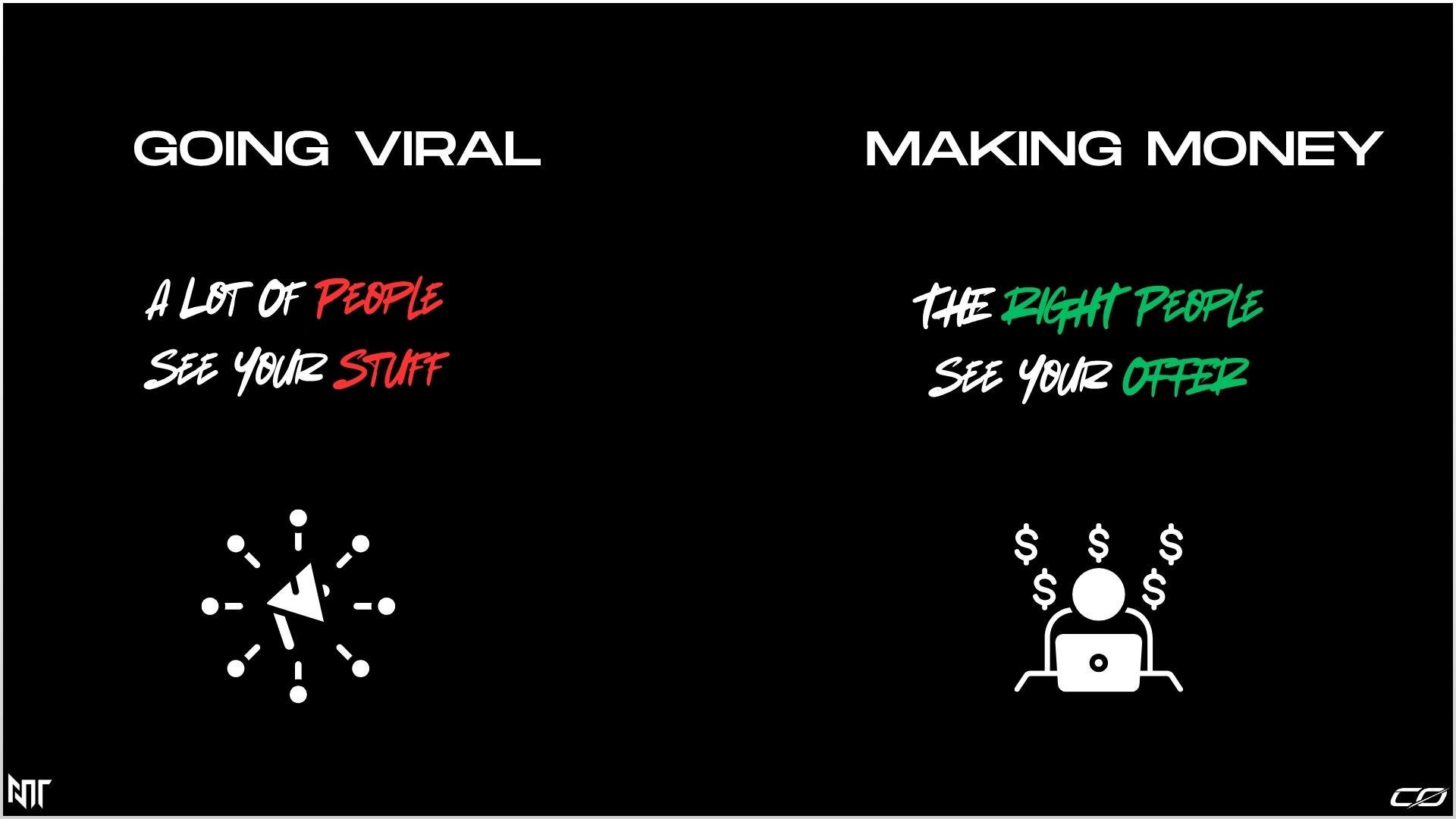
Going viral is showing your stuff to lots of people.
Making money is showing your offer to the right people.
See the difference?
Virality, by definition, means reaching the widest possible group of people.
To reach the widest possible group of people, you need to have something worth sharing at scale.
This is usually some form of content.
NOT landing pages, sales letters, offer pages, funnels, or e-commerce websites.
Yet…that’s the stuff that actually converts someone from browser to customer.
Think about it.
To convince someone to buy, you need to provide depth of information.
To reach the widest possible group, you usually have to sand off every edge and strip out the depth that a casual viewer won’t follow.
The stuff that goes viral is mostly broadly palatable instead of deeply relevant.
The things that make someone buy from you — specificity, strong opinions, a clear point of view, the sense that this person gets my exact problem — are the exact things that kill reach.
So you have a choice.
You can be interesting to everyone. Or you can be essential to someone.
Really hard to be both.
Specificity is how all the people you see that are boasting their monthly revenue dashboards win.
They focus on what matters.
Let me give you the math that nobody in the creator space wants to talk about.
You don’t need 10 million views.
You don’t need 100,000 followers.
You don’t need to “go viral.”
You need 200 people.
200 people paying €29 a month is €5,800 a month. That’s €69,600 a year.
From an audience that could fit in a small club.
This is not life-changing money, I know.
But it’s enough for most people to change their lifestyle and have some foundations to build from.
Also, a much more realistic target than the millionaire lifestyle most guru try to sell you.
Now here’s the interesting part.
To find 200 people who will pay you €29 a month, you don’t need reach. You need resonance. You need to say something so specific, so targeted, so clearly meant for them, that they feel like you’re reading their mind.
That kind of content doesn’t go viral. It can’t. It’s too specific. It’s too opinionated.
It’s too niche. It alienates 98% of people who see it.
And that’s exactly why it works.
The 2% who get it don’t just like your post. They subscribe. They buy. They tell the one friend who would also get it. That friend subscribes. That friend tells one more person.
Reaching requires you to go wider and wider, diluting your message every time.
Attracting requires you to go deeper and deeper, sharpening your message every time.
One scales through volume. The other scales through value.
Only one of them puts money in your account.
Maybe you're thinking:
"But Nick, if more people see my stuff, more people buy my stuff. That's just math."
Sure. Absolutely.
However...
It’s not about being known, but rather what you’re known for.
Let me prove it to you.
Who are the most trusted people in business?
Not the most famous. Not the most followed. The most trusted.
It’s the people who handle your money.
Financial advisors. Private equity partners. Wealth managers. The more money they handle, the more you have to trust them.
Someone wiring €5 million to a fund manager isn’t doing it because they saw a viral reel.
They’re doing it because of years of relationship, track record, and repeated proof that this person knows what they’re doing.
Do these people go viral? No. Most of them don’t even have a public social media presence. And that’s when something clicked for me: being trusted by someone beats being known by someone. Every time. It’s not even close.
So let’s put this debate to rest.
Being known beats not being known.
Being trusted beats being known.
Being trusted by the right people beats being known by everyone.
Now think about what that means for content.
A viral post reaches 100,000 people once. Most of them don’t remember your name by dinner.
A weekly essay reaches 200 people fifty times.
By week ten, you’re not a stranger anymore.
By week twenty, they trust your judgment.
By week thirty, when you offer something for sale, they don’t need a sales page. They already decided.
That’s the math nobody talks about.
A persuasive message repeated many times to a small group will always outperform an okay message shown once to a massive group. Always.
Trust is built through repetition, not wide exposure.
There’s something else I’ve noticed over the years trying to convert strangers into customers across many markets and price points.
If you’ve ever sold anything — anything — you’ve heard this objection:
“I need to talk to my wife / husband / business partner first.”
The sale is right there. The person wants it. They see the value.
But they won’t move until someone who isn’t even in the room gives them permission.
I’ve lost sales this way.
Now think about what that means for content.
When someone is making a decision — whether to buy something, start something, quit something — the voices in their head aren’t influencers with millions of followers.
They’re the five or six people closest to them.
The ones whose opinion actually matters.
The ones who can kill a sale they’ve never even seen.
So here’s the question most creators never ask: how do you become one of those voices?
Not by going viral. Not by showing up once in someone’s feed with a clever reel.
You become one of those voices by showing up in their life every single week for six months saying something that matters.
By being so consistent and so specific that they start quoting you at dinner without realizing it.
By being the person they send to their business partner with “you need to read this guy
So…
If your content is deep enough, specific enough, and consistent enough — you become one of those voices. Not for millions of people at once. For a few hundred over time.
But those few hundred don’t just read your stuff. They think about it when they’re making decisions. They send it to the one friend who would get it. They quote you without realizing they’re quoting you.
That’s not reach. That’s influence. And influence is where the money is.
Here’s the part where I lose most of you.
Everything I just described requires you to do something that feels deeply unnatural: say no to attention.
Turn down the reach. Stop optimizing for impressions. Stop checking your analytics every four hours. Stop comparing your view count to people who have been doing this for ten years with a full team behind them.
Instead, write one thing a week that makes 50 people think. That’s it. Not 50,000. Not 500. Fifty.
Most of you won’t do this. Not because you can’t. Because it doesn’t feel like progress.
Progress, for most creators, looks like the number going up. More views. More followers. More impressions. The dashboard moving to the right and upward. That’s the drug. That’s what keeps you posting seven reels a day that say nothing.
Saying “I wrote one essay this week and only 73 people read it, but three of them subscribed” doesn’t give you that rush. It doesn’t look good on a screenshot. You can’t post it with a fire emoji and a “consistency is key” caption.
But it is the thing that actually works.
I know because I lived the other version. I had the views. I had the reach. I had the followers. And I had nothing to show for it except a number on a screen and the quiet knowledge that none of it was translating into anything real.
The moment I stopped chasing viral and started building for the 200 people who actually give a sh*t…
That’s when money showed up and it all started to feel like a business.
The creator economy has a math problem.
Everyone’s optimizing for the wrong number.
They’re chasing the one that looks best — views, followers, impressions — instead of the one that matters: how many strangers would pay you right now, today, based purely on the quality of what you put out.
That number is the only number that matters. And it has almost nothing to do with massive reach.
You grow it by being specific. By being opinionated. By being willing to repel 98% of people so you can deeply serve the 2% who get it.
You grow it by writing things that are too long, too honest, and too niche for the algorithm to reward.
You grow it by doing the opposite of everything the “grow your audience” gurus tell you to do.
This is how I stopped trying to go viral.
And that’s when people started paying me.
But as I said, you probably won’t do this.
Because the views feel too good, and the silence of building something real feels too scary.
I hope you’ll make the right choice and prove me wrong.
Nick
No posts
Comments
Nothing yet. Say the first thing.
Sign in to join the conversation.