
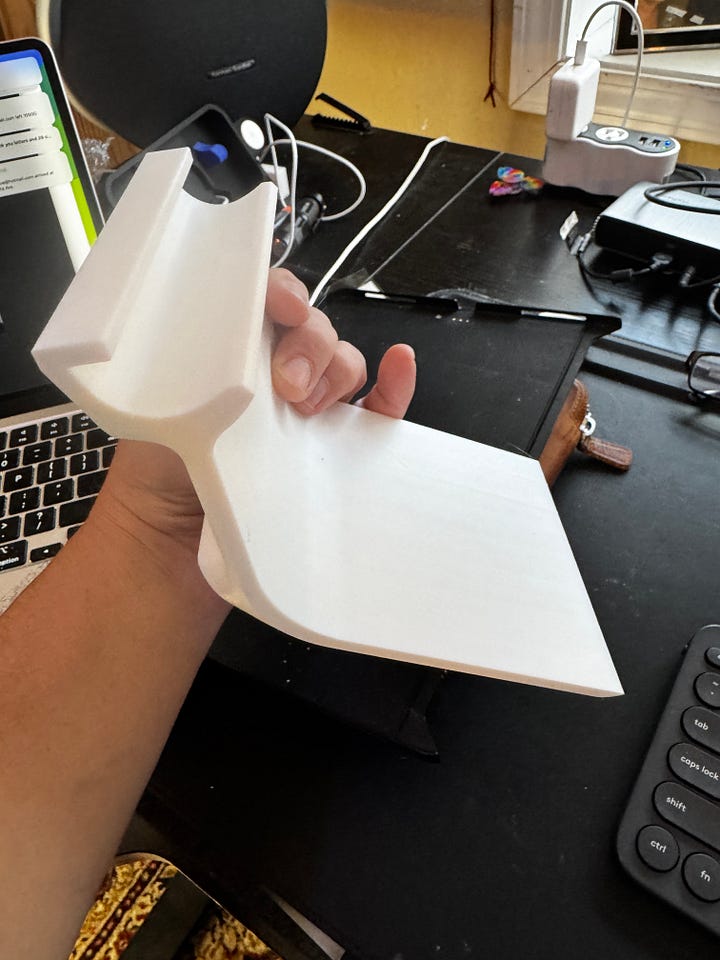
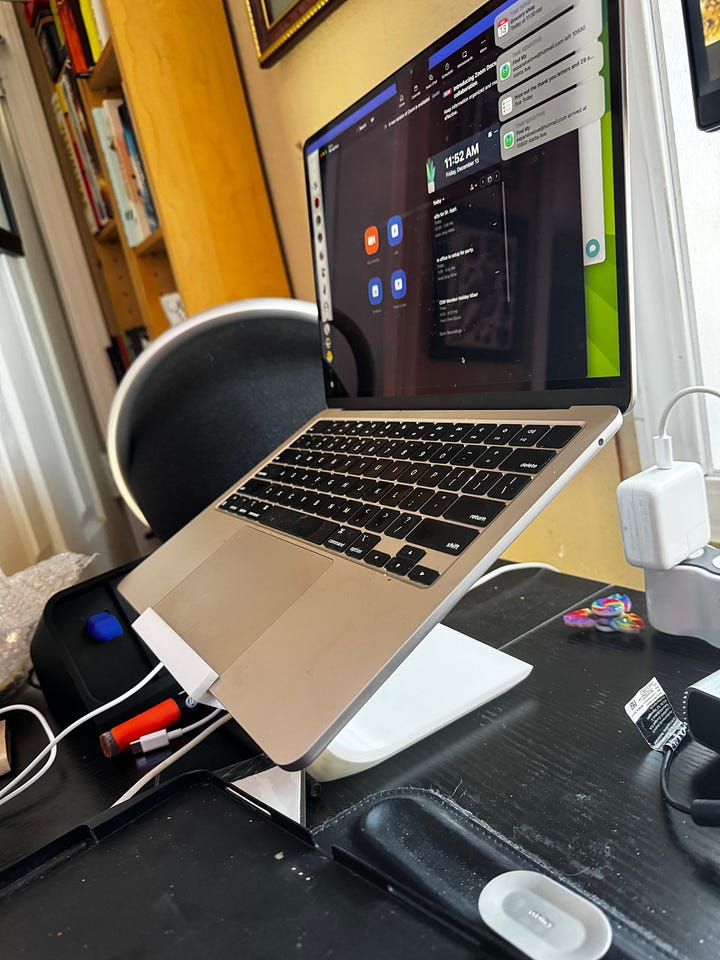
In the realm of “luxuries” during a time of austerity, the one thing I’m hanging onto for dear life is my membership in Madison’s “Bodgery” makerspace. It’s really an amazing space, with a loose but efficient set of leaders and area captains that take care of training, maintaining, and generally stewarding the various areas.
What kinds of areas, you ask? I couldn’t list them all here; it would take up the entire newsletter. I can tell you that I’ve gotten checked out on the “red tools” in the following areas: screen printing, woodshop, paper crafting, CNC ( “computer numeric control”) vinyl cutting and heat press, sewing machines (including the terrifying leather sewing machine but not the serger yet), CNC laser cutter, and 3d printers.
Also, my partner gave me a lovely holiday gift of enrolling me in a class to get certified on the CNC router, so I can carve things too…
But my focus lately has been on the 3D printers, especially the recent “Bambu PS” models the Bodgery invested in. I’ve been involved in 3D printing since 2020, when the nonprofit I worked for was needing to mass-produce mask back straps (remember those?). I found running that printer finicky, particular, and inconsistent — it was like having a home-built car that you had to fine-tune over and over and still failed about 25% of the time.
These Bambu printers are the opposite. They are consistent, they are easy, and I’ve been able to make some very useful desk items with them like the laptop stand above as well as an under-desk holder for my work laptop. I’ve also delved into the design world myself, using the free online app Tinkercad to design and then later print out holiday gifts for my family.
It’s amazing how much there is to do and learn at the Bodgery. And it’s been very good for my brain.
Recently I had a moderate disagreement with someone when I expressed a boundary — a relatively simple one, in that I was not going to offer suggestions on a project unless specifically asked.
On my end it didn’t seem that big a deal — simply a matter of me saving brain fuel and having one less thing to occupy or distract my attention. But to my surprise, especially for one person, it was interpreted as a “punishment” and expression of distrust.
What it revealed was that my understanding of boundaries is not, as I’d thought, shared by most others in my close circle. I think of boundaries as necessary to any healthy relationship, the equivalent of “a room of one’s own”. You can’t feel safe in a relationship, I believe, unless you know that the others in the relationship will not only respect but champion your ability to have your own safe space, whether virtual, mental, or physical.
While therapist Briana Shewan aimed the following at particularly femme-identifying people, I think it applies to everyone:
Boundaries are acts of self-love that define your needs, capacity, and desires.
Let’s collectively pause for a moment and breathe this in. Boundaries are about self-love. Within our patriarchal, femmephobic, homophobic, biphobic, fatphobic, transphobic, xenophobic, racist, classist, ageist, and ableist culture, people believe that feminized people’s very existence is for the benefit of others, and fear emerges when we take up space of our own. This compounds our need to set boundaries and challenge the pushback we get when we do. Femmes navigate relationships within this paradigm, and we often do this while working through our own internalized “-isms.”
Therefore, when we set boundaries, they are radical acts. And because boundaries are about you, they’re about saying no, and they’re about exercising your power based on your needs, they are radical acts of self love.
Happily, after I sent that quote there are plans for further discussions about how we all see the idea of boundaries. But I’m curious now what the rest of you think: are boundaries a measure of mistrust? Or simply an expression of self-identity? Are they necessary, optional, or detrimental to relationships of various kinds?
My partner and I have been watching the AppleTV series “Shrinking” since it started. We were skeptical at first, because while the supporting cast is very diverse, the protagonist is Another Middle Aged Cis White Guy, a therapist, no less, and we thought we might be in for some kind of white saviorism kind of series.
Boy were we wrong. All the characters have their own dramatic arcs, the writing is clever without being flippant, and we both literally have gone from laughing to crying to laughing again as the stories unfold. Harrison Ford, Jessica Williams, Michael Urie, Christa Miller, Luke Tennie, Lukita Maxwell — they are a tight ensemble cast, and it’s fun watching them interact.
But more to the point, the writers don’t cut corners. Does Jason Segel’s character try to be a “good guy”? Sure. And sometimes it goes ok, sometimes it goes wrong, sometimes it’s both. And it’s almost never the focus of an episode — it’s just one of several plot lines skillfully being woven together. It reminds me in some ways of Indian mythos, where characters are not always all good or all bad, and you have to deal with the inconvenient fuzziness of that reality.
Every time there’s been a plot point that my partner and I have said “Oh, no, I hope the writers don’t just go down THAT old trope” they not only haven’t but they’ve often taken it in directions we never expected — and we’ve found ourselves both thinking about and talking about the shows long after they’re watched.
100% recommend if you’re tired of the typical sitcom.
Comments
Nothing yet. Say the first thing.
Sign in to join the conversation.