
A while back I came across this YouTube video (link below) by the cartoonist DREWSCAPE talking about a daily visual journaling technique. As usual, I watched it enough to relish the envy and desire of Wow, that looks really cool, I wish I had that kind of discipline and practice…and then went on to the next video about creating a sketchbook habit, because watching videos about a thing is almost as satisfying and infinitely easier than actually doing a thing (see playlists about zen meditation, dance, dog training, home improvement, etc.).
It’s also cheaper than the related hobby of buying all the equipment needed for a skill or hobby and keeping it organized (or not) in your basement.
Unusually, though, I’ve actually done this technique. His method involves six panels, in a 2x3 grid on a piece of paper. Each panel has a purpose:
panel one is something you did that day.
Panel two is something you thought about that day.
Panels three and four are a conversation you had that day.
Panel five is one thing that day that made you smile.
Panel six is one thing that you ate.
Here’s an example that I did:
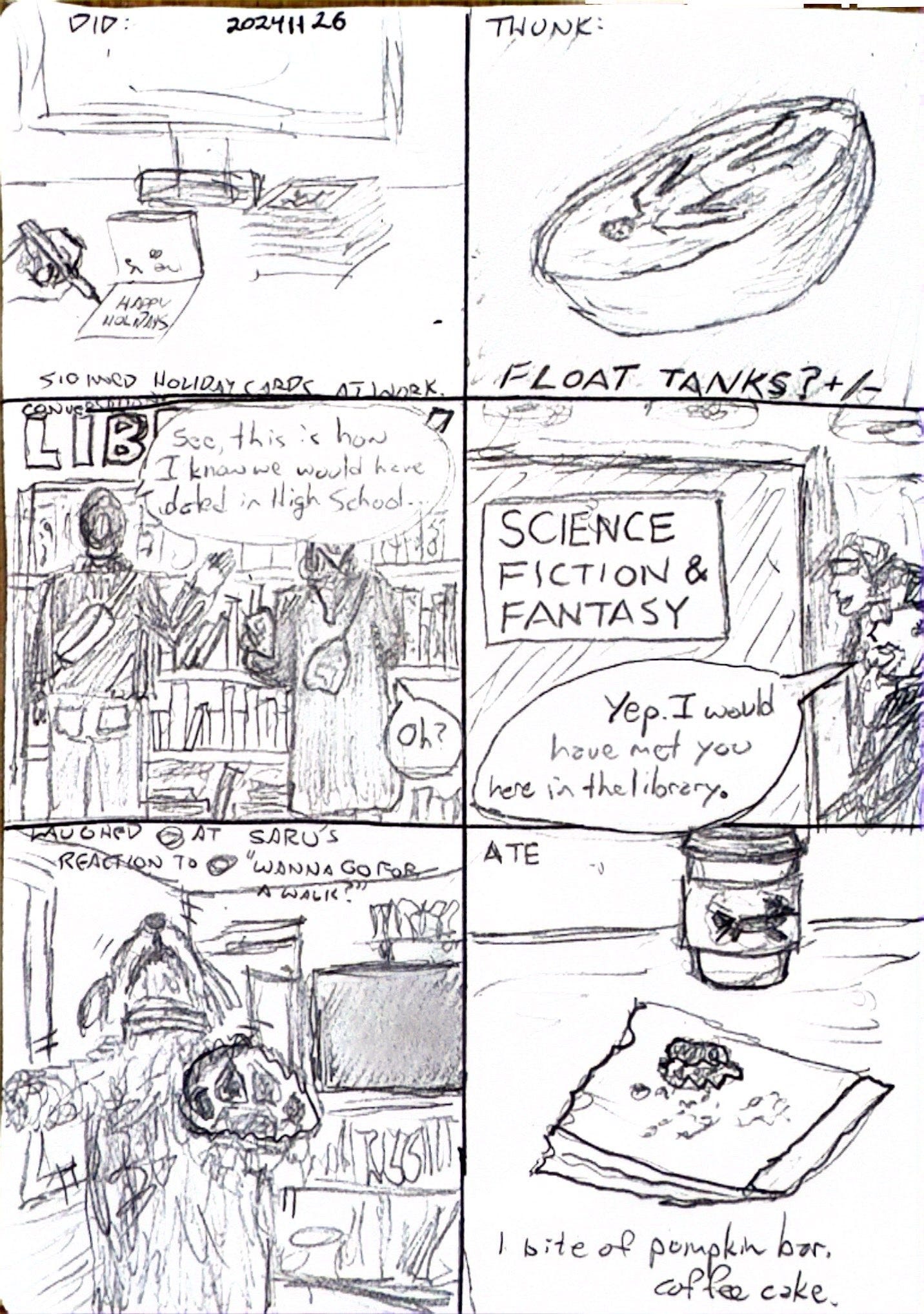
Pretty simple, right? And he does a good job in the video of stressing: this is not about quality. It’s about flow, and memory, and how you might communicate it with others.
I’ve not done it every day, but I’ve done a few, and shared them, even. I’m finding it a very relaxing and reflective practice, and can highly recommend it.
I mentioned that I’m listening to the audio book by that name by Cal Newport, right? And that I really strongly disagree with a lot of his other work, and kind of don’t like his libertarianesque white-tower demeanor?
That might give you an idea of how uncomfortable I get when he starts talking about things that I agree with — or at least have to grudgingly admit might be good points.
Most recently, this has been his “First Principle of Slow Productivity”: Do fewer things. Or do less things, if you’re not a pedantic grammar prescriptivist (like me). He’s talking about project management and etc., but I’ve had at least two examples in my own life recently that highlight that the principle applies beyond just work:
One of the most common expressions of my ADHD executive function disability is the simple fact that I often forget to lock the back door and turn out the porch light after letting the dog out in the evening.
My partner has been helping me work on this by not ever doing it for me, but rather gently reminding me if she finds them undone (seriously, it’s a study in loving chastisement to hear her “My love, would you like to come lock the back door and turn out the light?”).
She’s also noticed that it seems to be more common when I take my phone out to the yard with me, often saying goodnight to people or squeezing a couple of more minutes of audiobook out of the day.
My solution to this is just to try harder to remember to lock the door and turn off the light when I go outside. This has met with some success, but definitely not all.
However, during my recent Simple Time of Peace (an off-grid, no-screen extended weekend) I did not bring my phone out (or a book or headphones or anything else) and guess what? Had absolutely no issue with remembering to lock the door or turn out the light.
Because…I was doing fewer things.
Likewise, yesterday I was planning on taking my partners to my eldest daughter’s engagement party, a very busy and packed event in the basement of a local bar. Picture our own extended family (four daughters, two marriages on my side, more on my ex-wife’s, and grandkids and spouses and friends) PLUS all her fiancé’s family.
I knew I’d likely have to take one of my partners home early due to her knee injury, but then come back to be there for romantic gestures like a song by my daughter or helping wrangle grandkids along with my other partner. Add to this the fact that the bar is notorious for bad parking.
So…I decided to add a bit more time-pressure to my life by starting a 3D print at the Bodgery maker space that would need to be checked on and retrieved right about the same time all the driving would need to be done.
It worked out; I got people where they needed to go, I was there for the people who wanted me to be present, and I got the 3D print not only finished but retrieved on time.
But it was stressful. Especially after coming out of the aforementioned off-grid time. And I realized, after, that I could have made it all at least 33% less chaotic by not trying to do a 3D print at the same time.
Do fewer things. Dammit, Cal, you might have a point.
Another thing I thought after the Simple Time of Peace was the realization that I am so avoidant of calm, quiet, non-public reflective time that I will latch on to whatever media is handy to distract me from it.
We’re not going to talk about that now. But I will briefly list the books I read between Thursday night and Sunday Morning, because if you’re looking for something good, they really were:
The Everything Box and The Wrong Dead Guy by Richard Kadrey. Really fun heist books with a flavor of magic — as if Douglas Adams and Terri Pratchett had written their version of The Italian Job
Creative Quest by Questlove: In the vein of The Creative Habit and other books about creativity by artists, this book by the co-founder of The Roots is full of not only interesting philosophical musings about the creative act but also concrete lessons for people who might want to do it professionally, as well as fascinating anecdotes about his lifetime (literally) in the music industry.
Zen Habits by Leo Babauta: A nice revisit to one of the O.G. “spiritual productivity” gurus. Short, inspirational, actionable chapters, and how I’ve been able to integrate that visual journaling habit above.
Sweet Tooth (compendium): I didn’t watch more than the first episode of the Netflix series, but this was really fun epic (and by fun I mean graphically violent, bloody, and emotionally devastating) and one of the better apocalyptic pieces I’ve read — took the whole “pandemic” trope in some very unexpected directions.
My Favorite Thing is Monsters: I got this supposedly to admire the artwork (amazing ballpoint pen-and-colored pencil literally on college-ruled paper) but the story drew me in — both the coming-of-age of a queer person in the late 60’s and also a larger murder mystery involving Nazis, NYC, lust, betrayal, family secrets, ghosts, and vision quests. Really amazing stuff.
Harley Quinn (assorted): My partner loves this character, and when we were invading the library (see comic above) she came away with a stack of trade paperbacks collecting many versions of the popular DC comic. I particularly liked the Birds of Prey spin off (not the movie) and the “Harley Quinn: Black and Red” collection of short vignettes by various artists and writers was a nice melange of art styles, layout, and storytelling.
What do you think? Anything here you’re adding to your to-do list? Let me know if you’ve read or tried any of this stuff and what your experience was like. Or just show it to a friend; I really appreciate your time, regardless, if you actually made it to read this far.
And finally, here’s a link to the video about the visual journaling.
Comments
Nothing yet. Say the first thing.
Sign in to join the conversation.