
“Why do you hate newsletters?” I asked my friend Nadia.
She didn’t hesitate. “They just seem so…salesy.”
We were body-doubling in our respective art studios, separated by more than a few state lines and at least one time zone. We’d been talking about our projects for an upcoming art show we’ve both got pieces in, and the conversation had turned to the infinite list of social media shoulds that plague every creative without a marketing team.
“They feel fake,” she continued, and saw my expression (the benefit of real-time video sharing). “What?”
“Are there any newsletters you like?” I asked, and winced inside, too late to call the words back. Was I really going to do the typical cis white guy you just haven’t met the right newsletter thing?
She didn’t seem bothered, though. “I read your articles when they come across Facebook. I like those. But that’s about it.”
I let the compliment glow for a moment in my heart. Then I said “Funny, I think of newsletters as the most authentic way to keep in touch with people — because unlike Facebook, they’re not going to try and sell me something else, or distract me, or make me angry.”
Nadia looked thoughtful a moment, and grudgingly accepted the point. “Ok. Maybe. But they’re also a real pain to create.”
At those words, this article burst from head fully-formed like Athena from Zeus — but I was not going to fall into the other typical masculine trait of offering unsolicited advice. I tried to keep my ADHD-fueled eagerness-to-share from my voice as I asked, “I…have some thoughts about that. Would you like to hear them?”
Nadia smiled. She also works on that particular brainfuel, and in spite of my efforts at grace could tell I really needed to get my idea out in the open. “Go for it.”
First, I’d talk about what I was working on right now. Literally, what is in front of me on the bench right now? In Nadia’s case, it was a rainbow canvas with a still-life of combat boots. “I’d write about what media I was using, I’d post some sketches as well as the work-in-progress, I’d describe why it felt like I should paint this.”
If it was hard, I’d talk about how it was hard. If it was productive procrastination, I’d talk about what work it was helping me avoid. And at the end of the one or two paragraphs talking about that, I’d ask people what they thought. Did they like the painting? Did they like boots? What kind of boots would they paint if they could?
Nadia could see where I was going with this — because all of those were things we’d already talked about earlier in our co-working time.“Second, I’d talk about what I’m thinking about.” I reminded Nadia about what she’d told me about the show we are both heading to in a few weeks. She’d been stressing about what works to bring. “If I bring the big stuff, it’ll be a show where people have light wallets. If I bring the little stuff, people will ask where all my big stuff is. And that makes it hard to figure out what new stuff to work on, too!”
I would put that in verbatim. I’d ask people what they thought. Especially if they were coming to the convention — which would be a lot of her fans, since she’d been to this show and similar ones all across the U.S. — she could just ask them straight out: “What kinds of my paintings, stickers, and sketches do you want to see?” Not salesy at all — just a real glimpse inside the brain of an artist they — and I — like.“Third, I’d talk about something I think is cool.” I decided to stop with the modesty, and told her “For example, you could say ‘I sent my friend Gray a bunch of scraps of canvas, papers, and odds and ends from my studio — and he’s been using them to do this whole ‘junk journal’ upscaling thing, with some really cool results.’” All of which was true, and she’d already oohed and ahhhed over the pics I’d sent her of various WIP — which, with a quick ask for permission, she could also share on her newsletter, perhaps with a link to my store.
”So, being an uplift for artists I like?” she said, and I nodded.
”Or a podcast you like, or tv show, book, whatever — it doesn’t have to be complex or deep, it’s about an authentic, personal curation that is not driven by an algorithm or marketer —that’s what everyone is hungry for these days.”Finally, I’d end with a simple coupon. “And as usual, for all my newsletter subscribers, here’s a coupon code for 10% off anything in my store. Feel free to share it with friends, but if you could share the newsletter too, I’d really appreciate it!”
Sure, there is a bit more — formatting the newsletter can be hell the first time around (“Old Man Shakes Fist at Mailchimp!”) but once it’s done, you have an easy formula for repeating it.
“You could put up a whiteboard in your studio at the beginning of the month with these three quesions on it, and at any given point during the month when a thought hits you “this should be in the newsletter”, you write it in. When it’s time to actually write the thing, you already know what it’s gonna be about.”
I should be honest: my friend didn’t do the whiteboard thing. Instead she sent me a photo of a hand-written list of thing in a spiral notebook, with about four or five entries under each of the three categories.
“That’s awesome! You know what I’m going to say, right?” I texted back to her.
“That I should pick just one from each category and leave the rest for other newsletters? Yeah, I know. My mind just likes lists.”
I have smart friends.
Now, I should make a confession here: it is much easier to tell someone else how to write a newsletter than it is to actually write one yourself. I have accounts in Mailchimp, Patreon, Wordpress, Ghost, and even somewhere on Hive (a blockchain-based series of blogs that I don’t understand but have friends who swear by it).
All neglected. That’s because there’s one last ingredient that is needed for this to really work: time.
And not just any time. It needs to be a set time, prioritized over anything short of life-threatening, with a set end time that you have to hit publish (ok, to be fair, you can type Well, that’s all the time I have for the newsletter today, hope you like it! but then you have to hit publish even if it’s not perfect.
That’s a hard kind of time to set, especially if you are prone to that brand of perfectionism that isn’t about nothing I do is good enough but rather about whatever I do people will think it’s stupid.
Guess what? You may be right. Those people might. And they can unsubscribe, and go find some other newsletter. There are people out there that want to know what you are doing. They don’t care if your participle dangles, you’re punctuation and speling is’nt quite write (sic), or if you are just sharing bits of soggy coffee-stained paper on a drying rack.
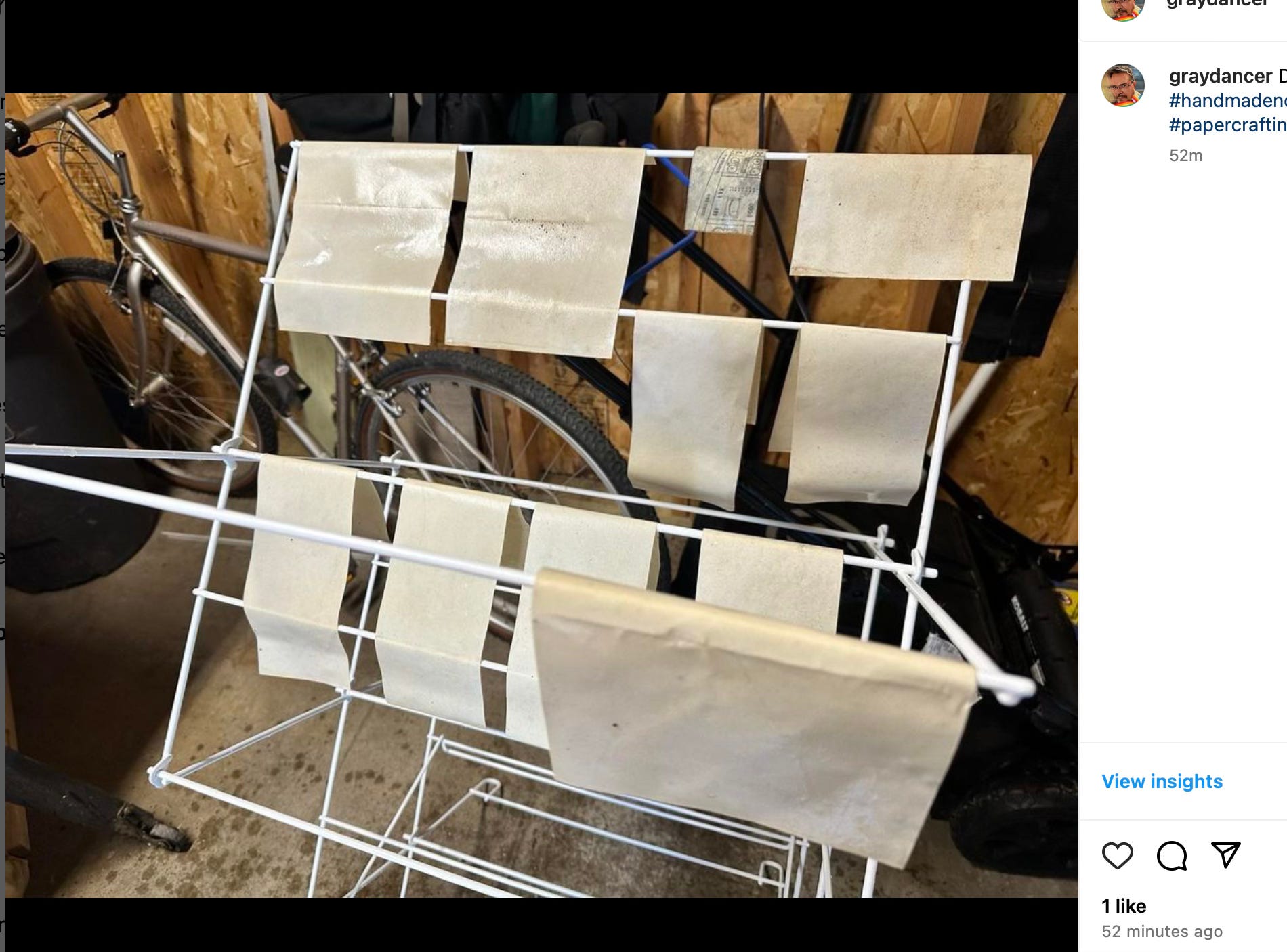
see? One like! It meant something to someone!
As I finished this article, I happened to go by my friends’ instagram. Now, let’s get something straight: Instagram (or any blog or social media platform) is not a substitute for a newsletter. Newsletters have the particular advantage of going out and finding your audience in a place they are going to be anyway.
But that doesn’t mean that you can’t repurpose the content on your newsletter in your other platforms. So you might imagine how thrilled I was when I saw these four posts on her IG (content warning: her art has sexual themes):
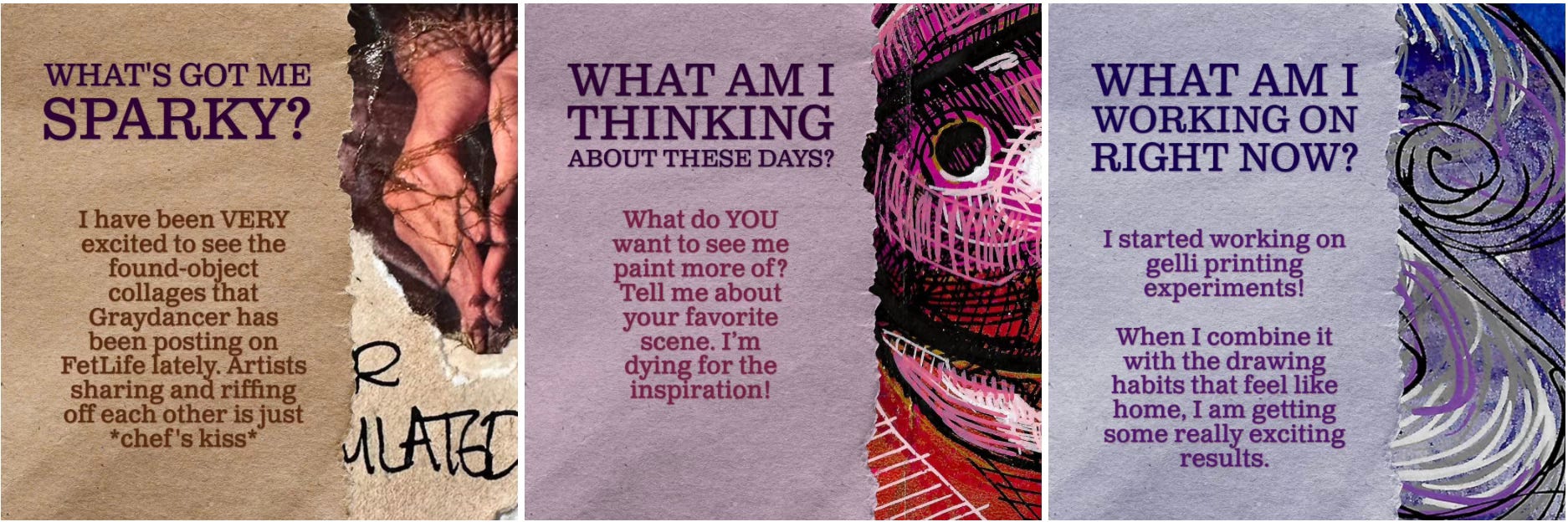
I can take no credit for these beautiful, eye-catching, and engaging posts. She did this on her own, and it’s brilliant.
It’s also proof that those three steps work. So what are you working on? What are you thinking about?
And most of all, to borrow Nadia’s excellent phrase: What’s got you sparky?
Comments
Nothing yet. Say the first thing.
Sign in to join the conversation.