
Back in 2013, my friend Gísli Rafn Ólafsson wrote an excellent book - The Crisis Leader - based on his experience as a technologist (I first met him at Microsoft), as a rescue worker with the renowned Icelandic mountain rescue teams and as a disaster manager with NetHope, a consortium of NGOs who co-ordinate emergency responses worldwide. Whenever I heard of a tsunami, earthquake, ebola outbreak or other disaster ... when anyone who could was flying out, Gísli was flying in.
Since then, his experiences have been equally extraordinary. Gísli has been the CTO of a leading tech-focussed investment bank in Europe, and of an agriculture-focussed non-profit in Africa. He has been a member of the Icelandic parliament and is now the director of the Red Cross in Iceland.
So, it was time to update his book on crisis management. And what an important new book this is!
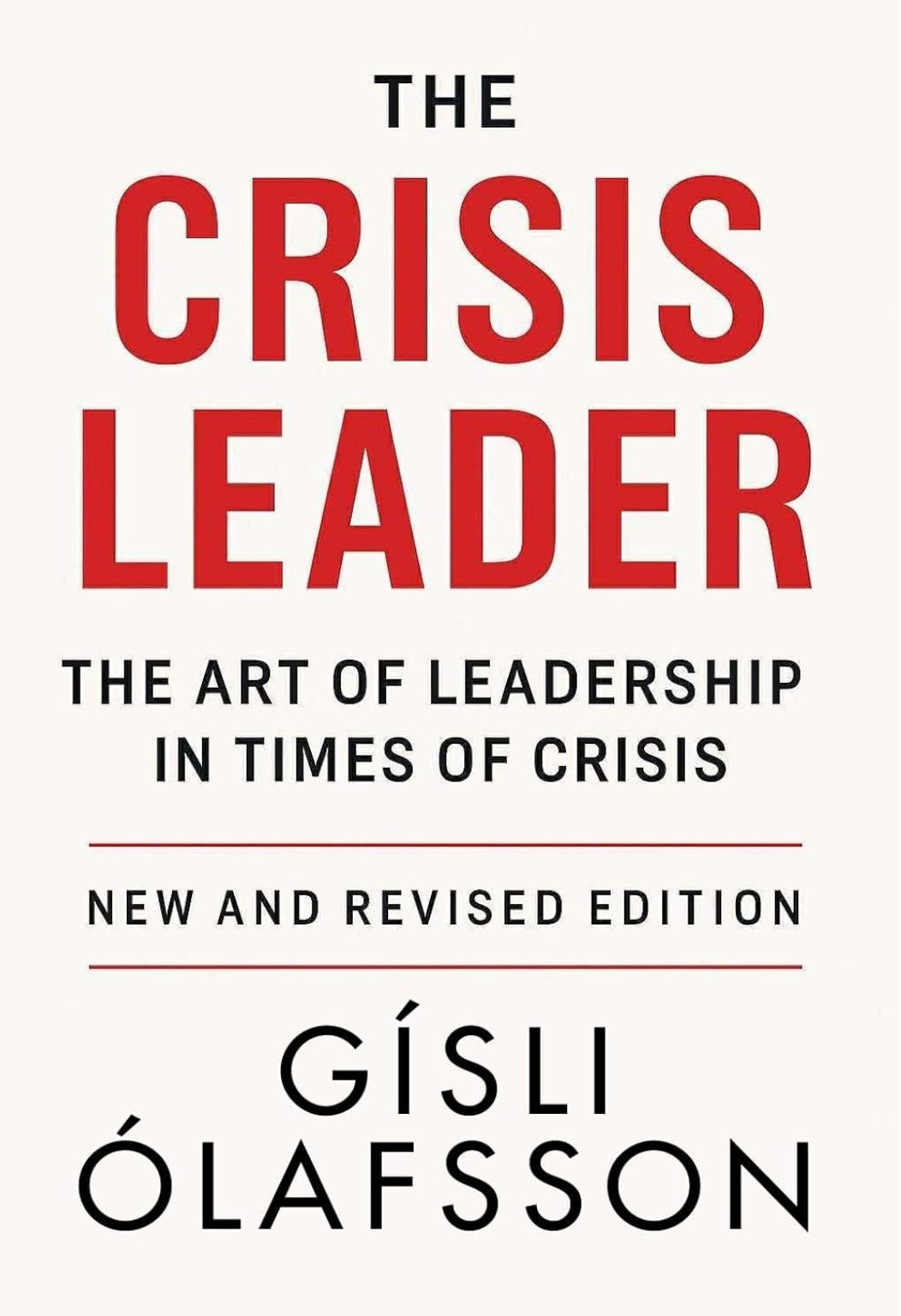
What strikes me immediately about Gísli's writing here is that a fundamental impossible possibility lies at the heart of crisis leadership. He tells us, plainly enough, that we should prepare for the unpredicted, plan for chaos and structure the unstructurable.
To this end, professional crisis management (especially among NGOs) appears to rely on endless protocols. But the decisive moments in the field rarely follow the manual; they’re about reading the situation, honouring the dignity of those affected, and resisting the urge to impose a pre-packaged solution.
For example, when Gísli speaks of his team in Haiti, of the moment they had to decide whether to continue searching the Caribbean Supermarket, and the consequences of the decisions he made, he moves beyond practical contradictions of planned and unplanned. There could be no right decision. What was needed was not a set of techniques or a checklist of skills, but a profound form of moral attention. Gísli and his team had to be fully present to the suffering, fully present to their own limitations and fully present to the weight of their decisions.
We had decided not to continue searching because we had not heard any signs of life. Yet we had left more people alive in the building than we had brought out.
That's the kind of decision Gísli has learned from and shares with us candidly. Compared to decisions in my own career, it is profound.
So, perhaps the most important preparation that emerges in this book, is not for specific scenarios, but for this quality of presence and moral attention. I say moral because you’re deciding not just how to act, but whose needs will define your action.
In many ways, you could read this as a straightforward leadership manual, albeit one informed by a fascinating and moving range of experiences. There are reading lists, assignments and exercises as you will find in any typical management book. They are very practical and useful.
But it is the experiences behind them which linger in the mind. I don't want to romanticize this work. I have read too many accounts of disasters which celebrate those who manage the symptoms of destruction while leaving the underlying structure of crises untouched. But in The Crisis Leader, when Gísli writes about the rescue workers he encountered (like those local women in Indonesia who were doing the real coordination work) what strikes me is not a drama about him or his team, but simply the patient, unglamorous goodness of the, often anonymous, locals.
That goodness of local people survices after the rescue teams have gone. Gísli is quite explicit about this: every crisis response ends, every team disbands, every lesson must be re-learned. Every After-Action Review bears the mark of who could not be saved, could not be reached, what could not be foreseen.
These time-bound, short-term, interventions could easily just repeat the mistakes of the Western savior complex: flying in, doing good and flying out again. But Gísli puts great emphasis on cultural humility and on empowering local voices.
Cultural humility is easy to announce but costly to practice. It means giving up a measure of control, accepting that your role is transient, and that the most valuable capacities in a crisis often belong to those who were there before you arrived and will be there after you leave. This can't be perfect, but in The Crisis Leader there is genuine self-critique within the constraints of existing economic and technical realities.
Gísli quotes Mark Twain: Good decisions come from experience. Experience comes from making bad decisions.
But in this telling, it's not just a question of simplistically learning from your mistakes. The tone and depth of this book, suggests that failure is not the opposite of success but a condition of its possibility.
One tension I notice throughout is between the urgency that crisis demands and the patient reflection that wisdom and learning requires. There’s a cognitive bias here: our brains are drawn to dramatic, acute interventions. But the slow, relational work of building trust, creating predictability and showing up consistently, often has greater long-term impact on emotional recovery. Gísli's respect for that mirrors what we see in sustainable psychological care.
In crisis, Gísli seems to act with a different sense of time; not the rush of anxiety, but what we might call attentive urgency. Notice, for example, how he structures rest for his team, insists on it, even when they want to push harder.
And he has the courage to admit that even our best efforts are incomplete. This is not defeatist but reflects the very structure of decision-making: every choice closes off other possibilities and the consequences always carry the trace of paths not taken.
In this book, leadership in crisis is not primarily technical: it’s relational and moral. Your presence, your ability to listen, and your respect for those around you are as critical as any logistical capacity. This is what I love about Gísli's book. This is not merely a guide for leaders (although it is a very useful one), but also the most moral writing about leadership I have ever read.
In the end, what moves me in The Crisis Leader is its simultaneous realism and hope. Gísli does not shy away from describing devastation, failure or the overwhelming nature of human suffering. Yet his act of writing, of sharing these reflections, is itself a form of hope, that others might respond to crises with more wisdom, more justice and more attentive urgency.
Leaders should be readers. Read this book.
Comments
Nothing yet. Say the first thing.
Sign in to join the conversation.