
The conventional claim that U.S. healthcare spending is a dramatic outlier, and therefore proof that single-payer is required, is overstated.
Higher healthcare consumption in the US underwrites the creative destruction that improves per-incidence outcomes globally. Healthcare costs are untenable in total, because a failure to prevent chronic disease is a free rider on Medicare and Medicaid.
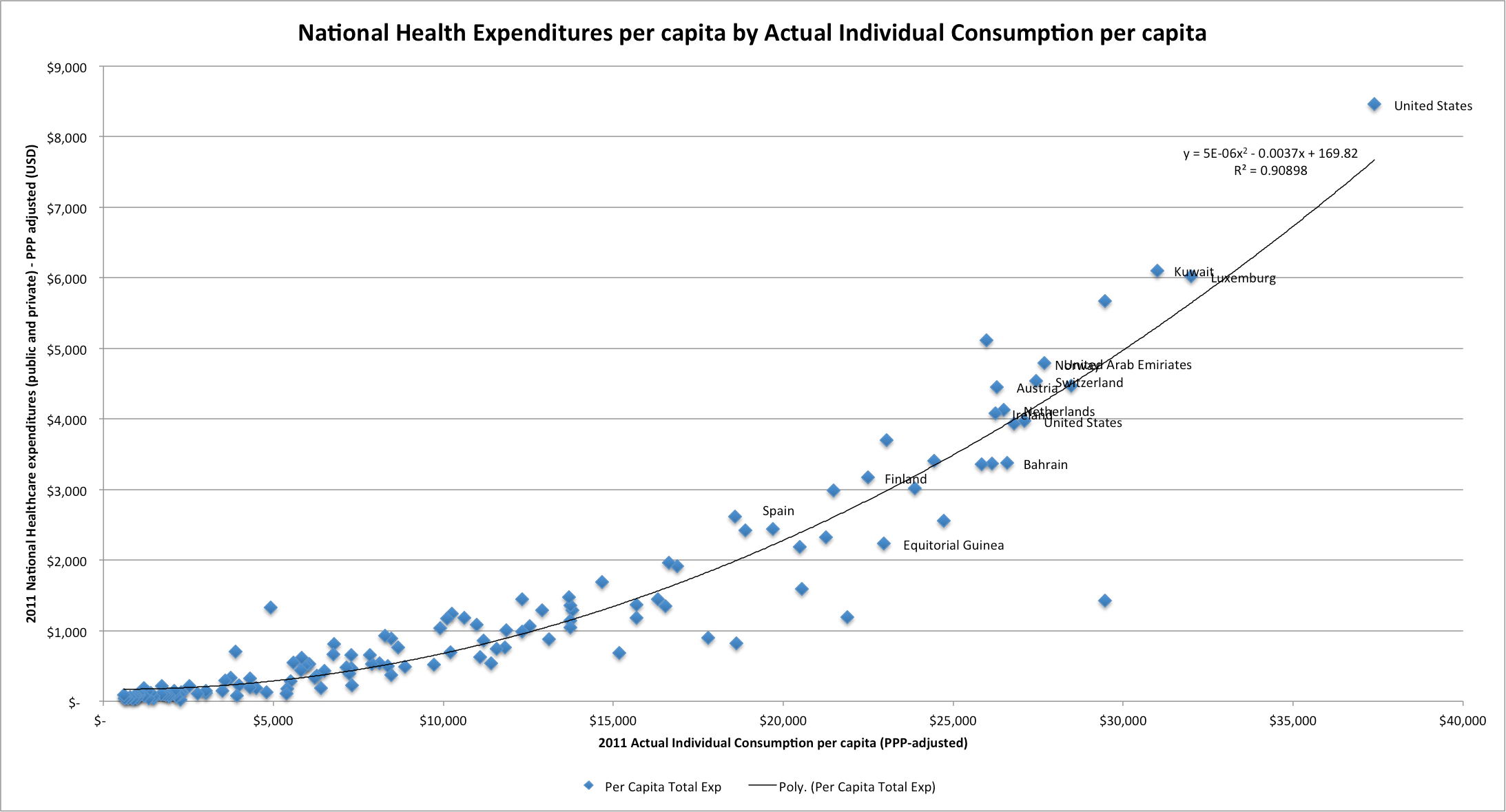
When national health expenditure is measured against Actual Individual Consumption (AIC) rather than GDP per capita, the United States aligns much more closely with the expected trend. High spending largely reflects higher real quantities of care consumed in a high-income, high-consumption society. Source: https://randomcriticalanalysis.com/2014/11/24/national-healthcare-expenditure-united-states-versus-other-countries-the-us-is-not-really-an-outlier/
This AIC principle has direct policy implications.
Most of the volume that drives expenditure is concentrated in chronic disease. It is substantially cheaper to prevent or delay the incidence of obesity, diabetes, cardiovascular disease, and related conditions than to treat their complications for decades. Financing reforms that merely compress payment rates leave the underlying incidence untouched. Prevention does not.
High-AIC demand plays a complementary role. The greater willingness-to-pay that accompanies elevated individual consumption underwrites the fixed costs of innovation, particularly in acute and complex care. This private demand signal finances discovery and early diffusion that would otherwise be harder to sustain under uniform administered prices.
The resulting innovations generate positive spillovers. Once refined in the high-AIC segment, novel acute treatments can be extended to lower-AIC patients through Medicare and Medicaid at administered rates. Public programs thereby convert privately financed innovation into broader access without having to bear the full cost of development.
Policy sequence that follows from the AIC principle:
Reduce chronic disease incidence at the population level.
Preserve the high-AIC demand signal that finances acute-care innovation.
Focus ARPA-H and NIH facilitating technology spillover.
Use Medicare and Medicaid as the channel that delivers the resulting spillovers to lower-AIC patients.
Expanding administered pricing across the entire population without first addressing disease burden mutes the innovation signal while leaving the volume problem intact. Prevention plus targeted public access to high-AIC-financed breakthroughs is the more coherent path.
Comments
Nothing yet. Say the first thing.
Sign in to join the conversation.