
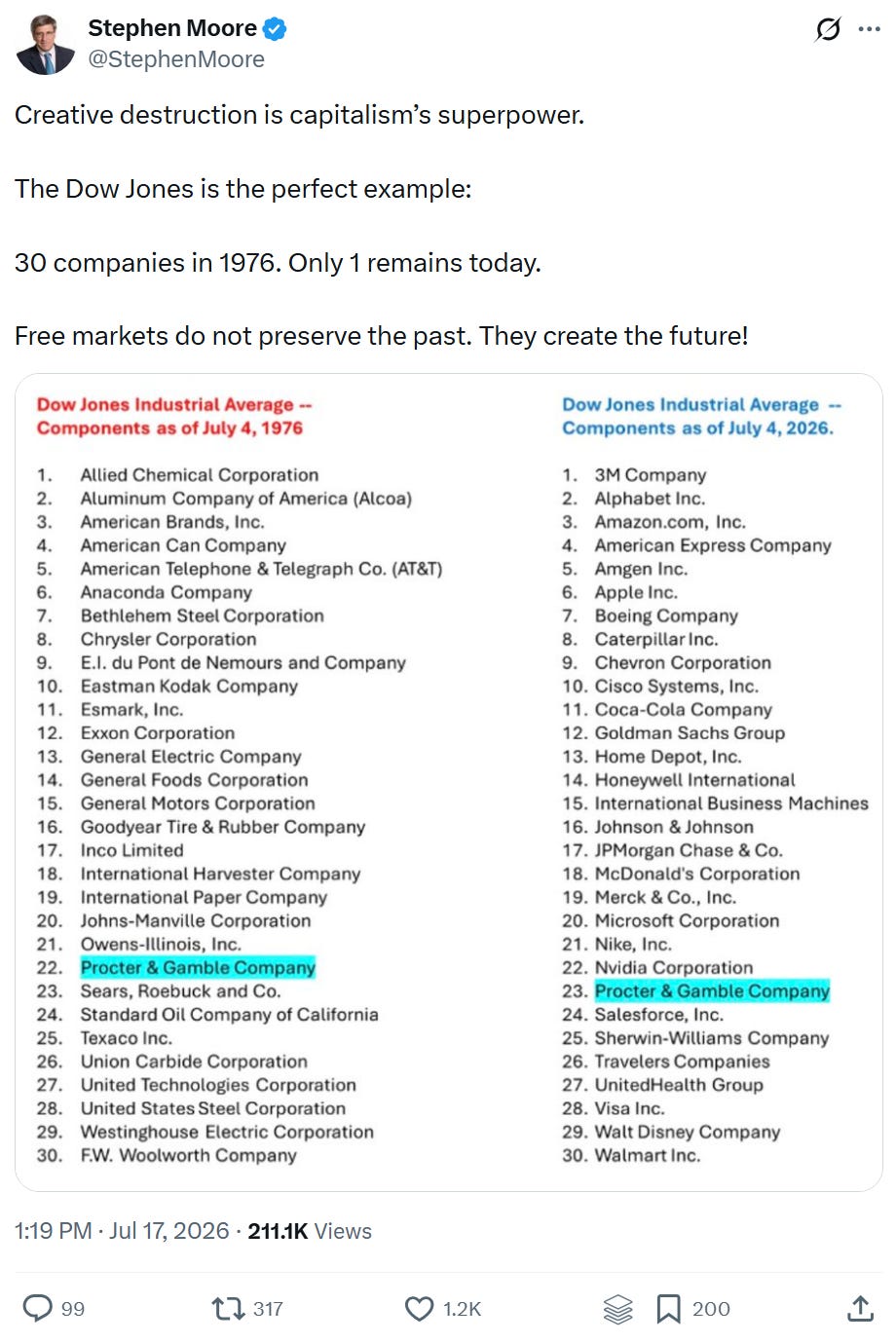
Stephen Moore writes,
Creative destruction is capitalism’s superpower. The Dow Jones is the perfect example: 30 companies in 1976. Only 1 remains today. Free markets do not preserve the past. They create the future!
He’s right. One name survived fifty years. Procter & Gamble. The other twenty-nine got torn down and replaced.
No one chose the replacements. No committee looked at Anaconda Copper in 1976 and slotted Nvidia into the seat. There was no plan. There was capital moving toward return, consumers picking what they wanted, a government open enough to let the swap happen, and innovation adapting to the next thing. The 2026 list is the residue of billions of small decisions. Not one large one.
The United States, for all its faults, does this better than anyone.
So the question for our decade. Does creative destruction speed up with AI, or slow down?
Hayek framed the stakes in 1945:
The peculiar character of the problem of a rational economic order is determined precisely by the fact that the knowledge of the circumstances of which we must make use never exists in concentrated or integrated form but solely as the dispersed bits of incomplete and frequently contradictory knowledge which all the separate individuals possess.
That was the case against central planning. The planner can’t gather what he’d need to know. The knowledge lives out at the edges, with the people on the spot.
It was also a case for AI, and the mastery of knowledge. Claude Shannon, Hayek’s contemporary, saw that. Three years later, in 1948:
These semantic aspects of communication are irrelevant to the engineering problem. The significant aspect is that the actual message is one selected from a set of possible messages.
Shannon threw out meaning and kept structure. Knowledge became a quantity. Something you could measure, move, and compute. Hayek said it was too scattered to centralize. Shannon said any piece of it reduces to bits and moves anywhere. Put the two together and the dispersed knowledge is workable by machine. The only question left is whose machine.
AI cuts both ways here.
One reading: AI finally builds the planner Hayek said couldn’t exist. Gather everything. Model everything. Plan from the center with a machine that never sleeps. The old dream, now with compute.
The other reading: AI arms the edges instead. It hands each of eight and a half billion people a tool that reads the fine print, prices the option, drafts the contract, checks the seller before the money moves. The person on the spot already had the local knowledge. Now they understand the deal without a specialist, and negotiate from a stronger position. Friction was the tax on being small. AI cuts the tax.
I think the mass of humanity probably has SkyNet beat. Not on principle. On arithmetic.
One planner, however good, is still one search running against the world. Eight and a half billion, each with an agent and their own local knowledge, is a different kind of engine. The center has to be right about everything. The edge only has to be right about one thing. Its own.
The wildcard is rent-seeking. A lot of the incumbents on the 1976 list didn’t die of old age. They died slow, propped up by regulation and captured allocation long after the market wanted them gone.
Musk put the line on it:
Physics is the law, everything else is a recommendation. Anyone can break laws created by people, but I have yet to see anyone break the laws of physics.
Regulation is a recommendation. It buys the incumbent time, not permanence. A better product arriving cheaper is closer to physics, and physics wins eventually. AI in the hands of the people writing the rules stretches the delay. AI in the hands of the people the rules are spent on ends it. Same tool. Whether the next fifty-year list turns over this fast depends on which hands hold it and on capital finding the future rather than guarding the incumbent.
Creative Destruction is the natural order.
Comments
Nothing yet. Say the first thing.
Sign in to join the conversation.