
Today is Obatala day in our 4-day calendar, and I’ve just completed The Earthsea Cycle, a six book fantasy series by Ursula LeGuin. The Orisha Obatala is often personified as an elderly Afrikan man in all white, the embodiment of wisdom, “master of the white cloth,” a cosmic shaper. A few close friends, myself included, thought that the Orisha path would see me as a child of Obatala. Maybe because of my low-key temperment, maybe because I moved slow and people had been calling me “old man” since I was an adolescent. We know these spiritual relationships are not about interest or even temperament, much less who we think we are.
These initiations spark processes of change, such that we don’t end up where we began. If we do it right, we live a life more rich (that’s a play on the name Owolabi) and flowing more powerfully (Aboyade) than we could have imagined entering the process.
That means we have to not only grow, but embrace the truth about ourselves and our partial knowing of such truths, and eventually release expectations or, at least, allow them to grow with us. We do this work at the crossroads, and at our altar. The happenings of our lives give us many opportunities to feel the friction of incorporating and embodying this work in real time.
What follows is by no means a complete review, merely a spontaneous sketch. In which I will point out the significance and try not to give away too many plot points of this series which was published from 1968 to 2001.
This six book fantasy series is special as decades may pass in the characters’ lives in between each book. One book doesn’t immediately follow the next. Time passes. People and situations change.
The young hero we are introduced to in the first book as an aspiring magician, is an elder in the sixth book who “is done with doing.” As the books proceed, we see a variety of characters grow, age, change roles, and die.
The plots in these books, how conflicts are resolved, is refreshing in this day of swashbuckling fantasy, controversial political intrigues, and exaggerated super hero action. Much of these books are filled with establishing the stakes, showing the web of relationships that are being called forth, what they risk, and how the world will be affected by the crisis at hand. The decision to act, and how to act are not treated lightly but as factors requiring consideration and study, attention to lore or tradition, negotiation between the characters who find themselves with the responsibility to solve the problem.
In this book the mages are men, schooled formally in magic and its language, committed to a gendered isolation, employed by lords and merchants. The witches are women, prohibited from Roke, the magical island that is the center of the Earthsea universe. Their growing and healing and finding and mending and providing… is labelled derogatorily as “women’s work”.
My godmother tells us how in many circles women are still prohibited from reading Ifa. Even though all readings take place symbolically in the space of the womb, it has long been thought of as solely men’s work.
Earthsea’s initial protagonist, Ged is changed over the course of the series as he meditates on the worldwide customs of prohibition and gender seperation. He reflects on where magic comes from, and experiences magicks of various depths in order to leave the series much older than he began it, a changed man with a different relationship to the system that has elevated and celebrated him.
The Earthsea Cycle feels much more like a journey than a battle. The main characters aren’t merely heros trying to defeat enemies, but people of significance to each other wrestling with issues that call forth their individual and collective discernment and courage. In this case, they are crises that reflect and impact crises of their world, Earthsea.
Reading the series now is right on time for me personally.
Earlier today I was called forth in my capacity as Orisha Priest of Sango and Oya. I wasn’t called to lead a religious ritual or perform a divination (group ritual is still a growth area for me, I must confess). Rather, a young brother trusted me with problems that were weighing on his heart. He was wrestling with his own patterns of behavior and the consequences of his behavior. It was one of those beautiful conversations where you can feel the trust increase periodically. We talked about spiritual practice and how it can help us to bridge the gap between the person you are and the person you want to be. We talked in terms of both immediate decisions, daily or weekly routines, and the accumulation of decades.
Today I am a New Afrikan Spiritual Mindset Priest and also a Spiritual Companion who was attracted into spirituality because of my own health conditions as well as unprocessed grief from immediate family passing.
There’s something about the journey that attracts me now. I think I used to be moved by concepts that could be considered constant— like accomplishments: “God” or “enlightenment.” Some relish in saying that “God is unchanging” or some treat enlightenment as a state to be reached when everything extraneous has been removed. I used to seek a pure state of being where sickness did not exist.
Sometimes we look to these things seeking refuge from the blows that life has dealt us.
Even the Orisha are growing and we can be part of their journey. When we are initiated, we return to the essence and contribute our lessons and experiences to the development of these Great Spirits that we participate in.
It is always a blessing when folks trust me enough to welcome me into their journey.
I’ve been surprised that my main experience of receiving a kidney transplant hasn’t been medical. It’s been existential, a wrestling with getting older. The transplant has just provided crises that I’m being called to respond to. It showed me somatically that my relationship to my body is changing. I also get to see which of my loved ones are journeying with me in this response. Some are cheering me on from a distance and I’m grateful; others are choosing to walk by my side. I’m observing how my own relationality is ever evolving. A month or so ago, my partner wondered if I were going through an initiation.
My body has become unfamiliar. My capacities have gone through the crossroads of being unknown to myself.
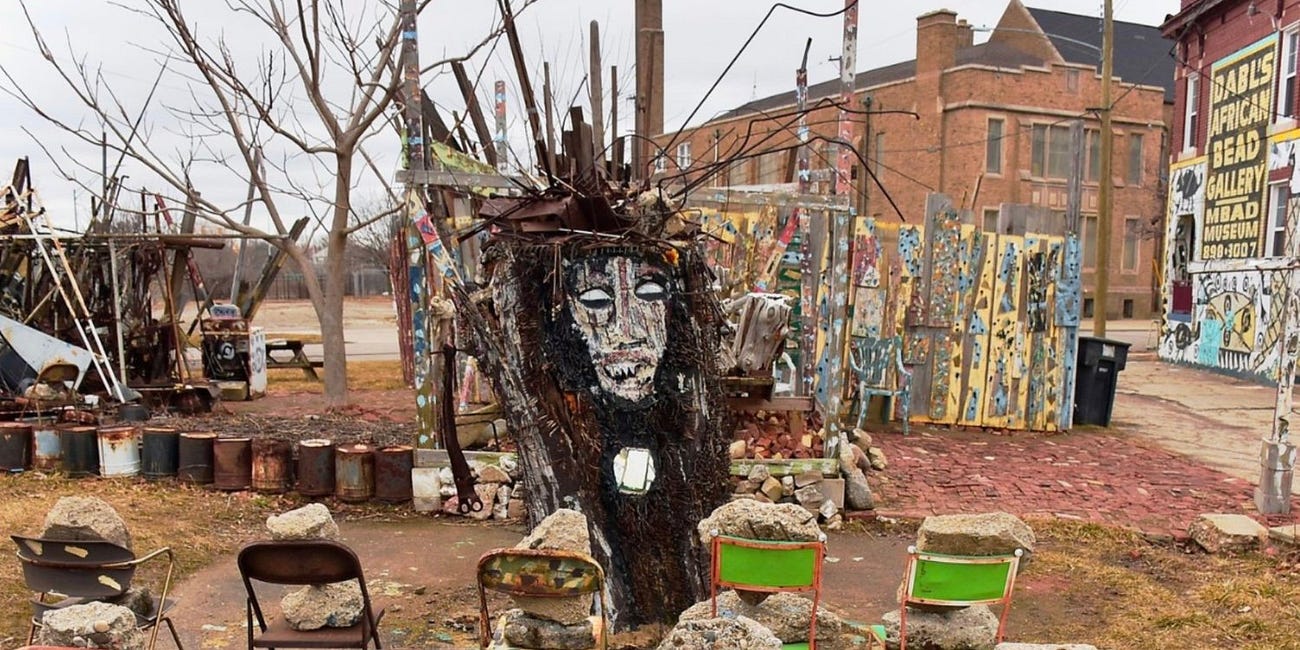
In this post-transplant period, I notice myself assigning myself the term Rusty Ole Negro. It rolls deliciously in my mouth. It makes me think of surrealism especially when it rocks its afro. It reminds me of family, Ancestors who were already grey when I was a child. It’s fun for me to resonate aloud with “rusty” which may include “disabled” and so much more.
I already wrote about it in a twitchy finger last month on Detroit as a “rusty” city:
#14 4:23:7
·
Jul 23
at some point we all have to confront our mortality, at some point you become conscious of the fact that you, too, will die, how do you respond to this moment of illumination, the hoodoo way is to spend your days ever more wisely, to tend to your longgame, I require only that you live a good life, one rich in service, rich in Fa, then death can not stin…
Today as I reflect on the series I resonate with Sparrowhawk or Ged, who in the course of this series attains the status of being the most powerful mage on the planet then walks away from it by the final book’s end.
He hardly appears in this sixth book. A whole nother team that we met along the way— that we saw in these six books grow into themselves, their responsibilities, their magic, their unfamilar and unknown identities— steps up to find courage, face death, learn and interrogate tradition, make themselves open to change in ways none expected.
He appears again in the book’s final pages. In the penultimate line of the entire series he says he “Kept the house.” The weight of the series is such that this doesn’t feel like a defeat, but an evolution, even a celebration.
As a former “community organizer” who worked to encourage those around me to step forward together to meet the crises of our place, of our moment. As one who “retired from activism” almost a decade ago amidst traumatic transitions and political defeats, if I’m keeping it 100. As a spirit-being in a dying world system that was built upon materialism and calls to be broken open/ burned down/ interrupted/ built anew. As a person who first learned vulnerability at the hands of organ failure and the medical industrial corporate care system. As a man that is still learning how to “keep the house.”
As a Rusty Ole Negro living in the twenty first century,
I enjoyed going to Earthsea on this journey led by gifted story teller Ursula LeGuin. I close this fantasy and step back into this brutal surreal world.
ilé is a Yoruba word that can refer to the body, the earth, a religious community, and a house.
I appreciate this journey of decades and timelessness where I am learning how to “keep the ilé.”
No posts
Comments
Nothing yet. Say the first thing.
Sign in to join the conversation.