
Our beach weekends are settling into familiar cadences and motions; the warm yoga class or gym visit bookended by a morning power walk to Dunkin’ Donuts and an afternoon boardwalk stroll. On last Sunday’s Dunkies in return, a book idea that’s been sitting on the back burner suddenly became crystal clear: characters, plot, a twist, and enough subtle Bruce Springsteen references to make Asbury Park proud.
As strategist and motivational speaker Charles Garfield once said, “Anyone who has taken a shower has a good idea, it’s what you do next.” After transcription, editing, and fixing more than a few weak points, I shared the rough outline with a friend who is similarly saturated in shore lore and an author. Haven’t heard back, implying the middle is too rough to find the story’s edges.
Am I going to do this again? After my last book barely sold through its advance, I swore to myself that I wouldn’t invest the time, energy or passion into another technical book. Search engines, now LLMs, and a general lack of interest in nerd craft have diminished the book market to a quaint boomer artifact. But a music book? A love story? Set along the Jersey shore? Write what you know, the advice is directed.
What I’ve learned in the intervening decade and a half is that you have to be intense and immersed in the project. Much of this insight came from the Three of a Perfect Pair prog rock camp, and before that a few recitals with the So.I.Heard school of music. Whether it’s a book, a recital piece, or practicing a 1970s prog rock song to play with my newest camper friends, my mental duty cycle goes something like this:
This is going to be exciting and fun. I love this piece, this idea, and the opportunity to express myself through it. [the quarter pole]
What was I thinking? This is devilishly complicated, with far too many moving parts, lines, and tones, and way above my competencies. I am watching the musical bus pull away while I stand here awkwardly holding my bass. [halfway through]
I hate this, I hate myself for even thinking it was close to my dexterity with keyboard, fretboard or ability to groove in any dimension, and I am staring at embarrassment in the mirror. [entering the home stretch]
There is a middle ground between perfection and ability, and if I simplify the lines, themes and style, I can be proud of what I’m creating. [about 90% of the way through]
With apologies to Peter Frampton, c’mon, let’s do it again! [about an hour post performance or draft emailed to the editors]
As Deb Carter Mastelotto has noted, music camp (like football camp, art camp, and stand up comedy camp for adults) works because it’s immersive: You’re thinking about music from the moment you get coffee and share institutional-quality eggs with fellow musicians to the master classes, performances, and guided listening sessions. Immersion focuses your thinking and allows you to pick up new details; intense practice time amplifies those nuances into longer-term abilities.
When I took wood shop class in 8th grade, we made a minimally functional gumball dispenser - cut the wood for the box, route the channels for the plexiglass front, drill a rotating handle to drop the balls where they’d skitter across the table top. Our shop teacher was very old school. He challenged us to find pleasure in using hand tools making something functional, telling us “In Germany, students make the same cross cut 500 times until it’s perfect.”
It’s taken me 50 years to realize that the German shop class story might have been hyperbole but the he understated the value of intensive practice required to asymptotically approach the axis of skill perfection.
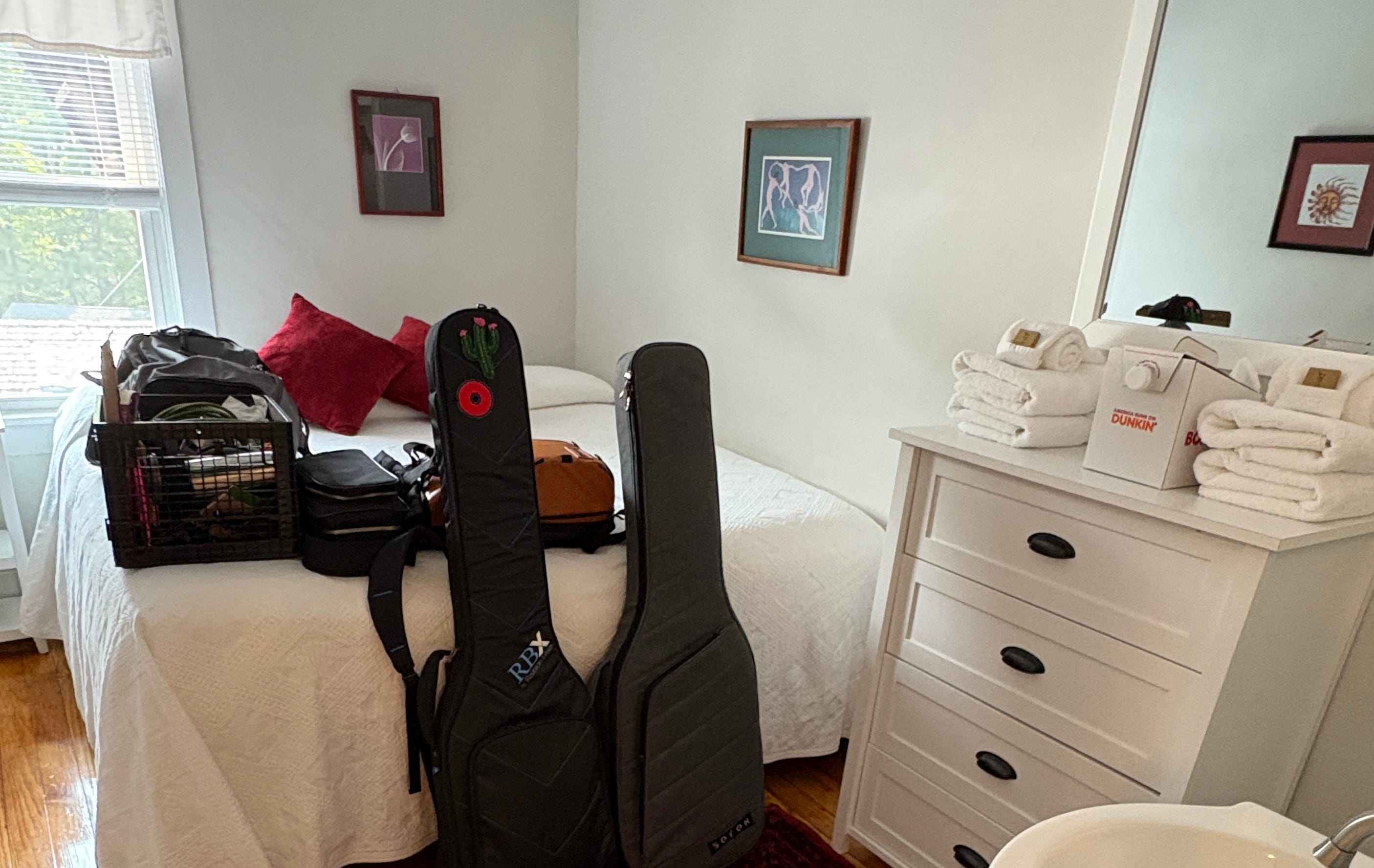
Counterparty to immersion is intensive work. Foundational to “10,000 hours of practice” it involves doing scales, writing exercises, becoming comfortable with the tools of your trade and building up the recall to compound the experiences of immersion. For the past month I’ve been auditing an improvisation class led by Markus Reuter (camp counselor, one-third of Stick Men with two other counselors, and superb touch guitarist). I’m neither a touch guitarist nor playing improvisational music, but the core of the class has been helped me develop strength and comfort with my instrument through exercises that are intentionally limited and challenging.
Cory Doctorow has written about his writing process, producing a fixed number of words each day and then moving on to other projects - he does one page a day, generating a full-length book in a year. John Scalzi summarizes the need for intensive work wonderfully (as always). Susan Righetti has a much more imperative call to get off the schneid with immersion and intensive effort to reach the finish line.
My goal for the warm months is to learn Roger Waters’s bass part on Pink Floyd’s “Have A Cigar” and pull the book into an outline that gets a return nod. Intense, immersive, practiced and rewarding.
No posts
Comments
Nothing yet. Say the first thing.
Sign in to join the conversation.