
Donate to Warm Springs & I’ll help you get prepared for disaster
The Warm Springs Reservation in Oregon has been hugely impacted by fire in the region and is facing years of recovery while. I’m continuing to spread awareness and encourage y’all to donate to the Confederated Tribes of Warm Springs Wildlife Recovery Fund.
Donate at least $75, forward your receipt to crammingfortheapocalypse@gmail.com and I’ll follow up to schedule a disaster preparedness consultation with you. More on what you get from that session in this post.

I’m writing this from my hometown of Spokane, WA amidst the honestly-not-so-bad air quality (the best it’s been since we got here a few days ago).
It’s been a strange visit to say the least. We came as planned for my son to attend the camp I grew up going to and was a counselor at, only for it to be cancelled the day he was supposed to go. More on that another time, but amidst this smoky air while hundreds of families are still evacuated from the Spokane Complex Fires and others reeling from losing their homes, it feels very apocalyptic.
The day we arrived, my mom was watching the national nightly news, so Finch and I joined her. The intro began with a string of headlines from around the world: “New footage emerges from a deadly shooting at In-N-Out!” “Watch this earthshaking footage from an operating room during an earthquake!” “A helicopter crashes while responding to deadly wildfires!” This went on for I’d say six or seven more headlines, all just as “harrowing” or “deadly” or “earthshaking.”
“I’m going to do something else,” Finch said, “this is too scary.” Smart kid. I followed suit. Later, as someone whose news is mostly from NPR and my Instagram news feed (the latter being not much better honestly), I asked my mom if this was the norm for every night to have a string of terrible things that they lead with. She shrugged and said, “yeah, I guess so.”
Honestly it does feel super apocalyptic outside right now, so I imagine perhaps the nightly news is just matching the feeling. But the sensationalism was a lot. And being in Spokane at this moment, I’m witnessing a lot more of the good things that come from community after a disaster. Everyone wants to help and do something and there is no shortage of mutual aid and kindness. And perhaps maybe that should also be what we’re looking at. There will always be light in the dark and sometimes that’s what we need to focus on to make sure our hope doesn’t fizzle.
With that in mind, I’m going to share some good news that has given me bursts of hope this last week.
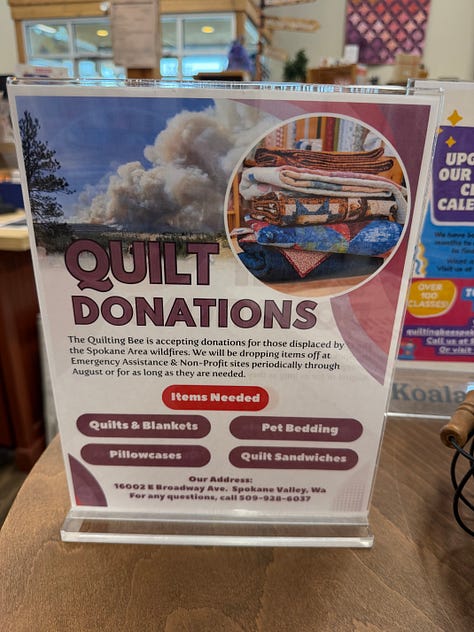
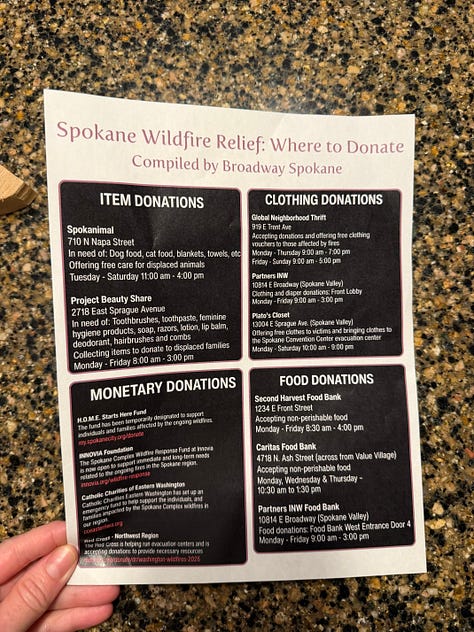
Let me be clear that large-scale disasters like the one experienced (and still being experienced) in Spokane is fully tragic. But there are also incredible things and news that can come out of devastation.
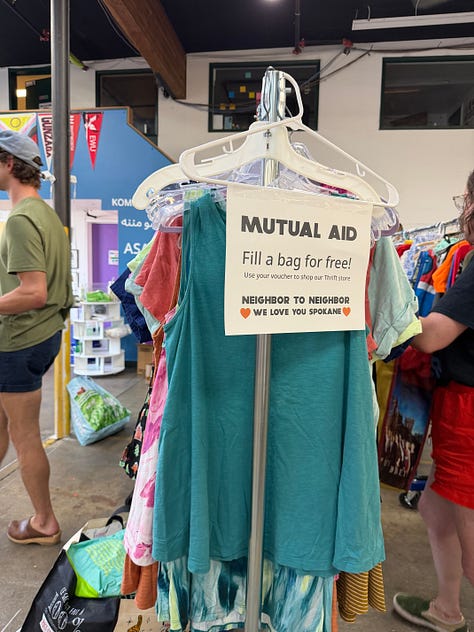
Mutual aid and community solidarity. As Rebecca Solnit wrote in A Paradise Built in Hell that there are little utopias built from disaster. The mutual aid, the generosity, the community love. Disaster often brings out the best in many people. And Spokane is no exception. In just a week, The INNOVIA Foundation had already raised $2.8 million where 100% of the proceeds are going to wildfire victims for immediate needs and long-term recovery efforts. And that’s just one organization. Countless volunteers have helped deliver meals through World Central Kitchen. One of my favorite local thrift shops, Global Neighborhood Thrift & Vintage (which already does incredible work supporting refugee communities) had to pause receiving clothing donations because of the outpouring of support and is giving out free clothing vouchers to fire victims.
No reported deaths from the Spokane Complex Fires. This honestly feels like a miracle, but there have been no reported deaths from the fires. Part of this was circumstance (this happened during the day!) and perhaps some because of what firefighters learn from all the other urban fires we’ve been seeing across the world in the last few years. Spokane learned a lot from past fires and they helped relay risk quickly to many people in the regions affected to give some time to evacuate. While it’s depressing to know that this is just the beginning of what is to come amidst a rapidly warming planet, it’s a win we should hold onto.
The scale and efficiency of logistical implementation of support and relief. My mom in particular wanted me to point this out because it’s been truly impressive to witness how quickly the community, various organizations and firefighters from the region and around the country mobilized to respond. A relief center was quickly set up at Shadle Park High School where people around the community have donated and those affected can receive resources. This also includes various insurance agencies who set up resource tables at these sites to talk to victims about their options. Thousands of firefighters set up camp at the Spokane County Fairgrounds that served as command central for fire response. It’s truly been a cool thing to witness everyone stepping in and finding their part.
NPR ran this sweet, hope-filled story on August 1st about seven-year-old Khalib Townsend meeting conservation scientist from the Audubon Discovery Center in Philadelphia. Having met Khalib’s mother for another story, reporter Janet W. Lee, learned about Khalib’s love of nature and birdwatching. Lee wanted to know what it might take for a kid as young as Khalib to hold onto their dream job. So she introduced him to Russell.
What resulted was a touching and sweet story of Russell and Khalib going on a rainy walk through the Discovery Center’s nature trails. Khalib’s truly excited voice in the background as Russell pointed out various birds was the cutest thing. And you can tell that Russell, who is Black, was touched by and very invested in this mentorship opportunity for another Black kid.
This is one of those feel-good stories that comes out of the not-so-good state of government funding of scientific research. However, Dr. Daniel Blumstein of the Rocky Mountain Biological Laboratory (RMBL) long-term marmot study, gets major points for creativity around scientific communication by putting their marmots on OnlyFans to raise money (aka OnlyMarms) promising “Uncensored Marmot Content.”
I know so many people in higher ed and research writ-large who are cutting budgets and people, I applaud the ingenuity here. It shouldn’t come to this, but here we are.
Learn about OnlyMarms at this NPR story and get all the links to donate as well as the OnlyMarms site at their LinkTree site.
About half of vaccines are thrown out because they can’t be refrigerated properly, but a solution is under development.
The company Stablepharma was able to convert a liquid tetanus-diphtheria vaccine into a “fridge-free” dry powder for a year. To administer the vaccine to around 60 volunteers, the powder only needs to be mixed with water in order to be injected. If they’re able to do this with a variety of important vaccines, this could change the landscape of vaccine distribution around the world.
The constant smoke in the Pacific Northwest is depressing, but it’s important to remind ourselves that progress is being made. Maybe not to the scale we need to progress, but it’s happening nonetheless. Here are some good news climate stories to make you feel a bit better:
Deforestation rates of Brazil’s Amazon rainforest are reporting a historic 40-year low! This is huge news for scaling back the devastation of the world’s giant lung.
New Mexico’s major utility service flipped its energy source from primarily fossil fuels to majority renewable energy in just five years. This is so important to have examples out there to show not only that it can be done, but how.
The EU has banned the destruction of unsold clothes and shoes.
Mangrove ecosystems are bouncing back. This resilience is great news for coastal regions and adaptation.
I hope this lifted your spirits just a bit. Putting it together brought me a little more hope.
No posts
Comments
Nothing yet. Say the first thing.
Sign in to join the conversation.