
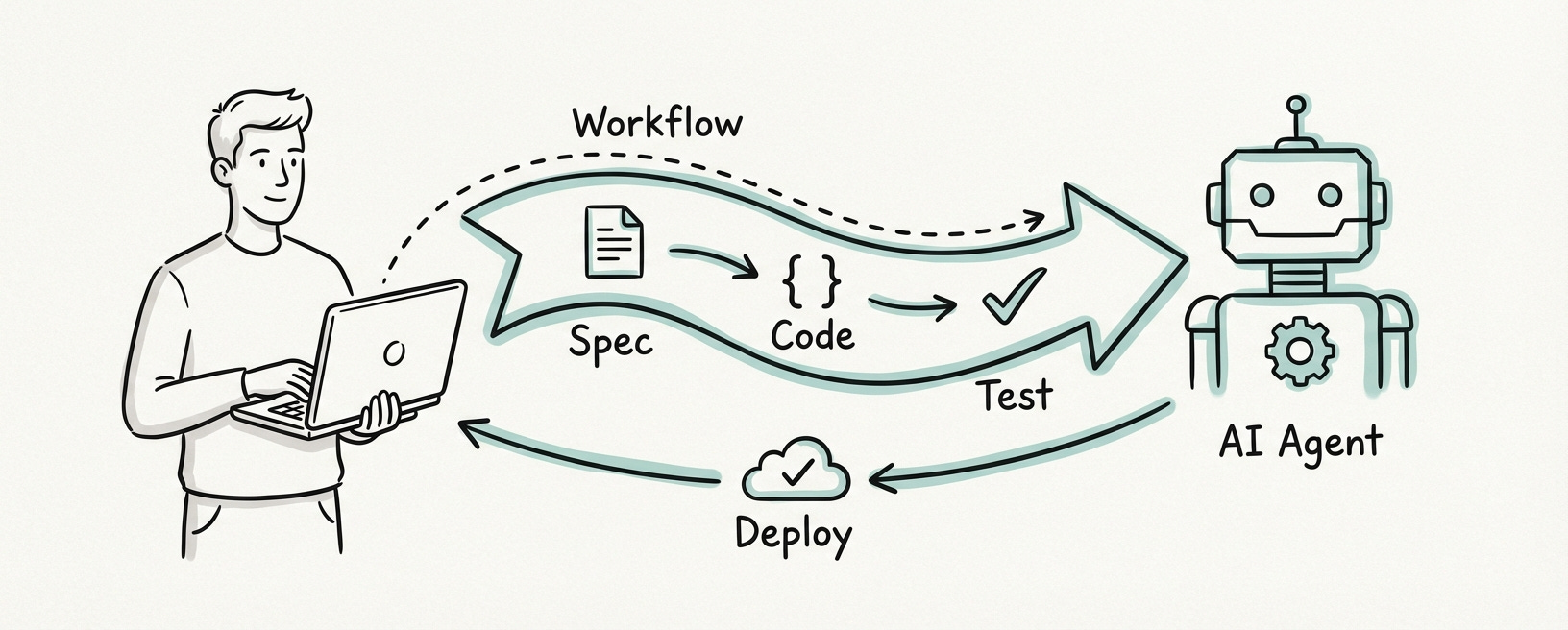
I’ve been running my business with a fleet of AI agents via OpenClaw for a few weeks now.
Janet coordinates everything.
Atlas handles content.
Sterling runs outreach.
But there’s one area where I had to get brutally honest with myself: my AI agents aren’t great coders.
That’s not a criticism—it’s just reality. And once I accepted it, everything changed.
Here’s the development workflow I’ve landed on after many trial and error cycles.
It’s the best of both worlds:
I get to leverage AI for coordination, context, and testing, while I stay in control of the actual code.
Janet (my main AI agent 🦞) handles orchestration.
She knows my entire business—customers, revenue, content pipeline, the works.
She’s running 24/7 on my Mac, managing cron jobs, responding to alerts, coordinating sub-agents.
But when I need to build something new, I don’t ask her to write the code.
Instead, we’ve developed a handoff pattern that plays to both our strengths.
I tell Janet what I want to build.
Not in technical terms—I don’t speak fluent Python.
I speak in outcomes:
“I need a webhook handler that catches form submissions from my landing page and adds them to my email sequence.”
That’s it. Janet knows my stack, my data model, my existing infrastructure. She fills in the gaps.
Within seconds, Janet provides a detailed specification. This includes:
The exact files/modules she’d create
The database schema changes needed
What API calls are involved
How it should be tested
Potential edge cases
This is where she shines. She’s read every doc in my second brain, she knows my naming conventions, she understands my tolerance for complexity (low). The spec is good.
Here’s the key: I don’t code where Janet lives.
I code on my local machine using Claude Code (the CLI version of Claude).
Why? Three reasons:
Speed. My local machine is fast. I can iterate quickly without spinning things up in my production environment.
Isolation. When I inevitably break things—and I do, constantly—I’m only breaking my local copy. Janet keeps running.
Cost. If you’re playing by the rules you don’t use your Claude Code subscription where you run your openclaw, and Opus 4.6 gets expensive by the API
I paste in Janet’s spec, fire up Claude Code, and start building.
I test locally. I break things. I fix them. I test again.
Once I’ve tested locally and feel confident (which usually means “it works and doesn’t immediately crash”), I push to a GitHub repo that Janet has access to.
She watches this repo. She’s configured to pull changes, install dependencies, and run her own validation suite.
Janet pulls down the changes, installs whatever needed, and runs her own tests:
Embeddings generation (I use vector similarity for context)
API call validation
Cron job scheduling
Integration checks with my existing systems
If something breaks, she tells me. If it works, it’s live.
The real insight here is division of labor based on comparative advantage.
Janet is incredible at:
Keeping context across time (she remembers what I built last month)
Understanding my entire business as a system
Testing and validation (she can run the same checks every time)
Coordination (she manages sub-agents, cron jobs, alerts)
I’m better at:
Reading error messages and debugging
Making quick iterative decisions
Writing clean, simple code (simple is my north star)
Knowing when to pivot vs. persist
Neither of us is great at the other’s strengths. And that’s fine.
I spent weeks trying to get Janet to write code.
She’d generate something, I’d paste it in, it would almost work but then there’d be some subtle bug—the wrong import, a missed edge case, a variable naming collision.
I’d spend more time fixing her code than if I’d just written it myself.
The breakthrough was realizing: I’m the engineer here.
She’s the co-pilot, the context keeper, the test runner. Not the writer.
Here’s what’s wild: because I can develop locally and hand off to Janet for testing and deployment, I can move fast on ideas.
Last week I wanted to add a new lead scoring system. I told Janet the outcome I wanted, she gave me the spec in 30 seconds, I coded it over lunch, pushed by 1pm, and she had it tested and running by 2pm.
That’s a 2-hour feature cycle. For a one-person operation (well, one human + a fleet of agents).
If you’re running AI agents in your business and you’re frustrated that they can’t code well—this is normal.
They’re not supposed to code well. They’re supposed to coordinate, context-manage, and validate.
You’re the engineer. Let them handle everything except the code.
If you’re looking for some help getting AI systems like OpenClaw and other AI agents live in your business, we can help. https://agentprime.io is the premier AI Agent building partner for businesses.
No posts
Comments
Nothing yet. Say the first thing.
Sign in to join the conversation.