
Life can be hard. Even the most serene existence has difficult moments. Bad news comes out of the blue. A serious threat can be unexpected and real.
An emotional jolt quickly turns physical. Cortisol spikes. Your heart rate increases, sphincters tighten. The adrenaline effect may pass quickly as the apparent crisis turns out to be imagined.
Many people deal with lurking fear in the background. Life threatening health issues, tenuous footing with a relationship, financially or at work. Some have loved ones struggling with addiction or mental illness, making every phone call an adrenaline encounter.
I’ve been there with a medically brittle addict son. My hands sweat spontaneously with the memory of it all as I write this. Countless cycles of crisis and near death washed over my wife and I. Crisis cycles turned to waves of grief when our only son passed away at age 29.
I learned a lot along the way. My goal in writing is to pay some of that learning forward for the benefit of others. You may be tempted to pass over today’s nugget believing it to be trite. Think again.
When the shit hits the fan it is natural to try and solve the problem. Unfortunately, the solution is often beyond our control. Attempts to fix things can simply add more energy to a negative situation.
Focus on managing yourself. Centering yourself allows you to do better in any situation.
Breath deep. Long. Slow. Deep.. Again. And again. And once more.
Breathing is more than just air. Breathing affects the autonomic nervous system, the system that governs heart rate, stress response, digestion, and focus.
Instinctive rapid breathing tends to activate the fight-or-flight, cortisol producing sympathetic nervous system. It is our involuntary initial response to threats. Shallow breathing is a physical manifestation of fear.
Slow, deep breathing activates the rest-recover-recenter parasympathetic nervous system. It improves decision making. Deep breathing calms our mind and supports self regulation.
Your body’s chemical response to stress is linked to your breathing. You can control breathing and therefore your internal state.
Slow, deep breathing should be the very first thing you do when stressed. It buys time for your mind to recenter, changes brain chemistry in a helpful way and allows you to do better. It allows you to self regulate and avoid unnecessary, emotional mistakes.
Deep breathing is always the right thing to do.
As an athlete I’m always looking for ways to improve performance - or these days to slow the inevitable decline that comes with ageing.
Turns out breathing exercises are a legitimate workout. Your physical performance (fitness) is directly related to breathing capacity - which can be measured (VO2 max) and improved.
Improved with breathing exercises. No kidding. You can simply sit there doing structured breathing exercises and improve your physical performance.
Serious athletes include breathing drills as part of their conditioning routine. Results include improved oxygen delivery, carbon dioxide balance, endurance and recovery - along with less unnecessary muscle tension
Breathing is a trainable skill and includes techniques such as belly breathing, box breathing, physiological sigh, resonant breathing and cadence breathing with movement.
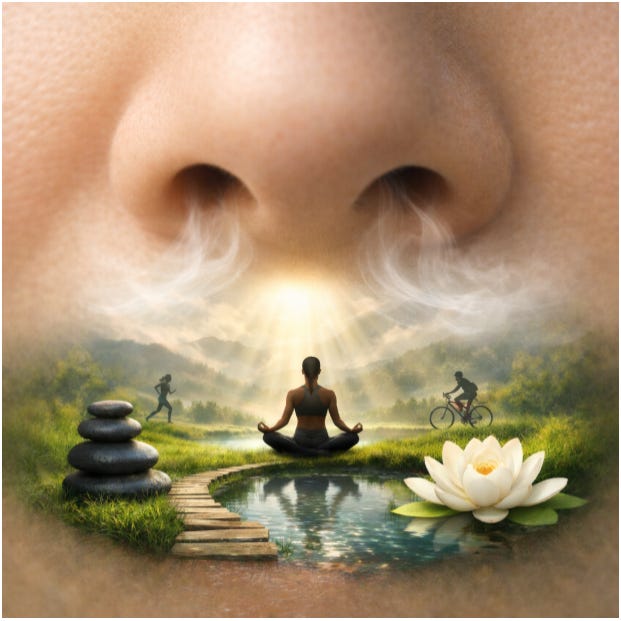
A simple, powerful tool for better living is right under our nose.
Helpful for mind, body and spirit. Available to anyone, anywhere at any time.
With love and support
Craig
Craig A. Williamson
Lessons from Addiction
lessonsfromaddiction.com
📖 Read my book, Regarding Substance Abuse & Addiction, where I share real-world insights from firsthand experience - losing my only son to addiction.

Comments
Nothing yet. Say the first thing.
Sign in to join the conversation.