
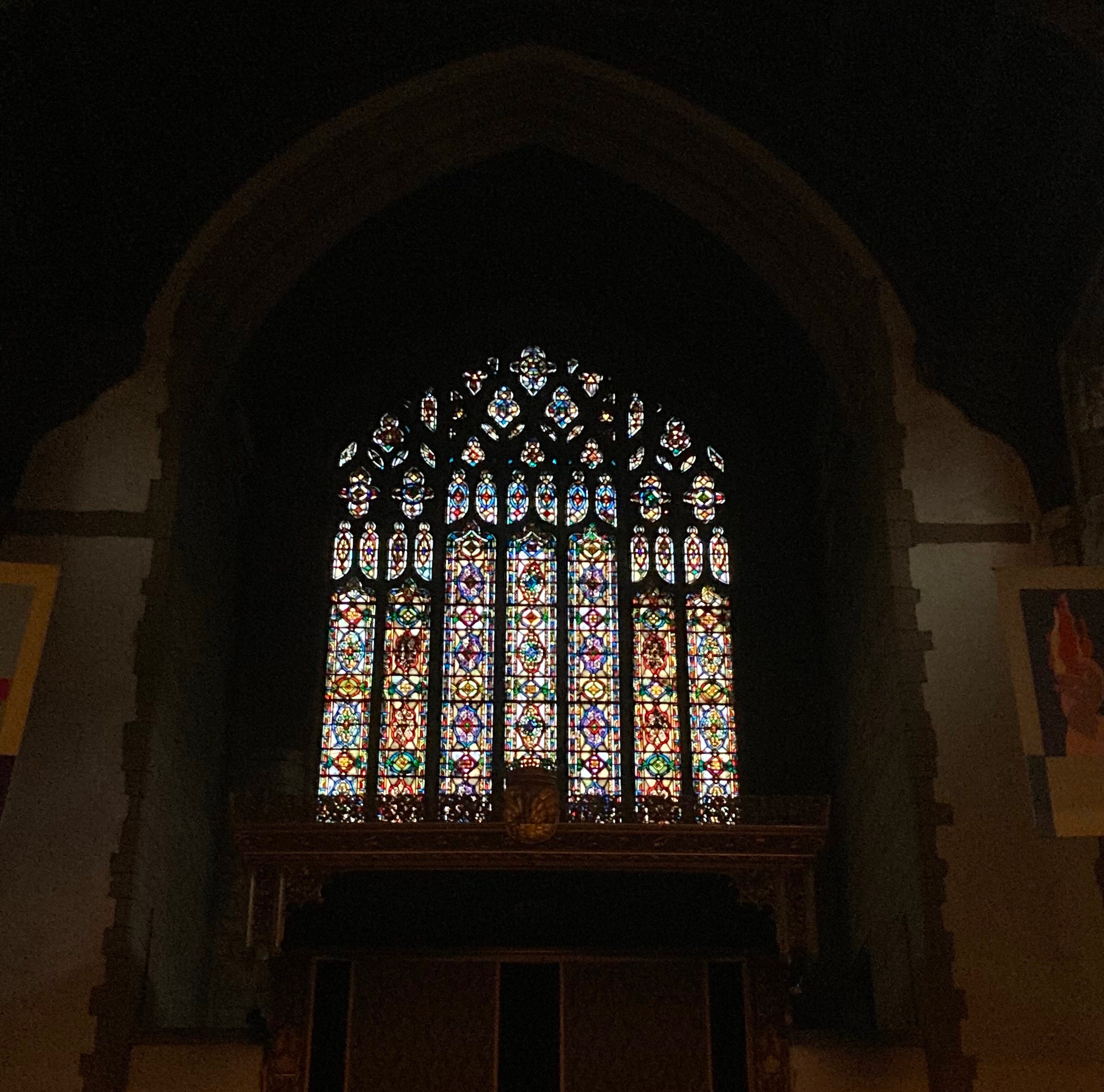
My friend is a priest of a church in New York City that is wonderfully out of place as a Gothic Revival church sandwiched in the middle of an avenue block, just around the corner from the assault-of-the-senses that is Times Square. When you step out of the craziness, away from the all-you-can-eat breadsticks at Olive Garden, and into this hallowed place of prayer it feels almost like a sensory deprivation tank at first.
Now this church is not some whitewashed, iconoclastic cave. It was built in the glory days of the revival of medieval architecture and high ceremonial that followed the Tractarian movement in the Anglican tradition. It is filled to the brim with shrines and chapels and vaulted arches and gilding — what was (and still is to some) viewed as excess and esoterica. But as elaborately decorated as this church is, it has an orientation, unlike the chaos of the LED brain rot of Times Square.
When your eyes adjust to the relative darkness of this church you begin to be drawn in by a subtler light. The flickering candles at the votive racks. The seven sanctuary lamps. The use of light and shadow and the devotional structure of the space lifts one’s eyes to the Rood, where our Lord, flanked by our Lady and the Beloved Disciple, is emblazoned in light, remarkably high over the sanctuary.
The motif of darkness and light in Christian theology is not an on/off switch any more than damnation/salvation or judgement/mercy are. These are terms of pilgrimage. That are descriptors of the reality of a fallen world that God has entered into in obscured humility.
For us in our limited vision, light is not complete knowing. Unadulterated, unfiltered light is iris searing, it is blindness. God knows this. The Uncreated Light of the Transfiguration was just plain confusing to Peter, James, and John. It made no discernable sense to them until they approached Jerusalem with their rabbi, till they saw him dragged away in the night, till they witnessed his trial and crucifixion. The light of the transfiguration only made sense in relation to the understated, confusing, wonderful, life-giving encounters that the disciples had with their risen Lord: touching wounds; bumping into the gardener; eating broiled fish on the shore. It was through the darkness that the disciples encountered the light of Christ, not by way of spotlights or firework shows.
Fr. Jameson review Paul Kingsnorth
What does this mean for us in our worship? It’s said that Fr Hope Patton, the restorer of the Shrine of Our Lady of Walsingham in England, loved dimly lit churches so much that he built the shrine church in such a way that when he got older he could barely read the words in the missal for lack of light.
Maybe this is a bit of overkill, but I’d still much rather worship in a dim church where I can barely make out words over a halogen-lit warehouse of a church any day.
Churches tell the story of the faith. They point to the reality of our pilgrimage from the darkness of the fallen world — the darkness of our own sinfulness, of our own tendency to move toward nothingness — into the light of Christ.
This isn’t to say churches need to all be medieval to be “authentic.” But it should make us think about the ways in which we use our buildings. Do priests really need Madonna mics? We made it 2000 years without them. Do the lights need to be so bright that sunglasses would be reasonable?
We live in a world of blaring sounds and images, of streaming video and rapid-fire information. Can we just let church be a respite from all of this? Can we let it point us beyond ourselves — even beyond itself — deeper into the mystery of God in Christ?
The world is looking for a subtler beauty, a confident simplicity, a space for devotion that is alluring instead of assaulting.
Let’s let Christ be the light and turn down the LEDs.
Comments
Nothing yet. Say the first thing.
Sign in to join the conversation.