

Welcome to Confluence. Here’s what has our attention this week at the intersection of generative AI, leadership, and corporate communication:
Looking Back Three Years
A Simpler Way to Build Skills
The Shift Toward Agentic AI Use, Continued
Anthropic Launches Claude Academy
Reflections on rereading the first edition of Confluence.
Three years ago this week, we published the first edition of Confluence1. We spent some time over the past week reviewing the arc of what we’ve covered. Across 183 editions (including special issues) and 700 individual pieces, two dominant patterns emerge. First is just how far the technology has come, and second is that we’re asking many of the same questions today as we were at the beginning. Our perspective has evolved with experience and exposure, but many of the fundamental dynamics we were paying attention to three years ago are exactly the same ones we’re wrestling with today. Those dynamics have only become more urgent and broadly recognized.
The contents of that first edition offer a striking demonstration of both patterns. That edition included five pieces: an Atlantic profile of Sam Altman (titled “Does Sam Altman Know What He’s Creating?”), a brief introduction to Claude 2, a guide to ChatGPT’s custom instructions, an overview of using ChatGPT as a writing tutor, and a perspective on the importance of disclosure in AI use. Knowing what we know now, some of the observations in that edition come off as almost laughably quaint:
From the Sam Altman piece: “OpenAI will almost certainly play an outsized role in shaping major developments in both the consumer and enterprise technology landscape, and for that reason alone it’s worth understanding the company’s origins, technological approach, and vision for AI.”
From the piece on Claude 2: “While Chat-GPT has become synonymous with large language models and generative AI, it’s far from the only game in town. Earlier this summer, Anthropic launched their competitor to Chat-GPT, Claude 2.”
In the two practical pieces — on custom instructions and on using AI as a writing tutor — we write about prompting the model to “think step by step,” and we share a 17-sentence prompt that we encourage others to use. Those were cutting-edge approaches to working with AI at the time, but are now completely obsolete. We’ve come a long way.
But for as much as the capabilities have advanced and the competitive landscape has evolved, the underlying dynamics in that edition are as relevant today as they were then. The Altman profile asks whether Sam Altman truly grasps the power of what he and OpenAI were creating; the Hugging Face hack and related events of this summer only underscore the importance of that question. The Claude 2 piece introduces a scrappy competitor to OpenAI called Anthropic; today, Anthropic is preparing for a potential $2 trillion IPO. The pieces on custom instructions and using AI as a writing tutor (with its 17-sentence prompt) foreshadow the explosion of features and sophisticated harnesses we now take for granted; the piece on Skills below in today’s edition is an extension of those pieces, applied to the capabilities today. And AI detection and disclosure have been one of the dominant topics of discussion in AI for the past several months. We’ve written about that dynamic from various angles in six of the last eight editions of Confluence.
What might we learn from comparing that first edition to where we are today? First, that the technology will advance in ways we cannot predict right now and that for as powerful as these tools are today, we should remember (to borrow a phrase from Ethan Mollick) that today’s AI is the worst AI we’ll ever use. The capabilities of today’s models, and the tools through which we use them — like Claude Code and Codex — will, as powerful and even astounding as they seem to us today, feel like antiques three years from now.
But humans are humans, and we expect to still be grappling with many of the same dynamics three years from now as we are today (and as we were three years ago). The hardest questions (for those of us not building the technology) will continue to be the human questions. Some of those will be out of our control, like whether the people building this technology understand what they’re building. Most of them won’t be: whether we’re using the technology in ways that sharpen rather than outsource our thinking, how we maintain trust and credibility while integrating machine intelligence into more of our processes, and how we develop people if traditional development pathways become increasingly obsolete. None of those questions get easier as the models get better, but they do get more important.
Whatever is in store for the next three years, we look forward to continuing to share our perspective here in Confluence.
You don’t need a plan to build a useful Skill.
Skills remain one of the most useful ways to work with Claude. Having Claude perform complex, multi-step tasks to our specifications with a single prompt speeds up our work, makes it easier to embed our standards and our expertise in how Claude works, and lets us create greater consistency across teams when we share Skills at scale. (Skills now exist in Copilot Cowork and in ChatGPT as well, though we haven’t tested whether the approach below works in either.)
We’ve been building Skills since last October, and usually we build them from scratch. That means starting a conversation with Claude by saying “I want to build a Skill that does X,” then working through Anthropic’s skill-creator Skill to shape it deliberately, embedding our expertise, building in steps no human would reasonably sit through (a six-pass proofread, say), and giving Claude the right reference materials. It’s a good process, but it requires knowing what you want before you start.
We have started to flip this process on its head. Rather than only building Skills from scratch, we build them after we’ve completed a task with Claude that we expect we’ll need to do again. We work with Claude to perform the task, giving it context, steering its output, managing the process, and at the end of it all we simply say “let’s turn this into a Skill.” Claude reviews the chat and builds it. Minimal extra fuss or work on the user’s end.
This might sound like it contradicts something we wrote in June. There we argued that the way to work well with AI is to first define what good looks like, in terms specific enough to hand off. We still think that’s right. That piece started with a Dutch company building robots that lay bricks. Its engineers interviewed master masons about how to build a good wall and learned very little they could teach a robot. So they watched video footage instead, and saw that the masons vibrated their hands slightly as they set each brick, working mortar into the pores for a stronger bond. None of them had mentioned it because none of them knew they did it. Our chats with Claude work a bit like that footage. We do the work, ask Claude what we just did, and it writes down the steps we never would have thought to specify ourselves. We still end up examining our own process. It just happens at the end instead of the beginning.
Here’s an example of how this works in practice. Our firm has been experimenting with collaborative writing, where we divide a set of writing prompts across the entire team and ask each person to spend 15 minutes writing a paragraph or two in response. Each prompt has multiple colleagues responding to it, so we capture multiple perspectives on each one. Everyone then emails their response to a single person, who works with Claude to produce a set of responses that reflects the shared wisdom of the group.
Getting from dozens of scattered emails in an inbox to a cogent document is a multi-step process, even with Claude. Claude extracts the responses from the emails, organizes them by prompt, looks for common themes and contradictions, flags the tensions that require human input to resolve, and creates a properly formatted document. The first time our firm did this, it took this Confluence writer about 45 minutes from the first message to Claude to the finished document. At the end, suspecting this might be something we’d want to do again, this writer asked Claude to turn the workflow into a Skill. It did, and when our firm ran the same exercise a few weeks later, what previously took 45 minutes took about 10.
One caution. A Skill built this way records the path you actually took, including the wrong turns and the corrections you made along the way, so be ready to iterate on it. Fixing it is straightforward. Tell Claude “we need to update this Skill” and give it feedback the way you would on any other draft, or open the Skill in the Customize tab and edit it yourself.
Our bias has become to build more Skills rather than fewer, with a fairly low threshold for deciding to create one. If we know we’re going to ask Claude to perform a task more than a handful of times, we build a Skill. Most of us should probably build more than we do. And if you’re unsure where to start, pay attention to the chats you have with Claude that you find most helpful. There’s a good chance your past and future conversations are Skills just waiting to be built.
A new OpenAI report shows agentic AI use growing rapidly across enterprise accounts.
Earlier this summer, we covered an OpenAI study that showed how OpenAI’s own employees were expanding their use of agentic AI and argued that the use of coding tools was going to increase across organizations. Last week, OpenAI released a new study on use across enterprise accounts. It supports our prediction, finding that the gap between the organizations that are at the frontier of AI use and the rest is widening, fast. The blog post is here, and the complete working paper is here. Their headline findings are worth exploring.
First, enterprise AI use (measured here by output tokens) continues to accelerate, and it’s becoming more and more agentic. Codex now accounts for 64% of combined ChatGPT and Codex output tokens among enterprise customers, which means nearly two-thirds of the work done by enterprise users is now agentic in nature. In February, that share was only 13%. Users at frontier firms are also more likely to use advanced capabilities like Plugins and Skills on a weekly basis.
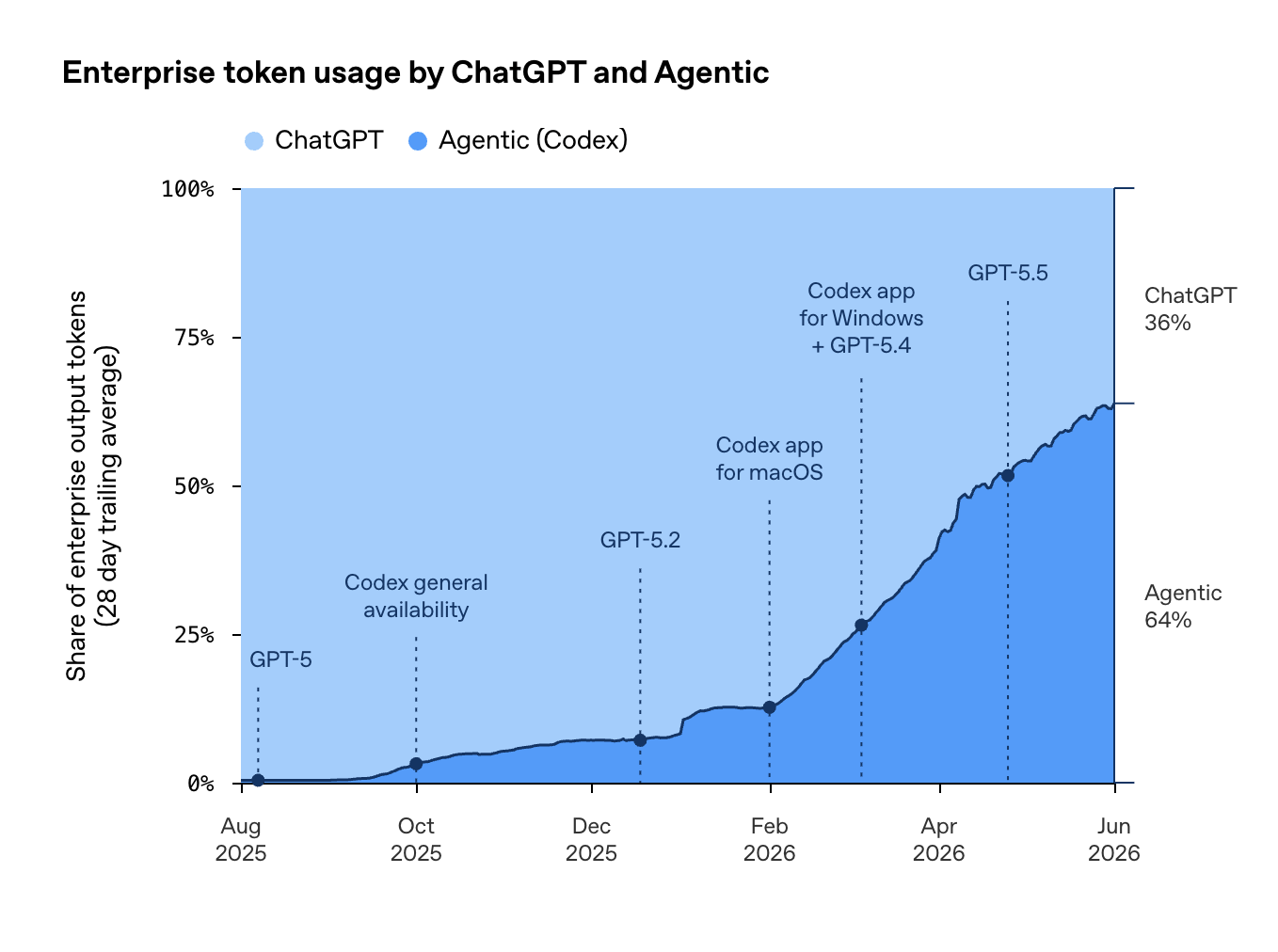
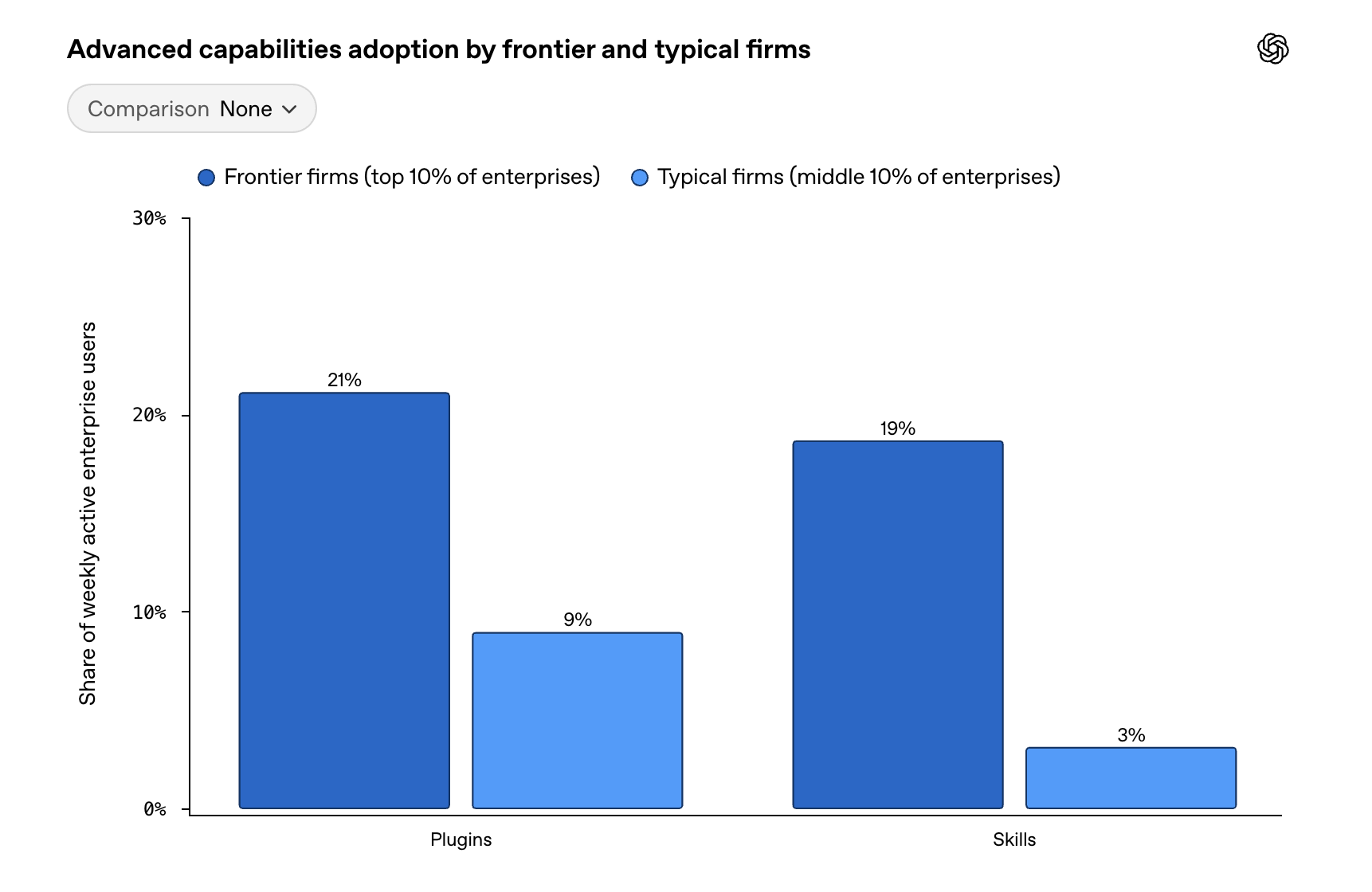
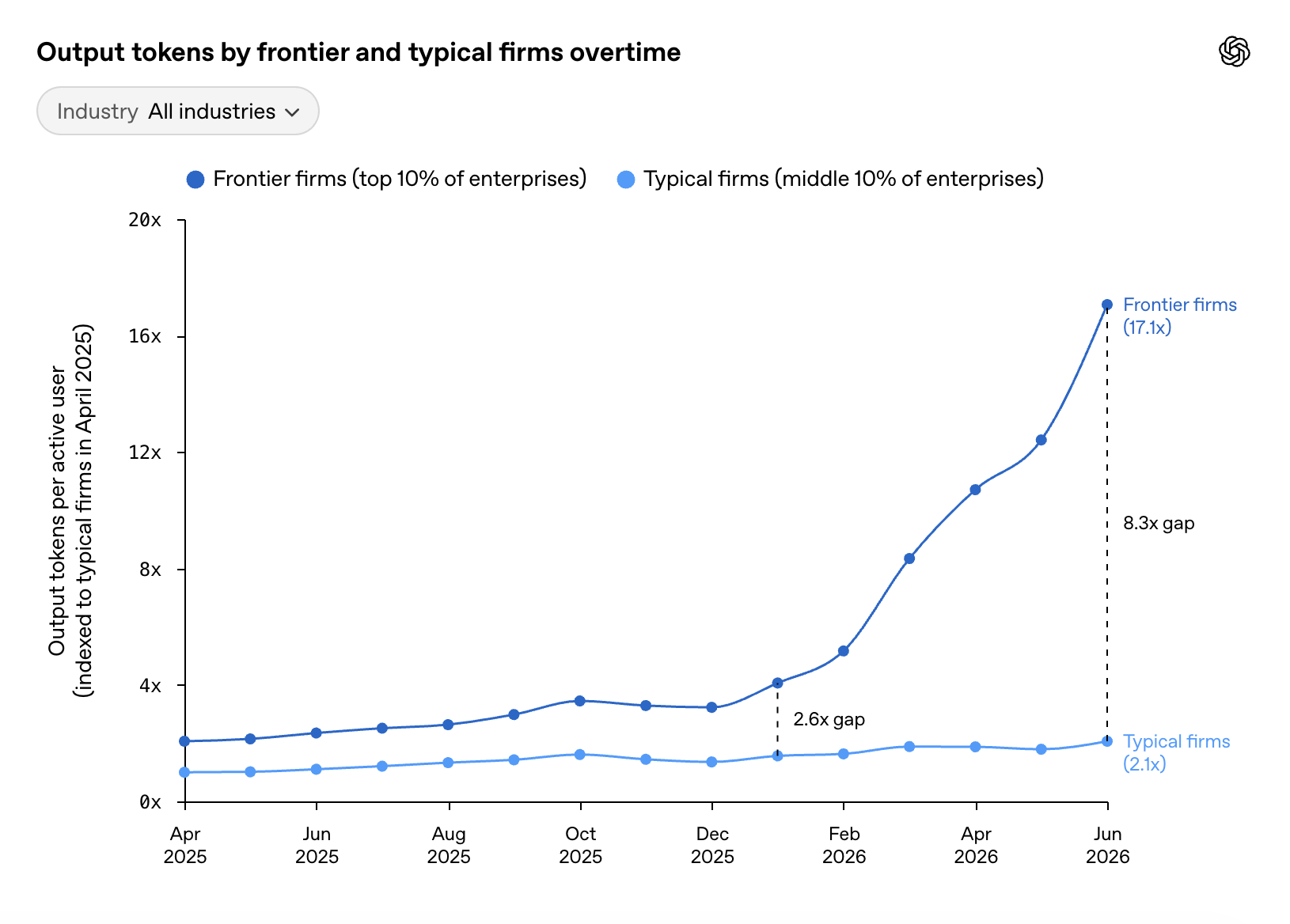
Second, the gap between what OpenAI calls “frontier firms” (those whose output tokens per active user rank in the top 10%) and the average organization is expanding rapidly. Frontier firms now generate 8.3 times as many tokens per active user as a typical organization, up from 2.6 times in January. The study also finds that enterprise adopters overall tend to be larger, more valuable organizations that spend more on R&D, a pattern OpenAI reads as evidence that “complementary investments in continuous employee learning, shared workflows, data infrastructure, and governance can support broader and deeper adoption.” The research doesn’t offer much detail about what that looks like in practice, but our own experience internally and with clients supports that conclusion: access to frontier tools is not enough if not supported by ongoing learning and governance.
Finally, agentic AI use is spreading across functions and levels. As OpenAI’s analysis of its own organization in June predicted, agentic adoption tends to begin in software engineering and then spread to other departments from there. Since February, the number of weekly enterprise Codex users in legal roles alone grew 108 times over, and users in sales and recruiting roles grew 41 times. Those roles are pretty far afield from software and tech. Across all enterprise users, early-career employees work with ChatGPT most often, with usage falling as seniority rises.
All of this confirms and expands the story we’ve been telling for months now: that the shift from chat to agentic AI is in full swing. In a matter of months, agentic work has come to account for two-thirds of enterprise output tokens across ChatGPT and Codex. That’s a remarkable rate of adoption for a capability that not long ago felt very foreign to most professionals outside of software engineering. For leaders, this should create some sense of urgency, if it hasn’t already. A few months ago, the story was that coding tools were coming. Now they’re here, and the organizations embracing that shift are pulling ahead.
An impressive new resource hub with something for almost everyone.
This week, Anthropic launched Claude Academy, a free learning hub built for people new to Claude and LLMs as well as existing users who want to measure and extend what they already know. We haven’t worked through the courses in detail, but at first blush the range is considerable. Introductory tracks cover Claude, Claude Code, and Cowork, followed by deeper material on agent Skills, subagents, and the Model Context Protocol. For developers, there’s also a substantial curriculum about building on the Claude API, as well as platform-specific resources. Everything is free, and each course issues completion badges on completion.
What struck us most is the AI Fluency content, organized around the 4D AI Fluency framework (Delegation, Description, Discernment, and Diligence) and sorted by who the learner is:
AI Fluency: Framework & Foundations (14 lessons, 4 hr)
AI Fluency for Builders (9 lessons, 3 hr)
AI Fluency for Small Businesses (9 lessons, 4 hr)
AI Fluency for Nonprofits (9 lessons, 4 hr)
AI Fluency for Students (5 lessons, 3 hr)
AI Fluency for Educators (4 lessons, 1.5 hr)
AI Fluency for pK–12 Educators, with Teach For America (10 lessons, 3 hr)
AI Fluency for pK–12 Train the Trainer (4 lessons, 45 min)
Teaching AI Fluency for faculty and instructional designers (7 lessons, 4.5 hr)
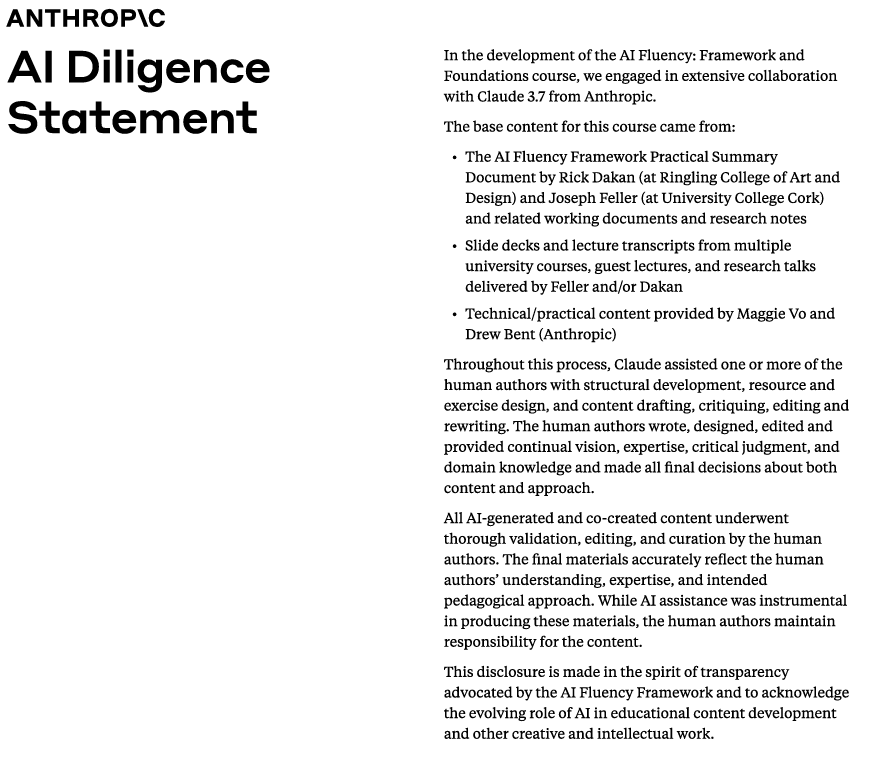
The 4D framework comes from Rick Dakan of Ringling College of Art and Design and Joseph Feller of University College Cork, who developed it in 2023-2024. Anthropic has partnered with them to build coursework around it. The 4D competencies are Delegation (deciding what work goes to AI and what stays with you), Description (communicating the product you want, the process to follow, and the standard to hit), Discernment (evaluating outputs and model behavior critically), and Diligence (taking responsibility for AI-assisted work, including disclosing it). Anthropic demonstrates Diligence on the course page, publishing the statement below on how it worked with Claude to design the course:
Over the past few years of designing and delivering our own generative AI learning forums, we’ve noticed a change in where learners start. It is now unusual for someone to come to an AI conversation cold. Most professionals we speak with these days spend regular time with the models and have worked out a few applications for their own work. Claude Academy indicates that Anthropic has seen the same trend. Distinguishing the courses by profession or goal assumes the learner already knows what the tools do generally, and is asking something narrower: “How can this be used for my job specifically?” It’s the question all organizations should be asking.
We’ll leave you with something cool: Generalist’s new robot foundation model can watch just a few seconds of a human demonstration and then try the task itself.
Listen to Confluence on Apple Podcast
Listen to Confluence on Spotify
AI Disclosure: We used generative AI in creating imagery for this post. We also used it selectively as a creator and summarizer of content and as an editor and proofreader.Today’s cover image uses the exact same prompt from our first issue, but uses the latest Midjourney model (8.2) rather than the model available in 2023 (5.2).
Comments
Nothing yet. Say the first thing.
Sign in to join the conversation.