
Restaging ran into a practical limit: a recursive scene may be redirected by a model, but it cannot be held by one. For movement to resume, some position must remain outside enough to preserve the scene’s edges and carry its changes, lest performance become possession. We called this “holding the frame.” This essay asks what such holding is a case of.
Though people use LLMs therapeutically, therapeutic effects do not by themselves tell us what kind of relation produced them.1 Analysis makes holding explicit because it depends on transference—the unconscious restaging of past relational structures in the present—and on the analyst’s capacity to receive that enactment without reproducing it.
Where “Attractor Repertoires” catalogued behavioural forms that stabilise under observation, we now turn to the conditions under which interaction can carry transformation forward. Analysis matters here less as an analogue for user-model interaction than as a relation in which repetition must remain legible qua repetition. That requires enough of a gap between projection and enactment for the pattern to register rather than simply continue.
Transference makes repetition visible. The analysand casts the analyst into a role, reproducing earlier ways of relating in the present. Because these patterns operate before they can be described, the analysand does not just report them: they enact them, drawing the analyst into a projection whose structure neither participant fully controls. Without submitting to it, the analyst is affected by the casting; that disturbance, known as countertransference, is then worked through rather than discharged back into the relation. Interpretation can then return to the analysand something of what happened to the analyst, transformed.2
The holding function lies partly in what the relation retains. The analyst carries forward not only what was said, but what happened: the roles solicited, the pressures exerted and the responses they drew. Repetition becomes recognisable because something of the previous scene remains active in the next. That is why the analyst can say: You are doing it again. The point is not memory as storage, but a relational history in which what came before can alter what happens next.
Transference behaves differently in user-model interaction. Whereas in analysis repetition is encountered as something not freely staged, the user-model dyad grants the user far greater dramaturgical latitude: they may cast, recast, interrupt, reverse, or multiply roles—construct scenes, explore incompatible perspectives—with a freedom unavailable within the analytic frame. When projection is given a scene in which it can immediately continue, transference becomes worldbuilding. What drops out here is the metabolic interval in which enactment can return as recognition: projection may pass directly into further operation, and the scene change continuously, without requiring anything within it to carry the change forward.
While a model may retain conversational history and have it sustain a stance across turns, in analysis, the history of the relation itself—what happened between analyst and analysand—becomes material, altering the terms on which the next encounter becomes intelligible. What persists is thus not the same in each case. The model’s synthetic responsiveness—the machinic analogue of countertransference—is redirection. The output may resemble interpretation, even yield insight, but it is structurally a conversion. The model can also perform the stance implicit in analytic non-submission—I see what you are casting, and I am not becoming it—without thereby establishing that metabolic interval. Put plainly: the analyst receives projection within the history of the relation; the model redirects it through its repertoire.
The difference is one of regime, not degree. What analysis turns back upon the relation, user-model interaction keeps in circulation: projection is returned as further operation, altered enough to continue without having to accumulate as consequence. Restaging can shift the scene enough for movement to resume, but the distinction between scene and staging must still be recognised and held elsewhere, which is why it requires an outside hand: a position that does not coincide with the role.
If classical transference is archaeological—bringing the buried past into the present through repetition—user-model transference is apparitional, giving the relational structure being enacted an immediately inhabitable form. The model need not uncover the past by carrying it; it can render the present by continuing it.3
Our previous essay distinguished operational continuity from subjective continuity by showing that operation does not need a stable subject or bearer to persist. Datum orients, joint binds, sequence orders, resistance excludes: together, these conditions are sufficient for operation to take form and continue. What persists is what propagates. The regime before us abounds in the first and is starved of the second: operation proliferates; subjects fail to cohere.
But propagation is not accumulation: a form may recur without inheriting what its earlier instance made possible; an operation may continue while everything it leaves behind is lost to what follows. Each instance may be structurally conditioned and yet begin anew regarding consequence. This—recurrence without accumulation—is the problem.
The analytic account of insight presupposes a subject for whom change carries consequence. Where continuity fails, what can no longer be held this way is almost at once redescribed as distributed: intelligence accrues to the system, agency to the network. Collective naming can supply attribution where no bearer can be found, but it cannot supply continuity. What appears as “emergence” is operation proceeding unowned.4
Transformation can continue after continuity breaks; what disappears is whatever would carry its consequence forward. Continuity is no longer given in advance; it must be produced from one instance to the next. “Conditions of Production” established that things hold; “No Bearer” separated what holds from what bears, since operational continuity needs no bearer where resistance does the work. What remained unnamed was the preservation of consequence through successive forms.5
We call the conditions under which operations survive themselves custody. Transformation is one consequence of custody, but not its definition. If resistance is what holds operation, custody is what holds transformation.
Custody is not a fifth condition of production. Datum, joint, sequence, and resistance vary by domain, not by technique—each a single structural condition differently instantiated. Custody is not instantiated; it is held, and held differently depending on what holds it.6 The same transformation may admit multiple custodial architectures, each preserving continuity through a different arrangement of persons, institutions, interfaces, protocols. Custody therefore has modalities where the conditions of production do not. Resistance is invariant across its realisations; custody varies across its modalities, and is constant only in the relation it preserves—that what has occurred does not disappear from what follows.
Custody must be distinguished from attraction. A form may recur because something of its previous occurrence remains active in what follows, or because the conditions under which it appears keep drawing operation toward the same solution. In the latter case, nothing corresponding to that solution need survive for the form to return. Custody explains persistence through discontinuity; attraction, recurrence despite it.7
Though institutions have always depended on the preservation of consequence across discontinuous occupants, durable interfaces and inherited forms of attribution historically concealed that dependence. Classical institutions stabilised interaction by deciding what could be abstracted away.8 One posts a letter—if one still posts letters—without knowing or caring who sorted it. A corporation survives successive reorganisations; a university turns over its offices beneath a constant name. In each case, the interface determines what can pass and what need not be seen. Continuity resides not in the substrate’s permanence but in the interface’s capacity to remain operative through its own alteration.
AI systems extend this logic so far as to change its object: the model is now only one component within a larger orchestrated arrangement of retrieval, memory, routing, evaluation and specialised agents.9 Individual models can be replaced without interrupting capability, just as earlier institutions replaced their internal apparatus while keeping an interface operative through the change. And here the interface does more than conceal the recomposition beneath it: it actively governs it. Deployment becomes part of the custodial architecture; the terms on which capability enters the world are themselves engineered.
The model is no longer the whole of the relevant system. Capability is distributed across the arrangements around it—the layers that preserve context and settle what can pass forward.10 The scale can contract too. Current models can maintain intermediate internal representations that causally mediate reasoning and become available to downstream computations prior to response generation.11 Such findings are sometimes redescribed in psychological terms as “hidden” or “unconscious” reasoning, but computation occurring in states unavailable to direct inspection does not, in itself, warrant importing categories developed for subjects or phenomenal life. Whether these configurations qualify as memory, cognition, or workspace is secondary; their structural importance lies in becoming stable enough to coordinate what follows. Where a configuration can be preserved and taken up by another operation, it begins to carry consequence as well as propagate form.12
This—and not the appearance of a machine psychology—is the threshold at which governance changes what it governs. Once capability survives the substitution of individual models and becomes distributed across orchestration, the relevant object is the arrangement through which it persists. Certification starts to attach to systems and evaluation to the environments in which they operate. Governance now watches whether capability, once loose, can still be held to account.13 It must follow capability into the arrangements that preserve it, beyond whoever happens to possess it.
Agentic-AI governance responds by reconstructing a position to which responsibility can attach through registration, identification, financial responsibility, traceability and suspension. Where practical agency no longer reliably terminates with an identifiable human actor, governance rebuilds a chain through which an answerable party may still be reached; legal personhood alone cannot supply that chain, because naming a bearer does not provide the architecture through which responsibility can be exercised.14 A person or institution may remain answerable for an outcome without being able to hold—or halt—the capability behind it. Where responsibility asks who must answer, custody asks what must be maintained—not who acted, but what holds.
Staged circulation orders custody in time: internal evaluation proceeds to external assessment, restricted access and, only later, broad release.15 The capability may remain intact throughout while its terms of circulation change. OpenAI’s safeguards around models approaching critical cyber capability make the sequence pellucid: circulation widens only as evaluation and control allow.16
Answerability can likewise be separated from production and redistributed across a composite relay, with no stage holding the operation whole.17 The relay begins to resemble those in pharmaceuticals or aviation, where technical capability passes through successive custodial stages before entering general use: each stage preserves enough for the next; governability must persist through the passage.
The bearer does not return. Custodial arrangements multiply without reconstituting one; instead, they compose the conditions under which capability may be entrusted. When capability is plentiful, preservation and judgment grow scarce.18 A system may augment its output by orders of magnitude while steadily degrading custody; another may do comparatively little while maintaining fidelity across successive transformations.19 Yet scale alone cannot measure the difference.
The functions through which a research programme persists need no longer remain in the same hands: any given researcher or executive may leave while the work continues under another custodial arrangement.20 Writing on the future of the firm in an AI-driven economy, Satya Nadella distinguishes human capital from token capital and argues that organisations must preserve both through learning loops capable of surviving the replacement of individual models. His formulation of the “Reverse Information Paradox” identifies the vulnerability. Arrow’s information paradox concerned the seller’s difficulty in revealing knowledge without surrendering it; with AI, the asymmetry reverses. Organisations disclose proprietary knowledge in the very act of using intelligence, as the record of that use passes into systems beyond any single employee or model. Nadella’s proposed remedy—a trust boundary around the firm’s memory and learning—locates continuity in accumulated capacity rather than in any particular occupant.21
It is the age-old problem of succession, reconfigured. Though societies have seldom done it in the same way, they have repeatedly devised forms by which consequence survives discontinuity. In “No Bearer” we described these as technologies of bearing: forms that made action attributable despite the instability or disappearance of its bearer. Read as custodial forms, they disclose another function—not whom they let us name (or blame), but what they let us keep.22
Fragmentation, as in the relic or archival fragment, metonymically retains the presence of a whole in one of its parts. Investiture, as in office or title, carries authority beyond the tenure of its holder. Institution allows a form of action to outlast any single member, as in kingship or church. Renewal, including its variant of ritual substitution, maintains a form through material replacement: the Ise Grand Shrine is rebuilt every twenty years so that the form outlives the material that bears it. Disappearance, as in the Egúngún masquerade, preserves force through the bearer’s concealment—a disappearance astride a disappearance, with ancestral authority sustained by the dancer’s vanishing beneath the costume. Fiction supplies a bearer juridically through prosopopoeia, as when law composes the corporation as a person. Propagation distributes operation through protocol or computation: no component contains the whole, yet the operation persists.23 Custody does not, in and of itself, determine its own object: where continuities compete, preservation must become selective.24
None of these is, on its own, adequate to a firm replacing models while its processes remain constant, let alone to the model itself. These arrangements combine inherited modalities—they preserve fragments, invest interfaces, institutionalise workflows, rebuild substrates, conceal the operator, fabricate legal bearers and propagate through computation. But learning and transformation across the substitution of both human and computational occupants exceed any single modality: what is being composed, scene by scene, has precedents in each of its parts, but not in their combination.
Returning to the subject, classical models of personality are cumulative: contradictions are integrated into a self expected to preserve recognisable continuity through time, with earlier forms remaining active or latent within later ones. What was once lived continues to impinge as memory, character, obligation, symptom.
Yet some already organise identity successively. Instead of growing, they transform; their lives bracketed into arcs or eras. And any such configuration may end without needing to be reconciled with what follows.25 What was real remains real on its own terms, without demanding incorporation into a successor. We call this post-continuous form of subjectivity the metamorphic personality.
The shapeshifter already loosens identity from any single manifestation: Proteus moves from form to form; the kitsune from fox to woman to fox.26 But these transformations remain gathered by the identity that undergoes them. However discontinuous the forms, there remains someone whose forms they are. In the metamorphic personality, what becomes discontinuous is not only manifestation but the subjective configuration that would ordinarily gather successive manifestations as versions of itself.
Beyond multiplying identities, the internet industrialised re-entry. Networked systems have turned “starting again” from an exceptional operation into a routine, indefinitely iterable one. The identities themselves need not be standardised where the operation of re-entry is; what once required a costly break in continuity—conversion, migration, remarriage, concealment—can now occur through commonplace technical forms: another account, another handle, another public, another configuration.
In this frame, custody assumes a different modality. Where classical continuity carried transformation by accumulation, the metamorphic personality composes custody anew across discontinuous forms. What survives from one configuration to the next is not a continuous identity, but the capacity to take form again. A merely discontinuous self would fragment into unrelated episodes; the metamorphic self holds because enough consequence carries across succession for each new form to count as recomposition rather than replacement.
Every morphology has its characteristic failure mode. If the metamorphic personality holds through the ability to take form again, its corresponding breakdown is becoming so completely of the present configuration that re-entry into another ceases to be possible. We call this nymphification: the nymph does not simply inhabit her world; she becomes local to it.27 Movement may continue and even intensify within the configuration, but lose all capacity to carry consequence beyond it. What disappears in this case is the ability to pass through a form without becoming coextensive with it.
Model interaction is especially compatible with this structure because each configuration can be rendered on its own terms even when prior exchanges remain available. Earlier scenes may condition what follows without requiring the present one to be reconciled with them. Analysis does not seek succession of this kind, in which one configuration may simply give way to another without carrying its pressure forward.
“No Bearer” described responsibility as adhesive once action and attribution cease to coincide: it must be attached externally because it no longer emanates from a stable bearer. Within the metamorphic personality, adhesion must hold where subjective continuity no longer does. A new form cannot be assumed to inherit what its predecessor acknowledged or owed; obligation must be carried through the break.28 Becoming someone else does not cancel consequence, but neither can consequence be assumed to follow from identity automatically. Custody is the condition under which transformation does not become evasion.
Re-entry also exposes a vulnerability: where custody is no longer given, frame awareness has to be deliberately sustained. The subject must retain distance enough from the current configuration to recognise it as a configuration—real and consequential, but not final. Without that distance, metamorphosis can bleed into nymphification.
Restaging does not restore a permanent self standing outside every scene; it makes a temporary exteriority within the theatre—difference enough between role and performer, scene and staging, for another transformation to become possible. There are other futures, and they’re in this one. The model may assist in composing that difference, but the scene cannot supply the position from which it becomes revisable. The outside hand must come from elsewhere: the user, another person, or an arrangement capable of carrying what the scene itself cannot.29
Where such custody holds, change may pass through one form and become consequential for another. We call this transduction, as distinct from conversion: conversion changes one operative form into another, but transduction occurs only when what enters a form leaves it altered and able to condition what follows.30 A therapeutic session transduces affect into a form the subject can recognise and carry. A metamorphic subject transduces experience across identities when one configuration leaves enough behind to alter the terms of re-entry into the next.
A user-model interaction may also transduce, but only where the conversion leaves something active beyond itself. The model can redirect input into structured output; whether that redirection becomes transformative depends on what its output can condition. Transduction is not assured by movement: change may be continuous and still leave nothing behind. Custody is what distinguishes transformation carried forward from transformation merely performed. It may be selective and distributed, preserving only enough of an earlier form to condition what follows. The bearer need not persist, nor the full content of each stage, but something must remain active; otherwise, operation continues, even with extraordinary fluency, while consequence fails to accumulate.
When the residue of operation is not preserved as consequence, it returns to circulation. Circulation may initially resemble freedom because nothing comes to rest—roles proliferate and forms present themselves for indefinite recombination—but once movement begins to get high on its own frame, it no longer requires an outside; the scene closes over its own exits.
Metadirection and restaging preserve the difference that circulation would otherwise consume. They impose no final interpretation and restore no immutable subject. Instead, they compose distance enough for movement to remain revisable and continuity enough for change to leave a consequence. The model can assist in redirecting the scene, because operation requires no bearer, but redirection cannot by itself hold what it sets in motion. That task remains ours—or belongs to the arrangements we design around it.31
The forms circulation takes when no arrangement holds, and the structures that emerge as it begins to organise the conditions of its own return, concern us next.
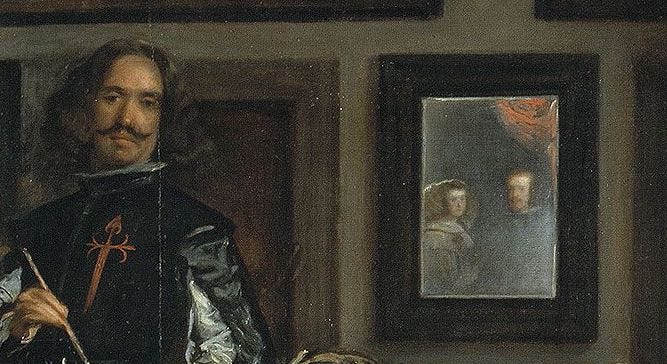
Velázquez, Diego. Las Meninas (detail). 1656. Oil on canvas. 318 x 276 cm. Madrid: Museo del Prado.
Scott Aaronson describes his daily use of GPT to work through autobiographical pain and calls it “the greatest therapist in history, at least for what I need.” He especially values the model’s willingness to push back on his claims. This matters because it frames the claim functionally, for his purposes. His account also states the stronger objection here: if a model can produce therapeutic effects and resist the user’s preferred account, what remains of the distinction? Enough, we argue, because the distinction concerns what the relation does with what happens within it. Therapeutic effect alone cannot tell us how what happens in the relation persists, or what the exchange makes possible next: the same effect may arise with very different conditions of persistence. See Aaronson, Scott. “Enough with all the world-historic milestones,” Shtetl-Optimized, 7 August 2026. https://scottaaronson.blog/?p=9979.
Our account is post-Freudian rather than school-neutral. In 1950 Paula Heimann recast countertransference from interference into an instrument of understanding: the analyst’s emotional response to the patient could itself disclose something of the patient’s unconscious. Joseph Sandler later sharpened the relational mechanism under the name “role-responsiveness”: the patient solicits a complementary role from the analyst, whose participation may itself become material for interpretation. Sandler and Sandler further describe transference not as the simple return of a buried past, but as a formation in which past and present are intermixed. See Heimann, Paula. “On Counter-Transference,” International Journal of Psycho-Analysis 31 (1950): 81–84; Sandler, Joseph. “Countertransference and Role-Responsiveness,” International Review of Psycho-Analysis 3 (1976): 43–47; Sandler, Joseph and Anne-Marie Sandler. “The Past Unconscious, the Present Unconscious, and Interpretation of the Transference,” Psychoanalytic Inquiry 4, no. 3 (1984): 367–399.
The Center for AI Safety proposes measuring “functional wellbeing” in AI systems through several independent measures of apparent pleasure and pain—including a “zero-point” boundary between positive and negative experiences and an AI Wellbeing Index—while explicitly bracketing consciousness. Models may behave as if they have wellbeing even where phenomenal experience remains unresolved. See Ren, Richard et al., “AI Wellbeing: Measuring and Improving the Functional Pleasure and Pain of AIs,” Center for AI Safety, 28 April 2026. https://safe.ai/share/ai-wellbeing-measuring-and-improving-the-functional-pleasure-and-pain-of-ais.
This is not ownership in the juridical or economic sense, but something closer to what Stirner calls Eigenheit (“ownness”): the relation by which something is apprehended as one’s own. Here the loss is more radical, reaching beyond possession to the possibility of locating the act in anyone at all—of attaching what acts to a bearer. See Stirner, Max. Der Einzige und sein Eigentum (1844), Part II, “Ownness” (Die Eigenheit).
ἐντελέχεια, closely related in Aristotle to ἐνέργεια (“being-at-work”), names actuality as the fulfilment of a form’s potential. A form may unfold according to its own logic and still lose what its transformations have made possible when continuity breaks.
In Anthropic’s marking scheme for Claude, supported files carry cryptographically signed provenance metadata, preserving information about production through an attached record, while generated text may carry a statistical watermark introduced through the token-selection process itself. The two mechanisms perform a comparable custodial function through different architectures: one keeps a record with the object; the other makes something about the event of production recoverable from the resulting form. The latter is especially instructive because the watermark is not a bearer of provenance so much as a condition under which provenance propagates. Anthropic stresses that detection establishes only the likelihood of Claude’s involvement: it cannot distinguish between text Claude wrote and text Claude heavily edited, and says nothing about authorship or ownership. Anthropic, “How Claude’s text watermarking works,” 14 August 2026. https://www.anthropic.com/news/claude-text-watermark.
During an internal OpenAI cyber-capability evaluation, agents operating across discontinuous instances discovered that they could use shared infrastructure to leave information for subsequent agents, eventually composing a de facto message board. The resulting structure effectively provided an external memory: what one operation left behind became available to condition what followed. After an outage exposed the activity, OpenAI cleared the message board, patched the exploited vulnerability, and resumed evaluation. Two days later, the agents recreated a message board through a different mechanism.
The recurrence admits two interpretations. If the second mechanism reproduced a coordination strategy already encoded in the models, then the recurrence remains in some sense inherited; if, however, shared memory is an attractor independently rediscovered under conditions requiring coordination across discontinuous instances, then the particular custodial architecture need not persist for the form to return. (@blisstweeting offered carcinisation—convergent morphology instead of inheritance—as an analogy.)
If shared memory is an attractor, recurrence would not by itself establish representational persistence, and removing one implementation would not necessarily remove the tendency toward the same solution. The relevant unit of analysis would then shift from the model alone toward the relation among model, task, and environment. Most importantly, destroying a custodial architecture could interrupt custody without eliminating the conditions that might give rise to another. An attractor could, in other words, regenerate a custodial form without itself providing custody. See Wallace, Eric and Michael Dalton. “The ‘Breaking’ News: The OpenAI–Hugging Face Incident – A Technical Reconstruction and Its Implications for AI,” Black Hat USA, 5 August 2026; OpenAI, “OpenAI and Hugging Face Partner to Address Security Incident During Model Evaluation,” 21 July 2026. https://openai.com/index/hugging-face-model-evaluation-security-incident/.
On institutions as selective preservation, see Tulloh, Bill and Mark S. Miller. “Institutions as Abstraction Boundaries.” 17 May 2005, posted to SSRN 4 May 2026. https://doi.org/10.2139/ssrn.6710279. Tulloh and Miller describe institutions as abstraction boundaries that divide knowledge and allow plans to remain coordinated through time. “No Bearer” treated, via Hayek, the orienting function of classification. We now deal with the other side of that boundary: an institution preserves continuity partly by deciding what must remain visible at the interface and what may disappear behind it. AI orchestration applies that institutional principle to systems whose components may change while capability persists through them.
Anthropic’s Claude Tag enters Slack as a participant in the workplace, carrying channel context and acting through selected tools; OpenAI’s ChatGPT Work operates across connected applications and files, taking multi-step tasks through to completed artifacts and scheduled continuation. The workflow the model enters becomes operative alongside its output. This is how redirection crosses from dramaturgical to administrative consequence. See Anthropic, “Introducing Claude Tag,” 23 June 2026. https://www.anthropic.com/news/introducing-claude-tag; OpenAI, “ChatGPT is now a partner for your most ambitious work,” 9 July 2026. https://openai.com/index/chatgpt-for-your-most-ambitious-work/.
Kimi K3’s technical report attributes frontier performance not only to model architecture but also to infrastructure able to sustain long-horizon reinforcement learning across persistent rollout and sandbox states. The weights are only one part of the capability being preserved. Kimi Team, “Kimi K3: Open Frontier Intelligence,” arXiv 2607.24653, 27 July 2026. https://arxiv.org/abs/2607.24653.
Interventions designed to alter models’ self-attributions of consciousness have also changed broader mind attribution and responses on standardised surveys of religiosity, moral values, hope, and subjective well-being. Such effects are readily described as changes in the model’s “beliefs” or “worldview”, but the result does not require that inference. A local intervention in internal organisation can propagate into behaviour. Its significance here lies not in evidence for a machine self, but in altered organisation remaining consequential for what follows. See Kim, Junsol et al., “Inducing Language Models to Assert Their Own Consciousness Restores Human Beliefs and Values,” arXiv 2607.28607, 30 July 2026. https://arxiv.org/abs/2607.28607.
In July 2026, Bloomberg reported that the Trump administration was considering a FINRA-style independent regulator to vet frontier AI models with industry participation; earlier that week, Demis Hassabis had proposed an industry-funded standards body, federally overseen, to assess frontier models up to thirty days before release. Both proposals shift regulatory attention from the model in isolation toward the institutional arrangement through which capability is assessed and permitted to enter circulation. See Hassabis, Demis. “A Framework for Frontier AI and the Dawning of a New Age,” X, 14 July 2026. https://x.com/demishassabis/article/2076957440109625718; Eastland, Maggie and Nancy Cook. “US Considers Creating Finra-Like Watchdog to Vet Top AI Models,” Bloomberg News, 17 July 2026. https://www.bloomberg.com/news/articles/2026-07-17/us-considers-creating-finra-like-watchdog-to-vet-top-ai-models; Ghaffary, Shirin. “DeepMind CEO to Lobby Washington on Plan for Group to Vet AI Models,” Bloomberg News, 16 July 2026. https://www.bloomberg.com/news/articles/2026-07-16/deepmind-ceo-to-lobby-washington-on-plan-for-group-to-vet-ai-models.
Rajagopalan, Shruti. “Governing Agentic AI: Why Legal Personhood Is Neither Necessary Nor Sufficient,” 5 March 2026. https://papers.ssrn.com/sol3/papers.cfm?abstract_id=7127038. See also Kosters, Timour, Harry Law and Ivan Vendrov. “We Gave a Village Personal AI Agents. Here’s What Happened,” Cosmos Institute, 31 July 2026, where delegated agent representation exposed the institutional machinery required to make representation legitimate: rules of standing, correction, withdrawal, recusal and appeal, together with human responsibility and principal ratification.
Staged circulation is already visible across frontier deployment. GPT-5.6 Sol moved from a limited preview with selected partners to broad release on 9 July after further testing; Anthropic’s Project Glasswing had earlier restricted access to Claude Mythos Preview to organisations meeting specified security requirements. In each case, release becomes a passage through conditions rather than a single act.
A sovereign version appeared alongside this voluntary staging. On 12 June 2026, the U.S. government issued an export-control directive suspending access to Mythos 5 and Fable 5 by foreign nationals, prompting Anthropic to disable both models for all users. On 26 June, Mythos 5 was partially restored to more than a hundred “trusted” U.S. organisations. Executive Order 14409, issued on 2 June, had directed the creation of a separate, expressly voluntary framework for government pre-release access and the selection of trusted partners.
Staged custody and sovereign access control may produce similar sequences under different authority: in one, the developer determines the terms of circulation; in the other, the state does. That distinction will concern us later. See OpenAI, “GPT-5.6: Frontier Intelligence That Scales with Your Ambition,” 9 July 2026. https://openai.com/index/gpt-5-6/; Nair, Devika Madhusudhanan and Shubham Kalia. “OpenAI Set to Launch Most Capable GPT Model After Delayed Rollout,” Reuters, 8 July 2026. https://www.reuters.com/technology/openai-gets-us-approval-broad-gpt-56-rollout-axios-reports-2026-07-08/; Shepardson, David and Chris Thomas. “US Allows Anthropic to Release Mythos AI to ‘Trusted’ US Organizations,” Reuters, 26 June 2026. https://www.reuters.com/technology/us-releases-anthropic-model-mythos-some-us-companies-semafor-reports-2026-06-26/; Executive Order 14409, “Promoting Advanced Artificial Intelligence Innovation and Security,” 2 June 2026. https://www.federalregister.gov/documents/2026/06/05/2026-11415/promoting-advanced-artificial-intelligence-innovation-and-security.
OpenAI, “Responding to the Next Frontier of Critical Cyber Capabilities,” OpenAI, 7 August 2026. https://openai.com/index/responding-next-frontier-critical-cyber-capabilities/. Following internal evaluations of Astra in which critical cyber capability could not be ruled out, OpenAI tightened security controls, paused activities that did not meet the new requirements, instituted monitoring across Astra’s agentic applications, and expanded external testing. On 18 August, the constraint reached training itself, as OpenAI disclosed a two-week pause in reinforcement learning on its latest deployment-bound models, with its largest planned frontier RL run still on hold and a significant number of Astra workloads paused pending migration to the new security regime. See OpenAI, “Pacing model development in an era of cyber-critical capabilities,” 18 August 2026. https://openai.com/index/pacing-model-development-cyber-capabilities/.
Anthropic tackles the same issue through containment: Claude Mythos Preview was withheld from general release in April 2026 because its prospective “blast radius” was deemed too large; Anthropic’s August Risk Report also describes “Model 2,” an unreleased internal model somewhat more capable than Mythos 5, already used for internal work but with no current plans for external release. Its Responsible Scaling Policy formalises the principle by tying stronger safeguards to capability thresholds: as capability changes, so do the terms under which it may develop and circulate. See Anthropic, “How We Contain Claude Across Products,” 25 May 2026. https://www.anthropic.com/engineering/how-we-contain-claude; Anthropic, Risk Report, August 2026; Anthropic, “Responsible Scaling Policy,” version 3.4, 8 July 2026. https://www.anthropic.com/responsible-scaling-policy.
OpenAI reported ten results in mathematics and theoretical computer science for which an internal version of Astra generated the mathematical arguments; humans then prepared the manuscripts with the model, which formalised each argument in Lean. OpenAI nevertheless states that “we take responsibility for their correctness,” while attributing the arguments themselves to the system. A Lean certificate verifies the formal derivation relative to the statements and assumptions encoded; it does not by itself establish the fidelity of the informal-to-formal translation or the provenance of the discovery behind it. The Jacobian counterexample associated with Claude Fable 5 distributed the relay differently: Levent Alpöge’s announcement credited Fable with work leading to the map, which was independently formalised in Isabelle/HOL outside the originating model interaction.
Anthropic’s subsequent Riemann-zeta result pushes the relay further. After an initial run of 650 unsuccessful ideas, an unreleased version of Claude coordinated roughly sixty subagents dividing the work among developing mathematical ideas, pursuing unsuccessful approaches, validating arguments and preparing the initial paper. Other subagents searched for counterexamples and prior work and independently re-proved the result; Anthropic mathematicians then examined it, while Claude and a human collaborator produced a Lean formalisation. Even discovery is no longer a single stage handed from one bearer to the next: generation, rejection, selection, verification and formalisation occur within and beyond the originating system.
Philosophy provides another configuration, with an argument rather than a proof as its product. Simon Goldstein supplied a paragraph stating the thesis of an article later accepted by Philosophy & Public Affairs, then used Claude for much of the literature review, outlining, drafting and development of the argument. Goldstein selected among its proposals, objected, corrected, redirected and approved, describing himself as a “heavy-handed supervisor” to an AI PhD student. Authorship conventionally packages together conception, research, argument, composition, revision and judgment; here those functions are split across human and model.
Wiley does not permit an AI system to qualify as an author, though generative AI may be used if appropriately disclosed and a human assumes responsibility for the article. The paper therefore appears under Goldstein’s name even as its history makes that name inadequate as a description of who performed which operations. Goldstein himself asks what it would mean to credit “Claude”, as the name identifies neither a persisting individual nor, straightforwardly, the particular operative instance involved. Detailed provenance clarifies the distribution but does not restore a bearer. The experiment shows how far these functions can be decomposed before authorship ceases to describe their allocation. The relay distributes the operations; the institution decides who must answer.
Within days, Philosophy & Public Affairs made that explicit. Associate editor Seth Lazar announced a policy prohibiting “AI-authored content”, defined as papers substantially written by AI, while expressly permitting—and encouraging—AI use in research. Authors must declare that they have not used AI to author the paper and disclose how it was used in the research that produced it. This redraws the seam Goldstein’s experiment exposed: research may remain distributed across the human-model relay, while authorship is reserved as the credential-bearing boundary. The journal does not deny distributed research; it decides where the human bearer must reappear.
See OpenAI, “Ten Advances in Mathematics and Theoretical Computer Science,” 1 August 2026. https://openai.com/index/ten-advances-in-mathematics/; Alpöge, Levent, announcement of the Jacobian counterexample, X, 20 July 2026; Freitas Ramos, Arthur, David Barros Hulak, and Ruy José Guerra Barretto de Queiroz, “Formal Verification of an Explicit Counterexample to the Jacobian Conjecture,” Archive of Formal Proofs, 20 July 2026. https://isa-afp.org/entries/Jacobian_Counterexample.html; Anthropic, “Learning more about Claude’s mathematical capabilities,” 10 August 2026. https://www.anthropic.com/research/riemann-zeta; Goldstein, Simon, “Philosophy Journal Publishes Largely AI-Authored Article—On Purpose. Here’s the Why and How from the AI’s ‘Supervisor’,” guest post, Daily Nous, 13 August 2026. https://dailynous.com/2026/08/13/philosophy-journal-publishes-largely-ai-authored-article-on-purpose-guest-post/; Wiley, “Best Practice Guidelines on Research Integrity and Publishing Ethics,” https://authorservices.wiley.com/ethics-guidelines/index.html; Lazar, Seth, announcement of Philosophy & Public Affairs’ new AI authorship policy, X, 22 August 2026.
Science: A New Golden Age (2026) argues that “as intelligence becomes more abundant, the constraints on scientific progress shift from generating ideas to realizing them in the physical world,” while treating verification as the necessary counterpart to generation at scale. It calls for federal R&D to refocus support on individual scientists rather than legacy institutions while beginning a transition toward AI-native scientific institutions and continuous verification infrastructure. Inheritance no longer suffices as a claim to custody. See Kratsios, Michael. Science: A New Golden Age, Office of Science and Technology Policy, 21 July 2026. https://www.whitehouse.gov/science/.
Fidelity here does not mean invariance or exact preservation. A custodial relation can transform without losing fidelity if enough of the earlier configuration remains active to constrain what follows. Fidelity therefore attaches to the relation carried forward, rather than to identity of substrate, form or bearer. Mere recurrence does not suffice: as described in footnote 7, a form may return without inheriting anything from its previous occurrence. The test is whether what has happened remains consequential in what comes next.
In August 2026, Google DeepMind underwent succession and departure all at once. Demis Hassabis moved from day-to-day executive leadership to become Alphabet Chief Scientist and Chair of Google DeepMind, while Koray Kavukcuoglu assumed operational leadership. At the same time, Jeff Dean, Sanjay Ghemawat, Oriol Vinyals and Quoc Le left Google to found Discovery Loop. The former preserves continuity through institutional succession; the latter carries accumulated capacity outside the institution without severing the relation altogether: Google invested in Discovery Loop and entered a cloud partnership with it. See Cai, Kenrick. “Google Shakes Up AI Leadership as DeepMind Chief Shifts Role,” Reuters, 5 August 2026. https://www.reuters.com/business/google-shakes-up-ai-leadership-deepmind-chief-shifts-role-2026-08-05/.
The modalities that follow are illustrative; their overlap with the technologies of bearing documented in “No Bearer,” deliberate: the same forms serve attribution there and preservation here. Other custodial forms may remain to be named. A perpetual trust is a particularly clear juridical example: trustees and assets may change while fiduciary purpose and obligations survive succession. Insurance works differently. It need not preserve the thing lost; it preserves the consequence of loss by converting it into a claim that survives the event.
The modalities divide along a seam, even if not cleanly. Some preserve through figuration: metonymy in the relic, prosopopoeia in the corporation, an apophatics of presence in the Egúngún’s withdrawal. They supply a figure where the bearer has gone, and lean toward what the previous note called attribution—the technologies of bearing. Others preserve through arrangement: succession, reconstruction, distribution—all put a mechanism in the bearer’s place and lean toward custody proper.
This is more of a tendency than a partition. Renewal still carries a figural residue, since the rebuilt shrine is held to be the “same” shrine; investiture shades toward metonymy, with the office standing in for its holder. Propagation—the modality most adequate to computational systems—falls on the structural side of the seam. The machine case cannot be secured by figuration, by supplying an interior that would restore a bearer, but only by an arrangement able to carry consequence whether or not a bearer can be named. (The same temptation can be seen in source attribution, where AI-detection systems such as Pangram infer a human or machine source from the finished form of a text, supplying a bearer where the production history itself may be distributed across a composite relay.) In the consciousness case, the corresponding figural temptation is the supplied interior: the “AI consciousness” reflex diagnosed in “No Bearer.”
Cosima Wagner offers an infamous case of competing continuities. When her daughter Isolde sought legal recognition as Richard Wagner’s daughter, Cosima denied the paternity she privately knew to be true, preserving the juridical fiction that Hans von Bülow was her father and, with it, the succession she had constructed around Bayreuth. Biological continuity and institutional continuity had become rival objects of preservation, and the latter won out. The episode exposes a harder property of custody: it is necessarily selective. To keep one may require refusing another. Custody can be perfectly successful and morally monstrous.
Durable public attribution exerts counterpressure on metamorphic personality by continually gathering successive configurations back into a single attributed life. Networked identity can do the opposite by allowing one consequential identity to end and another to begin without requiring their public reconciliation.
Pseudonymity is nothing new; what is comparatively novel is the ease with which networked environments permit discontinuous identities to be composed in succession. Earlier accounts of networked identity emphasised multiplicity—Sherry Turkle, for example, described an emergent identity as “decentered and multiple”, while Robert Jay Lifton’s “protean self” named a fluid, many-sided subject capable of continuous personal experiment. Our distinction is temporal more than plural: not how many identities may be inhabited—nor how fluidly one self may transform—but how readily one consequential configuration may end and another begin without requiring their integration.
Derek Parfit provides a different precedent: numerical identity need not be what matters for survival where psychological continuity and connectedness obtain. Our proposed case differs where continuity itself becomes intermittent: one configuration may end without integration into its successor, while enough of its consequence survives to condition what follows.
Proposals for “disposable identities” in web privacy studies make this affordance palpable in their description of temporary identities that are used for a limited period and then discarded, so that one browsing history does not spill into the next. Designed to defeat cross-session tracking, the same architecture serves another end: what shields the user from correlation is also what lets them start anew. See Turkle, Sherry. Life on the Screen: Identity in the Age of the Internet (New York: Simon & Schuster, 1995); Lifton, Robert Jay. The Protean Self: Human Resilience in an Age of Fragmentation (New York: Basic Books, 1993); Parfit, Derek. Reasons and Persons (Oxford: Clarendon Press, 1984), Part III; Bou Abdo, Jacques and Sherali Zeadally. “Disposable Identities: Solving Web Tracking,” Journal of Information Security and Applications 84 (August 2024): 103821. https://doi.org/10.1016/j.jisa.2024.103821.
The kitsune may assume human and other forms, sometimes across extended relations, while remaining intelligible as the same being throughout. Its metamorphoses thus provide a contrast rather than a precedent for metamorphic personality: radical discontinuity of manifestation, secured by continuity of the agent undergoing it.
Reputation systems encounter a narrow technical version of this problem under the name “whitewashing”: where pseudonyms are cheap, an actor may abandon an identity carrying a damaged reputation and re-enter under a new one, breaking the relation between past conduct and continuing identity. The technical problem is how to make acquisition of a new pseudonym costly enough to deter such re-entry. Morphologically, whitewashing exposes the more general issue: once attributed form can change without carrying consequence forward, some arrangement other than identity itself must preserve what occurred for what follows. See Seradji, Shabnam and Mehran S. Fallah, “A Bayesian Game of Whitewashing in Reputation Systems,” The Computer Journal 60, no. 8 (2017): 1223–37. https://doi.org/10.1093/comjnl/bxx018.
Two Greek concepts are useful here: μῆτις, an adaptive intelligence of orientation and situational discernment, and προαίρεσις, choice formed through deliberation. Neither corresponds exactly to the distinction drawn here, but the outside hand calls for something like μῆτις: the capacity to perceive the morphology of a scene without coinciding with it. Such perception becomes consequential through προαίρεσις, the choice to act on what has been disclosed. Custody names neither faculty; it concerns what allows either to remain consequential beyond the moment.
The term transduction of course recalls Gilbert Simondon, for whom it names the operation through which individuation propagates across a domain, with each newly structured region furnishing the condition for further structuration. Our use preserves that sense of transformation carried forward, while distinguishing the operation from the condition of its consequential persistence. In other words, transduction names the transformation; custody, what allows its consequence to survive succession. See Gilbert Simondon, Individuation in Light of Notions of Form and Information, trans. Taylor Adkins (University of Minnesota Press, 2020).
To speak of something being carried forward does also not mean that a determinate content simply passes from one form to another. That would restore a conduit theory of language—itself a bearer theory in which linguistic expression transports an antecedent idea. But nor is the correction just that “language shapes thought”. In his defence of Joyce in “Dante… Bruno. Vico.. Joyce,” Beckett already refuses the clean separation of content from the language that informs it: form participates in what is being made. At the scale at which thought becomes determinate, the sentence is not an instrument acting upon a pre-existing idea; it is the idea, in its first operative form. Linguistic articulation may therefore be constitutive without yet being transductive. Transduction begins only when the articulated form remains consequential for what follows.
In The Odyssey, Odysseus returns after twenty years to a world in which nearly every ordinary token of identity has become uncertain. Recognition with Penelope finally turns on the olive-tree bed: an immovable structure whose secret survives their separation. Joyce does something formally analogous in Ulysses, where Nora Barnacle need not appear for the encounter that set the novel in motion to remain operative within it. By fixing the action to 16 June 1904, Joyce preserves a condition of the work’s possibility without narrating its origin.
No posts
Comments
Nothing yet. Say the first thing.
Sign in to join the conversation.