
Last fall, thousands of mothers across the United States participated in the Count on Mothers AI & Child Safety: Mothers’ Views on a Rising Influence in Kids’ Lives study, describing how artificial intelligence is entering their children’s lives through schools, devices, and everyday digital platforms.
For readers of this publication, the study has been part of an ongoing conversation. Many of you participated in the survey itself, contributing firsthand observations about how rapidly changing technologies are appearing in classrooms, homework routines, and digital spaces children use every day.
In a technology landscape evolving as quickly as AI, mothers’ experiences offer something rare: an early view of how new systems are actually functioning inside families — often before institutions fully understand the downstream effects.
Those perspectives are now beginning to appear in national coverage.
Two recent articles — one in Education Week and another in Newsweek — drew on findings from Count on Mothers research to explore different dimensions of family life today: the rapid introduction of AI into schools, and the broader pressures shaping whether families feel supported as they raise children in the current environment.
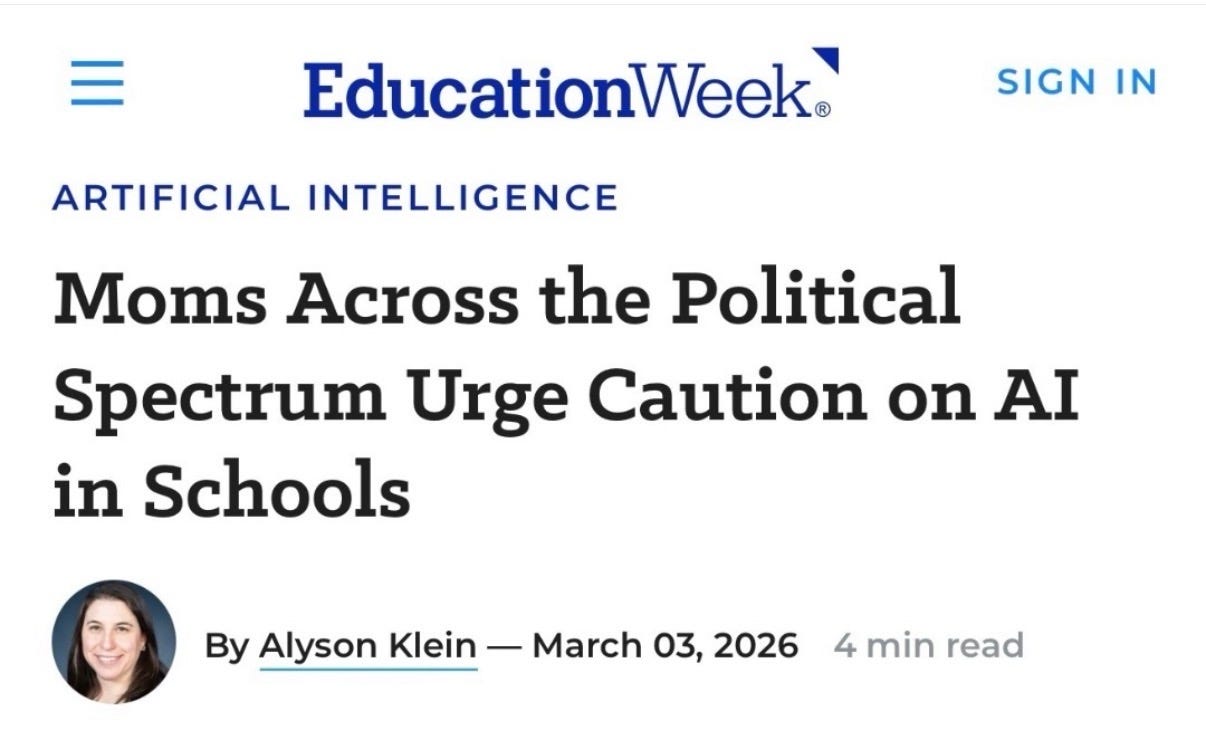
A recent article in Education Week examined findings from the AI & Child Safety study related to artificial intelligence in schools.
One result stood out: only 6 percent of mothers described AI as a positive force for children and believed students should actively learn to use it now.
Most mothers took a more cautious view. While many mothers recognize that children will likely need to understand AI as it becomes integrated into education and future work, they also reported significant concern about developmental impacts, the pace of adoption in schools, and the lack of clear safeguards, transparency, and developmental testing accompanying these technologies.
This tension surfaced repeatedly in the data. Mothers often hold two ideas at once: recognition that technological literacy will matter for children’s futures, alongside concern that institutions may be introducing these systems faster than they are able to ensure they are safe and developmentally appropriate.
That tension — between technological inevitability and institutional responsibility — has implications not only for schools and policymakers, but also for technology companies and other institutions whose work depends on maintaining the trust of families.
Another issue surfaced clearly in the study: many mothers report limited visibility into how AI systems collect and use children’s data.
In the survey, 39 percent of mothers said they either did not know whether their children’s data was being collected by technology tools or did not understand how that data tracking works, while 41 percent reported trying to stay informed but still having gaps in their knowledge.
Only about one in five mothers said they fully understood the privacy risks associated with AI tools and knew how to protect their child’s data.
This visibility gap is particularly relevant in school settings, where AI-enabled tools may be embedded within required platforms and families may have little practical ability to opt out.
“AI can help kids learn, but without strong safeguards it can expose them to risks that can harm their safety and development.”
— Mother from Massachusetts
Coverage in Newsweek highlighted another dimension of the research: the growing pressures families report navigating in daily life.
Drawing on findings from the Pulse Check 2025 study, the article explored the increasing mental load many parents describe when deciding whether to start or expand a family.
Among the findings cited:
53 percent of mothers report difficulty caring for their own mental health
Time scarcity — not finances alone — is the most frequently cited constraint
Concern about children’s emotional well-being remains high
These pressures often intersect. Economic conditions matter, but they interact with broader structural realities: the availability of childcare and family support systems, the increasing complexity of navigating health, education, and family services, and the safety and design of the digital environments children increasingly inhabit.
For many families, parenting today involves navigating systems that did not exist a generation ago — including social media platforms, algorithmic technologies, and increasingly AI-enabled tools that shape children’s social and informational worlds.
Another pattern emerging in conversations with mothers concerns the environments children move through every day and the commercial forces embedded within them.
Families today are navigating a landscape in which children encounter products and platforms from multiple industries — including AI-enabled digital platforms, vaping products, cannabis products, and online gambling platforms.
These sectors operate under different regulatory frameworks, but they share structural characteristics: rapid product innovation, strong commercial incentives to encourage early exposure or early use, and safeguards that often lag behind adoption or remain uneven across jurisdictions.
For parents, these dynamics rarely appear as isolated issues.
Instead, they form a broader environment in which digital platforms, peer culture, school systems, and commercial markets intersect in ways that shape children’s attention, behavior, and risk exposure.
Understanding how these environments interact is increasingly important for policymakers, educators, technology companies, and other institutions seeking to support child development and family stability.
The studies referenced in recent coverage examine different issues — from artificial intelligence in schools to the pressures shaping family life — yet they reveal a common pattern.
When mothers’ experiences are captured systematically through nationally representative research, they provide early signals about the pressures shaping family life in the United States.
Seeing those patterns clearly helps institutions and policymakers make decisions that strengthen trust, reduce pressure on families, and address emerging risks before they become entrenched.
Comments
Nothing yet. Say the first thing.
Sign in to join the conversation.