
The data is ready. Wave 1 of the National Benchmark of U.S. Mothers, a recurring, nationally representative measure of the conditions shaping American families, is now public. It was fielded in May 2026 with 2,818 U.S. mothers, weighted to U.S. population targets for region, race and ethnicity, education, household income, and mothers’ age, and the topline findings are free to read, share, and cite. This is the first wave of a measure we will repeat every six months, so every number below is a baseline that becomes a trend.
Here is what stood out.
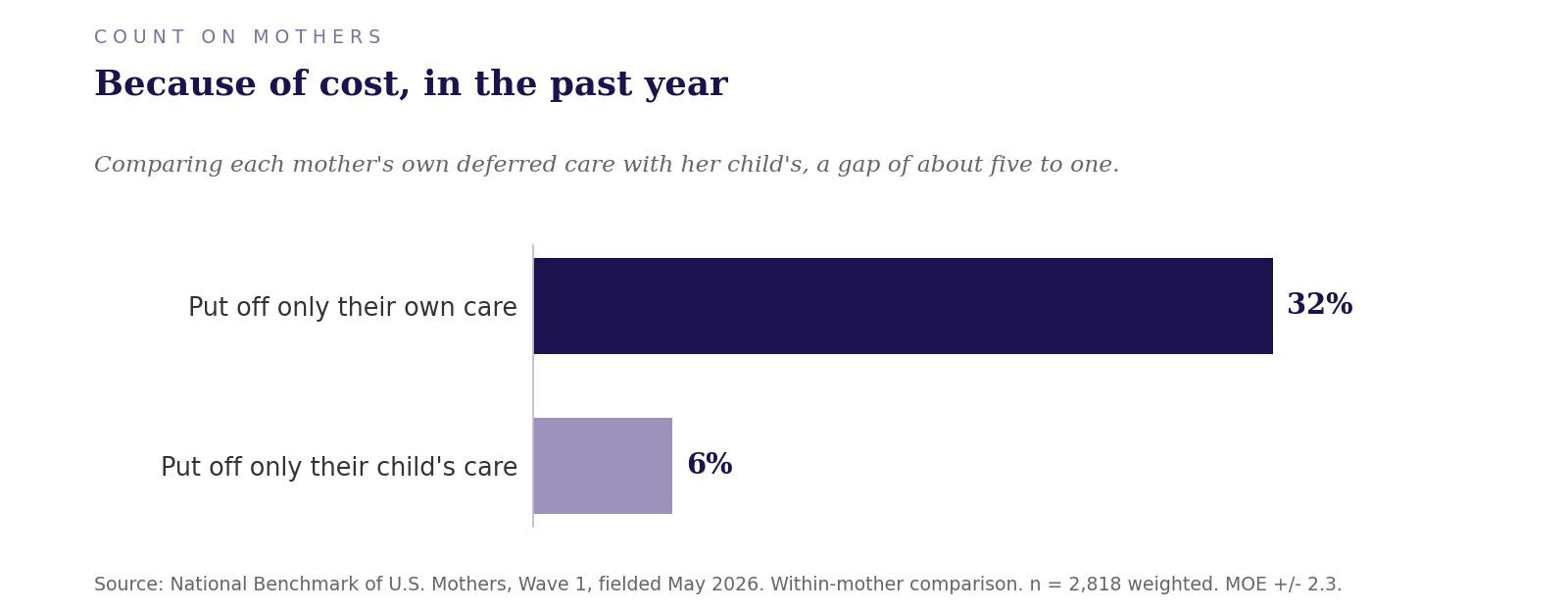
That mothers sacrifice for their children is not news. What that costs them in care, and at what scale, now has a number. About 2 in 5 mothers put off their own health or mental health care this past year because of cost. And when only one person’s care was deferred, it was overwhelmingly the mother’s. Nearly a third of all mothers (32%) put off only their own care, fewer than 6% put off only their child’s, a gap of about five to one, and a further 7% put off care for both themselves and their child.
This is the first nationally representative comparison of a mother’s deferred care against her child’s, and it puts a number on something no waitlist or claim can show. A mother who goes without care leaves no record, which is why this survey asked her directly.
Financial fragility reaches incomes you might not expect. Even among households earning $100,000 to $149,999, nearly 1 in 4 mothers could not absorb a surprise $500 expense without debt, and 38% ran out of money for food at least once this past year. Fragility also peaks in the early-teen years, when 41% of mothers whose youngest is 13 to 15 say a single surprise $500 expense would mean debt, the highest point of childhood.
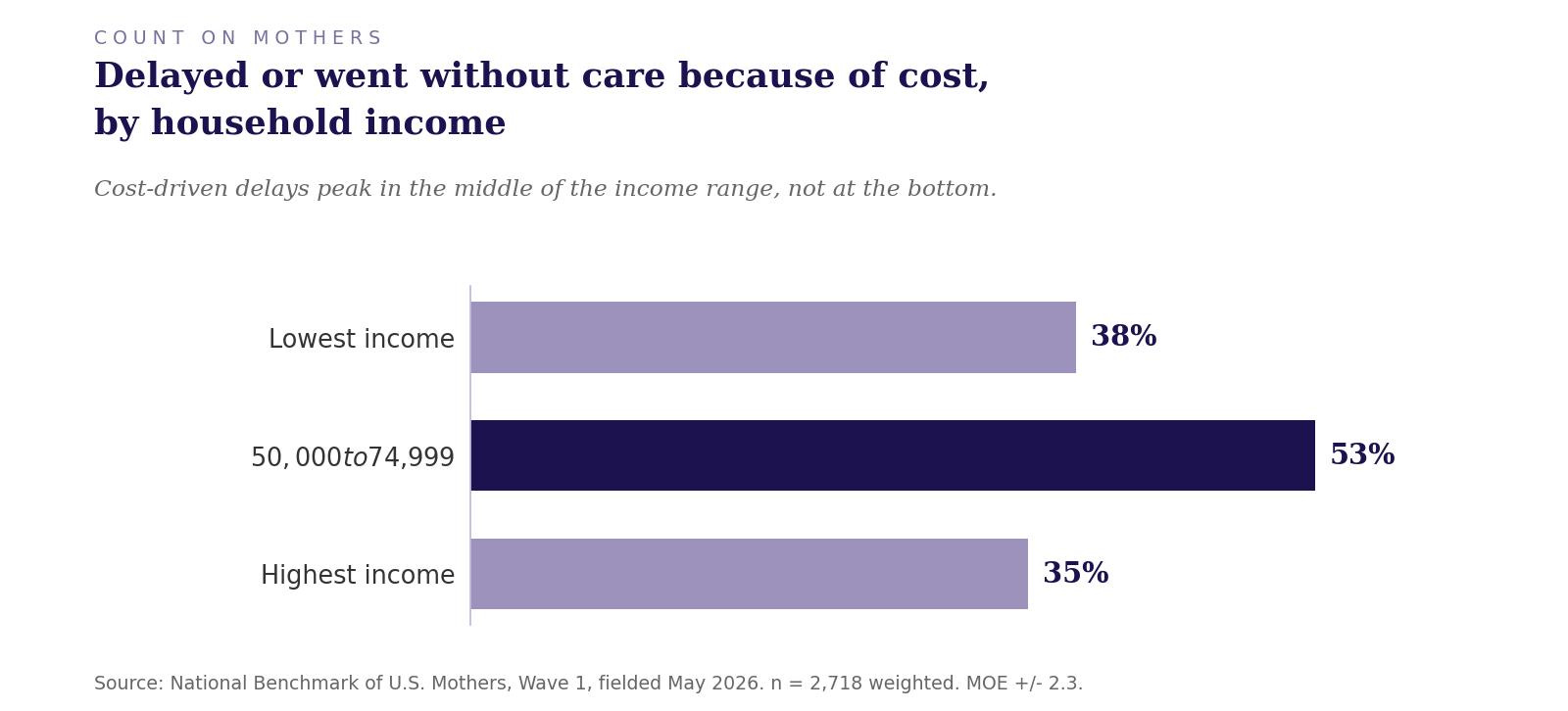
The care-cost squeeze is tightest in the middle. Delaying care because of cost does not simply ease as income rises. It peaks in the middle of the income range, where 53% of families earning $50,000 to $74,999 delayed or went without health or mental health care, above both the lowest-income group (38%) and the highest (35%).
Childcare strains households at almost every income. Among mothers for whom childcare applies, nearly half (47%) report moderate to extreme financial strain from it. Unlike food hardship, which eases as income rises, childcare strain holds at similar levels from households earning under $25,000 to those earning $200,000 or more, and it climbs with each additional child.
Pressures compound, too. Mothers whose child needed mental health support this past year were nearly three times as likely to report extreme childcare strain as mothers whose child did not.
When a child needs support, getting it is hard. Nearly 4 in 10 mothers say their child needed mental, emotional, or behavioral help this past year, and among them, 47% had difficulty getting it. For a mother’s own mental health care, cost is not even the barrier she names most. Time is, named three times as often.
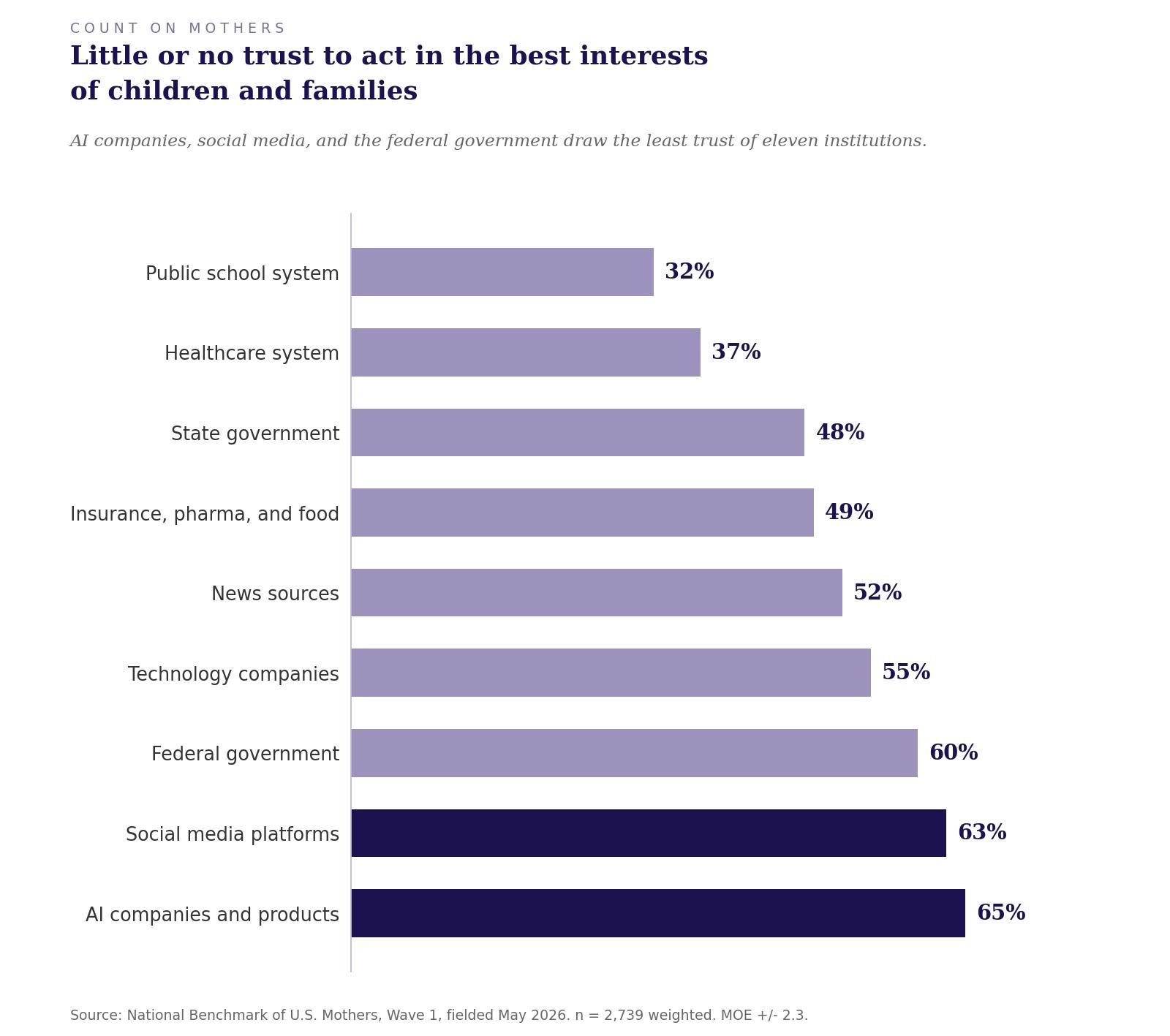
Mothers may be seeing something about AI that is worth all of our attention. Asked how much they trust eleven institutions to act in children’s interests, mothers put AI companies last (65% little or no trust), below social media platforms and the federal government, and that distrust holds in every political group, from 55% of very conservative mothers to 73% of liberal mothers. Among mothers whose children use AI beyond entertainment, 62% agree it may make it harder for their child to learn to solve problems and think independently.
Products the law keeps out of stores are reaching children anyway. About a third of mothers (32%) say their child has been marketed a product that is illegal to sell to a minor, such as vapes, gambling, alcohol, cannabis, or pornography, and more than half (55%) report at least one harmful or age-inappropriate product. Because much of this marketing arrives on devices and in feeds parents do not see, what mothers report is a floor.
Every wave asks one open question of every mother. In your own words, what is your biggest concern about your family’s wellbeing right now? Financial stress led by a wide margin, named first by 41% of mothers who named a concern, and it led in every income and political group. But money was not the only thing on mothers’ minds. Alongside it they named their own mental health, their children’s care, and the technology in their children’s schools. The two answers below carry both.
“Honestly I will say the cost of everything. Groceries, insurance, cost of summer camp. One very big emergency and the budget goes out the window. I just want to keep everyone healthy without going broke.” Mother, New Jersey
“Deeply concerned about the use of screens and Chromebooks in school, starting in kindergarten. I can control what goes on in my house, but not in the school.” Mother, Colorado
Beneath the findings above sit five full indices covering a whole terrain of raising children in America today, from maternal stress and family finances to institutional trust, the environments children grow up in, and whether families can get care. We will measure all of it the same way every six months, wave over wave, so the Benchmark can show not just what families are experiencing now, but whether the conditions of raising children are getting better or worse over time, and for whom.
Why through mothers? Because most numbers about families count transactions, and the Benchmark measures the conditions underneath, through the one person with firsthand experience across all of it. We made the full case, including the five indices and how they fit together, in The Earliest Signal We Have.
We are careful about what one wave can claim. Wave 1 measures different families once, so it cannot yet say whether the strain of the early years accumulates into the financial fragility of the teen years, or whether conditions are improving. That is what the trend line is for. Wave 2 fields this fall, adds household composition to the instrument, and turns every number here into a direction.
Last week we sat down with a roundtable of Anchor Mom Advisors from across the U.S. to talk through what Wave 1 found, mothers responding to the data about their own lives. We will share clips from that conversation, along with more analysis, over the coming weeks.
Two more releases draw on the deep data behind Wave 1, the layers beneath the public topline. Later this year we will release Pulse Check 2026, our next in-depth national study of mothers’ views on children’s mental health needs, care, and support. It draws on the child wellbeing data behind Wave 1 and builds on Pulse Check 2025 that first documented the scale of unmet need.
And together with our research partners at University College London, we have published a white paper, Children, Young People and AI Chatbots, drawing on Wave 1 and our January 2026 AI & Child Safety survey to examine how AI chatbots reach children, why children are more vulnerable to their design, and the safeguards mothers want in place.
The public report is our read of the toplines, the findings we judged most important to put in front of everyone. The full Wave 1 data goes much deeper. Our goal is a simple one. Every organization whose decisions, services, or products touch family life should start from what mothers see, what they trust, and what their families need. Every finding can be examined by child age, household income, region, ethnicity, number of children, insurance type, and political ideology, with each wave adding a new point to the trend. Members work with that depth, beginning with our founding member, Inseparable, the national mental health advocacy organization.
And a note on independence. Members and partners support the infrastructure, and our Methodology Advisory Board at University College London advised on the instrument, but none of them shape the findings. The Count on Mothers research team holds final authority over every question, every analysis, and every finding. Learn more at countonmothers.org/partners.
If you are reading this and you were one of the 2,818 mothers who answered Wave 1, thank you. You gave valuable time, and you answered honestly and in detail, many of you after long days spent doing the very things the survey asks about. Some of you have been sharing your experiences with us since 2023, through the surveys, roundtables, and open answers that shaped the five conditions the Benchmark now measures. The Benchmark exists because mothers decided their experience should be measured, and we do not take that lightly. These findings belong to you, and the full topline report is free to read, share, and cite.
And if you are a mother who has not yet joined, the Benchmark is built from voices like yours. Wave 1 set the baseline. Wave 2 starts the trend this fall. Your experience counts.
Count on Mothers is an independent, nonpartisan research organization tracking maternal experience at national scale. Wave 1 of the National Benchmark of U.S. Mothers is public and free to cite at countonmothers.org/benchmark. Wave 2 fields this fall.
The Count on Mothers Report publishes new analysis as each wave of the Benchmark is released. Subscribe to follow the work.
Comments
Nothing yet. Say the first thing.
Sign in to join the conversation.