
By @docrussjackson
Imagine a federal strategy document that instructs agencies to identify Americans for scrutiny based not on what they’ve done, but on what they believe.
Imagine it names specific political and cultural positions as indicators that a person or group may soon commit violence.
And imagine it authorises “rapid identification and neutralisation” of the people and funders behind those beliefs, before any crime has occurred.
Sadly, that is no longer a hypothetical. It is the substance of National Security Presidential Memorandum 7, the Trump administration’s new counterterrorism framework, expanded on by Secretary of State Rubio’s summit on what officials call “radical left terrorism” and by counterterrorism director Sebastian Gorka’s description of the strategy’s targets: groups whose ideology is “anti-American, radically pro-gender, or anarchist.”
This is worth taking seriously regardless of where you sit politically, because the argument against it does not depend on defending the left, or on denying that political violence from the left is real.
It depends on a much older and more broadly shared American principle: government should respond to conduct, not conviction.
Existing federal law already criminalises bombing, arson, assault, and conspiracy to commit them, regardless of the perpetrator’s politics. NSPM-7 does not close some gap in that law.
What it adds is a mandate to preemptively map and disrupt people and organisations based on ideological indicators, before any specific criminal act. That is a different kind of power than “prosecute people who commit violence.” It is the power to treat a belief system as evidence of latent criminality.
Every democracy that has gone furthest down this road has used the same justification: an urgent, genuine threat that required getting ahead of the violence rather than waiting for it.
Soviet doctrine targeted “counter-revolutionaries” this way. McCarthy-era investigations inferred disloyalty from association. Latin American security states built files on “subversives” identified by belief rather than act.
None of these are offered here as equivalents in scale or brutality to a 2026 American policy memo, rather they are offered as evidence of a mechanism: once a state defines its enemy by ideology instead of action, the category of “suspect” naturally grows to include anyone who disagrees with the government of the day.
The administration’s justification rests heavily on the idea that left-wing violence has been dangerously underweighted. There is some evidence to support part of that claim.
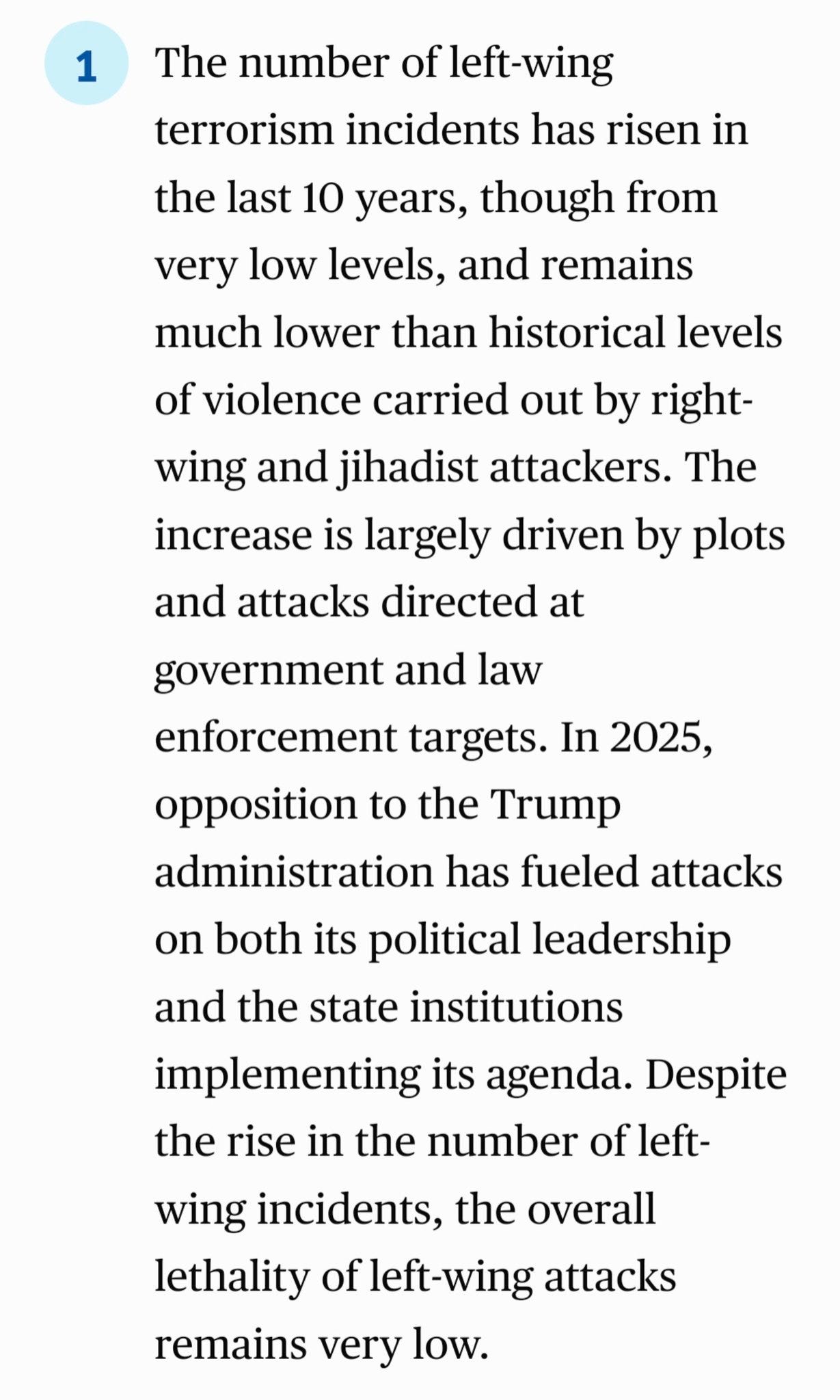
Research from the nonpartisan Center for Strategic and International Studies (hardly a left-wing advocacy shop) documents that left-wing terrorist incidents have risen sharply since 2016, and that 2025 was the first year in three decades in which left-wing attacks and plots outnumbered right-wing ones. That trend is genuine and deserves a serious government response.
However, “more frequent” and “more lethal” are very different questions, and the strategy answers only the first while claiming to address the second.
Over the past decade, left-wing attacks killed 13 people in the United States. Right-wing attacks killed 112. Jihadist attacks killed 82.
Left-wing violence has tended toward arson, vandalism, and confrontations with law enforcement, all of which are serious, prosecutable crimes, but rarely mass-casualty events, partly because perpetrators are usually disorganised and choose hardened targets like government buildings over soft civilian ones.
A policy genuinely calibrated to lethality would not train its most aggressive preemptive tools almost exclusively on the less lethal side of the ledger.
It is also worth examining closely the two cases the administration has leaned on hardest to justify the strategy (the Trump assassination attempt and the murder of Charlie Kirk), because neither holds up as cleanly as officials suggest...
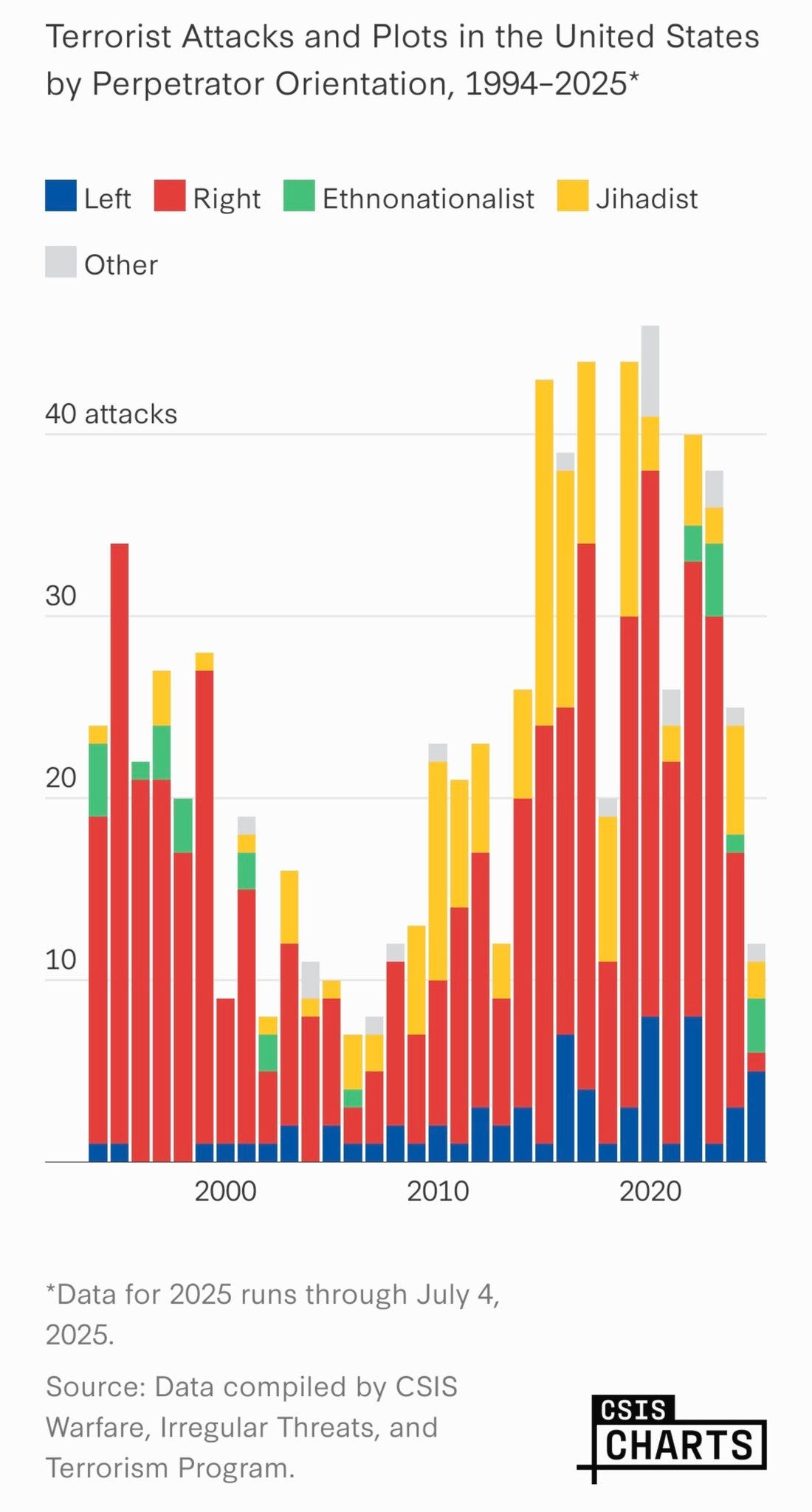
The gunman who fired on Trump is not classified as a left-wing terrorist in CSIS's dataset at all: investigators and journalists found no clear ideological motive, pointing instead toward personal grievance.
As for the "extreme transgender ideology" language written into the strategy's justification, tied to Charlie Kirk's killer, this described the shooter's family relationships more than any confirmed political motive for the killing itself.
If these two examples, invoked to justify a sweeping ideological-mapping regime, don't survive close scrutiny as clearly ideological, that's a serious problem for the policy's foundation.
Distrust of an unaccountable federal bureaucracy that decides who is dangerous based on political belief has been a central conservative commitment for generations.
It's why the IRS's scrutiny of Tea Party nonprofits in 2013 became a scandal. It's why revelations about federal pressure on social platforms to suppress disfavored viewpoints drew conservative outrage. It's why an FBI memo treating "radical traditionalist Catholics" as an extremism category was rightly condemned across the political spectrum.
The objection in each cases was the same: the government should not get to define disfavored belief as a security risk.
NSPM-7 applies that same logic, just aimed in a different direction. If the principle was correct when conservatives were the ones in the file, it does not stop being correct now that others are.
For those on the left, the immediate stakes are more direct: this is a policy that names your movement's core commitments (opposition to the current administration, support for transgender rights, skepticism of concentrated federal power) as risk indicators, independent of anything you have done.
But the broader stakes matter beyond the immediate target: expansive surveillance and preemptive-disruption authority, once built, does not stay with the administration that built it.
The domestic intelligence infrastructure expanded after 9/11 to fight foreign terrorism was later turned toward Americans with no connection to jihadism.
COINTELPRO, built to counter Soviet infiltration and violent radicals, was turned on civil rights leaders and anti-war organisers who posed no violent threat at all.
A "rapid identification and neutralization" apparatus built today is a tool the next administration inherits, whichever party controls it.
None of this requires pretending left-wing political violence is imaginary, or that arson attacks on ICE facilities or Republican party offices don't deserve prosecution: they clearly do, under laws that already apply to conduct regardless of ideology.
The Trump administration's own defenders note that the strategy explicitly disclaims targeting "fellow Americans who simply disagree" with the government, and argue that years of comparatively less attention to left-wing violence justified a correction. That's a real argument, often made in good faith by people genuinely worried about political violence, and it deserves to be engaged rather than dismissed.
The disagreement is narrower and more precise than "is left-wing violence real." It is this: does a policy that names ideologies, rather than organisations tied to specific violent acts, actually function as counterterrorism, or does it function, regardless of intent, as a mechanism for treating political opposition as a security problem?
Given the data, the contested foundation of its two headline justifications, and how consistently this kind of tool has expanded beyond its original target in every prior instance where it's been tried, the burden of proof should sit with those defending the policy, not those questioning it.
That's not a partisan position. It's the same principle (government responds to what you do, not what you believe) that Americans across the spectrum have invoked to defend themselves from an overreaching state.
Whoever holds that power today will not be the only one to hold it.
The Infrastructure Already Exists
A policy that maps citizens by ideology needs a machine capable of doing the mapping. That machine is largely already built, and it belongs to Palantir.
The company holds a reported billion-dollar Department of Homeland Security agreement (nearly half its annual government revenue, folded into one deal) and is under contract to build ICE's central Investigative Case Management system, upgraded specifically to include what's called ImmigrationOS.
The design goal, per the government's own procurement language, is a single "enterprise lakehouse" merging ICE case files with data from other law-enforcement agencies, the FBI's criminal justice information systems, biometric identification records, and national telecommunications databases.
That is, by design, a unified, searchable, alert-generating system spanning immigration, criminal, and communications data, built by one contractor, for one government-wide pool.
This isn't speculative. It's documented in the contracts themselves and in bipartisan congressional oversight: Senators Warner and Kaine have formally demanded an investigation into DHS's use of Palantir-linked tools alongside Clearview AI facial recognition and Penlink communications-monitoring software; Representatives Goldman, Wyden, and Velázquez sent a separate letter after a House Judiciary hearing in which DHS Secretary Kristi Noem was asked directly whether the department was building a database of protesters, and denied it, on camera, right after being shown footage of an ICE officer telling someone he was adding them to "a nice little database" as a "domestic terrorist."
None of this proves Palantir's systems are formally wired into NSPM-7's ideological-mapping mandate. That specific link has been alleged by some reporting but isn't officially confirmed, and it's worth being precise about that distinction rather than collapsing "the capability exists" into "it's already being used exactly this way."
However, the relevant fact is that the technical capacity for exactly the kind of preemptive, cross-database, belief-adjacent targeting NSPM-7 describes isn't hypothetical anymore. It's procured, funded, and operational: built for immigration enforcement today, and available for whatever the government decides to plug into it tomorrow.
That's worth pairing with who is steering the company building it.
Palantir's co-founder and largest shareholder, Nigel Farage's "friend", Peter Thiel, has been explicit for over a decade about where he thinks the limits of democratic government should sit.
In a widely cited 2009 essay, he wrote that he had come to see freedom and democracy as fundamentally at odds, pointing to the expansion of the franchise (including to women) as a development that had made "unthinking" mass politics harder for people like him to work around.
He described his life's project since as finding an "escape" from politics altogether, through means other than the ballot box.
That isn't offered here as a personal attack: it's directly relevant context.
A surveillance architecture capable of preemptive, belief-adjacent targeting is concerning on its own. It's far more concerning when the company building it is steered by someone who has said plainly, on the record, that he doesn't think the majority (or voters) should get the final word.
The safeguard against this kind of policy has never been that the technology to do it doesn't exist. It's that democracies choose not to build it, or restrain it once built. One of those choices has already been made.
FFS WAKE UP!
Thanks for reading! This post is public so feel free to share it.
Tory Peer Young promoting "Midazolam Murders"
·
Jul 9

Conservative Peer Toby Young founded the Daily Sceptic (then Lockdown Sceptics) at the start of April 2020 to promote alternative interpretations of the science. In reality its a disinformation rag providing a platform for all sorts of conspiracy theorists. Young was an influential figure for the anti-lockdown movement, initially arguing that sacrificin…
Analysing the Language of Lowe
·
Jun 19
Rupert Lowe was elected as a Reform MP in 2024, but after his relationship with Nigel Farage quickly soured he left Reform and founded Restore which sits further to the right. Elon Musk weighed into the fall out to back Lowe as his clear preference for future Prime Minister stating he felt that Farage didn’t have what it takes to bring about the changes…
No posts
Comments
Nothing yet. Say the first thing.
Sign in to join the conversation.