
Two tangentially related topics this Friday:
I was interviewed by Hao Nguyen for the How I Make Money Writing Substack. Authors probably don’t talk about money enough, even if many of the reasons are understandable. (Anyone remember when the #publishingpaidme hashtag went around and a few writers who were honest about their high advances got raked over the social media coals?) Anyway, I try to talk practically and honestly about money-related matters on Counter Craft and I’m glad there is a Substack devoted to authors explaining how they juggle jobs and balance bill paying and art making.
Nguyen’s Substack has a paywall, but he gave me a 30-day guest pass link to share with Counter Craft subscribers if you want to read the interview. I talk about my years cobbling together freelance and adjunct income as well as my “business model” on Substack of publishing everything for free initially and then paywalling select older articles for paid subscribers:
Philosophically, I like readers being able to read what I post for free. And from a career perspective, it seemed more useful to build up subscribers and have a “platform” that might help me sell books. It was all free at first. At some point, I realized I’d been writing several books worth of articles and thought it was fair to put older articles behind a paywall and keep posting everything new for free. I really am indebted to the readers who subscribe. It helps me keep it going.
At this point, I probably make more from Substack subscribers than I would placing the pieces in literary-minded websites and magazines. But I’m fortunate to not depend on either Substack or freelance income anymore. I would have to completely change how I do the newsletter if I was trying to live on subscriptions. As for other outlets, I almost never pitch anymore. If an editor at a journal I enjoy solicits me, I typically say yes. But I don’t really pitch non-fiction anymore. I need to save what non-work, non-Substack time I have for fiction writing.
There’s been a lot of discussion on the decline of book reviews and what it means for authors, most recently from Dwight Garner in the New York Times. Garner’s article “Where Have All the Book Reviews Gone?” was good although I did think it was an oversight to ask that question and not mention Substack. This is where many of the book reviews have gone, including for people alluded to in the article (e.g., Ron Charles was one of the critics let go by the Washington Post and is now on Substack.) I normally find the Substack cheerleading quite silly. This is a social media slash blogging platform. It has plenty of problems, and recreates many of the usual problems of both online platforms (AI slop, rage bait, etc.) and humans in general (group think, cliques, etc.). But, I do think Substack is where a lot of book reviews are migrating. BookTok remains huge, but the types of books that go viral there tend to be very different from the ones that get coverage here.
This isn’t anything magical about a tech platform. It’s just that this is a platform built around longform text and so will attract readers and writers of longform text in the same way that Instagram has become a popular platform for photography and illustrations. Lena Dunham’s new bestselling memoir was apparently promoted through a sort of Substack tour and has credited the platform for helping the book sell. As I’ve said before, I received as many or more reviews of Metallic Realms on this site than in professional magazines. Anyway, that’s all I’ll say about that.
But speaking of Substack and book reviews more generally, I wrote about my mixed feelings on traditional book reviews earlier this month. Other recent Substack essays worth reading on the subject are Derek Neal with a more critical take on the traditional 800-word book review, Stephen Piccarella on publishing a book in a world without reviews, and Blake Lefray on the problems with overly positive book reviews.
The last piece in particular got me thinking a little more about book reviews and why I think some of the issues with them are tricky to solve. I agree that book reviews are on the whole too positive—and Lefray also correctly points out this is a longstanding problem, quoting Elizabeth Hardwick complaining about them in the 1950s. In more recent history, I remember when the review aggregation site Metacritic began including books. If you’re not familiar, Metacritic aggregates reviews by converting them into a 1-100 score and then averaging them. High averages are colored green, middle scores are yellow, and low are red. For movies and TV, this works well. For books, it did not. Nearly every book got good reviews on average. A wall of green scores with a few yellows and the occasional rare red flop. Metacritic soon dropped books from the site.
(Lit Hub’s BookMarks has a similar aggregation model, and does a better job of providing a range of scores. Though this is largely by adding a second positive category—it goes Rave, Positive, Mixed, Pan—that Metacritic lacked.)
That was over 20 years ago, before the social media age and the complete gutting of book review sections we’ve seen in the last decade. Book reviews seem to have always skewed positive. There are many reasons for this, but I think the most popular ones are both true and incomplete. Yes, there is a sort of desperate and corny rallying around books: “Any reading is good reading! Especially today in our mindless TV binging and cellphone doomscrolling age!” The near extinction of full-time book critics does mean that most book reviewers are fellow novelists who may be too willing to go easy on a fellow practitioner—“It’s an accomplishment for anyone to finish a whole book and manage to get it published!”—or, more cynically, afraid of pissing off an author (or their agent or editor or friends) who you might need a favor from or hope to work with down the road.
All those factors are in play, but again the problem is an old one. Critics have always been mostly fellow authors. Acclaimed novelists like James Joyce and Virginia Woolf wrote reviews and acclaimed critics like James Wood or Susan Sontag are or were novelists. Even the critics who haven’t published novels tend to publish books of criticism, meaning they too potentially have incentives not to piss off agents, editors, and publishers. (There’s no real solution here except maintaining your own integrity as a critic and reading critics who believe have integrity.) The decline of reading and the general cultural fragmentation plays a role, but then Elizabeth Hardwick’s Harper’s essay is from the 1950s, back when literature still held a central role in American culture. So, what else is at play?
I tend to think so many of the issues people have with publishing—many of which I agree with—ultimately stem from one big blunt fact: there are a shit ton of books. There are tons of manuscripts written and tons of books published. And, yes, there aren’t all that many readers for them. But even when there were lots of readers, people complained that reviews were too positive.
Publishers Weekly recently reported that over 4 million books were published in 2025. Granted, most of those were likely some form of spam, scam, slop, or else super niche book that would never get general review coverage. When I interviewed Fisher the Bookseller (a buyer for an independent bookstore) they said they look at about 50,000 titles a year across the various publisher catalogs. Those are 50k books that might be stocked in a bookstore, which is a fair proxy for what might get book reviews. Let’s make the math easy and say 1,000 books a week.
Compare 1,000 new books a week to how there are only about 3 new wide-release movies in theaters each week. Even adding in streaming platform originals, we’re talking a tiny fraction of the number of new books. A lot of things spill out from these numbers. One is that wide-release films are always targeted to a wide audience. Books, OTOH, do not have to earn nearly as much to be profitable and are often aimed at very specific niches. If you’re a culture editor at a major newspaper or magazine, you could reasonably conclude that every new film is of potential interest to your readers. The New Yorker (or whatever) can justify reviewing any new MCU film or kid’s movie or anything at all because a lot of their readers might care to read about it. The same doesn’t hold for books.
What percentage of the New Yorker’s audience cares about a random romantasy or thriller title by an obscure author? Hell, what percentage of romantasy or thriller or [insert any genre including literary fiction] readers care about any given random title? The percentage is always functionally zero. 99.999% of books do not attract inherent interest from book review readers, who themselves are a small number anyway.
This is part of the reason why positive reviews are more common than pans. “You Need to Read This Great Book” is a better selling point than “You Need to Avoid this Bad Book, Which Is One of Roughly 1,000 New Meh Books You Should Avoid This Week.” Sure, I believe you that yet another book is boring. But why would I spend my time reading about yet another bad book by yet another author I’ve never heard of and may never hear from again. If it’s a famous name—a Stephen King or a Sally Rooney—sure, many people may be excited to read a pan. A book review editor can always justify assigning reviews of famous names. Outside of such rare authors though, who cares? Probably not your readers.
I’m not trying to pawn this issue off on editors. This is how I feel as a reader too. Why would I spend my time reading about a random mediocre book by a random author that I’ll never hear about again? I have better things to do with my time. (Or at least pretend I have better things to do. Probably I’ll just waste time on my phone. Still. Hope for productivity springs eternal.)
There are two exceptions here. The first is when you admire an individual critic. I will happily read Parul Sehgal or Christian Lorentzen, to pick a couple examples, talking about a book I have no intention of reading. Here is where the disappearance of full-time book critics hurts. And also where Substack helps. If someone subscribes to your newsletter, they presumably value your voice and thoughts and so are more likely to find value in reading a critic of an unknown book.
The second exception is, of course, famous or newsworthy authors. While few people may actively want to read pans of books they don’t care about, plenty of people will delight in pans of Ocean Vuong and Ben Lerner, or else Rebecca Yarros and J.K. Rowling. (First time those four have been in the same sentence together?) Or a takedown of a book like Shy Girl or American Dirt that are at the center of a buzzy controversy. You can almost feel the relief that book reviewers have when there’s a worthy target to shred. Finally! A reason to bring out that fancy Japanese chef’s knife you got as a wedding gift. Something worth cutting apart.
The same logic holds true in niches. Here on Substack, there are Substack famous authors who might sell few books compared to a NYT bestseller yet who are known enough here that there is interest in reading critical coverage—positive and negative—about them.
The flipside of the gigantic quantity of books published is the paltry remuneration for book reviews. This is a problem that has gotten worse and worse. Writing a book review really does take a lot of time, even just reading the book. I’m a book critic, at least at times. I feel I’m very honest in my reviews. I would never rave about a book I disliked nor pan one out of artistic jealousy or the like. Yet I’m sure if you read all my reviews you would find that they skew positive. Money is a big part of that. If I’m assigned a review at a major newspaper that pays real money, I’ll review whatever I’m assigned and pan or rave as need be. Otherwise, though, I’m probably only going to bother writing a review for something I like. I won’t even pitch writing one unless I’ve read the book and am excited enough about it that I want to write about it. If the book sucks—or to be more charitable, if it simply doesn’t connect with me—I won’t finish it. Again, I have, or like to pretend I have, better things to do with my time.
Even assigned book reviews will likely skew positive without factoring in any of the cronyism, “positive literary citizenship” corniness, and any other such things. Book review assignments aren’t random. Editors mostly assign reviewers books in the genres and styles that they care about. I’m typically asked to review weird story collections or dystopian SFF novels and never inspirational celebrity memoirs or lighthearted commercial romances. If I was, I’m sure I’d write more negative book reviews.
Then again, it might be fair to say as someone who doesn’t read many inspirational memoirs (or whatever) I’m not really in a place to judge them. They aren’t a genre I’m familiar enough with to really comment. And again, this is downstream from the volume of books. It’s pretty rare to have a professional movie reviewer who will only review one genre of film. It’s common to have reviewers who only review romance, science fiction, etc.
Anyway, those are just some scattered thoughts. As I wrote recently, I’m hoping to review more books here on Counter Craft. But they probably will mostly be books that I enjoy not because I don’t think negative reviews are useful but just because, well, I’ve only got so much time. Here’s my latest one, if you missed it:
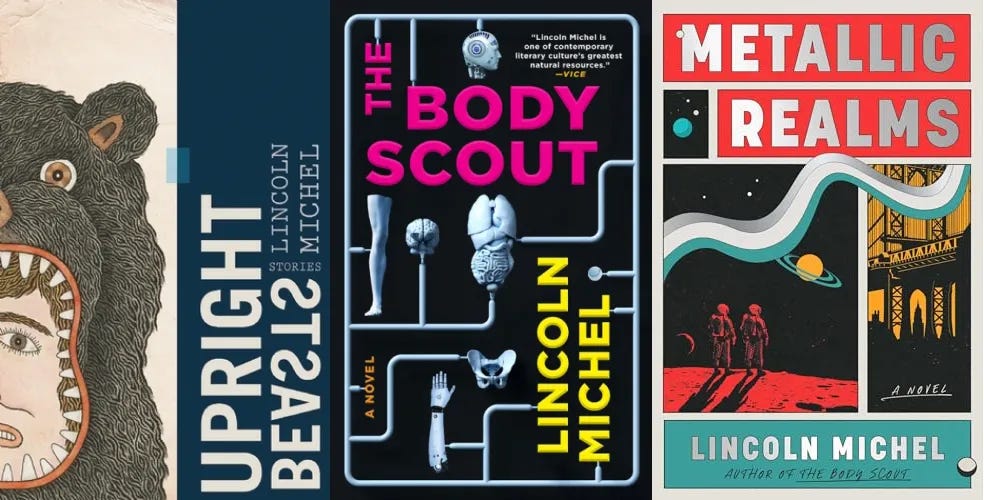
My new novel Metallic Realms is out in stores! Reviews have called the book “brilliant” (Esquire), “riveting” (Publishers Weekly), “hilariously clever” (Elle), “a total blast” (Chicago Tribune), “unrelentingly smart and inventive” (Locus), and “just plain wonderful” (Booklist). My previous books are the science fiction noir novel The Body Scout and the genre-bending story collection Upright Beasts. If you enjoy this newsletter, perhaps you’ll enjoy one or more of those books too.
Comments
Nothing yet. Say the first thing.
Sign in to join the conversation.