
I can still remember so well the first time I played Halo: Combat Evolved when I was younger.
That game was incredible for so many reasons. And among them was the setting where the game takes place: a giant alien ring structure.
The game is set in the 26th century and starts off with a cinematic scene showing the humans onboard the spacecraft Pillar of Autumn as they exit from faster-than-light travel in a star system where the gigantic alien ring structure orbits around a nearby world. The humans had escaped from the planet Reach under pursuit by an alien force called the Covenant, but the alien enemies arrive there first and attack the Pillar of Autumn. Players assume the character of Master Chief Petty Officer John-117, an enhanced human supersoldier called a Spartan who is decked out in battle armor, and jump into the game as the Covenant are boarding and assaulting the humans onboard the Pillar of Autumn.
The humans abandon their ship to descend on the ringworld while the ship’s captain crashes the ship itself into the ring. After that, the gameplay follows Master Chief and the humans as they battle against the Covenant within the world of the ring. And, along the way, they learn more about the ring and its purpose.
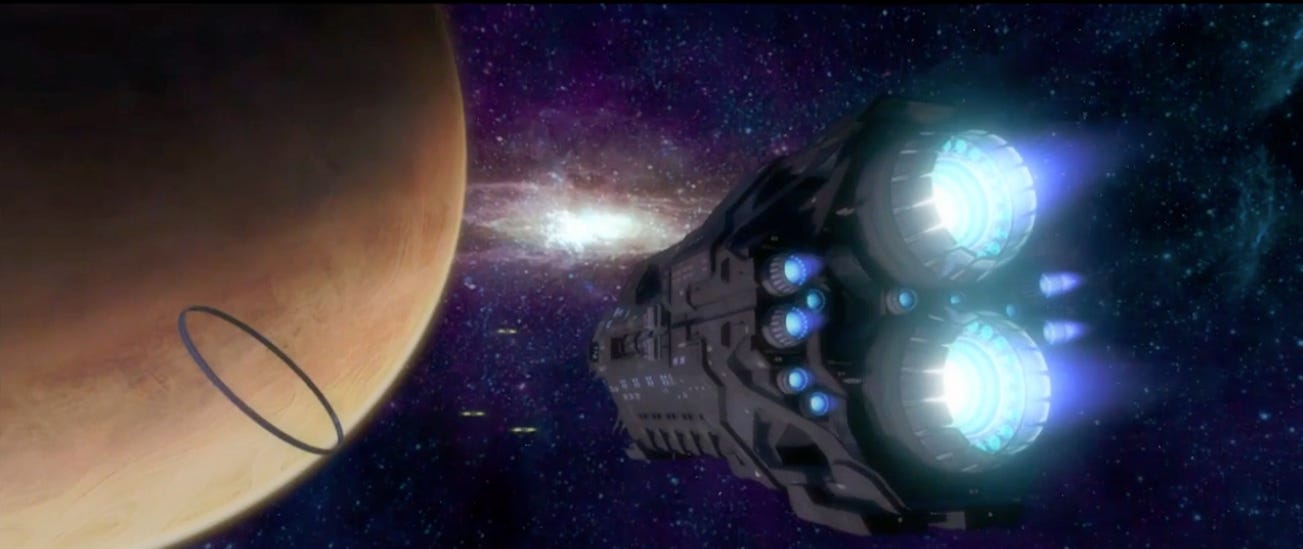
It’s made immediately clear in the story that neither humans nor the Covenant made the ring. The Covenant, in fact, treat it as a sacred object, a relic of a vanished civilization they call the Forerunners (beings so technologically advanced that the Covenant have built an entire religion around their memory). The Covenant refer to the ring simply as Halo.
As Master Chief and the humans fight against the Covenant on Halo, they learn that the station is some kind of weapon and are determined to stop the Covenant from using it. The game takes the player to various settings across the ring’s surface and within its internal structures. There are forests and rivers and mountains, all on the internal structure of the ring being held in place by the ring’s spinning motion.
As the game proceeds, the player learns that the Halo is part of a weapon system built by the advanced Forerunners long ago to stem the outbreak of a parasitic zombification organism called the Flood. The Halo itself, when activated, destroys every sentient lifeform within a large range, thus killing off the supply of hosts/food for the Flood. The game ends with Master Chief destroying the Halo to prevent its activation, escaping just ahead of the detonation. But it turns out there are more Halos, and the subsequent games continue the story from there (it’s been a long time since I’ve played them: might have to run through them all again sometime in the coming year).
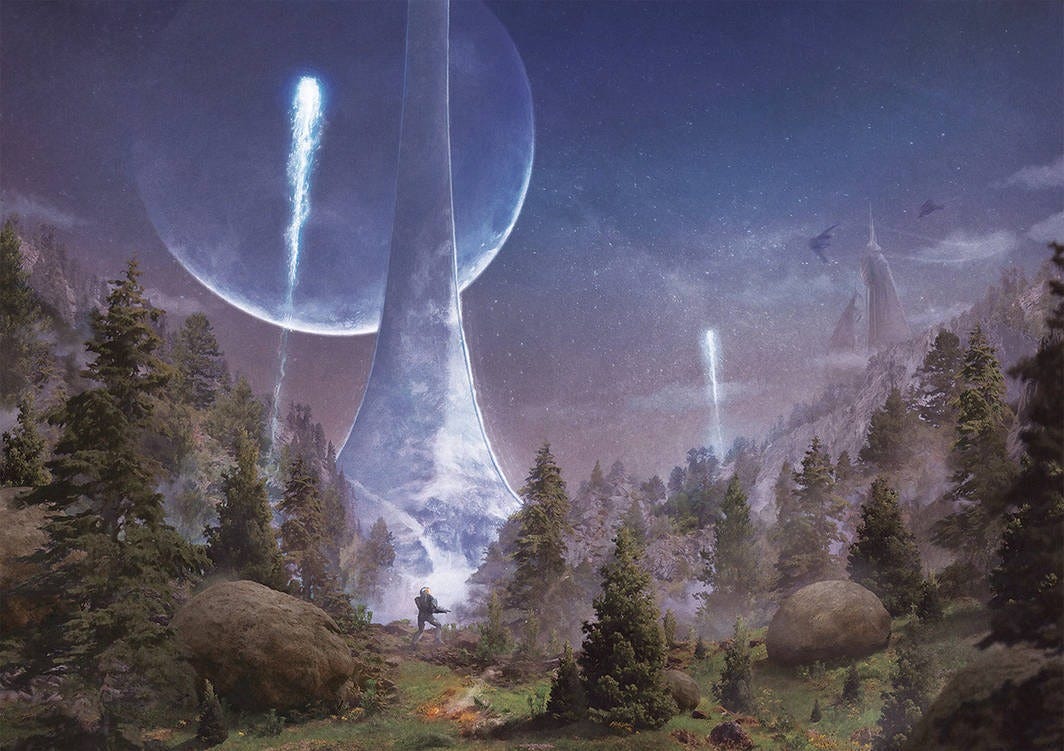
The ring structures in these Halo games were certainly not new ideas at the time of the game’s development.
In 1970, science fiction author Larry Niven published the now-classic story of Ringworld.
It’s been a long time since I’ve read it, so I had to get a little help from Claude to put together this quick synopsis:
The story of Ringworld follows a crew of four as they are recruited to investigate an enormous unknown structure discovered deep in space. What they find is a ring-shaped band of matter a million miles wide and roughly six hundred million miles in circumference, encircling a star at approximately the distance Earth orbits the Sun. It rotates to generate artificial gravity. A series of shadow squares orbiting closer to the star creates a day-night cycle. The inner surface is landscaped with oceans, mountains, continents, an atmosphere retained by walls a thousand miles high at each edge. The Ringworld’s habitable surface area is equivalent to roughly three million Earths. The civilization that had built the structure has collapsed, its descendants reduced to scattered primitive cultures who have entirely forgotten that they inhabit a machine. They believe they live on a world. Some worship the structure’s creators as gods. The crew crash-lands and spends the novel trying to get back off the surface, crossing vast distances and slowly piecing together what happened. The mystery of the builders is never fully resolved in the book (but explored in further novels set in that universe).
Niven himself described the Ringworld as “an intermediate step between Dyson spheres and planets.“
It’s a structure that captures some of a star’s energy, provides vast living space, but stops short of full enclosure (more on that below). The engineering demands alone are staggering: the material of the ring floor, which Niven called “scrith,” would require a remarkably strong tensile strength. And as soon as the book was first published, readers started pointing out that having the ringworld in orbit around its star would likely lead to instabilities (without some kind of propulsion sources to maintain stability). Fans at the 1971 World Science Fiction Convention (Worldcon) pointed out that the structure was also gravitationally unstable and would drift into its star, leading some MIT students to chant “The Ringworld is unstable!“ in the hotel hallways (which sounds like some glorious nerd lore!). Niven acknowledged this and began writing sequels by addressing the problem directly.
Ideas like Ringworld and the Halos tie into a larger realm of our explorations of possible alien megastructures in the cosmos. And they’re so much fun to think about both in science fiction as well as for the real science of astrobiology that they deserve their own entry here in Astrobiology 101.
Jumping in on the concept of alien megastructures is actually a good place to take a little step back into mythology and our own human history of architecture and construction as well.
The impulse to build huge structures that push our minds into realms of contemplation and feelings of connection to something bigger than ourselves is ancient and runs deep in our species.
Long before we had the tools to realize our grandest ambitions, we had the imagination for them. The earliest permanent human settlements were modest, with walls against wind and predators, roofs against rain, but something in us kept reaching further. Across every culture and era, humans have poured enormous collective energy into structures that go well beyond the purely practical: pyramids raised on the banks of the Nile, stone temples oriented to the solstices, towering ziggurats in the heart of Mesopotamia, monolithic obelisks planted as proclamations of power and divinity, cathedrals whose spires were built by generations who would never live to see them finished.
Many of these large creations through time have been centered on what could be argued as folly and narcissism: many a king and emperor have forced the labor of slaves and common people to create monuments to themselves, for example. And yet, we now can look back and see human ingenuity and a drive for creation on amazing scales in what our ancestors built around the planet. And many of these ancient and past constructions for honor and celebration or for contemplation and ritual were all more than just functional. They served as arguments about what human civilizations in their places and times were capable of. They speak to what was valued (even if in many cases the value was determined not by the majority but by a privileged few).
Mythology is also full of the same impulse taken to various extremes.
Across cultures and time, humans have imagined fantastic constructions of supernatural form and dimension. We’ve considered flying temples, floating islands, palaces of the gods that feel infinite to mortal people, dwellings of monsters and creatures at the borders of our known realities. We’ve even questioned what it would mean if we ourselves could build in such ways as to approach the gods and the supernatural. Consider, for instance, the Tower of Babel, the biblical story of a united humanity constructing a tower tall enough to reach heaven; all going well until a divine (and wrathful) Hand of God scattered the builders and split their languages to confuse them so that they couldn’t again unite to rise to the level of the gods.

The story of the Tower of Babel is far from unique to that tradition (and certainly itself comes from far earlier stories).
In Ovid’s Metamorphoses, a race of giants attempts to storm the heavens by piling mountains on top of one another until Jupiter strikes them down with thunderbolts. The ancient Hindu Shatapatha Brahmana tells of demons building a fire-altar of bricks high enough to reach heaven, foiled again by divine interference. Variations on this theme, that there is trouble to be had when humans want to build themselves up to be on level with the gods, can be seen in various ways across Mesoamerican traditions, in early Islamic history, and in sub-Saharan and Pacific Island mythologies. There is a remarkable consistency: in myth after myth, the attempt to build at cosmic scale triggers a divine response. The universe, we have told ourselves, notices when we humans reach too high, too fast.
“Rendering the heights of heaven no safer than the earth, they say the giants attempted to take the Celestial kingdom, piling mountains up to the distant stars. Then the all-powerful father of the gods hurled his bolt of lightning, fractured Olympus and threw Mount Pelion down from Ossa below.”
From Ovid’s Metamorphoses
In many of these stories from the mythological realm, we see the idea that civilization may be capable of building at a scale that would be fantastical in the minds of those imagining. Much as Arthur C. Clarke wrote of technologies that, “Any sufficiently advanced technology is indistinguishable from magic,” so it seemed in our imaginings that construction on the grandest scales would put us into a place of divinity, miracle, or even threat.
And, indeed, there is something wildly impactful that can happen for us modern humans when we visit grand constructions of our distant past, like Mayan temples or Egyptian pyramids as well as Medieval cathedrals and long lived Buddhist temples. I personally find such locations to speak to a mystical feeling of the sublime. I can only imagine how such locations felt to the people who built them and the people who used them in their time.
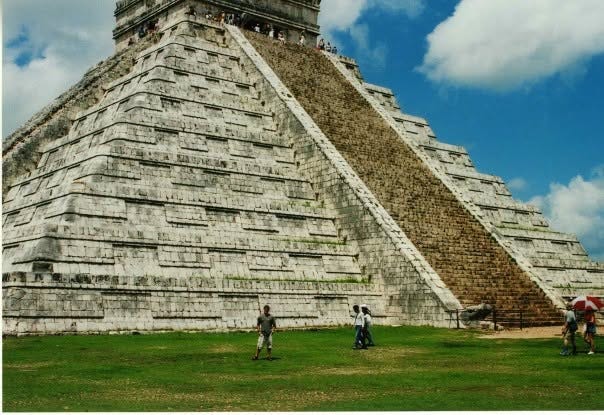
While our ancestors often imagined the greatest of our possible constructions to be a sign of vanity and a threat for the gods to address, we have now in our modern day very much become the civilizations building such grand constructions that they imagined. Heck, many of the structures humans build today would have been incomprehensible to the ancient world. The Burj Khalifa in Dubai stands 828 meters tall: more than twice the height of the Empire State Building. The Three Gorges Dam on China’s Yangtze River, the largest power station ever built (so far), stretches more than two kilometers across and generates enough electricity to supply a substantial fraction of a continent’s needs. The International Space Station, assembled piece by piece over more than a decade by five space agencies, is the largest structure ever built off the surface of the Earth, orbiting at roughly 400 kilometers altitude and visible to the naked eye from the ground below (you can find out when the exact times when you’ll see the ISS in the sky with the Spot the Station app!).
While we certainly have continued building monuments to gods and people alike, most of our more modern great constructions aren’t rooted in any ideal of religious or spiritual practice nor to inherently serve as a memorial for people with luxurious wealth and power. Much of what we’ve done now is rooted in our attempts to build big to harness energy, make a grand show of our capabilities, harvest and move resources more efficiently, to organize our collective labor, and for various other functional reasons.
And yet, measured against what physics actually permits, these are still just modest beginnings.
As our civilization continues to develop, we may find new means for creating ever larger structures with various purposes. Perhaps we’ll wish one day to create humongous starshades to block our own world from some amount of sunlight, we may sculpt cityscapes on Mars or other worlds, we might find means for building larger edifices within our own cities on Earth (perhaps some so large that they would be considered self-contained cities in their own right: I instantly imagined the arcology buildings from SimCity 2000 when writing this), we could develop huge generational spaceships to take some portion of us to the stars, and far, far more.
And if we can imagine ourselves growing and expanding into ever larger constructions for a number of reasons, then certainly other civilizations out there may have imagined or even have done the same.
Science fiction has always been a laboratory for engineering ideas too large or too wild for the present.
As I’ve argued in our Mythologies of Alien Life series, in many ways the early drives toward making meaning with mythology and asking questions that could be tested and corroborated with early science are the same. And much as how we see science fiction in the modern day creating new mythologies for us, I think early mythologies can very much be seen as the earliest science fiction.
We see both in practical ability and in our stories this drive to consider ever larger and more complex buildings. And while our earliest imaginings may have considered the gods and earthly beings of great power to be those able to build beyond us, our modern storytelling follows a lineage of wondering if alien beings out there, perhaps somewhat similar to us in some ways, have been or are currently building the great structures we’ve imagined.
In science fiction, we’ve long had a trope now referred to as the “Big Dumb Object (BDO).” A term first coined in 1981 by Roz Kaveney when writing an article about the state of science fiction through the 1970s, the Big Dumb Object is some enormous object that is often made by aliens, tends to be artificial, and is usually of unknown or questionable origin. Its creators are almost always absent. Its purpose is initially opaque though often unfolds during a story. And its presence generates, in the characters who encounter it and the readers who follow them, an overwhelming sense of scale that no amount of explanation can entirely domesticate.
There are so many examples of BDOs from across the genre of science fiction. There are things like V’Ger in Star Trek: The Motion Picture, the obelisks in 2001: A Space Odyssey, giant alien ships like Rama in Rendezvous with Rama, and the various ancient constructions found in the Mass Effect games. The BDOs are often used to grab a sense of mystery and to consider the potential not only for advanced aliens to create humongous structures but also for those structures to have some unknown meaning, perhaps even decipherable over time (we do love to think we’ll be able to figure these things out).
The Halos and Ringworld certainly fall into this realm of BDOs. And the word “Dumb” here is only being used in a jovial manner by most of us. While they’re often used as plot points or settings for good storytelling, we also have good reason to think they could exist out there already.
Those who’ve read my work for some time surely know of my love for the novel Star Maker by Olaf Stapledon. While people have dreamt of great constructions by humans, gods, monsters, and aliens alike long before his novel in 1937, I think all of modern sci-fi that includes BDOs of any form can trace connections to the impacts of Star Maker on our imaginings. Star Maker is one of the most ambitious works of imaginative literature ever written (IMO), and it contains, buried in its cosmic sweep, the first literary description of a star-enclosing structure. Stapledon described alien civilizations that had surrounded their stars in what he called “light traps,” capturing the energy of entire solar systems for technological use, and he noted that the effect would be visible from outside as a dimming of the galaxy itself. His writing directly ties into the work of Freeman Dyson and the concept of the Dyson Sphere.
Freeman Dyson, in 1960, wrote the now-famous paper: Search for Artificial Stellar Sources of Infrared Radiation.
A fun and short read, what it proposed was a thought experiment about an alien civilization building a sphere around their star system. He considered what would happen here if we took the mass of Jupiter and evenly distributed it into a shell around the Sun with a radius of 1 AU. Such a sphere would allow our civilization or an alien civilization to capture all of the incident light from the central star (just 4 years later, Kardashev published his famous scale that considers such a civilization as a Type II). A sphere of this nation would also be forced through the laws of physics (as we know them) to re-radiate heat in infrared, and so Dyson thought experiment concludes with the argument that we could search for such spheres covering stars by looking in the infrared. It’s a piece of stellar writing!
The idea later came to be known as the Dyson Sphere.
And as we’ve expanded our thinking and our dreaming of what such alien megastructures might be like, we’ve also wondered if maybe rather than a single shell if some civilizations may instead place one or many rings (like Ringworld) some distance from their star(s). We envisioned swarms and collections of other kinds of orbiting structures as well. And we’ve also wondered about how large our own potential structures in the future might be, including those that could become home to future humans choosing to leave the Earth.
Starting in the 1970s, a physicist named Gerard K. O’Neill at Princeton was approaching the megastructure question from the other direction. He was thinking about what we might need right now in terms of human engineering and resources to begin building permanent human settlements in space. Much as viewers saw in 2001: A Space Odyssey with an orbital station in the shape of a large wheel rotating around its central axis to provide a sense of internal gravity, O’Neill envisioned huge cylindrical structures orbiting the Earth that could become home to entire ecosystems within. He wrote papers and then books on the idea, like his most famous The High Frontier: Human Colonies in Space.
O’Neill’s vision was earnest and practical. He argued then, as many do now, that space settlement beyond the Earth was an engineering problem and not just a fun fantasy (of course, politics and funding come into solving that engineering problem at scale, but that is the way of things). O’Neill’s cylinders became the template (or, at least, inspiration) for nearly every rotating habitat that appeared in science fiction afterward, from the space stations of Babylon 5 to the colony ships of Interstellar to the enormous Stanford torus that opens the film Elysium.
O’Neill Cylinders sit at the modest end of a spectrum that extends almost without limit, at least in certain ways. If we can imagine becoming a Type I Kardashev civilization soon, and using the total amount of energy available at the surface of our planet, then by that point we may indeed already be constructing large space stations like O’Neill envisioned by that point. We might even start building larger structures. An interferometer telescope composed of multiple huge parts placed far apart in the orbit of Earth or another planet, humongous starshades that we can automate to be able to articulate so that we can choose just how much sunlight we want to receive at the surface of our world, data centers on the Moon that are as large as cities, Martian settlements, and more. But then we might grow even further; and, if we could, then aliens may have as well.
The construction of something star system scale like a Dyson Sphere or giant Ringworlds is not out of the question. And if those are possible, could there be ever larger or more complex alien megastructures out there? And what would it take to find any of them?
While Stapledon and others, including our ancestors, may have imagined what kinds of amazingly large structures could exist, Dyson really fired things up when he started the process of applying real math and physics to how we might detect such things if they are exceedingly far away from our immediate perceptive abilities. I mean, sure, if a humongous alien spacecraft appears above our skies tomorrow or one of the brightest stars in our sky just suddenly appeared to “wink out”, then we would likely see with our own eyes an immediate awareness of their presence. But the vast distances of space require tools for searching.
And so far those tools have mostly relied on either infrared excess (waste heat built up within a structure) or optical dimming (the partial or total blockage of starlight).
For instance, Dyson calculated that a sphere entirely covering a star system would block the visible light from the central star while also emitting strongly in the infrared. That could be a sign of a point source of IR light to look for as a target for then refined spectral searches. And something like giant rings or even a large deployment of many huge structures (often referred to as a Dyson swarm), would have a double impact of blocking some starlight at times while orbiting but then also emitting in IR.
We haven’t found any point sources of IR light or signs of Dyson spheres or swarms from IR studies yet.
After decades of looking for such IR signals, nothing has ever been confirmed. Of larger, systematic surveys that have been conducted, there are those like one that used data on 250,000 star system candidates using the Infrared Astronomical Satellite (IRAS), which scanned 96% of the sky and turned up a handful of weak candidates (again, none confirmed and likely due to other sources). More recently, Project Hephaistos has used combined data from Gaia, 2MASS, and WISE to produce the most rigorous search to date of 5 million candidates, ultimately flagging seven M-dwarf stars with unexplained infrared excesses. Their work is ongoing, and definitely worth exploring further!
But beyond searching for the IR excesses, we also have the potential for optical dimming to point out weird behaviors of starlight that might suggest some alien megaconstruction.
The most famous case study is KIC 8462852, better known as Tabby’s Star (named for astronomer Tabetha Boyajian, and, as some folks have argued, it might more appropriately be referred to as Boyajian’s Star). Thanks to the Kepler Space Telescope and its collection of the light emitted by a large number of stars, we’ve discovered many thousands of exoplanets, but those data also allow us to look for stellar dimming that can’t be simply explained by the presence of an exoplanet. In the case of Boyajian’s Star, the light coming from the star was experiencing (and continues to experience) events where the light dims and brightens irregularly over time, leading some astronomers to suggest that one possible explanation could be an orbiting alien megastructure.
Science always works when competing hypotheses that can be tested are presented to explain some new phenomenon. In the case of Boyajian’s Star, other hypotheses that have been put forward include some giant field of dust in between us and the star system, a cometary field like the Oort Cloud or a belt of objects far out in the star system, remnant coalescing material still in the process of building the star system, the disintegration of some wondering exomoon or even a planet leading to irregular materials slowly being distributed, and more, but the potential for the dimming and brightening events to be due to some alien megastructure still remains on the table and is worth exploring further!
Another cool realm of study of optical dimming has been led by the Vanishing & Appearing Sources during a Century of Observations (VASCO) group, with a key researcher being Beatriz Villaroel. This group has been looking back through past catalogs and databases of astronomical observations to see if there are any cases in which we had observations of stars at certain times that appear now to be entirely gone or even to see if there are places where some stars appear to have winked out and re-appeared.
I wrote about some similar work on stellar sources that appear to blink or have anomalous brightening and dimming when sharing a paper from Benji Fields and Jason Goodman last year:
When it comes to our searches for technosignatures, alien megastructures may be some of the easiest (and most bewildering) things for us to find. A megastructure around a star should impact the light coming from the star as well as the light that would be emitted from the structure itself. I even wonder if there might be other kinds of structures beyond the sphere and rings held stationary around a star.
For instance, it could be possible that in the distant future, some remnant of what we are now, the beings that come after us, will choose to turn our entire world into a spaceship. Perhaps we would wish to encapsulate the Earth in its own mini-Dyson sphere and then shoot that object out into the galaxy or en route to another galaxy over exceedingly long time spans.
Or maybe much like in the Halo games, the rings themselves would not be placed around a star and could potentially be moved between star systems.
Other possible wild constructions may go well beyond our own imagined intentions. Could we find some bizarre branching structure well beyond any star system with branches or other networked structures that themselves are broader in scale than entire star systems? What if we found something as grand as the Pillars of Creation but entirely artificial? Could there be alien megastructures that take the prefix mega- and push into realms of disbelief for our current state of evolution? What other wild constructions can you imagine?
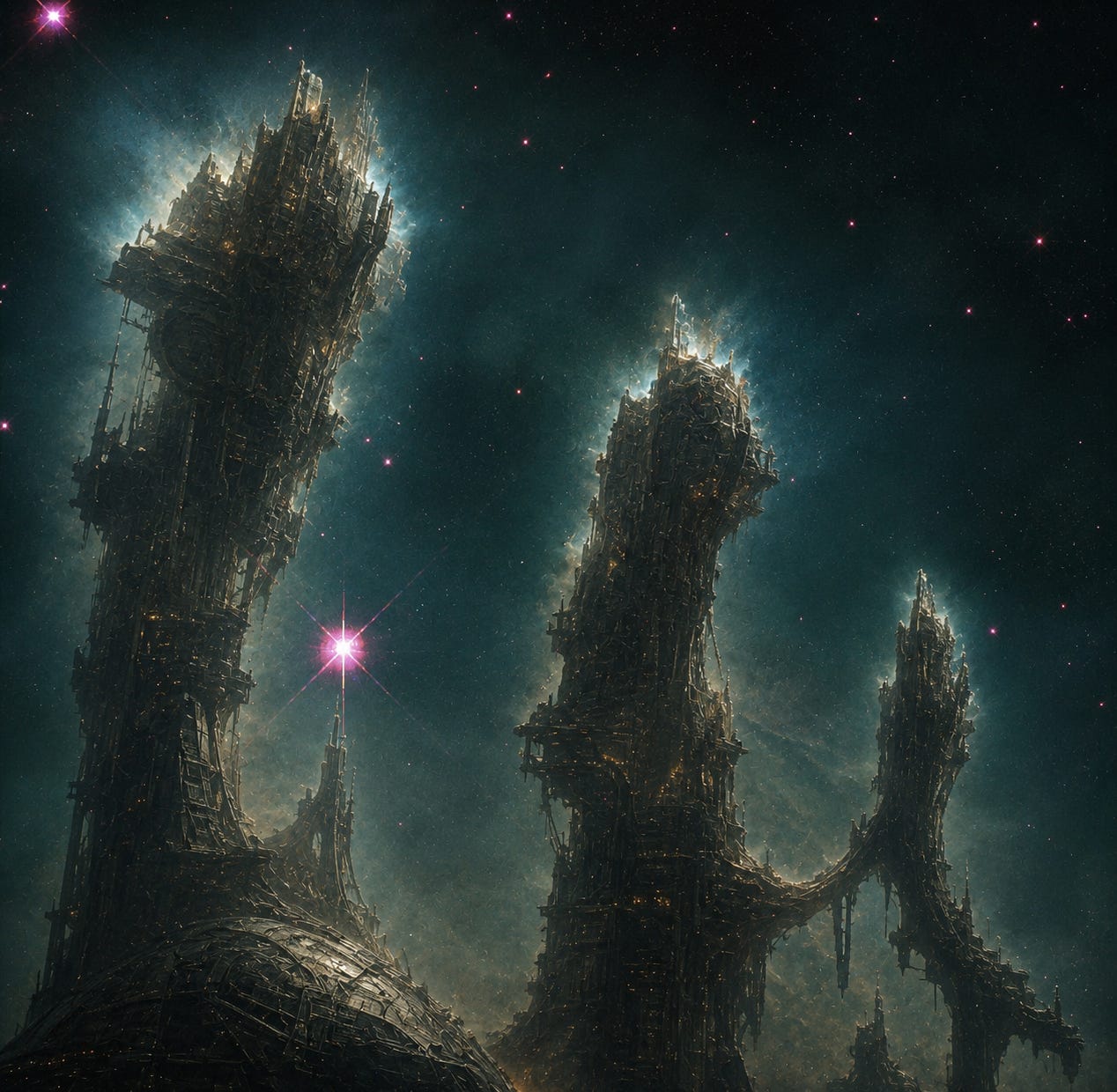
The search for alien megastructures is, at its core, a search for life and intelligence out there.
We can imagine ourselves building things like Dyson spheres, Halos, the Ringworld, and more in our own future. Our drives toward resource and energy production and use as well as to expand our own civilization and biosphere tell us that perhaps there could be others out there who have thought or felt or acted the same. It’s not a guarantee: perhaps many alien civilizations reach some peak where building at scale in space is no longer an interest for them. But there could be some out there who’ve built these things. And it’s worth considering that in our own searches.
Not only do things like Halo and Ringworld and Dyson spheres make for fun sci-fi, but they also inspire us to wonder about the intentions and actions of our possible alien neighbors in the cosmos.
Alien megastructures themselves fall into a realm of passive technosignatures, which don’t inherently require intention for our discovery. Unlike receiving an intentionally constructed and sent message, things like industrial gases in atmospheres, apparent alteration of planetary system orbits, and the brightening and dimming of starlight from megastructures are all important targets for us to consider both in the search for alien life as well as SETI. And, much like some of these other possible signs, alien megastructures wouldn’t inherently require a civilization to still be around.
We have examples in our own world of past civilizations that built remarkable things. In some cases, their constructions are so remarkable and they are so removed from us in time that some modern people (often tending to lack a depth of knowledge of history and culture) will believe that humans couldn’t have built such things. We see this with Egyptian and Mayan pyramids, the Nazca lines, and more. Perhaps there are real alien constructions out there where the modern alien civilization has long ago forgotten how or why their own ancestors built some grand construction. Or, perhaps sadly, maybe there are alien megastructures built long ago where the civilization itself has long since collapsed or been destroyed or even elected to leave the megastructure behind and seek out some other form of existence in the cosmos.
The ancient mythologies were not wrong to treat the impulse to build at cosmic scale as something that changes everything. Much as our ancestors envisioned great constructions daring the attention of the gods as beings from beyond, maybe some alien civilization out there may draw our attention from beyond. Maybe our own constructions in the not-too-distant future will do the same for us.
We haven’t found an alien megastructure yet, but it could happen.
Thanks as always for reading.
Lots more to come in our Astrobiology 101 series (I try to publish at least one piece in this series each month). I also have some more works in the Panzoic Effect, the mythology of alien life, the nature of communication with aliens, and far more coming down the pipeline.
Until next time, stay curious!
No posts
Comments
Nothing yet. Say the first thing.
Sign in to join the conversation.