
Not simply anger. We have had anger for decades. Not merely political division. They have been feeding us that for as long as I can remember.
This feels different.
It feels like withdrawal.
People are withdrawing their trust from institutions that once commanded it automatically. Government. Medicine. Academia. Corporate media. Banking. Political parties. Even the idea that some credentialed authority somewhere necessarily knows what is best for us.
Anger doesn’t necessarily threaten a system. It can often be redirected, monetized and used to justify more control.
The deeper threat comes when ordinary people stop believing the institutions ruling them are legitimate.
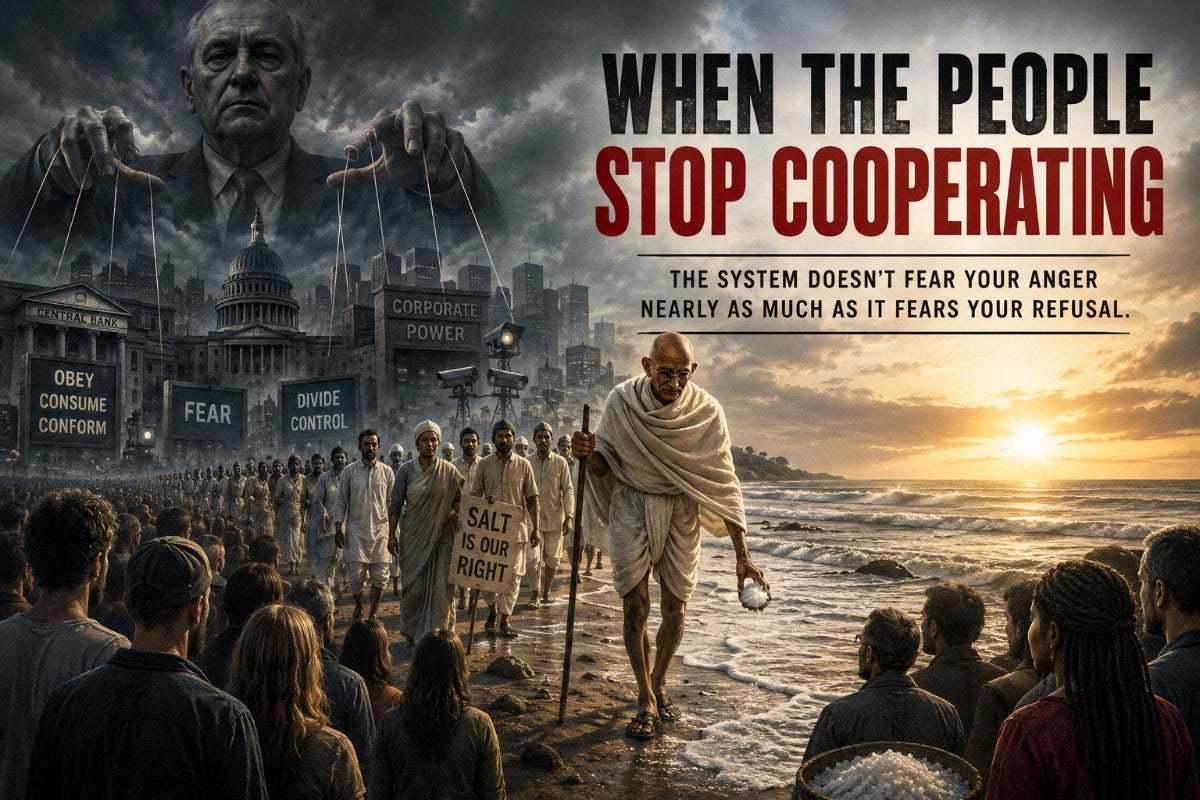
Gandhi’s Salt March demonstrated how something as simple as refusing an unjust rule can expose the dependence of power on cooperation.
Real resistance doesn’t have to mean violence. It can mean refusing fear, manufactured division and unnecessary dependency.
A system ultimately depends upon millions of ordinary people continuing to participate in it.
Paul Cudenec recently published an essay called Our Revolt Will Be Raw.
His language is deliberately visceral.
He describes humanity as a cornered animal finally discovering the strength to fight back against a system tightening around it.
I understand the impulse.
People are struggling with housing costs, food prices, debt and declining purchasing power while wealth becomes increasingly concentrated.
We are watching the expansion of digital surveillance, artificial intelligence, biometric identification and increasingly sophisticated systems capable of tracking human behavior.
Wars continue.
Governments borrow sums ordinary people can barely comprehend.
Political institutions promise change while somehow the machinery keeps moving in roughly the same direction.
And every few years we’re given another existential emergency requiring just a little more obedience.
Eventually people become suspicious.
Eventually they become angry.
Eventually they begin asking the dangerous question:
What if I simply stop cooperating?
That question interests me more than revolution.
Power understands anger.
It has had thousands of years of practice.
An angry crowd gathers.
Police arrive.
Someone throws something.
Windows break.
Cameras capture the most dramatic images.
Politicians condemn the violence.
Media outlets choose their preferred villains.
Emergency powers expand.
Surveillance increases.
Half the population cheers while the other half screams.
And everyone goes home even more divided than before.
The machine keeps running.
Sometimes anger even strengthens the thing it was supposed to destroy.
That doesn’t mean anger isn’t justified.
It means anger is predictable.
And anything predictable can eventually be managed.
But refusal is different.
Quiet refusal gives the machine very little to grab.
History gives us one extraordinary example…
In March 1930, Mohandas Gandhi began walking.
Britain controlled India, including something as basic as salt.
Under British colonial law, Indians could not simply gather or produce their own salt freely. Salt production was regulated and taxed.
Think about the symbolism of that.
The ocean is sitting there.
The sun evaporates the water.
Salt remains.
Nature provides it.
And an empire says:
You cannot have that unless you go through us.
Gandhi understood that salt represented something much larger than salt.
So he began walking from Sabarmati Ashram toward the coastal village of Dandi.
The journey was roughly 240 miles.
At first the procession was relatively small.
Then people joined.
And more joined.
Villages came out to watch.
The march became a national event.
When Gandhi finally reached the Arabian Sea, he picked up salt from the shore and deliberately violated British law.
A handful of salt.
That’s all.
No army.
No artillery.
No palace stormed.
No king dragged from his throne.
Just a human being bending down and effectively saying:
I no longer recognize your authority over this.
The British Empire possessed weapons, police, prisons, courts, bureaucracy and enormous financial resources.
Gandhi had salt.
Yet the empire had a vulnerability all centralized systems share.
It required cooperation.
We are taught to imagine power flowing downward.
Presidents command governments.
Governments command agencies.
Agencies issue regulations.
Corporations employ workers.
Banks issue money and credit.
Institutions establish what is acceptable.
Therefore, the people at the top possess power.
But that is only half the picture.
Power also flows upward.
A president needs administrators.
Administrators need employees.
Corporations need workers.
Banks need borrowers.
Media organizations need viewers.
Technology platforms need users.
Governments need taxpayers.
Armies need soldiers.
And every institution needs some degree of public acceptance.
Which means the enormous pyramid we call “the system” rests upon something surprisingly fragile:
That doesn’t mean you can simply stop paying your electric bill and declare yourself sovereign.
Reality is more complicated than slogans.
We are deeply embedded in systems upon which we genuinely depend.
But it does mean that institutional power isn’t quite as absolute as it appears.
The machine requires human beings to keep turning its gears.
This is where I differ somewhat from Cudenec’s image of raw revolt.
Perhaps the uprising doesn’t arrive as one enormous explosion.
Perhaps it arrives as millions of small withdrawals.
A parent begins questioning what the school is teaching.
A patient asks the doctor to explain rather than simply obeying.
A viewer turns off the television.
A reader stops believing headlines automatically.
Someone begins buying food from a local farmer.
Someone leaves a social-media platform.
Someone starts a small business.
Someone grows tomatoes.
Someone repairs something rather than replacing it.
Someone talks to the neighbor whom political propaganda says should be an enemy.
Someone says:
No.
Not violently.
Not theatrically.
Just no.
Taken individually, these acts appear insignificant.
So did picking up a handful of salt.
One of the most powerful forms of noncooperation may simply be refusing to hate one another.
Look at how much energy is invested in keeping populations divided.
Left against Right.
Black against white.
Young against old.
Men against women.
Religious against secular.
Vaccinated against unvaccinated.
Urban against rural.
One nation against another.
Every disagreement becomes another identity.
Every identity gets a uniform.
And every uniform needs an enemy.
Once you’ve accepted the enemy, someone else gets to tell you what must be done about him.
That is an extraordinary transfer of power.
What happens if we refuse it?
Not if we suddenly agree about everything.
We never will.
But what if we simply stop allowing disagreement to be converted into hatred?
That would remove an enormous control mechanism overnight.
There is another part of Gandhi’s example that gets overlooked.
Noncooperation wasn’t cowardice.
It required discipline.
It is easy to scream at someone.
It is harder to refuse to become what you oppose.
Gandhi called his approach satyagraha—often translated as “truth force.”
The idea wasn’t merely passive resistance.
It was that a human being could refuse cooperation with injustice while refusing to surrender his humanity in the process.
That distinction matters.
Because if resistance becomes hatred, the system has already won part of the battle.
You may overthrow the people occupying the palace.
But if you carry their consciousness into the new palace, you’ve changed nothing except personnel.
History is full of revolutions that discovered this too late.
Yesterday’s revolutionaries become tomorrow’s bureaucrats.
Yesterday’s victims become tomorrow’s censors.
Yesterday’s rebels discover that power feels pretty good once they’re holding it.
The cage gets painted.
The prisoners celebrate.
And eventually someone notices the door is still locked.
So perhaps the first act of noncooperation is internal.
Stop allowing fear to make your decisions.
Stop outsourcing your perception.
Stop assuming credentials equal wisdom.
Stop believing something merely because your political tribe believes it.
Stop believing the alternative merely because the opposing tribe believes the first thing.
Stop asking permission to notice what you notice.
That doesn’t mean believing every contrarian claim on the internet.
That’s just another form of outsourcing your mind.
It means recovering something much more basic:
your own judgment.
Listen.
Observe.
Question.
Compare.
Change your mind when the evidence requires it.
Say “I don’t know” when you don’t know.
There is tremendous freedom in those three words.
The great illusion of centralized power is that ordinary people are irrelevant.
I don’t believe that anymore.
The system needs our attention.
It needs our labor.
It needs our consumption.
It needs our debt.
It needs our fear.
It needs our outrage.
Most of all, it needs our belief.
Without enough of those things, the machinery begins to sputter.
That doesn’t mean we should burn it down.
There are hospitals in that machinery.
Water systems.
Electric grids.
Farms.
Factories.
Truckers.
Engineers.
People doing useful and necessary work every day.
Civilization itself isn’t the enemy.
Human cooperation isn’t the enemy.
The problem begins when cooperation becomes dependency and dependency becomes control.
The answer isn’t chaos.
It is remembering that institutions exist to serve human beings—not the other way around.
Maybe that’s why Gandhi walking toward the sea still matters nearly a century later.
He exposed something extraordinarily simple.
The empire appeared enormous.
The individual appeared tiny.
Yet the empire needed millions of those tiny individuals to continue behaving as though the empire’s authority was unquestionable.
Gandhi questioned it.
Then others questioned it.
Then millions did.
The British didn’t leave India the next morning.
History rarely moves that cleanly.
But something had changed.
The spell had been broken.
And perhaps that’s what we’re watching now.
Not revolution.
Not yet.
Maybe something quieter.
A population looking at institutions that once seemed permanent and asking:
Why am I still cooperating with this?
That question will produce different answers for different people.
Good.
There doesn’t need to be another centralized movement telling everyone what to do.
We’ve had enough people telling everyone what to do.
Maybe the next revolution doesn’t need leaders.
Maybe it needs adults.
People capable of saying yes when yes is warranted.
No when no is required.
And I don’t know when nobody really knows.
People who refuse fear.
People who refuse hatred.
People who refuse manufactured enemies.
People who refuse to surrender their judgment merely because somebody with a title demands it.
Paul Cudenec may be right about one thing.
Something primal is stirring.
But perhaps its most powerful expression won’t be smashing the machine.
Perhaps it will be millions of human beings quietly withdrawing the one resource every system ultimately requires:
their consent.
The system doesn’t fear your anger nearly as much as it fears your refusal.
— Lone Wolf


Our revolt will be raw by Paul Cudenec
Walter Russell — The Universal One
Clif High — Event Stream and Consciousness Cosmology
Richard Berry (Lone Wolf) — Consciousness Is Primary Framework


No posts
Comments
Nothing yet. Say the first thing.
Sign in to join the conversation.