
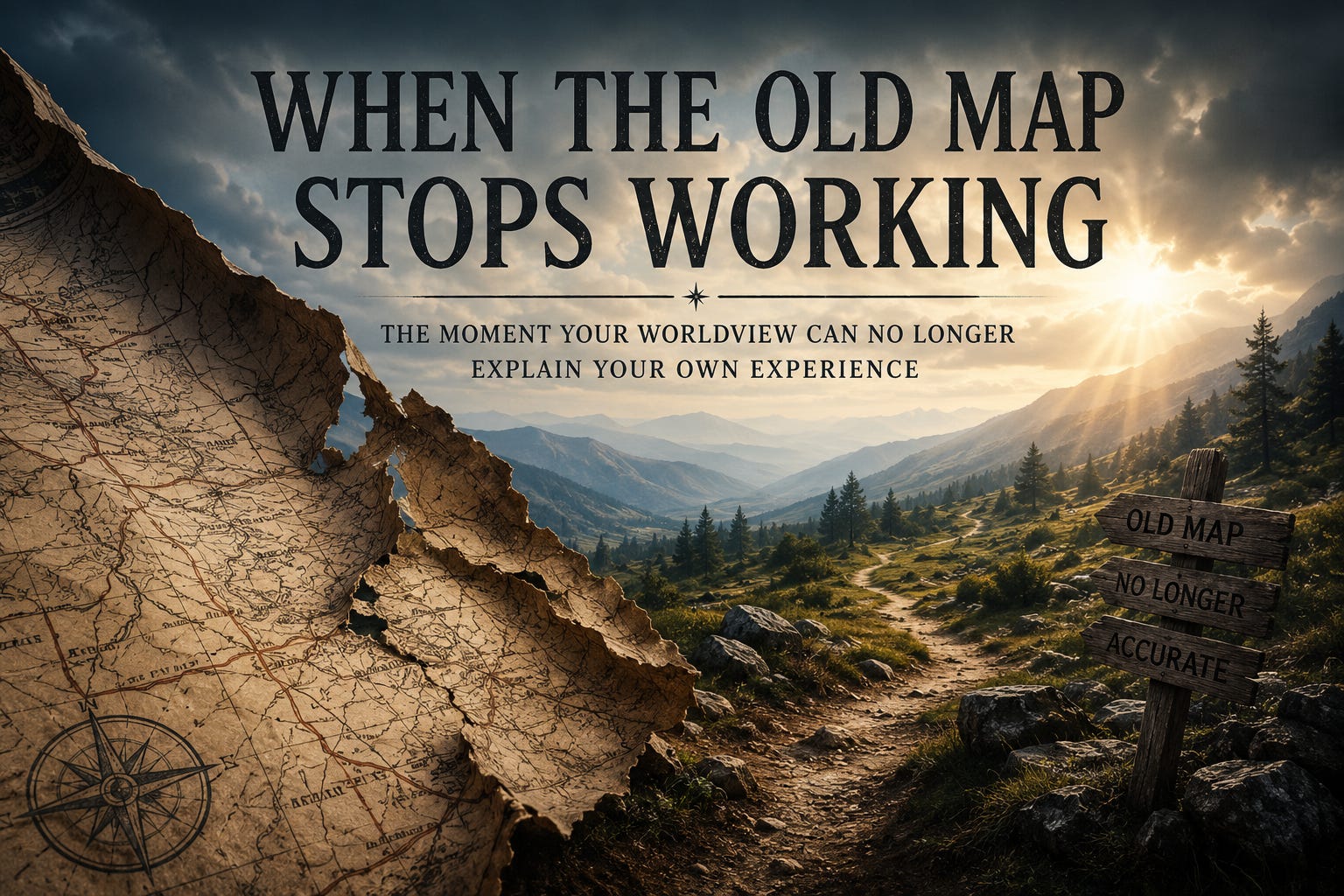
There comes a point when adding more information to the old worldview doesn’t help.
The problem isn’t missing information.
Most of us don’t realize we’re carrying a map.
It tells us what is possible and impossible. Who can be trusted. What counts as evidence. What success looks like. What happens when we get sick. What we’re supposed to do with our lives. Even what questions are reasonable to ask.
We didn’t necessarily draw this map ourselves.
Much of it was handed to us.
Parents gave us some of it. School added more. Religion, science, television, medicine, government, culture, friends and experience filled in the remaining territory.
By adulthood, the map can feel indistinguishable from the landscape.
And suddenly the roads aren’t where the map says they should be.
For a long time, inconsistencies are easy to ignore.
One contradiction here.
An unanswered question there.
Something you personally experience that doesn’t quite fit the official explanation.
Most of us simply fold the map differently and keep walking.
We are remarkably good at this.
We rationalize.
We compartmentalize.
We tell ourselves there must be an explanation we don’t understand yet.
And sometimes there is.
Changing your entire understanding of reality every time something surprises you would be foolish. A good map should survive a few wrong turns.
But eventually there can come a moment when the exceptions stop looking like exceptions.
The contradictions begin forming a pattern.
And that is when things get interesting.
Because now you face a choice.
Keep modifying the old map.
Or consider the possibility that you are standing in territory it was never designed to describe.
The philosopher Alfred Korzybski famously said:
“The map is not the territory.”
Simple sentence.
Enormous implications.
A map is a representation of reality. It is not reality itself.
The same is true of every worldview.
Materialism is a map.
Religion is a map.
Political ideology is a map.
Modern medicine is a map.
Mysticism is a map.
Even the ideas I write about here are maps.
Every system selects certain features of reality, gives them names, establishes relationships between them and creates a framework for navigating the world.
That can be enormously useful.
The trouble begins when we forget what we’re holding.
A map should help us navigate reality.
Instead, we often demand that reality conform to the map.
When something doesn’t fit, we don’t question the map.
We question the experience.
That reversal may explain far more about human behavior than we realize.
This connects directly to what I wrote about in The Normies Cannot Hear You.
People don’t necessarily reject information because they’re stupid.
Sometimes they’re protecting the map that allows their world to make sense.
Pull out one small piece and nothing happens.
Pull out a load-bearing piece and the whole structure may shake.
Imagine discovering that something you trusted for forty years wasn’t what you believed it was.
That isn’t simply receiving new information.
It can mean rewriting decades of personal history.
Decisions you made.
People you trusted.
Things you defended.
Things you ridiculed.
Things you taught your children.
Suddenly the question isn’t:
“Is this new information true?”
The deeper question becomes:
“Who am I if it is?”
That is a much harder question.
And it explains why throwing more evidence at someone often accomplishes nothing.
You’re showing them a different map while they’re still trying to keep their old world from collapsing.
There is another way the map changes.
Life changes it for you.
A marriage ends.
A career disappears.
Someone dies.
Your health changes.
Your body stops doing something you always assumed it would do.
The future you quietly expected to arrive simply doesn’t.
Suddenly you’re standing somewhere you never planned to be.
I have learned something about this firsthand.
There was a version of my future that included independence, familiar routines, golf, my own surroundings and the ordinary freedom of deciding what I would do with my day.
Living in a care center and learning again what my body can and cannot do wasn’t territory I had marked on the map.
And an interesting thing happens when enough of the familiar world falls away.
You begin discovering which parts of your identity were actually yours and which depended upon circumstances remaining unchanged.
Possessions look different.
Time looks different.
Independence looks different.
Even the meaning of progress changes.
The old question might have been:
How do I get my old life back?
Eventually another question appears:
This is the part we rarely talk about.
When an old worldview breaks, a new one doesn’t necessarily appear the following Tuesday.
There is an in-between place.
You know the old explanation no longer works.
But you don’t yet know what replaces it.
That can feel like being lost.
Maybe it is.
But being lost isn’t always failure.
Sometimes it simply means the old coordinates are useless.
This is where people become vulnerable to grabbing the first replacement map offered to them.
A guru.
A political movement.
A spiritual system.
A conspiracy theory.
A scientific theory.
An online tribe.
Anything that makes uncertainty disappear.
I understand the temptation.
Certainty is comfortable.
But replacing one rigid map with another isn’t awakening.
It’s changing cartographers.
There is another possibility.
Stay in the wilderness for a while.
Look around.
This is where the previous essay enters the story.
If the old map is gone, how do you navigate?
You pay attention.
Not blindly.
Not foolishly.
Not by believing every intuition, coincidence or strange idea that wanders through your head.
You observe.
You test.
You notice patterns.
You compare what you were told with what you actually experience.
You become willing to say three extremely useful words:
Those words are not weakness.
They create space.
And in that space another kind of perception can begin operating.
You notice what feels coherent before you can explain why.
You recognize patterns before you’ve assembled the argument.
You begin distinguishing between fear, wishful thinking and something quieter.
Call it intuition.
Call it direct knowing.
Call it pattern recognition.
Call it the Field.
The label matters less to me than the experience.
Something changes when we stop demanding that reality first receive permission from our worldview before we are willing to see it.
There is a trap here too.
Discovering that one map was incomplete doesn’t mean maps are useless.
We still need reason.
We still need evidence.
We still need other people.
We still need the accumulated knowledge of those who walked through the territory before us.
The mistake isn’t using maps.
The mistake is worshipping them.
A useful map should remain erasable.
New information should be able to change it.
Experience should be able to challenge it.
And occasionally we should be willing to write in the margin:
Here be dragons. I don’t know what this is yet.
That is a surprisingly liberating sentence.
I used to think transformation meant arriving somewhere.
You learn enough.
You figure things out.
You finally understand how reality works.
I’m less convinced of that now.
Maybe transformation is becoming comfortable enough with uncertainty that you no longer require a finished map.
You carry a pencil instead.
You walk.
You observe.
You correct your course.
You listen.
Sometimes you follow the road.
Sometimes you notice a trail nobody bothered to draw.
And sometimes life drops you into completely unfamiliar territory and asks you to discover who you are without the landmarks you thought you needed.
That isn’t easy.
But perhaps the goal was never to possess the perfect map.
The landscape was always larger than the paper.
Walter Russell — The Universal One
Clif High — Event Stream and Consciousness Cosmology
Richard Berry (Lone Wolf) — Consciousness Is Primary Framework

No posts
Comments
Nothing yet. Say the first thing.
Sign in to join the conversation.