
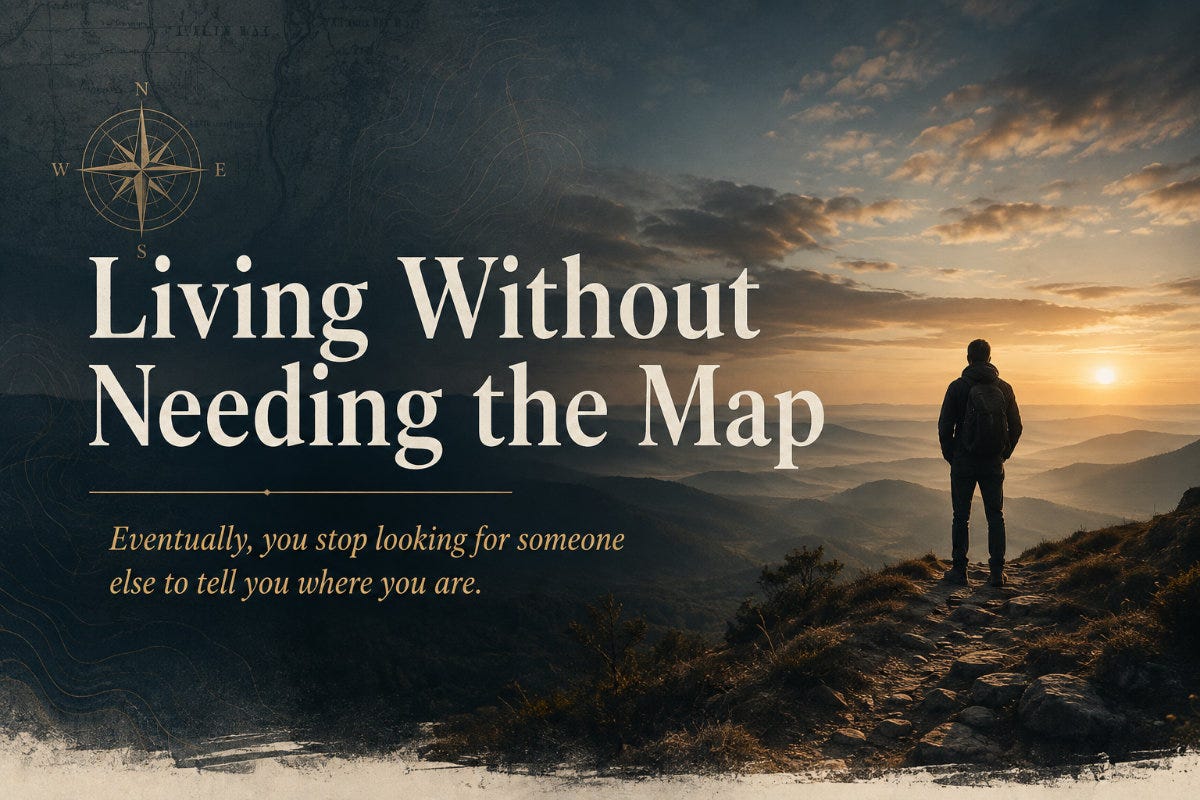
The institutions you once trusted no longer seem infallible. The experts contradict one another. The stories you inherited begin to crack. Things you once accepted without question suddenly look different.
And for a while, you go looking for another map.
A better one.
A truer one.
You find new writers, new researchers, new teachers, new communities. You read the books you were never told about. You listen to people outside the approved channels. You discover forgotten history, alternative explanations, different ways of understanding the world.
Some of it is valuable.
Some of it changes you permanently.
But eventually another uncomfortable realization arrives.
You are still looking for a map.
You may have rejected the old authorities, but somewhere inside you remains the hope that another authority will finally explain everything.
Someone who has connected all the dots.
Someone who knows what is really happening.
Someone who can tell you where you are.
That is the last dependency.
And perhaps the hardest one to surrender.
When an old worldview collapses, the temptation is enormous to replace it immediately.
We don’t like empty spaces.
Uncertainty makes us uncomfortable.
So when one story fails, we reach for another.
This happens everywhere.
People leave one political tribe and join another.
They reject conventional medicine and adopt an alternative system with equal rigidity.
They abandon one religion and turn another philosophy into doctrine.
They stop trusting mainstream media and begin trusting alternative media automatically.
Different map.
Same relationship to the map.
The names change.
The dependency doesn’t.
Someone still has to tell us what is true.
And this is where discernment becomes more difficult than simply becoming skeptical.
It is relatively easy to distrust the people you already disagree with.
The harder task is questioning the people who tell you exactly what you want to hear.
Especially the ones who make you feel that you are among the few who finally understand what is happening.
That feeling can be intoxicating.
It can also make you very easy to fool.
There was a time when I thought uncertainty was a weakness.
If you had studied something long enough, surely you should know what you believed.
Now I think almost the opposite.
There are things I believe strongly.
There are things I suspect.
There are things I consider possible.
And there are things where the only honest answer is:
Those three words have become surprisingly comfortable.
I don’t know exactly what happened.
I don’t know who is telling the truth.
I don’t know whether this theory will survive another five years.
I don’t know what the world will look like next.
And I no longer feel compelled to fill those spaces immediately.
That isn’t surrender.
It is refusing to manufacture certainty just because uncertainty makes me uncomfortable.
Sometimes the evidence isn’t there yet.
Sometimes two explanations remain possible.
Sometimes the person we distrust happens to be right.
Sometimes the person we trust happens to be wrong.
Reality owes no loyalty to our worldview.
This series began with a simple problem.
Sometimes people cannot hear what you are saying because the information threatens the structure through which they understand the world.
But there was always another side to that observation.
Neither can we.
None of us stands outside the human condition.
None of us sees the whole terrain.
We all have assumptions.
We all have emotional attachments.
We all have things we desperately want to be true.
And we all have blind spots.
The person who recognizes this has an advantage—not because he becomes impossible to deceive, but because he becomes a little harder to capture.
He can change his mind.
He can notice when the evidence stops supporting the story.
He can listen without immediately surrendering judgment.
He can say, “That doesn’t make sense to me.”
He can also say, “I was wrong.”
Those may be two of the most important sentences a person can learn.
A map tells you where everything is supposed to be.
A compass does something different.
It gives you orientation.
That distinction matters.
I increasingly care less about possessing a complete explanation of the world and more about maintaining a few reliable bearings.
Does this match what I can observe?
Is the claim internally coherent?
What assumptions are being smuggled into the argument?
Who benefits if I believe it?
What evidence would change my mind?
Am I examining the claim—or defending my identity?
Am I afraid of the answer?
Am I hoping for a particular answer?
And perhaps most importantly:
What do I actually know, and what have I merely been told?
Those questions don’t produce a perfect worldview.
They produce something more useful.
Orientation.
You can move with orientation.
You can correct course.
You can discover that the road you trusted ends at a cliff and turn around without having to pretend the cliff isn’t there.
Modern life has trained us to outsource enormous portions of perception.
We look at a screen to find out whether it is cold outside.
We consult an expert to tell us whether we feel well.
We check statistics to determine whether our neighborhood feels safe.
We ask algorithms what we should read, watch, buy, fear and think about next.
Information is useful.
Expertise is useful.
Technology is useful.
But something strange happens when the representation of reality becomes more authoritative than reality itself.
Eventually you stop looking out the window.
One of the things I have tried to recover is something much simpler:
Pay attention.
Watch.
Listen.
Notice patterns.
Notice your own reactions.
Notice when someone’s explanation requires you to ignore what is directly in front of you.
And notice when your own explanation does the same thing.
That last part matters.
Otherwise “trust yourself” becomes just another slogan.
Your perceptions can be wrong.
Your intuition can be contaminated by fear.
Your hopes can masquerade as insight.
Your previous beliefs can shape what you think you are seeing.
So trusting yourself does not mean believing every thought that crosses your mind.
It means developing a relationship with your own perception strong enough that you can examine it rather than automatically obey it.
That is a very different thing.
There is something deeply liberating about realizing that nobody gets the final word on reality.
Not the government.
Not the university.
Not the television.
Not the alternative researcher.
Not the bestselling author.
Not the charismatic teacher.
Not the guy with three million followers.
And certainly not the Lone Wolf.
Compare it with experience.
Keep what survives.
Discard what doesn’t.
And leave some questions open.
You don’t need to join every camp.
You don’t need an opinion about everything.
You don’t need to defend yesterday’s conclusions simply because you said them publicly.
You don’t even need everyone around you to understand what you see.
Eventually something changes.
You stop asking:
Who should I trust?
And begin asking:
How should I evaluate what I encounter?
Those questions sound similar.
They are worlds apart.
The first is looking for an authority.
The second is developing discernment.
And discernment is slower.
Messier.
Sometimes lonely.
There is no certificate at the end.
No moment when you become officially “awake.”
No finish line where deception becomes impossible.
You simply become more willing to look.
More willing to question.
More willing to wait.
More willing to admit uncertainty.
More willing to change direction.
And less frightened when the map says there should be a road beneath your feet and you can clearly see that there isn’t one.
Then you look around.
You check the terrain.
You find your bearings.
And you keep walking.
Maybe that was the destination of this entire series.
Not another worldview.
Not another doctrine.
Not another collection of people telling us what reality is.
Just the gradual recovery of something we had forgotten we possessed.
Our own capacity to perceive.
To question.
To learn.
To correct course.
To stand in uncertainty without immediately filling it with somebody else’s certainty.
The old map may have stopped working.
You may never find a perfect replacement.
Perhaps you were never supposed to.
Eventually, you stop looking for someone else to tell you where you are.

Walter Russell — The Universal One
Clif High — Event Stream and Consciousness Cosmology
Richard Berry (Lone Wolf) — Consciousness Is Primary Framework

No posts
Comments
Nothing yet. Say the first thing.
Sign in to join the conversation.