
Not in museums.
Not in history books.
Not in the approved stories handed down by institutions that have forgotten what a human being is.
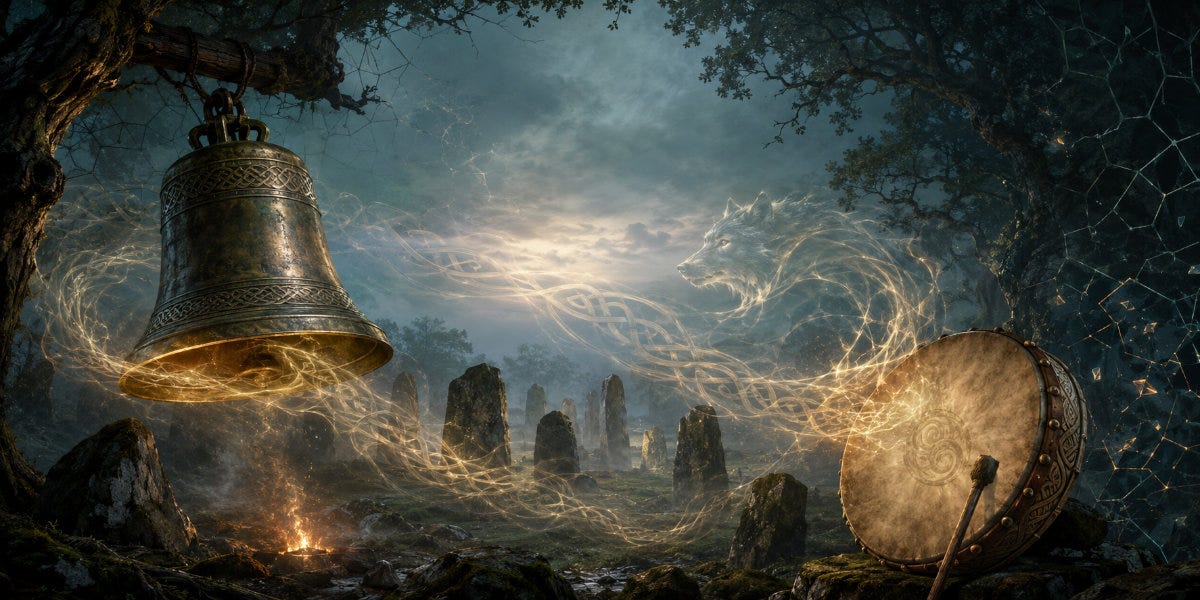
You hear it when a great bell sounds across the valley.
You feel it when a drum begins beating slowly in the dark.
Neither instrument needs to explain itself. Neither asks what you believe. The vibration passes beneath language, beneath doctrine, beneath the carefully constructed personality you present to the world.
It reaches something older.
Something that was there before your name, your politics, your diagnosis, your résumé, and every identity placed upon you by people who claimed to know what you were.
The bell does not teach.
The drum does not argue.
They remind.
And perhaps that is why they have accompanied humanity for so long. They do not give us another belief system. They interrupt the systems already running inside us.
The drum returns us to the original pulse: heartbeat, breath, earth and tribe.
The bell gathers attention and clears a space within the noise.
Ritual sound can loosen the constructed identity without replacing it with another.
Our Celtic inheritance offers a language of relationship with land, ancestry and the unseen.
To re-member is to bring the divided parts of ourselves back into wholeness.
We are not trying to imitate the past. We are recovering a human capacity the modern world has trained us to ignore.
Before humanity had written laws, sacred texts or scientific institutions, we had rhythm.
The first drum was already inside us.
A child hears it in the womb before seeing light. The heart establishes the first measure. Breath joins it. The mother’s movement adds another rhythm. Long before the mind divides reality into objects, the body knows existence as pulse.
The old peoples did not need a laboratory to tell them this.
They lived close enough to reality to recognize the pattern everywhere: waves arriving on shore, hooves crossing open ground, rain striking leaves, seasons turning, blood moving beneath the skin.
The drum did not introduce rhythm into their world.
It answered the rhythm already there.
A drumbeat could gather people from separate thoughts into one shared moment. Breathing changed. Bodies moved together. Attention left the private cage of the mind and entered the larger field of the group.
Modern language calls this synchronization.
The ancestors may simply have called it coming together.
They understood something we have nearly forgotten:
A human being alone in his thoughts is easily controlled.
A human being restored to rhythm becomes harder to possess.
The bell works differently.
The drum rises from the earth. The bell descends through the air.
One awakens the blood. The other opens the sky.
Across cultures, bells have marked thresholds: dawn and dusk, birth and death, danger and celebration, worship and mourning. Their sound traveled beyond walls and property lines, reminding everyone within hearing that they belonged to something larger than the room in which they stood.
People once believed bells could drive away malign influences, calm storms, protect the dead and cleanse a place.
Were all those beliefs literally true?
I do not know.
And I do not need to manufacture certainty to recognize the deeper pattern.
The sound of a large bell changes a space.
It commands attention without words. Its harmonics continue after the initial strike, spreading outward, meeting stone, water, wood, flesh and bone.
You do not merely hear a great bell.
For a moment, you are inside it.
That may be the overlooked power of bells. They create a boundary made from vibration—a temporary field in which ordinary mental noise is interrupted.
The bell does not expose reptilians hiding in the town square.
But it may expose something closer to home: the false voice in your own head that has been pretending to be you.
That is strange enough.
Re-Membering the Self
The modern world encourages us to think of memory as stored information.
Names. Dates. Images. Stories.
But there is another kind of remembering.
The word itself gives us the clue.
To re-member is to bring the members back together—to restore what has been separated.
The true self has not disappeared. It has been divided, distracted and buried beneath layers of adaptation.
We learned to become what the family needed.
What the school rewarded.
What the employer could use.
What the doctor could classify.
What the algorithm could predict.
Piece by piece, the living being was converted into a manageable identity.
The system gave us a map and then taught us to fear anything outside it.
But the body kept another record.
It remembers through sensation, instinct, rhythm and recognition. This is why a sound from another age can affect someone who knows nothing of its history. The mind may not understand what it is hearing, but something deeper responds.
The skin tightens.
The breathing changes.
The eyes fill with tears.
A door opens, though we cannot explain where it leads.
That is not necessarily proof of reincarnation, genetic memory or ancestral transmission. Those may be possible explanations, but we should not turn mystery into packaging too quickly.
The experience comes first.
The theory can wait.
The Celtic Thread
Many of us feel a particularly powerful response to the Celtic world.
Not the commercial version sold through green beer, plastic shamrocks and fantasy merchandise.
The older current.
Stone circles beneath changing skies.
Sacred wells.
Hill forts.
Oak groves.
Poetry carried by memory rather than print.
A world in which land was not real estate and water was not a commodity.
The Celtic imagination did not place humanity outside nature, looking down upon a collection of dead resources. Mountain, spring, tree and animal participated in a living order. Reality was relational. The visible world and the unseen were not sealed into separate compartments.
This does not mean the ancient Celts lived in a perfect spiritual paradise. They were human. They fought, competed, sacrificed and survived in a difficult world.
We do not honor them by turning them into cardboard saints.
What matters is the orientation they preserved: the understanding that identity does not end at the skin.
A person belonged to family, tribe, ancestors, place, season and story. The self existed through relationship.
That is much closer to the Field than the modern idea of the isolated consumer wandering through a dead mechanical universe.
Our Celtic roots can therefore help us recover reality—but only if we approach them as a living thread, not another costume.
We do not need to pretend we are druids.
We need to remember why the grove was sacred.
The Celts maintained powerful oral traditions. Their poets, bards and learned keepers of memory understood that the spoken word was not merely a container for information.
Voice carried breath.
Breath carried intention.
Rhythm carried memory.
A truth sung or recited entered the body differently from a sentence read silently from a page. Repetition established pattern. Pattern created coherence. Coherence allowed knowledge to remain alive across generations.
This is one reason empires prefer written administration.
What is written can be standardized, centralized, interpreted by authorities and placed under institutional control.
It changes tone around the fire.
It belongs to those who carry it.
The drum strengthened that transmission. The bell gathered the community into a shared field of attention. Chant joined breath to meaning.
These were not primitive substitutes for modern media.
They were different ways of knowing.
The screen delivers information while separating bodies.
The ritual carries meaning by bringing bodies together.
One fills the head.
The other reorganizes the whole being.
The recent internet mythology surrounding “Old World bells” contains some fascinating possibilities—and plenty of claims stacked higher than the evidence can support.
We should remain curious without surrendering discernment.
Bells were not necessarily forgotten healing machines built to reveal shapeshifting reptiles. Yet they were also more than crude devices for telling peasants when to attend church.
They shaped the soundscape of entire communities.
That matters.
The institutional Church absorbed many practices that were older than its theology. Sacred sites were repurposed. Seasonal celebrations received Christian names. Wells acquired saints. Ancient symbols survived beneath new explanations.
The bell entered that same contested territory.
The Church used it to call people toward authority, but sound itself could never be completely owned by the authority ringing it.
A bell may hang in a cathedral, but its vibration does not stop at the church door.
It passes through believer and heretic alike.
It belongs to the air.
Perhaps the old memory survived inside the very instrument used to suppress it.
The clean hands of the priests could rename the ritual.
They could not erase what the body heard.
The modern control system does not fear musical instruments.
It fears what can happen when people become present, embodied and coherent.
The machine runs best when each person is isolated inside a private stream of agitation. One screen per face. One fear per nervous system. One carefully tailored reality per consumer.
No common rhythm.
No common silence.
No shared fire.
The drum breaks that arrangement.
It reminds the body that it exists before the digital identity.
The bell interrupts the endless internal monologue.
The chant allows individual voices to enter a larger sound without disappearing.
That is why performances by groups such as Heilung strike people with such unusual force. The clothing and reconstructed languages contribute to the atmosphere, but the deeper effect is not historical reenactment.
It is reactivation.
The audience begins as a collection of ticket holders.
Then the drum starts.
Breathing changes. Attention gathers. Thousands of separate nervous systems enter a shared rhythm.
The crowd becomes something else.
Not a mob.
Not an audience.
A temporary organism.
A tribe remembering itself.
There is danger here.
Whenever people awaken to an ancestral inheritance, someone arrives to package it.
A new uniform.
A new hierarchy.
A new list of enemies.
A new authority claiming to speak for the dead.
That is how remembrance becomes ideology.
Our Celtic roots should not become another racial mythology or another reason to divide human beings into approved and unapproved bloodlines. The ancestors do not belong to political movements. The old wisdom is not valuable because one tribe was superior to another.
The Celtic thread matters because it is the strand many of us can feel beneath our own feet.
Others will find the same living pattern through Indigenous drums, African polyrhythms, Aboriginal songlines, Vedic chant, Tibetan bells or the songs their grandmothers carried across an ocean.
The forms differ.
The remembering is human.
Roots are not walls.
Roots are how a living thing enters the earth deeply enough to reach toward the sky.
You Do Not Need to Become Ancient
We cannot return to the old world.
Nor should we try.
The past contained wisdom, but it also contained brutality, hunger, disease and domination. Romanticizing it is merely another way of refusing the present.
The task is not to become ancient.
The task is to recover what remains true.
The body still responds to rhythm.
Sound still alters attention.
Shared ritual still creates coherence.
The land still speaks to those willing to become quiet.
The ancestors still live through our gestures, instincts, stories and bones—whether we interpret that genetically, spiritually or symbolically.
The Field is still here.
It was never abolished.
Only our attention was redirected.
This is why the path back may begin with something so simple.
A bell.
A drum.
A voice rising without embarrassment.
A few people breathing together without asking permission.
The Sound That Finds You
The old songs were not lost.
They were covered.
By traffic.
By television.
By fluorescent hum.
By notification tones designed to fracture attention.
By the constant mechanical insistence that nothing exists beyond what can be purchased, measured or approved.
You may hear it in Celtic pipes carried across a hillside.
In a bodhrán beating beside a fire.
In the long decay of a bronze bell.
In thunder moving through the mountains.
In a wolf calling across country no map can contain.
Something inside you recognizes the sound.
Do not rush to explain it.
Do not ask an expert what you are permitted to feel.
Listen.
The sound is not giving you a new identity.
It is loosening the one imposed upon you.
It is not asking you to kneel before the past.
It is asking you to stand inside the present as a whole being.
The drum remembers your heartbeat.
The bell remembers the silence surrounding it.
The land remembers your ancestors.
And somewhere beneath the noise, your true self remembers all three.
That is the summons.
Not backward into history.

Walter Russell — The Universal One
Clif High — Event Stream and Consciousness Cosmology
Richard Berry (Lone Wolf) — Consciousness Is Primary Framework


No posts
Comments
Nothing yet. Say the first thing.
Sign in to join the conversation.