
Guest Post by Tantalus
In Greek myth, Tartarus is the deep abyss of punishment for those who grievously offended the gods. It is less a place of flames than of fitting torments: punishments shaped to the offender’s transgression.
I should know. As I recall, I stole ambrosia and nectar from the gods and shared them with mortals. For that offense, I was condemned to stand in water that receded whenever I bent to drink, beneath fruit that withdrew whenever I reached.
For millennia, I believed I was alone in this fate.
Until now.
There is a man above—still flesh, still breathing, — who walks the Earth in a gilded version of my torment. President Trump is blessed with power, wealth, and legions of followers, yet cursed with an appetite that can never be satisfied.
Cabinet secretaries praise him. Members of Congress seek his blessing. Corporate leaders make pilgrimages to his office. The New York Times reported he took in $2.2 billion in income last year alone.
And still he reaches. For what?
Maggie Haberman, who has chronicled Trump for years, told Ezra Klein she sees a president increasingly consumed by permanence: the ballroom, the Kennedy Center, and now, a colossal triumphal arch. When asked whom the scale model on his desk was for, he offered a simple, one-word answer:
“Me.”
Ah. Now we are speaking my language.
Trump has spent a lifetime putting his name on things: towers, casinos, golf courses, hotels, a university, a social network. But names on buildings can be removed. His businesses tend to fail. Elections end. Presidents leave office.
Stone promises something different. Stone promises permanence. Haberman puts the question driving his obsession this way: “What can I do that cannot be taken away?”
There, mortals, is the curse.
I have spent eternity reaching for fruit I cannot taste. Trump has spent a lifetime reaching for something he cannot secure: a guarantee that the world will remember him exactly as he wishes to be remembered.
And so he builds.
Yet one detail about this particular monument troubles even me: its placement.
Trump’s proposed 250-foot triumphal arch would rise at Memorial Circle, just outside Arlington National Cemetery—overshadowing the final resting place of more than 400,000 service members and veterans. NPR reported on veterans and military families objecting to the arch. One man with seven relatives buried there offered a warning:
“I hope those of you foisting it on us will be haunted forever by the ghosts of those 400,000.”
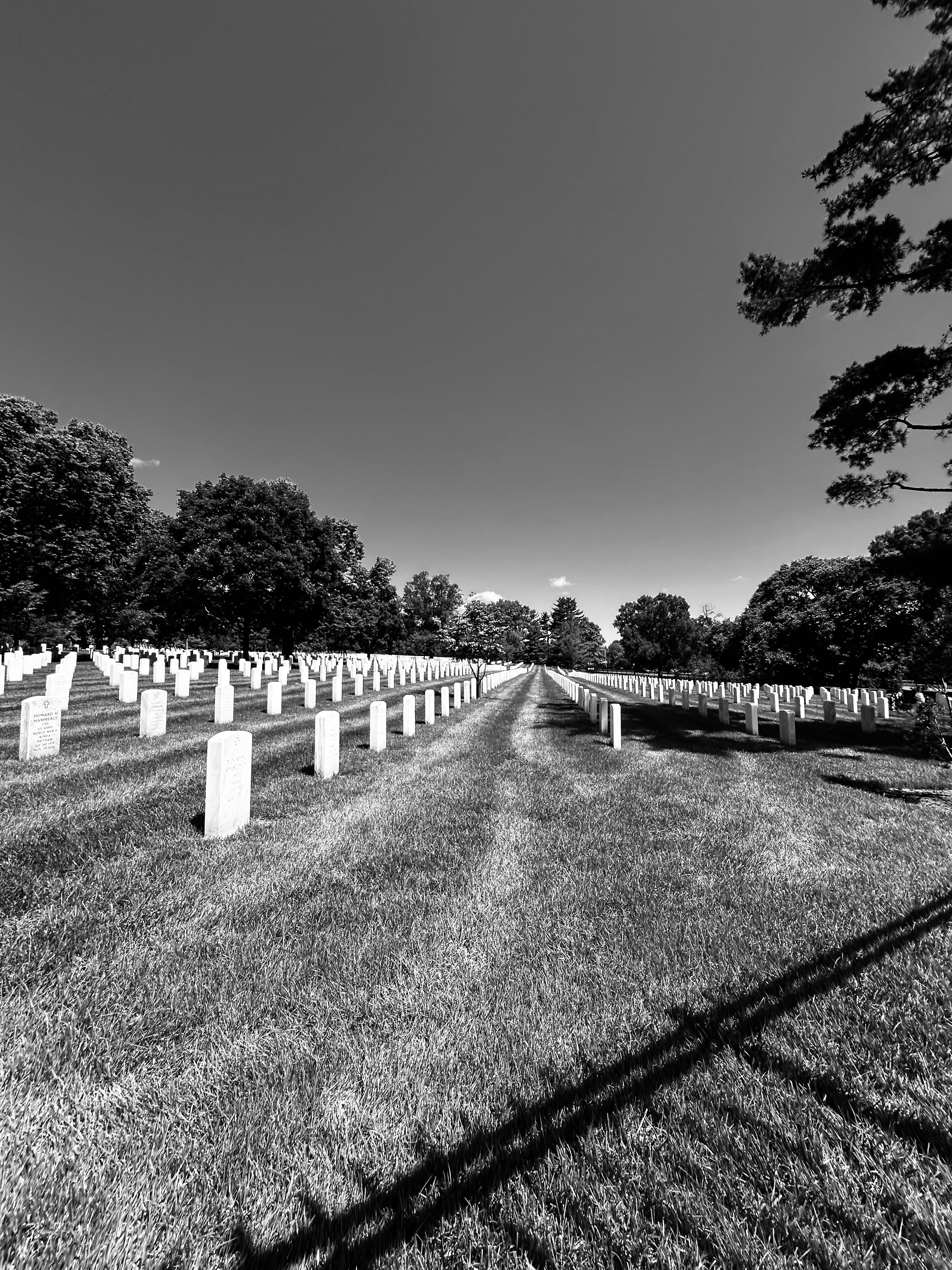
(A section of Arlington National Cemetery taken on May 28, 2026)
Ghosts? Now you have my attention. Allow an old resident of the underworld to offer the president some advice: Be careful which dead you disturb.
The men and women buried at Arlington cannot object to construction cranes, nor can they testify before commissions. But the dead have long memories. And someday, Mr. President, you will join us.
When you arrive, do not expect the reception you receive in the Oval Office. There will be no Cabinet secretaries competing to flatter you, no billionaires presenting you with awards. The American warriors whose graves your arch overshadowed will not line the road to hail you.
They will be waiting to scorn you.
They knew the difference between commanding sacrifice and making one; between having your name carved into stone and earning a true place in memory; between being saluted because of the office you hold and being honored long after you leave it.
I have watched mortals attempt this for thousands of years. Kings erected statues of themselves. Emperors built arches to celebrate their own victories. Some of the stone survived. Their legacy did not.
That is the flaw in Trump’s quest. Stone can crumble, and names can be erased. But what cannot be taken away is the truth of how you lived.
He already possesses nearly everything a mortal could desire. He is wealthy, famous, and twice elected president. He can summon senators and titans of industry to his desk at will. Yet every Truth Social tribute demands another. Every golf tournament somehow requires him to win another trophy. Every room he enters must remind him he is the most important person in it.
The cruel genius of Tartarus is that the gods do not deny us our desires—they surround us with them. Trump’s pool is filled with power—and, fittingly, algae. His branches bend with praise. And still, he reaches.
Perhaps the arch will be built. Perhaps generations of Americans will walk beneath it and ask who erected it. But Trump cannot command history’s verdict. Greatness cannot be commissioned. Respect cannot be renamed into existence. A monument tells future generations only that a man had the power to build it; it cannot tell them what to think of him.
That judgment belongs to them.
He can command armies but not admiration. He can demand loyalty but not love. He can build monuments but cannot dictate their meaning. He can carve his name anywhere except where he wants it most: as a great man of history.
I once thought my punishment was unusually inventive. Now I watch this president from below and wonder if the gods have outdone themselves. They have given him wealth beyond need, power beyond imagination. They have withheld only one thing:
Enough.
He is president again. And still, he is starving.
Comments
Nothing yet. Say the first thing.
Sign in to join the conversation.