

I once coached a client who finally received the job offer she’d been dreaming about. Great title. Solid pay bump. The kind of offer that should have felt like relief—especially because she had been out of work for several months.
Instead, she called me in a panic.
The process had moved fast. Almost too fast. One interviewer said the responsibilities were “still being defined.” Another mentioned casually that the last person in the role had lasted only six months.
The job looked great on paper, but she still had doubts. Her gut was telling her something was off.
When you feel like you really need a job, fear can change the questions you ask yourself. Instead of asking, “Is this a good opportunity?” you start asking, “Can I afford to say no?”
Both questions are valid. But the second can push you toward a decision based on fear rather than clear judgment.
After weeks or months of searching, a job offer can feel like finally being rescued at sea. You’re not stopping to check who’s throwing the life preserver. You’re just grabbing it and holding on for dear life.

That relief can cause you to minimize inconsistencies, skip the hard questions, and accept vague answers you’d never tolerate under different circumstances.
A BambooHR survey found 44% of new hires had regrets or second thoughts about their job within the first week, and nearly a quarter admitted to crying during that time. That’s not a small number of people wondering if they made a mistake. That’s almost half.
And early dissatisfaction often affects how long people expect to stay. According to ZipRecruiter’s Q2 2026 New Hire Survey, 78% of dissatisfied new hires plan to leave within a year. Compare that to the 48% of very satisfied new hires who expect to stay five or more years. How employees feel at the beginning can shape whether they envision a future with the company.
Here’s the part nobody says out loud.
Financial pressure changes which risks you’re willing to accept. But it doesn’t make those risks disappear.
Someone with six months of savings might be able to walk away from a shaky offer. Someone with a mortgage due next week and no backup plan often can’t.
According to Monster’s 2026 WorkWatch Report, 57% of workers say their pay has already fallen behind inflation, and more than half expect layoffs to increase this year. People are saying yes to jobs under real financial strain, not because they’re bad at reading warning signs, but because the stakes of walking away can be high.
So let’s be honest about the goal. It isn’t to eliminate all risk. That’s not possible. It’s to make an informed decision instead of one driven by fear.
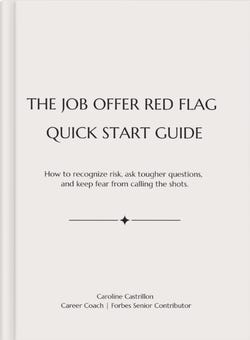
Download my free Job Offer Quick Start Guide to evaluate the role, manager, team, workplace, and offer before saying yes.
You’ll also join Corporate Escape Artist, where we talk about work the way you would if your boss weren’t in the room.
Here’s what I tell clients: A job offer isn’t the finish line. It’s the point when you finally have enough information to ask the tough questions and evaluate the opportunity carefully.
Interviewing is a two-way street. The employer is deciding whether you’re right for the role, but you’re also deciding whether the role is right for you.
I use a five-step framework with clients facing this exact situation: Notice, Question, Verify, Evaluate, and Decide.
Let’s walk through it.
The hiring process isn’t separate from the job. It’s your first experience of how the company communicates, makes decisions, and treats people before you’re even on the payroll.
Delays alone aren’t a red flag. Hiring timelines shift for a hundred different reasons. What matters is how the company handles the delay. Do they tell you what’s happening? Or do your follow-up emails disappear into a void?
Here’s a distinction I ask every client to make: separate the fact from your interpretation of it.
For example:
Fact: The hiring manager interrupted every team member during your panel interview.
Interpretation: This person might be controlling or dismissive.
Write down the fact. Sit with it. Don’t skip straight to the story you’re telling yourself, but don’t talk yourself out of what you saw either.
One moment rarely means much. A pattern does. Pay attention when the same concern surfaces repeatedly, multiple people reinforce it, or the explanation keeps changing.
Stop asking, “How would you describe the culture?” Almost everyone has a rehearsed answer for that question. Instead, ask what happens when someone disagrees with leadership. Ask how a missed deadline gets handled. Ask why the role is open in the first place, and how many people have held it in the last three years.
Listen closely to how they talk about the person who previously held the role. Respectful and specific answers are a good sign. Vague or dismissive ones are worth noting.
According to the same ZipRecruiter survey, 15% of new hires say their initial job description barely matched what they ended up doing, and 26% say they’d restart their job search because of it. So ask what success looks like in the first 90 days, and ask it of more than one person. If the hiring manager and the recruiter describe two different jobs, you’ve learned something important before you’ve signed anything.
Also, don’t skip questions about the manager just because you already like the company. You will spend far more time with your manager than with the mission statement. Ask how they give feedback, how often one-on-ones happen, and what current team members find most challenging about working with them. If nobody can answer that last question honestly, that’s revealing in and of itself.
Compare all the information you were given by the recruiter, hiring manager, and the rest of the team. Then check it against the written job offer itself.
Reach out to one or two former employees if you can. Keep it short. One specific question, not a full audit of the company. Something like, “Did the role match how it was described to you?” may make it easier for someone to respond honestly.
Job seekers also need to verify that the opportunity itself is legitimate. According to a Resume Genius survey of active job seekers, 67% say they’ve suspected a job posting was fake or misleading, and the biggest signals were poor grammar, vague company details, and a salary that seemed too good to be true. If something about the listing feels off, trust that instinct before you invest weeks into the process.

According to a 2026 BBB report on employment scams, reports have more than doubled year over year, driven largely by “task-based” scams where victims are asked to pay small fees to “unlock” earnings that never materialize. The FTC’s own guidance flags a similar pattern across reshipping scams, mystery shopper scams, and fake check schemes. If anyone asks you to pay for a job, deposit a check and send part of it back, or move the conversation away from official company channels and onto WhatsApp, stop all communication right there.
Then read every clause in the written job offer, especially if there’s a signing bonus attached. A generous bonus can look like a gift. A repayment clause that applies under a wide range of circumstances can turn that gift into a serious financial obligation. Ask directly whether you’d owe money back if the company eliminates your role, whether repayment is prorated, and whether it’s based on the gross or net amount you received.
Lawmakers have started scrutinizing these agreements more closely, and it’s about time. According to a 2026 Employee Relations Law Journal article by employment attorneys at Mayer Brown, states including New York and California have recently enacted legislation restricting certain “stay-or-pay” agreements. New York’s Trapped at Work Act, signed into law in December 2025, specifically calls these agreements “unconscionable” and “against public policy.” When state legislatures start using language that strong, it validates the alarm many people feel when they encounter a steep clawback clause.
Once you’ve noticed something, questioned it, and verified it, you still have to decide how to respond. Not every concern carries the same weight.
I recommend clients sort concerns into four buckets:
1. Normal discomfort. Nervousness about starting somewhere new. Fear of not performing well right away. Leaving people you like. This is real, but it’s not evidence of a problem with the job. Acknowledge it and move on.
2. A negotiable issue. Compensation, title, start date, vacation time, hybrid schedule, and relocation support. If one or more of these is off, ask whether it can be resolved before you say no.
3. An unresolved risk. Conflicting descriptions of the role. No one lasting more than a year in the position. Seven interview rounds for an entry-level job. A manager who avoids direct answers. These deserve a closer look before you decide.
4. A potential deal breaker. Dishonesty. Disrespect toward you or the people who came before you. Responsibilities that change significantly after you receive the offer. Pressure to resign your current job before you have anything in writing. When you encounter one of these, don’t let the relief of finally getting a job offer cause you to ignore the warning signs.
The goal is to match your response to the actual level of risk.
Weigh both costs, not just one. Here’s where most people get stuck. They spend all their energy calculating the cost of saying no and almost none considering the cost of saying yes.
Saying no might cost you more time without income, more uncertainty, and the very real fear that another offer isn’t coming soon. That fear isn’t irrational. In a tough hiring market, it can take months to get another job offer.
Saying yes to an opportunity you’re unsure about might cost you months or years in a toxic environment, a signing bonus you end up owing back, or a job search that starts over again sooner than you’d like.
A responsible decision means considering both costs at the same time. Ask yourself: what does saying yes cost me, and what does saying no cost me? Your decision may come down to which risks you can realistically manage right now.
The reality is that needing a job changes your risk tolerance. Someone facing a lapse in health insurance or a bill due next week will reasonably accept a level of uncertainty that someone with a financial cushion wouldn’t.
An imperfect job can still serve a practical purpose. It can provide income and stability, help you build a new skill, or simply give you time to regroup before your next move. Accepting a job that isn’t your dream role is different from pretending the risks don’t exist.
If you decide to accept a job strategically, protect yourself from day one. Keep the original job description. Save the written offer. Track your wins in writing as you go. Set a 90-day check-in with yourself and ask honestly whether the reality matches what you were promised. Keep networking and maintaining relationships outside the company. A strategic compromise is not a life sentence. It’s a decision you can revisit.
Here’s what I hope stays with you the next time you’re evaluating a job offer, whether it happens tomorrow or six months from now.
The hiring process is part of the evidence. Pay attention to how a company communicates when nothing is on the line yet, because that tells you something about how they’ll communicate once something is.
Relief is not the same thing as fit. An offer can solve the problem of unemployment while creating other issues.
A red flag can be a single serious incident or a pattern of smaller concerns. Pay attention when the same issue comes up more than once, several people reinforce it, or the explanation keeps changing. Wanting to understand the job you’re about to accept doesn’t make you difficult or ungrateful. It means you take your career seriously.
You may not be able to predict exactly what a job will become once you accept it. But you can absolutely pay attention to what the process is already showing you, right now, before you sign anything.
At the end of the day, you’re not looking for a guarantee. You’re looking for enough information to make a well-informed decision based on the opportunity, the risks, and your current reality.
Have you ever noticed red flags during the hiring process that you wish you’d taken more seriously? I’d love to hear about it. Email me or leave a comment. Your responses will help others and shape future posts.
P.S. If this guide made you think of someone who needs it, feel free to share it with them.
Comments
Nothing yet. Say the first thing.
Sign in to join the conversation.