
What do self-deprecating humor, workaholism, and constantly putting aside your own wants for someone else have in common?
At first glance, not much. One looks like comedy. Another looks like ambition. Another looks like kindness. Yet all three can become forms of self-sacrifice. And while self-sacrifice is usually treated as obviously virtuous, not all forms of self-sacrifice are equal. Some are holy. Some are tragic. Some are simply forms of violence turned inward.
Human relationships naturally accumulate tension. As Gil Bailie once said, tensions build up “like dishes in the sink. They just happen.” Misunderstandings accumulate. Irritations linger. Rivalries emerge. Expectations go unmet. Even healthy relationships produce friction simply because human beings are imitative creatures whose desires, fears, and ambitions inevitably collide.
And once tension appears, something usually has to give.
René Girard spent much of his life exploring how human beings resolve these tensions through sacrifice. Traditionally, this meant blood-sacrifice: finding someone or something to blame, exclude, punish, or unload conflict onto. Sometimes this is dramatic in the person of a scapegoated person, a social outcast, or an enemy. More often it is ordinary and socially acceptable: the difficult child in a family, the irritating coworker, the neighbors with the nicer car, the other political party, or the referee after a loss. The list could go on and on.
Someone must carry the tension.
Christianity demonstrates another possibility: self-sacrifice par excellence. Not the destruction of another for the preservation of peace, but the renunciation of oneself for the preservation of communion, for the good of the other. At least, that is the ideal. And because there are forms of apparent self-sacrifice that still remain governed by fear, victimhood, and sacrificial logic we should look at the forms of blood-sacrifice that “look a lot like” self-sacrifice.
- The man who insults himself before anyone else can.
- The employee who works himself into exhaustion because being useful feels safer than being unwanted.
- The spouse who always absorbs blame in order to keep the relationship from collapsing.
- The child who becomes “the problem” so the family can stabilize around him.
These are not exactly the same thing as scapegoating others. Yet neither are they fully the self-sacrifice of love. They resemble self-sacrifice externally while still operating according to the logic of blood-sacrifice. The violence has not disappeared. It has simply turned inward.
In traditional Catholic language, there is a distinction between imperfect contrition and perfect contrition. Imperfect contrition is rooted primarily in fear: fear of punishment, fear of consequences, fear of loss. Perfect contrition, by contrast, is rooted in love.
That distinction maps surprisingly well onto different forms of apparent self-sacrifice. Some forms of self-sacrifice are still fundamentally attempts to manage violence rather than transcend it.
“I will strike myself before you can strike me.”
This is the logic behind a great deal of self-condemnation. If I humiliate myself first, perhaps no one else will. If I accuse myself first, perhaps I can escape judgment. If I become my own executioner, perhaps I can stay in control.
What appears outwardly as humility can sometimes conceal panic. The person sacrifices himself preemptively in order to avoid rejection, exposure, or condemnation. This is still sacrificial violence. The violence has simply become internalized.
Much self-deprecating humor operates this way. So does certain forms of scrupulosity. So does the compulsive need to confess every weakness before anyone else can discover it. The person becomes both victim and executioner at once.
“I will sacrifice myself so you do not have to.”
This form appears nobler, and often comes much closer to genuine love, but it still remains entangled in fear. The fear is no longer punishment but abandonment. Peace is maintained because one person quietly agrees to become the sacrifice.
The person absorbs blame, suppresses resentment, carries impossible burdens, and slowly erases himself in order to preserve the relationship. Many families operate this way for decades. Someone unconsciously accepts the role of victim so the rest of the family system can remain stable.
This is closer to love than revenge is. Yet it still assumes that relationships survive through victimization. Someone must bleed so everyone else can remain at peace.
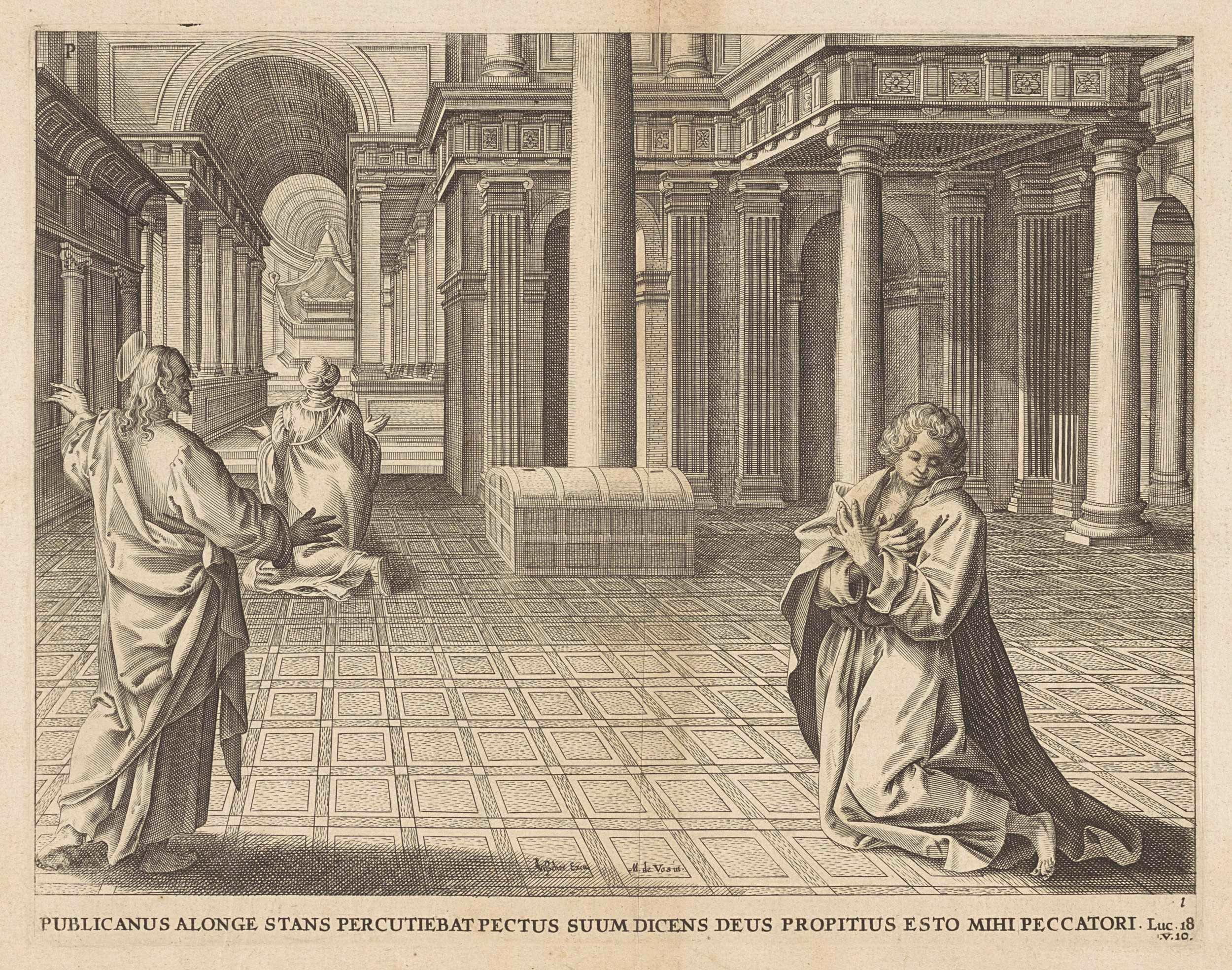
The clearest image of true self-sacrifice may not be the self-condemning person, but the Publican standing in the back of the Temple.
“Lord, have mercy on me, a sinner.”
He strikes his breast, but not because he hates himself. Nor is he trying to beat others to the accusation. His social position has already done that for him. He already knows how others see him.
Nor does he strike himself because he believes humiliation itself earns forgiveness. If that were his goal, he would stand at the front where everyone could witness his sorrow. Instead, he stands in the back.
The Publican strikes his breast because he has stopped defending himself against truth. He is taking responsibility for his own situation, his own actions, and the desires he has acted upon.
This changes everything, even if it looks much like the former situations.
His repentance is no longer rooted primarily in fear of punishment or fear of exclusion. It is rooted in honesty and love. He desires reconciliation more than self-protection. The movement is no longer: “I must destroy myself so the relationship survives.” Instead, it becomes: “I am willing to let falsehood, pride, rivalry, and self-protection die so communion can live.”
Not all self-sacrifice is holy.
Some forms of self-sacrifice are merely the scapegoat mechanism turned inward. The victim and the executioner collapse into the same person, while the logic of sacrifice remains intact.
But Christianity points beyond both scapegoating others and scapegoating ourselves. It points toward reconciliation without victims.
No posts
Comments
Nothing yet. Say the first thing.
Sign in to join the conversation.