
MARKET DATA

Source: Cornerstone Asset managers
MARKET NEWS
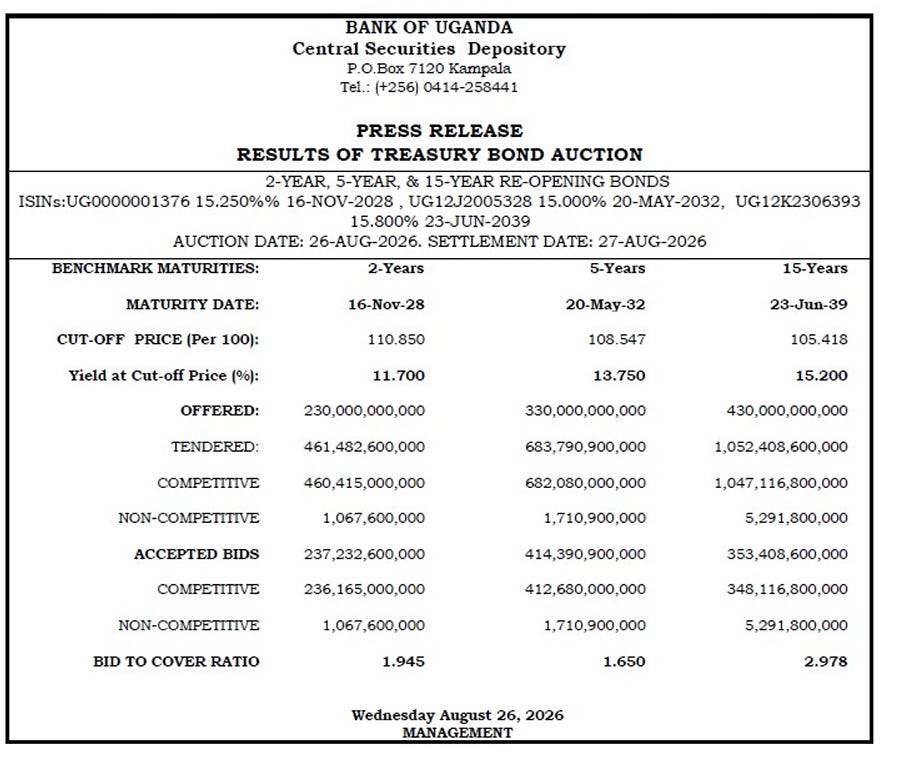
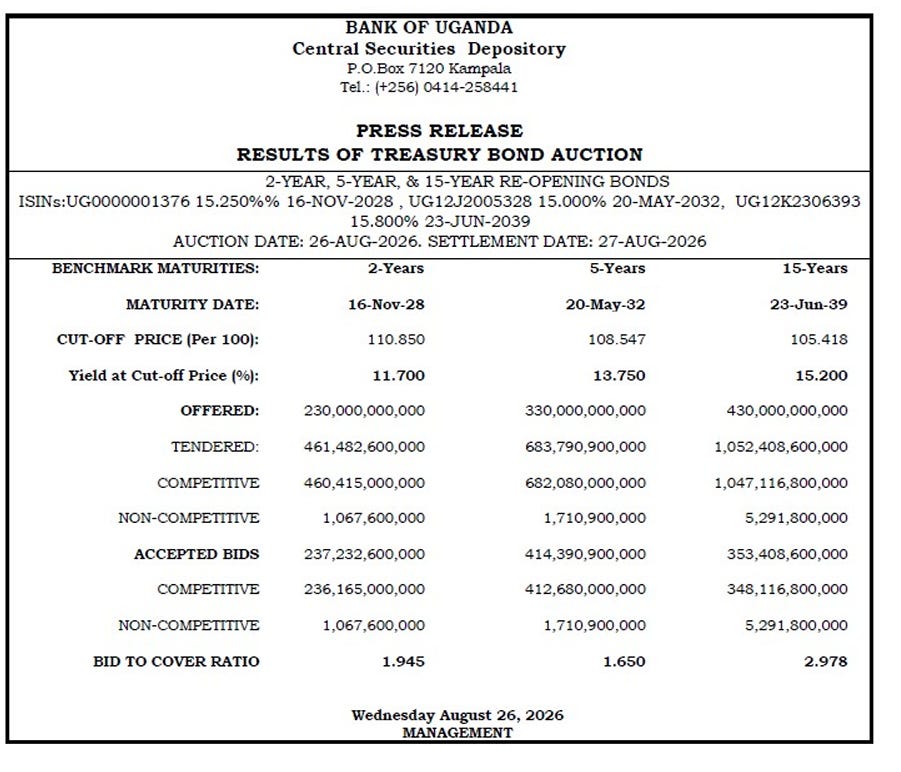
Treasury Bond Auction, 26 August 2026
In the 26 August 2026 Treasury Bond auction covering the 2-year, 5-year and 15-year re-opening bonds, government offered UGX 990 billion in total. Investors tendered UGX 2.20 trillion, more than double what was on offer, showing strong appetite for government paper across all three tenors. Of this, government accepted UGX 1.01 trillion and rejected UGX 1.19 trillion, choosing to turn away roughly as much demand as it accepted rather than pay up for the extra volume on the table.
The 15-year bond attracted the most demand by far, with over UGX 1 trillion tendered against UGX 430 billion on offer a bid-to-cover ratio of nearly 3 times, the highest of the three tenors. It was also the tenor with the largest rejection, with government turning away close to UGX 700 billion of that demand, more than the total rejected on the 2-year and 5-year bonds combined. This shows that while investors were most eager to lend long, government was also most selective on that end of the curve.
The cut-off yield on the 15-year bond (the 2039 line, often referred to as the “39s”) came in well below the level recorded at its previous auction, and below the opening guidance the market had been working with a drop of roughly 45 basis points from the last auction and around 60 basis points from where dealers expected the auction to open. This is not a one-off: it follows a similar pattern seen recently on the 20-year bond, which also priced meaningfully lower than its previous auction. Taken together, these results point to government deliberately using the current wave of strong demand to push borrowing costs lower, rather than simply meeting its funding target. Government has been running an unusually high number of bond auctions in recent months, raising more than its immediate spending needs suggest, which gives it room to reject expensive bids and accept only the cheaper end of demand. There is also a seasonal factor: government spending is typically slower in the first year of a new administration, meaning less urgent funding pressure right now, while systemic liquidity remains high following recent bond maturities and payouts, leaving investors with more cash chasing the same government paper.
For investors, this signals that yields particularly on longer-dated paper are on a clear downward path, and each subsequent auction is likely to clear lower than the last. Locking in current rates on the secondary market, or in upcoming auctions before yields compress further, looks more attractive than waiting. Investors should also expect it to become harder to get full allocations at attractive levels going forward, given how selective government has been about which bids it accepts, so acting early on good entry points will matter more than in previous cycles.
Disclaimer: This newsletter is for information purposes only and does not constitute investment advice. Past performance does not guarantee future results

No posts
Comments
Nothing yet. Say the first thing.
Sign in to join the conversation.