
MARKET DATA

Source: Cornerstone Asset Managers
MARKET NEWS
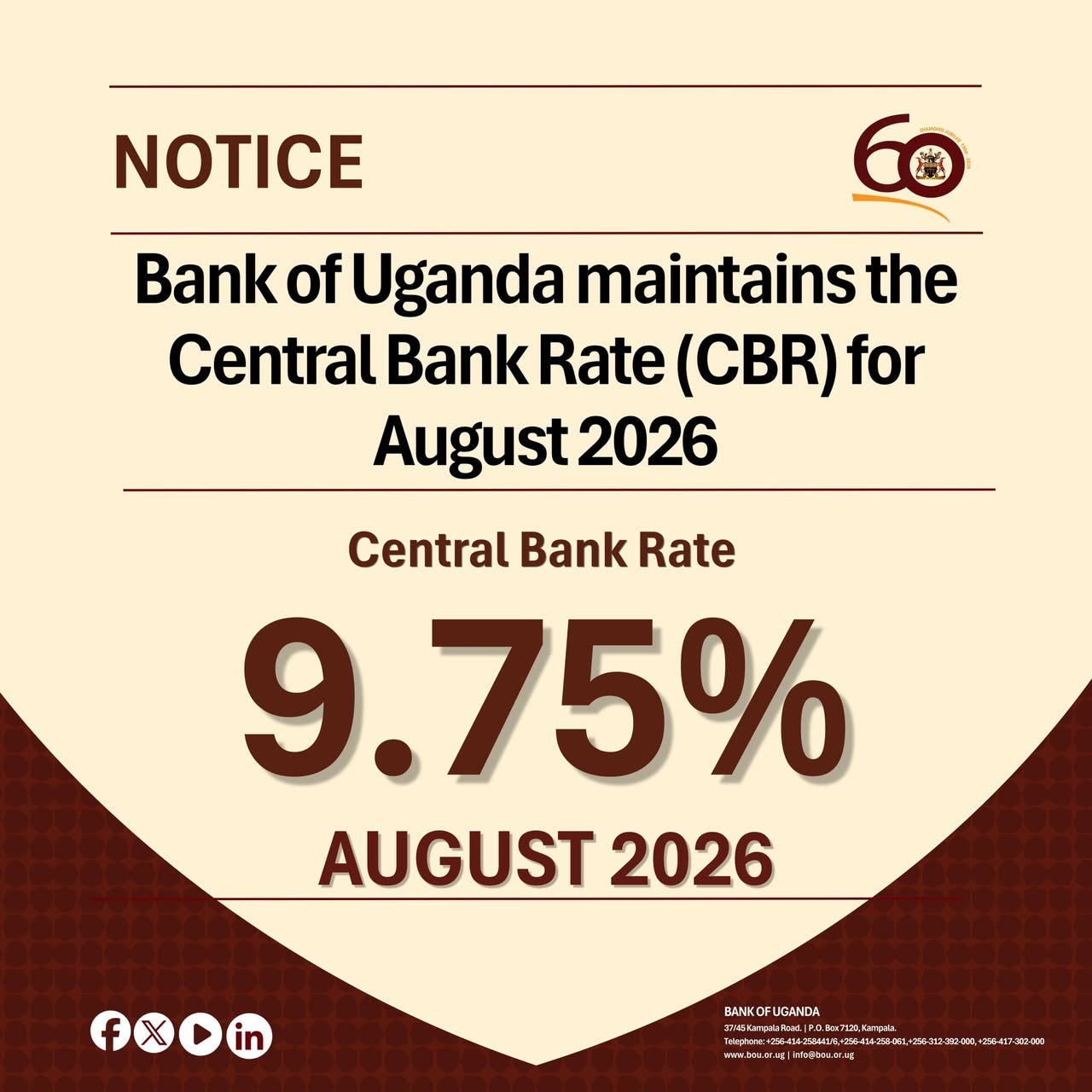
Bank of Uganda Monetary Policy Statement – 13 August 2026
The Bank of Uganda (BoU) has maintained the Central Bank Rate (CBR) at 9.75% in its August 2026 Monetary Policy Statement, signaling a cautious approach as the Bank balances price stability with continued economic growth. The decision comes at a time when Uganda’s economy remains resilient, with economic growth estimated at 6.4% in FY2025/26. The Bank expects growth to accelerate to between 7.0% and 7.5% in FY2026/27 and to around 8.0% over the medium term, supported by investment, exports, remittances, government spending and the expected boost from oil production.
For investors, the decision to hold the CBR steady provides an element of stability in the interest-rate environment. Credit conditions have continued to improve, with both demand for and supply of credit increasing, supported by easing lending rates and improved asset quality. This is important because more accessible credit can support household consumption, business expansion and private-sector investment. At the same time, the unchanged policy rate shows that the Bank is not yet ready to loosen monetary policy further while it assesses inflation risks and global developments.
Inflation remains relatively contained but has started to rise. Annual headline inflation increased to 4.0% in July 2026 from 3.7% in June, largely because of higher energy, fuel and utility prices and rising food-crop prices. However, core inflation remained at 3.4%, while services inflation eased slightly to 4.8%. The Bank therefore does not currently see evidence that the increase in oil prices has created broad-based inflationary pressure across the economy. Its forecast places average core inflation at 4.0%–4.5% and headline inflation at 5.5%–6.0% over the next 12 months.
The Shilling also remains an important part of the outlook. Exchange-rate pressures have eased after earlier depreciation, and the external position strengthened, with Uganda recording a balance-of-payments surplus of US$2.4 billion in the 12 months to June 2026. A more stable currency can help reduce imported inflation and improve predictability for businesses and investors. However, the Bank continues to flag risks from global inflation, geopolitical tensions, international oil prices, adverse weather and possible capital-flow pressures if major central banks raise interest rates.
Overall, the August policy decision presents a cautiously constructive picture for investors. Uganda is entering a period of stronger projected growth, supported by investment, infrastructure, credit expansion and oil-related activity, while monetary policy remains focused on protecting price stability. For investors, the environment favors disciplined, diversified and medium-to-long-term positioning rather than reacting to short-term inflation or interest-rate movements. The key issue to watch is whether inflation remains contained enough to allow financial conditions to continue easing while economic growth accelerates.
INVESTOR INSIGHTS
1. Stable rates can support continued investment
Holding the CBR at 9.75% provides policy stability while credit conditions are improving. If lending rates continue easing, businesses and households may have greater capacity to borrow, invest and consume. This can support sectors linked to construction, infrastructure, trade and productive investment.
2. Inflation remains a key risk to monitor
The rise in headline inflation to 4.0%, particularly from higher fuel, energy and food prices, means investors should remain alert to cost pressures. The Bank’s cautious stance suggests that further policy easing will depend on clearer evidence that inflation remains under control.
3. Uganda’s growth outlook creates medium-term opportunities
Projected growth of 7.0%–7.5% in FY2026/27 and around 8.0% over the medium-term points to a potentially stronger investment environment. Oil production, infrastructure, exports, remittances, private-sector credit and the Tenfold Growth Strategy could create opportunities across productive sectors. Investors may therefore benefit from maintaining a long-term perspective and focusing on diversified investments aligned with Uganda’s growth story.
Disclaimer: This newsletter is for information purposes only and does not constitute investment advice. Past performance does not guarantee future results

No posts
Comments
Nothing yet. Say the first thing.
Sign in to join the conversation.