
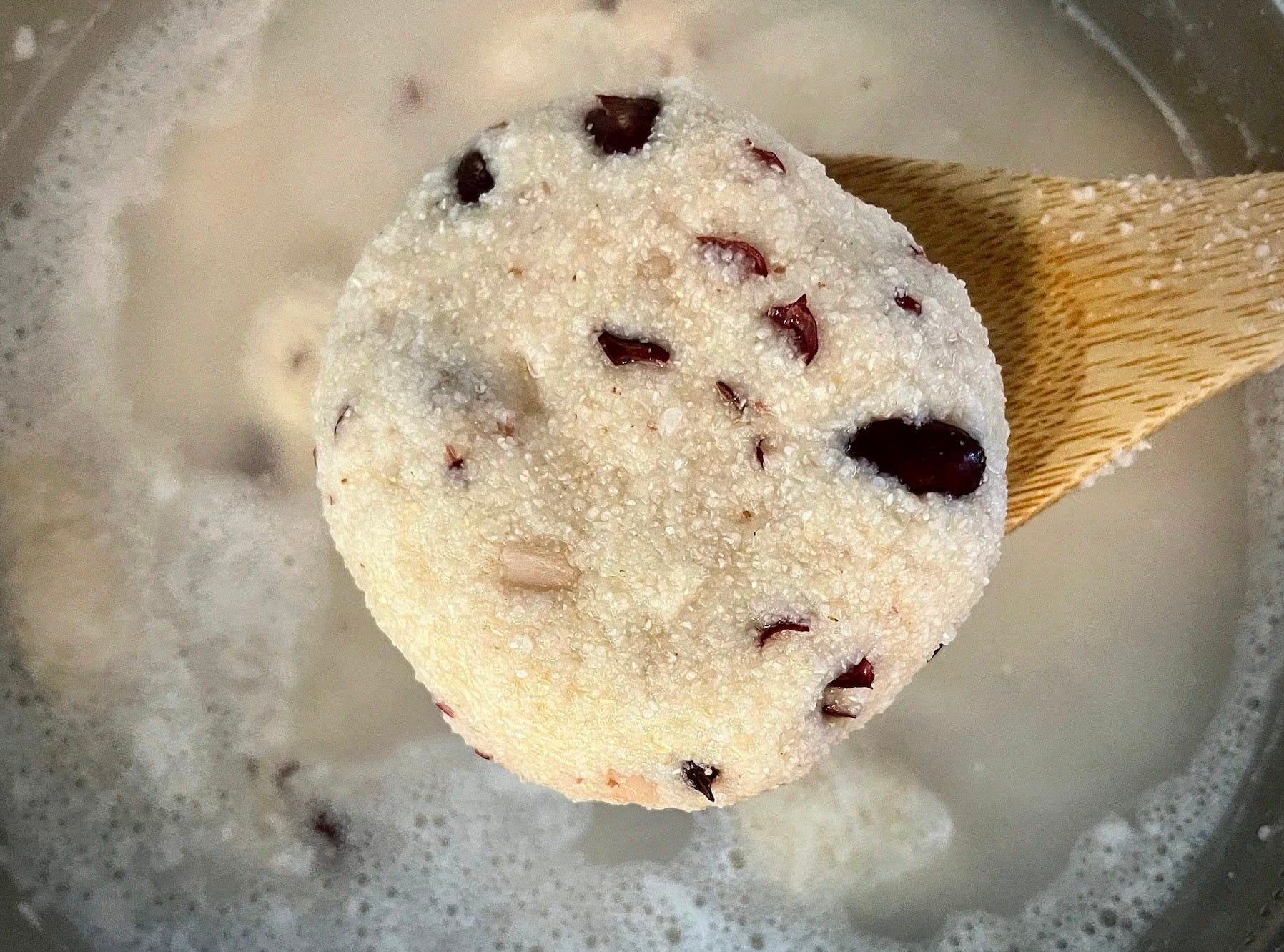
When I’m back on my reserve, I have a ritual of sharing a meal with my Tóta—the grandmother who gave me my name. Sometimes I bring her lunch—corn soup and meat pie, Kahnawà:ke staples—but my favourite is taking her to brunch and ordering a big serving of cornbread.
Haudenosaunee cornbread is different from that in the South. I don’t mean the yellow, cake-like side dish that sops up sauces or is drizzled with honey. I mean kana’tarokhón:we.
Sunday brunch for Mohawks consists of round, thick, disc-shaped dough balls made from cornflour, kidney beans, and a handful of oats. It’s hearty and akin to polenta in texture. Other communities have their own versions, but Kahnawà:ke-style is smothered in gravy and served with steak and breakfast sausages.
And over our plates of cornbread, my Tóta ordered cream for her coffee—full-fat, rather than her usual additive of 1% milk. She’s been unintentionally losing weight, and she joked that she needs to fatten up for the sake of her health.
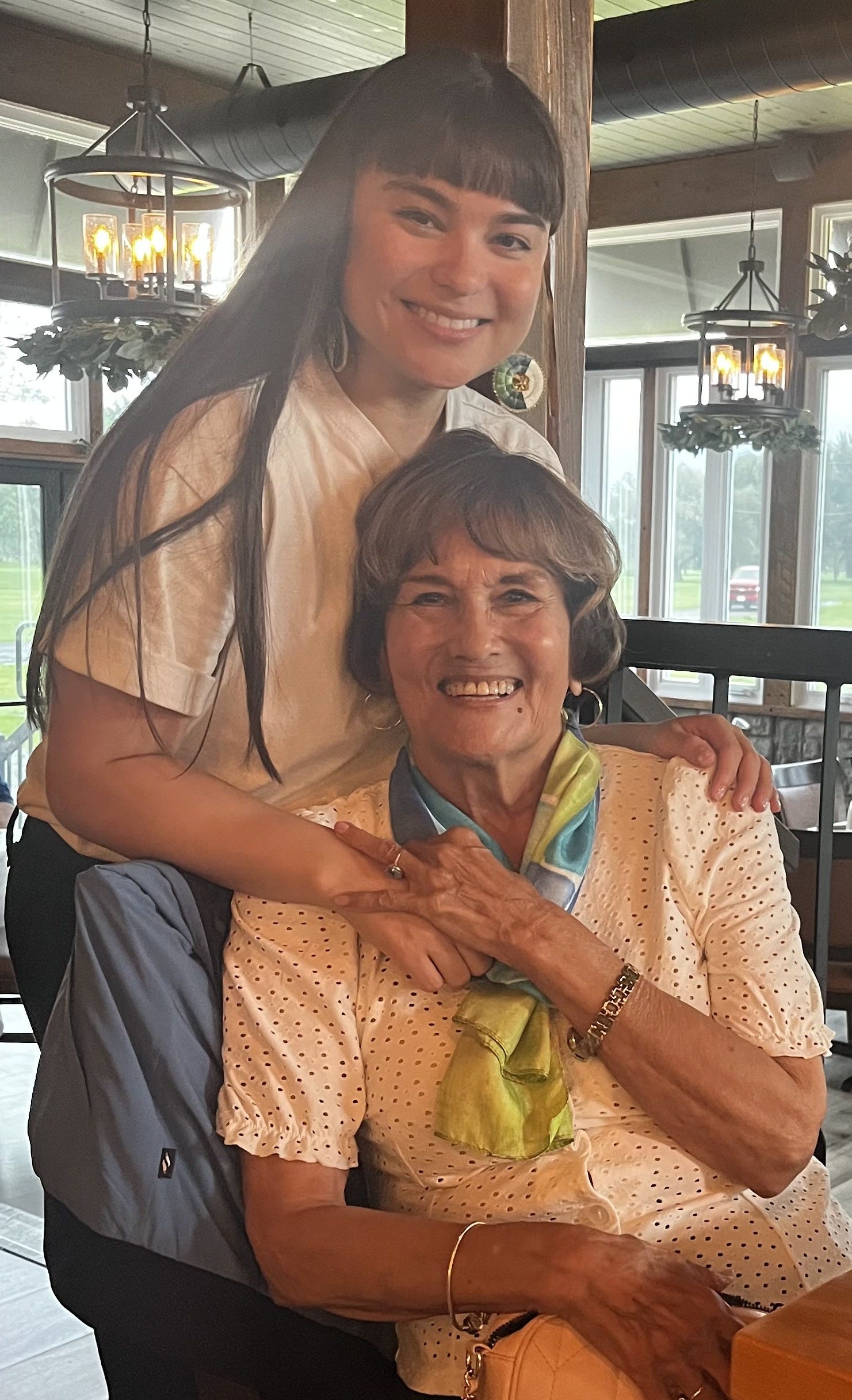
Recognizing that I was speaking to a woman of a certain generation, I’d followed some scripted comment—something to the likes of, “must be nice! Don’t you wish you would’ve had that problem when you were younger.”
Cue the formulaic “ha-ha” in response. But instead, my Tóta stopped me in my tracks.
She replied, “I’ve always liked how I looked. Y’know, I even used to be chubby! But I didn’t realize it at the time. I’ve gone up and down sizes and I’ve always felt great and didn’t really think about diets, I just ate foods that I liked.”
I was dumbfounded.
Now, my Tóta is stunning. It makes sense to me why she—and everyone around her—likes how she looks. And namely, she is a thin person. But still, I was gobsmacked that this woman managed to escape the gripping pressures of diet culture, especially across eras that were so cutthroat about weight.
In recent years, as film and television opened more doors for people of colour—and, in theory, more body diversity—I started to believe the worship of thinness was fading. But speaking to my Tóta, it dawned on me that our current society is both reverting and growing increasingly more cutthroat about ideas of weight.
I didn’t seek out writing yet another ThinkPiece™ in the cultural zeitgeist about the rise of Ozempic and its pitfalls—though truthfully, I have been clinging to these reads with a growing desperation. I’ve devoured countless podcasts, essays, and articles, looking to be satiated with a bolstered sense of self. Searching to have my own beliefs spewed back at me in an echo chamber of sanity—that it is okay not to be skinny. That I can still be happy, confident, successful even!—as an actor in the limelight. The intent: to have the messaging sink through and stick to the walls of the brain.
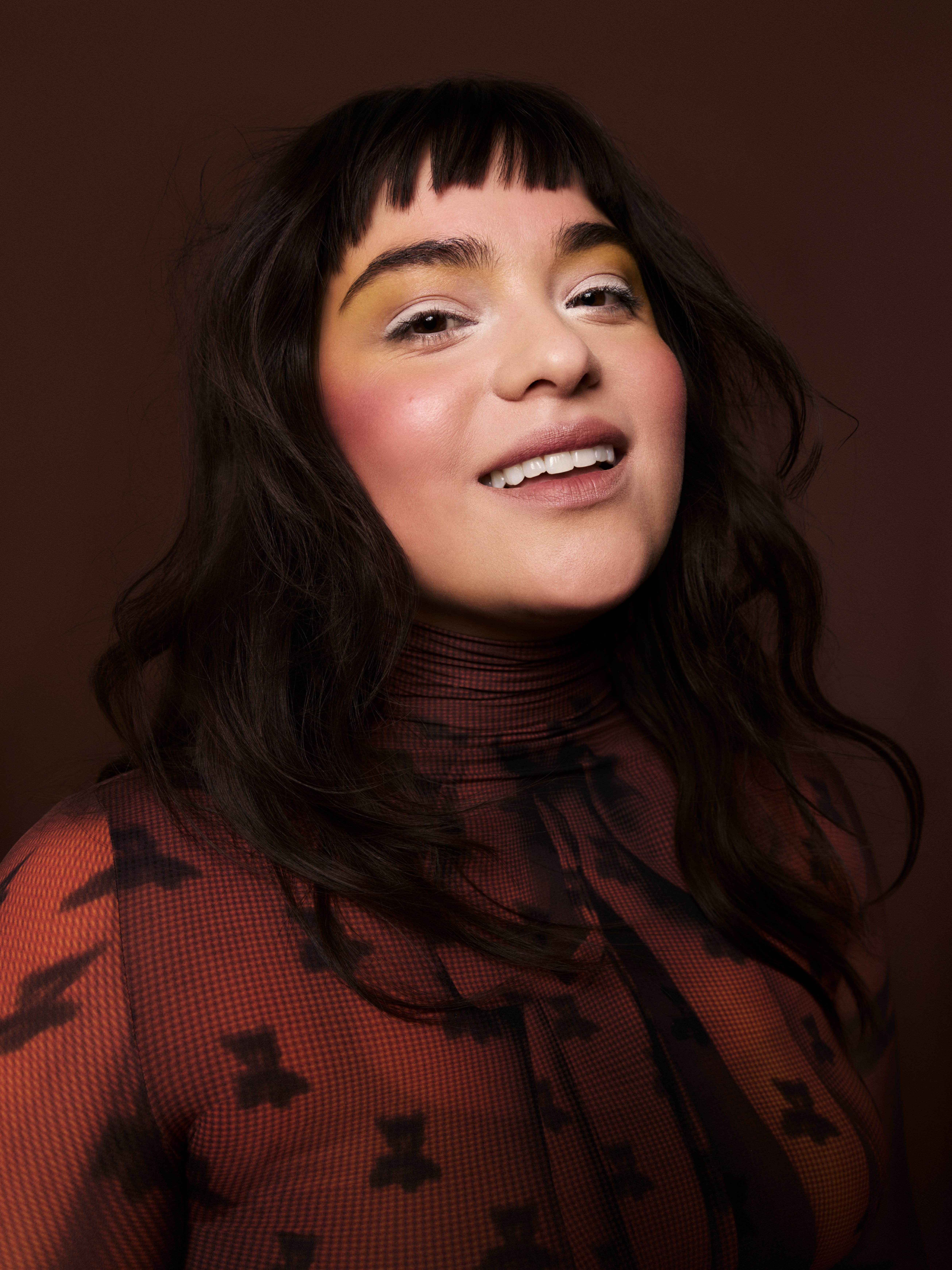
It must be acknowledged that I am an objectively thin person. I fit into straight sizes, I don’t face discrimination or oppression because of my proportions, and I’m generally considered petite. But like the generations of Mohawks before me, I have a broader back and a belly you can grab in handfuls. I have a wide jaw and round, cornbread cheeks that only get fuller when I smile. My waist does not curve inward, but I am strong and sturdy at a staggering five-foot-two. In the normal, non-Hollywood world—I am skinny. But to my industry, I most certainly am not.
In my field, emaciation is centred as the ideal. And achieving a gaunt, spindly frame is something outrightly impossible for me to achieve without dramatically depriving myself of sustenance. My late family doctor stressed, “losing weight is for the sick.” And it’s true. I can see that in more ways than just physically.
Realistically, I will also end up on one of these GLP-1s at some point. Not (necessarily) out of vanity—but because I’m Native. And if you’re NDN, you already know that my ass is predisposed to Type II of that shit. Forget a trust fund, the only thing I’m inheriting from my parents is diabetes.
Parents, grandparents, aunts, uncles—nearly everyone in my family has it. So why not inject myself now? Why not beat the ‘beetus to the punch?
Because I don’t fucking want to.
Cooking—finding recipes, improvising them, making them, eating them—is one of my life’s great joys. Wining and dining, and going to the farmer’s market to pick up seasonal, fresh produce is my goddamn jam. And as someone with ADHD, food creates an extra little ✨razzle dazzle✨ of a dopamine hit when consumed. It’s cultural, it’s comforting, and it nourishes my body and makes me feel energized and alive. And eating the food of where I come from makes me feel closer to who I am.
Also, succumbing to the Ozempic-era pressure would make me feel a sense of communal betrayal. I can’t help but imagine a future where my niece, who is now only five, grows into precisely my body type; healthy, athletic, and soft, and yet would witness how I contorted myself into a smaller, more acceptable shape, turning my rounded cheeks hollow. How could I uplift and praise her being without instating that she too needs to change? The two sentiments cannot coexist.
It does sound like these drugs have genuinely helped many people, and that there can be plenty of benefits to the medication—blah blah blah. I’m not speaking about people who use it for straight-up medical reasons (though some family members of mine were positively gleeful for their own skinny-making prescriptions). But I’m talking about compulsory thinness as a whole.
The pressure to be angular, lithe, is creeping up within me like I’ve never experienced before. Injectables, CoolSculpting, buccal fat removal are all things that seep into my For You page and blare across targeted ad breaks.
The first time I’d heard about the recreational use of GLP-1s for weight loss was years ago in Los Angeles. A stylist I’d worked with became unsettlingly thin, yet exchanged trade secrets with a nearby publicist, who toted Mounjaro as the source of her newly frail frame. Neither of them were above a size eight to begin with.
I’d attempted to sequester myself from those narratives; I asked if they speak about their weight, that they don’t do it around me. But it was like plugging holes in a sinking ship. The walls were already enclosing around me with a disordered eating hypnosis.
I’d looked for touchstones of lucidity. I confided in friends who worked outside my industry, and read up on systemic anti-fat bias and how to combat it from knowledgeable writers who I respect and trust.
Around this same time, I found myself preparing to speak at the Hollywood Reporter Round Table and, needless to say, was nervous as fuck. Here I was, among icons, still emerging and looking to hold my own, make a mark and have meaningful discussions with these legendary storytellers.
One conversation I thought would especially resonate with a group of actresses was the demand to look a certain way in our industry. I’d teed up a story of the expectations I felt and prepared for a conversational hand-off.
[Watch the clip from 43:56 — 45:08. Also, please ignore the amount of times I said “like.” As I said, I was nervous AF.]
I assumed that the subject would ignite the room in stories; struggles they faced, how they coped and overcame. But the room went… dead. Not a single person would touch that topic, and instead, the dialogue quickly shifted to my identity as an Indigenous actor.
It might not have seemed like a big deal watching it back, but in the room, in that moment, it felt like I’d touched on a nerve that was not to be fucked with.
I can only assume that the dead-end in the conversation wasn’t because they didn’t experience the crushing weight of these beauty standards themselves—but because they didn’t want to unpack this very struggle on camera. Which—totally fair. It’s not my place to force anyone to discuss their sense of body image publicly. I just thought it was something we could bring to light in order to give it less weight (pun intended).
In my consumption of media that resists GLP-1 trends, I think I’d hoped to find a resounding confirmation that I can achieve all that I want without having to be ultra-skinny. Not to wonder, “would I have landed this fashion opportunity if I were smaller? Would I have been passed over for this job if I looked more like her?” Logically, I know that even if I were to adhere myself closer to Hollywood’s frail ideal, I could envision how quickly I would fall into the never-ending pit of “still not enough”—just another pound, just one more procedure.
For the record, when I think about what I want, I don’t truly crave being smaller. I crave being desirable, being able to create work that is meaningful for me, and to be a part of bringing Indigenous stories to the global stage. None of these elements actually require alterations as a prerequisite.
It all makes me think back to my Tóta, and the radicalism in which she loved and continues to love her body. And it implants glimmers of what it could look like should I, too, love my body. Or at least be unaware of it, whether in “chubby” periods or not. She intentionally moves her frame multiple times a week (I recently saw a video of her doing wall push-ups… What a g), and she eats the foods she loves. That includes the kana’tarokhón:we that we share together.
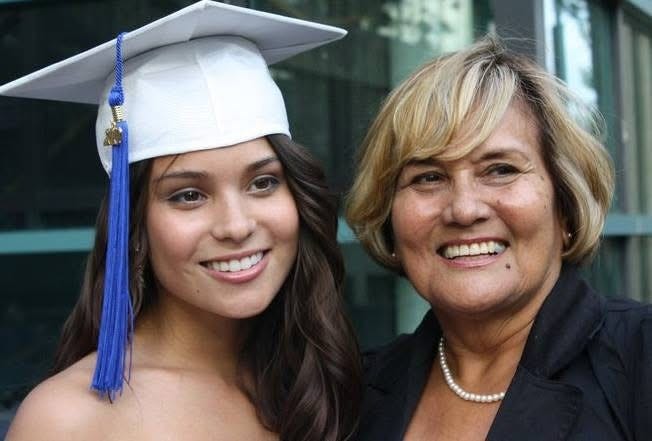
I’m not nearly as good or as experienced as my community’s aunties at making cornbread. Their image can be conjured instantly for me; gossiping and laughing with their thick bellies jiggling, and teaching the accompanying song to nearby babies.
Their hands, impossibly tough, as they pour boiling water into the mixture and form the scalding dough into balls. (I must still be an auntie in training, as I need to continually submerge my sensitive hands in an ice-water bath between formations.) Their bodies, too, are soft and wide. Bodies I felt safe around, who I thought of as perfect growing up.
[An Oneida rendition of the Cornbread Song.]
The ThinkPieces™ I’ve consumed and the stories from my grandmother have not spared me of these bodily pressures. But they’ve given me pause—a kind of gratitude for this soft, capable body that is still healthy and has carried me here so far.
They’ve also given me a renewed sense of resistance: to fight for the cornbread cheeks that reflect the faces that came before me.
Further informative media about cornbread, Ozempic, combatting anti-fat bias and myths about wellness:
No posts
Comments
Nothing yet. Say the first thing.
Sign in to join the conversation.