
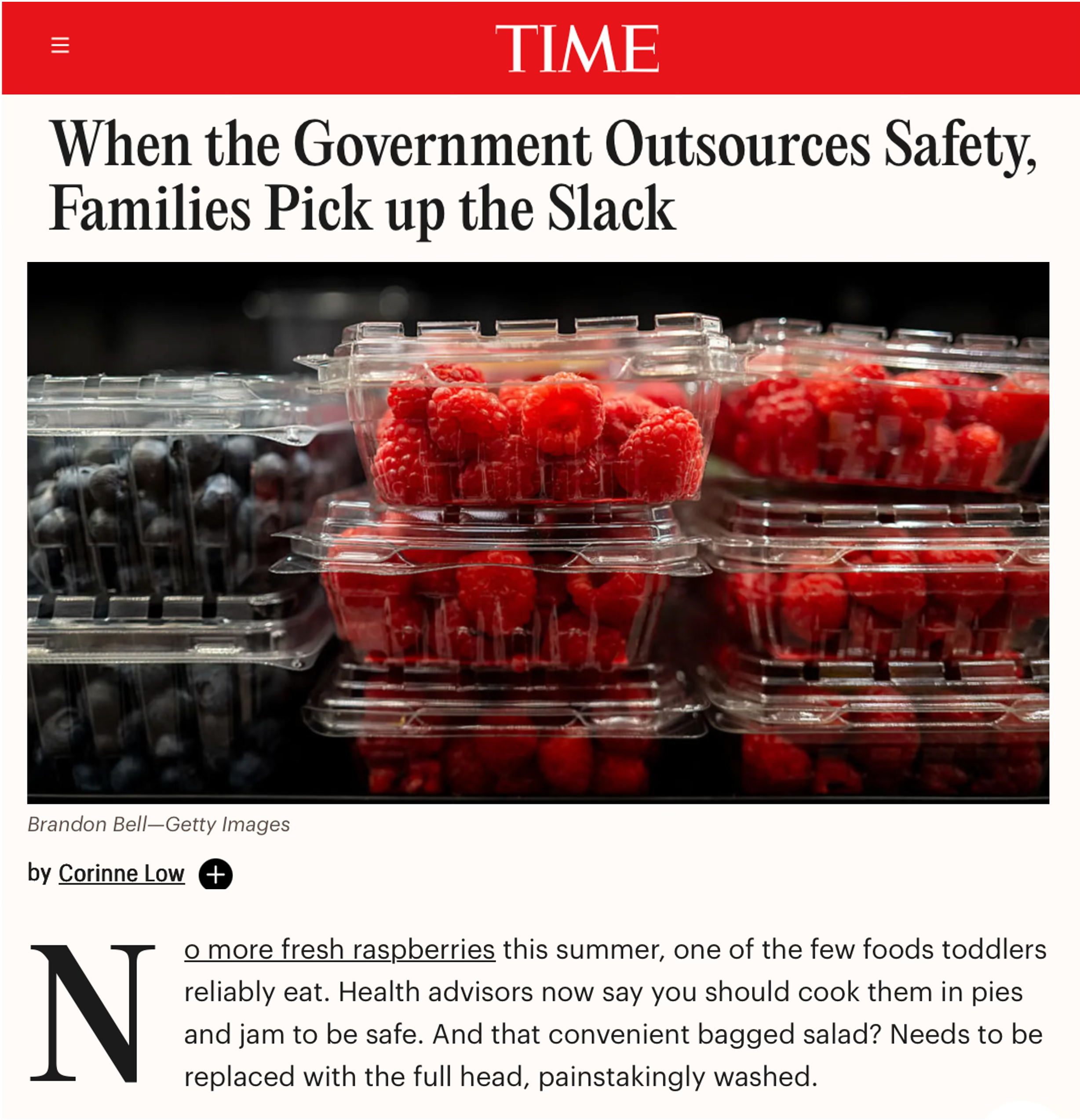
I have an article in TIME Ideas this week about how the cyclosporiasis outbreak is directly linked to the pullbacks in our food safety system that the Trump administration has made over the past 19 months (catalogued at the link). But my point is a more specific one, which is that the division of labor that American households depend on for where a parents’ duties end and the government's begin are being dismantled by this administration, to all of our detriment.
I’ve documented how American parents are more time-starved than ever before, spending countless hours doing everything from chauffeuring our kids to playing with them instead of casually observing them while putting away laundry. The older generation tsk-tsks what they see as parental neuroticism, neglecting the real incentives we’re responding to—not only a changed understanding of child development that means we recognize the way parental inputs of time and attention generate the output of human capital, but also the changes in our societal setup that make the “biking till sunset” summers of our youth impossible to replicate with our own children.
As I write in TIME:
Over the last year, much of the conversation about regulation has focused on its costs to the federal budget and firm productivity. But left outside the picture has been the cost to parents of having to monitor and mediate these issues on our own. The advice given to overwhelmed parents is often to do less, and be more “free-range,” letting kids play outdoors unsupervised.
But this advice relies on the safety of our lived environment. The more real dangers exist in our children’s surroundings, the more time parents must spend protecting our kids. We are tasked with choosing safer foods and cleaning products, endlessly reviewing labels and ingredients, following content creators to guide us through chemicals and their exact level of endocrine disruption, monitoring our children’s phone usage, researching smart watches instead of phones, keeping our children indoors when air quality is bad, washing lead dirt off tiny hands before they put them in their mouths, and keeping kids busy with structured activities because the street is too full of huge SUVs for unsupervised bike-riding.
I would love to be able to cut loose as a parent. To do that, I need to know the government has my back: That they’ll handle the air, water, pandemic, and diarrhea-causing parasites, while we do the parenting.
I’ve actually been wanting to write this piece for a while, and diarrhea lettuce provided the impetus. Because when I hear Jonathan Haidt and Lenore Skenazy tell me that I need to allow my kids to take more risks, I have a very specific picture in my head, and it’s this:

This image is from the movie City of God, about drug gangs in Brazil’s favelas (and if you haven’t seen it please, please do). In this film, children have the opportunity to be exposed to lots of risk in their environment. One would say it allows them to develop resourcefulness, and even their entrepreneurial skills. Most of them also end up dead, of course.
It’s easy to be a a free range parent in a place with robust public services, minimal gun violence, carefully enforced traffic laws, and strong environmental protection. It’s not so easy for the rest of us. And this isn’t just inconvenient, it’s inefficient.
I grew up in a libertarian household where individual responsibility was valorized over its opposite, government overreach. And, I came of age professionally in an (often) libertarian discipline where the same thing is thought to be true. But the reality of economic theory is different than the caricature. Some things are natural public goods, things that are more efficiently provided en masse by the government than individually by each household, and a system of food safety inspections and disease surveillance is one of them. So while we can all try to “Fair Play” our way to a better division of labor (and the attendant mental load) with our spouse, until the government starts doing their part, American parents are going to keep feeling the squeeze. Now back to menu-planning a summer meal of cooked vegetables.
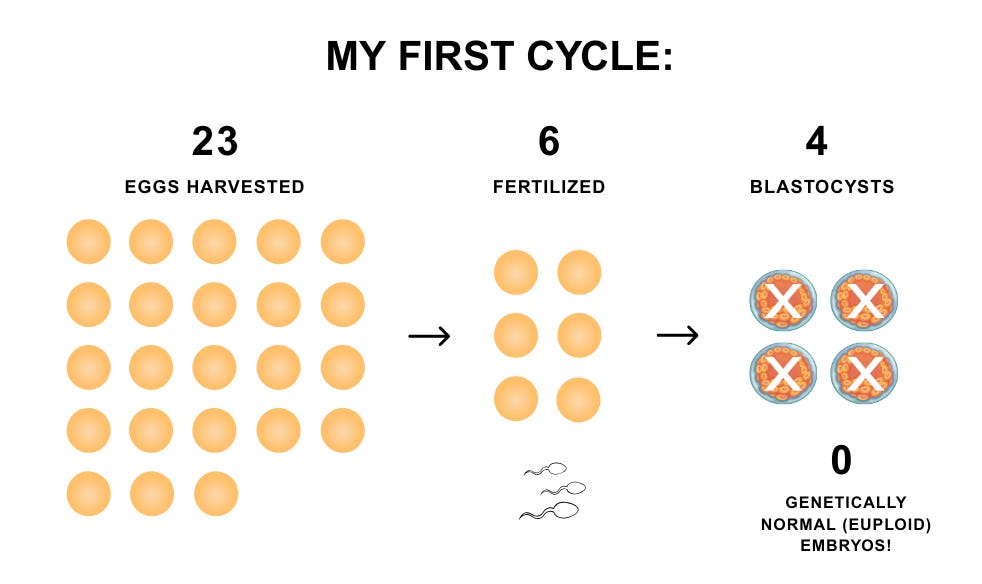
With the news that AOC is freezing her eggs at 36 I’ve been getting lots of media contacts to discuss this decision. If you’re interested, I wrote about the economics of egg-freezing in the very first edition of Femonomics, including my personal journey and what my fertility doc called “the embryo hunger games.” In economics terms, I think about egg freezing as saving up “reproductive capital,” and like any financial instrument that provides inter-temporal flexibility, the option to do it makes you richer. But while many women (including me) freeze in their late thirties or early forties, the chance of success (and fewer cycles to get there) are higher earlier. So I always recommend that women who are considering egg freezing and can afford it pull the trigger if they hit 34 and aren’t actively planning to start trying to conceive—because after all, even if you’re successful with a first baby without technology, fertility drops off so steeply in our late thirties, you might want the “savings” for your second. But for some new research on Assisted Reproductive Technologies, I’ve been thinking a lot about the political economy of these technologies, and one thing that occurs to me is that there is a fundamental tension in a technology that increases the reproductive success of female-male households (widely considered good) while also increasing the reproductive autonomy of female-only households (more ambivalent) without significantly increasing the reproductive capabilities of male-only households (uh-oh). Fundamentally, I think there is a resentment that technology can make AOC fertile for longer, and even able to reproduce on her own, but can’t make her bear the child of the Fox News host criticizing her. There still isn’t enough reproductive technology that men do not need women to have children, and therein lies the fervent need to control it.
Cyclosporiasis has thankfully left stone-fruit season unscathed, and so I’ll be enjoying what late summer produce we can. A friend told me about her burrata and peach and balsamic drizzle lunch that I’ll be replicating shortly. This year, I finally put the little box of herbs in the backyard that I’ve been dreaming about (don’t worry, my houseplants are still dying—if anyone has advice, please comment below) so it will have the sprinkling of snipped basil on top that makes me feel like a real grownup. Where are you finding joy while you dodge DOGE-induced intestinal distress?
I’m Dr. Corinne Low, an author, economist, and professor. I teach at the Wharton School of the University of Pennsylvania. If you liked this post you might like my book: Having It All: What Data Tells Us About Women’s Lives and Getting the Most Out of Yours. Thanks for reading Femonomics, and I hope you find your “All.”
Comments
Nothing yet. Say the first thing.
Sign in to join the conversation.