
I have spent a lot of time thinking about word problem solving in the elementary-age range. I have reflected upon my time teaching elementary-age students, teaching pre-service teachers, providing professional development to in-service teachers, engaging in experimental research, and reading research in this space. One pivotal theme that has continually emerged for me is so many difficulties in this space can be traced directly back to the initial learning environments students experience when acquiring concepts related to addition and subtraction. Student knowledge of addition and subtraction can support or hinder their success in tackling more “applied” problems requiring these forms of knowledge.
Advanced Organizer
Conceptual and Procedural Knowledge that relates to Addition
Conceptual and Procedural Knowledge that relates to Subtraction
The Influence of Conceptual and Procedural Knowledge on Word Problem Solving
I will reference the Common Core State Standards (CCSS-M) as the backdrop for grade-level expectations. I know that not every state uses the CCSS-M to guide grade-level competencies. If your state does not use the CCSS-M, chances are the alignment of grade-level expectations is pretty close.
Here are standards across grade levels that reference addition or subtraction concepts.
Kindergarten: Understand addition as putting together and adding to, and understand subtraction as taking apart and taking from
First: Understand and apply properties of operations and the relationship between addition and subtraction
First: Work with addition and subtraction equations.
Fourth: Understand addition and subtraction of fractions as joining and separating parts referring to the same whole.
Fourth: Add and subtract mixed numbers with like denominators.
Fifth: Use equivalent fractions as a strategy to add and subtract fractions
Here are standards across grade levels that reference additive1 word problems.
Kindergarten: Solve addition and subtraction word problems, and add and subtract within 10, e.g., by using objects or drawings to represent the problem.
First: Use addition and subtraction within 20 to solve word problems involving situations of adding to, taking from, putting together, taking apart, and comparing, with unknowns in all positions, e.g., by using objects, drawings, and equations with a symbol for the unknown number to represent the problem.
Second: Use addition and subtraction within 100 to solve one- and two-step word problems involving situations of adding to, taking from, putting together, taking apart, and comparing, with unknowns in all positions, e.g., by using drawings and equations with a symbol for the unknown number to represent the problem
Third: Solve two-step word problems using the four operations. Represent these problems using equations with a letter standing for the unknown quantity. Assess the reasonableness of answers using mental computation and estimation strategies including rounding.
Fourth: Solve multistep word problems posed with whole numbers and having whole-number answers using the four operations, including problems in which remainders must be interpreted. Represent these problems using equations with a letter standing for the unknown quantity. Assess the reasonableness of answers using mental computation and estimation strategies including rounding.
Fifth: Solve word problems involving addition and subtraction of fractions referring to the same whole, including cases of unlike denominators, e.g., by using visual fraction models or equations to represent the problem. Use benchmark fractions and number sense of fractions to estimate mentally and assess the reasonableness of answers.
To highlight the vertical alignment of core concepts and procedures. If the learning environment does not support mastery of concepts at a specific grade level, students will experience difficulty achieving core competencies at the subsequent grade level.
These concepts are pivotal across the elementary (and even subsequent grade levels). Students need mastery of conceptual and procedural knowledge that is introduced in Kindergarten and first grade for all subsequent grades. Student knowledge of additive schemas (e.g., Total, Change, Difference) is not just useful for whole numbers - students will need this knowledge in later grades as they solve word problems involving rational numbers.
When introducing addition two models are useful to consider.
This is often the first model you will want to introduce. The basic structure involves the following:
Count one set
Count another set
Combine sets
Count the entire set
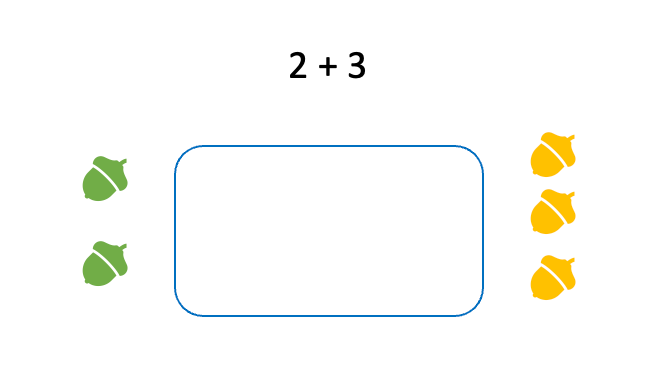
In this example, I have manipulatives that can be used as counters2 and a specified “mat” that will be used for combining the sets. I’d count the first set (green) and highlight this represents the 2 written in the abstract notation. I’d then count the second set (yellow) and identify this represents the 3 written in the abstract notation. Our goal is to have students identify the “parts” that we will be combining to create a whole and to explicitly connect how we are representing the abstract notation in the addition equation.
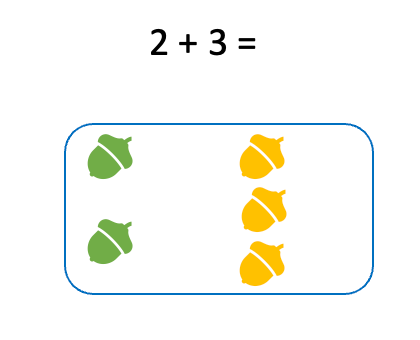
I’d then move both sets into our “mat” to represent combining two sets into a whole. I’d then count all the objects to identify the whole - 5. I’d write 5 down to complete the equation and have students identify the green set represents the 2 in the equation, the yellow set represents 3 in the equation, and the 5 represents the whole after we combined the sets.
A couple of thoughts to consider. Some preskills will facilitate student mastery of this skill.
Fluent verbal counting to the target sum. If you will bound your practice to 10 then you’d expect students to be fluent with verbal counting to 10.
Fluent 1:1 correspondence to the target sum. If you will bound your practice to 10 then you’d expect students to be fluent with 1:1 correspondence to 10.
Cardinality is the ability for students to count a set and identify the final number they counted stands for that set. For example, if I present 5 objects to a student and ask, “how many are in that set?” the student can use 1:1 correspondence to count 5. When the student is asked, “how many?” the student will say “5”. Students who do not have cardinality will recount the set again.
Number identification to the target sum. Students need to be able to be accurate in identifying the numeral in order to connect the manipulatives that represent that quantity.
Notice that for students to engage with the part-part-whole model of addition, they do not need to use the skill of counting on. They count one set, they count a second set, and then combine the sets and count the whole.
This is often the second model you will want to introduce. The basic structure involves the following:
Start with a set
Add another set
Coun on from the first set to identify the sum
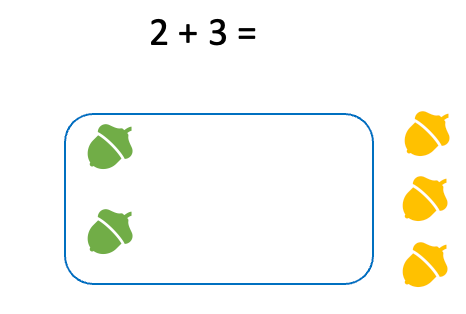
In this example, I’d start by identifying our sets. I’d count the green set and highlight this corresponds with the 2 in the abstract. I’d count the yellow set and highlight this corresponds with the 3 in the abstract.
This is where the join model changes from the part-part-whole model. As you can see the green set is already within our work mat. The green set represents 2. We will count on from 2. I would drag one yellow counter at a time and “join” it to the set. 2….3, 4, 5. By combining our set of 3 with our set of 2, the sum is 5.
The same preskills are present as for part-part-whole. However, what shifts here is students must be fluent in counting on from a target number. If you are limiting your practice to addends between 1-9 and a maximum sum of 10, then you’d need to ensure students count count on from numbers 1 through 9 up to the target sum of 10.
The commutative property of addition is easily introduced through the part-part-whole and the join models of addition.
For part-part-whole (see above), we can easily highlight this for students by strategically practicing items. The example I provided was 2 + 3. Notice the following:
I placed the green set on the left side of the box and the yellow set on the right side.
When combining the set and counting the whole, I started with the green set first and counted the yellow set second.
If I followed up this example with 3 + 2, what changes?
I would place the yellow set on the left side and the green set on the right side.
I would count the yellow set first and the green set second.
We can then have students examine both examples and conclude the order in counting our sets still resulted in a sum of 5.
I have zero scientific evidence for this (so someone can tell me I am wrong and send me a citation), but the join model seems to make more intuitive sense to me on highlighting the commutative property. In the example above, I used the example 2 + 3 by starting with 2 and counted on 3. If you followed this up with 3 + 2, you’d start with 3 and count on 2. Practicing items like this back to back can help students examine the order of the addends does not impact the sum.
This might be me stating the obvious, but the commutative property is extremely useful for students who are still strategy-bound in their math facts (not yet memorized). Counting on is one of the most used approaches by students (see join model above). A student who has a firm understanding of the commutative property can use this to their advantage. If they are presented with 2 + 9, they will start with 9 and count up 2. This has two major advantages. First, this is more efficient (takes less time) and less taxing on working memory. Thus, if the fact 2 + 9 was being used in an applied problem they can more quickly obtain the fact to use it for the problem solving process. The second MAJOR advantage is a reduction in errors. A student starting at 2 and counting up 9 is much more likely to result in an error do to counting then a start starting at 9 and counting up 2.
The associative property can also be reinforced through the part-part-whole and join models of addition.
For the part-part-whole and join models, we would have a minimum of three sets that we are combining. For example, 1 + 2 + 3. The teacher can easily show this by sequencing examples.
1 + 2 + 3 = 6
1 + 3 + 2 = 6
2 + 1 + 3 = 6
2 + 3 + 1 = 6
3 + 1 + 2 = 6
3 + 2 + 1 = 6
When introducing subtraction two models are useful to consider.
This is often the first model you will want to introduce. The basic structure involves the following:
Start with a set
Take away (separate) from that set
Count what is left
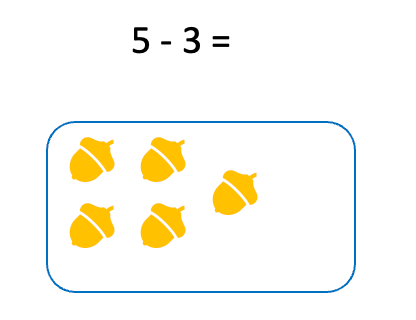
I’d start by counting our initial set. I’d highlight five corresponds with the subtrahend “5” in 5 - 3.
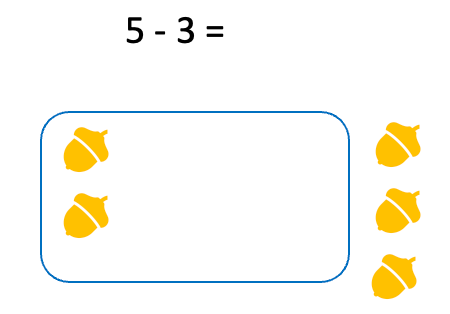
I’d then “take away” or separate three from our work mat. I’d highlight the three we separated corresponds with the minuend “3” in 5 - 3. I’d then count what is left, 2, which is our difference.
I’d then count the second set (yellow) and identify this represents the 3 written in the abstract notation. Our goal is to have students identify the “parts” that we will be combining to create a whole and to explicitly connect how we are representing the abstract notation in the addition equation.
Notice all the same preskills for part-part-whole are required for this task. If your students have fluency in counting backwards, you can embed this practice for this item. As they drag an item out they will count back 1, for example 5….4, 3, 2.
This is often the second model you will want to introduce. The basic structure involves the following:
Create one set
Create a second set
Compare the difference
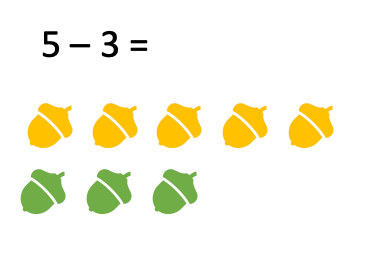
In this example, I created two sets to compare. I would highlight the first set is five and represents the subtrahend 5 in 5 - 3. I would highlight the second set is three and represents the minuend 3 in 5 - 3. One element to note here. Notice the organization schema used of the manipulative. They are ordered in a line and stacked to allow for easier comparison. This is much easier for students than the example I have below.
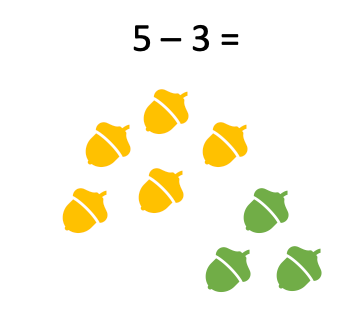
The benefits of the difference model of subtraction is it lends itself to highlighting the count-up strategy. As we ask students to compare the models there are two different elements we can have students consider. We can ask them how many yellow acorns they need to remove to make the sets equal, which is counting backward. We see higher error rates for counting backward so it is not as reliable of a strategy for students to use. The other prompt is how many green acorns we would need to add to make the sets equal. This would facilitate the student counting on from 3 (ex. 3….4, 5 (two more).
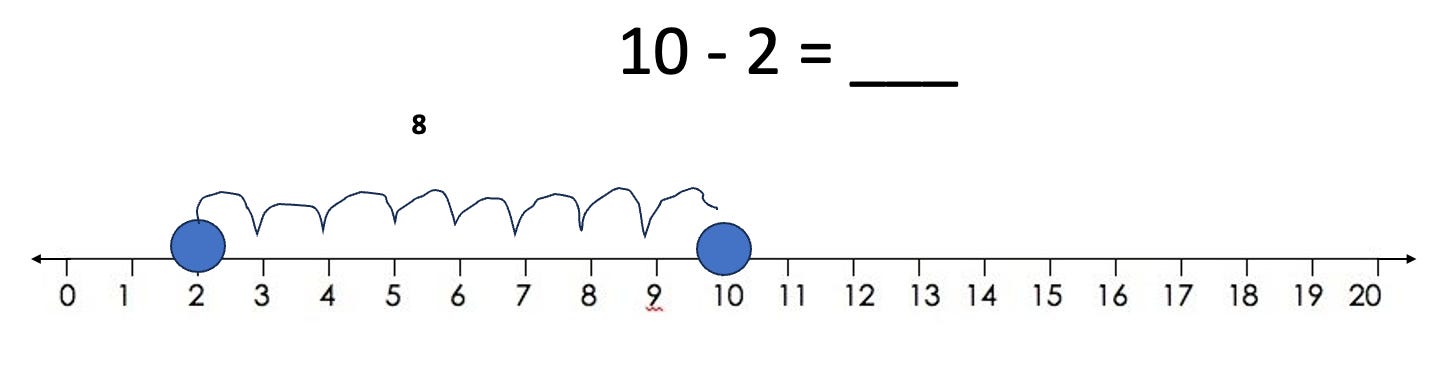
Number lines are another powerful way to reinforce subtraction concepts.
Separate Model
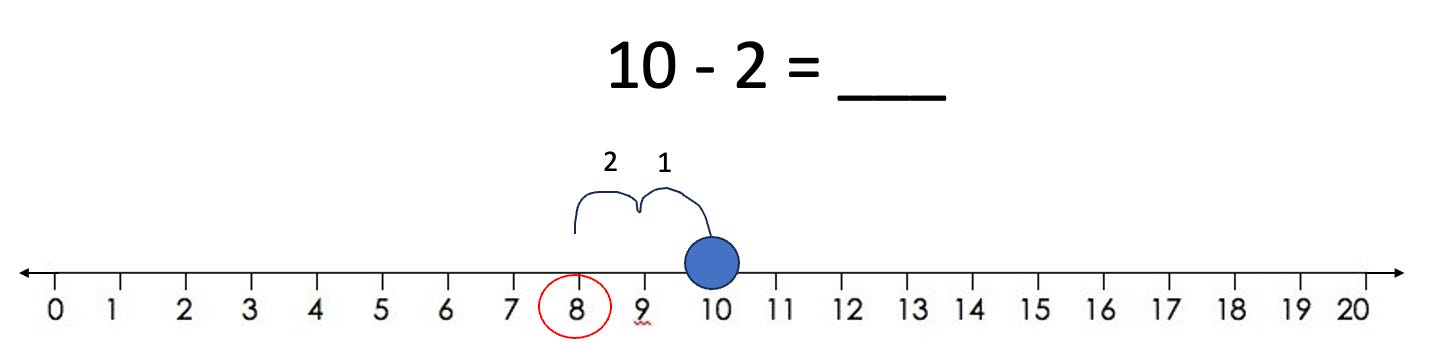
Difference Model
Notice, you can count backward from 10 or count up from 2.
I am reaching my word limit for this post so I’ll keep this brief.
Part-part-whole model of addition —> Total word problems
Join model of addition —> Change increasing word problems
Separate model of subtraction —> Change decreasing word problems
Difference model of subtraction —> Difference word problems
Word problems are amalgamation skills.
Decoding fluency and language comprehension support the comprehension of the word problem situation
Conceptual knowledge of addition and subtraction concepts supports the schema identification and identifying an appropriate solution plan
Math fact (or computation) fluency supports deriving the solution to the problem
Ensure both models of addition and both models of subtraction are taught and learned. Occasionally we run into the issue of over prioritizing part-part-whole (for addition) and separate (for subtraction) and students don’t build robust understanding of the other models.
Teach the commutative and associative property using both models of addition (part-part-whole, join)
If students are demonstrating difficulty with word problem solving, engage in some diagnostic assessment to investigate their knowledge of the understanding of the two addition models and two subtraction models.
Additive word problems are those that involve situations that would lend themselves to using addition and/or subtraction.
I do not want to detract from the current post but please read this article on manipulative usage (Willingham, 2017). Previous meta-analyses (Carbonnneau et al; Peltier et al.) have identified that in many situations bland manipulatives are more effective than perceptually rich manipulatives because student attention is allocated to the abstract concept the manipulative is representing instead of superficial features of the manipualtive.
No posts
Comments
Nothing yet. Say the first thing.
Sign in to join the conversation.