
2026 is shaping up to be a great year for action games inspired by Hotline Miami. Recently, I reviewed Slaughter Void, which I liked. Now, Kusan: City of Wolves has released. I first stumbled upon Kusan when I did my research for my 2026 outlook. I also tried the demo when it released a couple of months back and had a good first impression. But before we dive deeper into the game, let’s quickly discuss what kind of game we’re talking about.
As mentioned, Kusan is a top-down 2D action game reminiscent of Hotline Miami. It’s the first game by South Korean studio CIRCLEfromDOT. The game’s cast consists entirely of anthropomorphic animals. This stylistic choice was inspired by the music video of Caravan Palace, as confirmed by the developers themselves.
However, the game isn’t just a furry Hotline Miami clone, as it modifies the original’s gameplay in various ways.
While Kusan doesn’t exactly play like Hotline Miami, the original gameplay loop is still in place. In each level (called “scene” in the game), we need to kill all enemies. Each scene is divided into sublevels (“floors”).
The game only grants us a checkpoint in between floors. It also only saves our progress after completing a scene. In that regard, it’s similar to Ghostrunner, which uses the same concept. As a single hit is enough to kill us, progressing through the game is quite difficult.
So far, so Hotline Miami. Now, to the changes Kusan made to the gameplay. First of all, there are no weapon pickups in the game. Instead, we rely on our steel arm for melee attacks and our throwing knife and firearm for ranged combat. While our melee attack and the knife (usually) kill in a single hit, our firearm requires two hits. The first hit only stuns the enemy, which is also useful.
Throughout the course of the game, we unlock four different types of firearms (pistol, crossbow, shotgun, and old revolver). However, we can only bring a single one to each scene. All of the weapons have a very limited pool of ammunition. Fortunately, we can find some bullets inside of the levels.
What makes Kusan’s combat system interesting is our ability to seamlessly switch between our weapons. We can punch one enemy, hit another with the throwing knife, and shoot a third with our firearm within fractions of a second. If we know what we’re doing, the combat can be very fluid and fast-paced.
As it’s always easier to show this instead of describing it, here’s a video of me clearing a floor.
You can see me using melee attacks, my pistol, as well as the knife. Playing cautiously, it took me about 40 seconds to clear the floor. This was my first time clearing it; hence, I was focused on beating it instead of optimizing my score. I’d have to play much faster and chain more kills to get the coveted SS rank.
As the floors are quite long, and we’re so fragile, it’s very risky to play fast and score-oriented. Hence, I was taking my time in the recording. If we know a floor well and have figured out a proper route, things can also go much more quickly. Here’s another video where I clear a different floor quickly to show the difference.
To keep things fresh, the game varies the core gameplay slightly over time. For example, one stage is very dark, so both we and our enemies struggle to see each other. In two other stages, we need to protect another character. In that case, not only do we have to kill each enemy and survive, we also need to make sure that our ally survives. Sadly, they also die in a single hit.
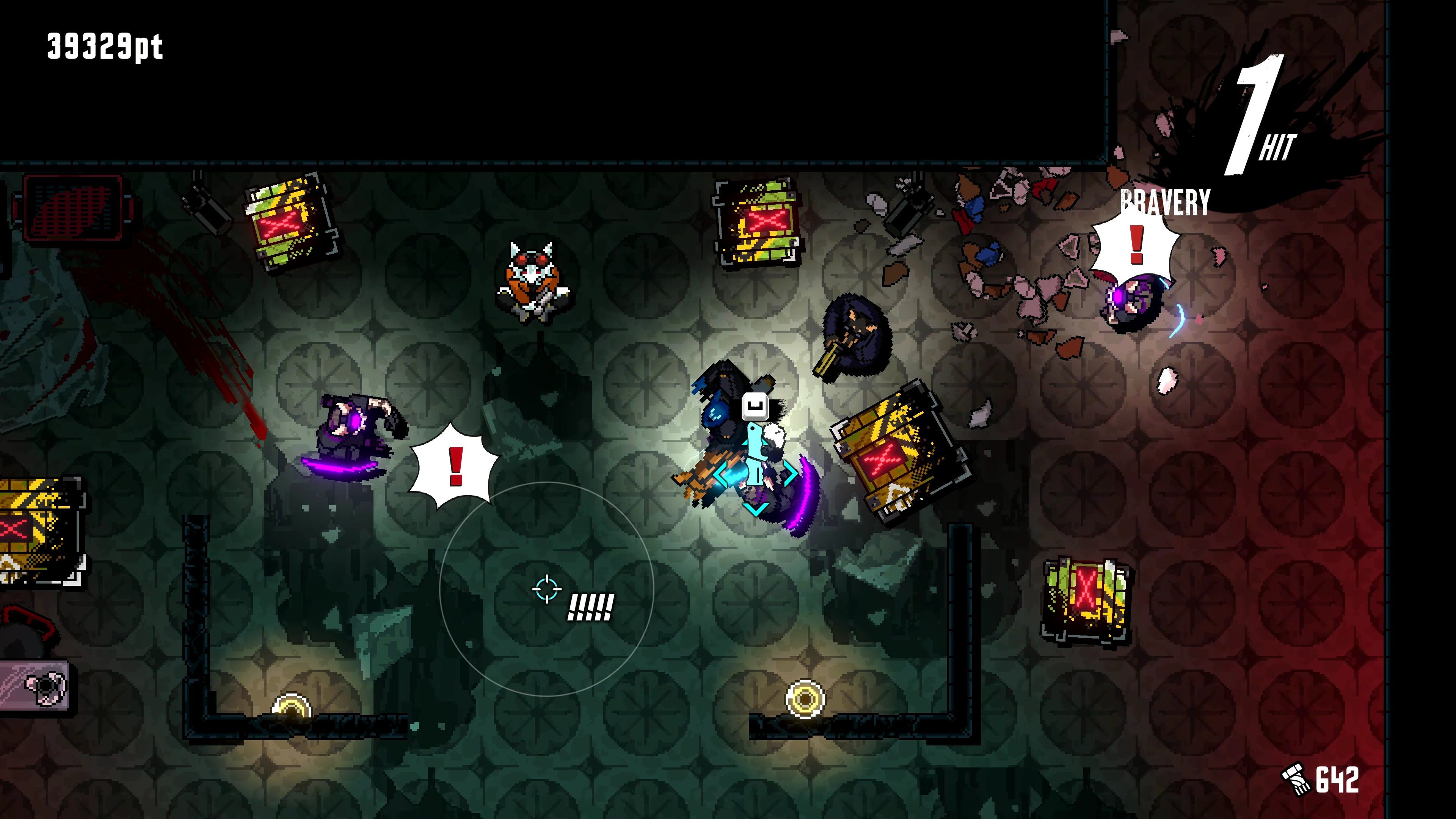
In another stage, we need to fight off enemies on the street while dodging incoming traffic. However, this can also work in our favor, as the incoming cars also crush our enemies.
There’s even a stage where we ride on a motorcycle and need to dodge enemies as well as incoming traffic. I found the stage rather frustrating, as the controls felt off to me, but it was a nice change of pace.
The biggest change of pace are the boss fights. These are bombastic, intense, and brutally difficult. In fact, we need to talk about the game’s difficulty in more detail.
Kusan is a hard game. It’s definitely harder than the first Hotline Miami. As the game is both blazing fast and sometimes difficult to read, we cannot rely on our reflexes alone. Instead, we need to learn the enemies’ patterns and figure out the best route through the floors, one death at a time.
Similar to Ghostrunner, Kusan resembles a high-intensity puzzle game. I like this gameplay a lot, but it’s also a demanding style that’s not for everyone. Combine this high intensity with a demanding saving system, and the end result is a game that expects our full attention.
Kusan isn’t something we play when we have half an hour of downtime that we want to fill. We need to consciously make time for it, similar to how we had to play old arcade ports without any saving system.
As said, this isn’t for everyone, and I think the game is slightly too hard. It just needs some tweaks to encounter design and readability to be even better. Especially in the boss fights, figuring out the patterns is needlessly difficult because there is just so much going on at the same time. At least the game rewards us with great kill animations once we finally beat the boss.
Furthermore, I think the individual floors should be a little shorter to make it easier to reach a checkpoint. As mentioned earlier, we tend to play cautiously when we’re close to finishing a floor to avoid losing our progress. This is at odds with the game’s scoring system and probably not what the developers had in mind.
Fortunately, the game also features an upgrade system that we can use to make our life easier and to customize our playstyle.
In Kusan, we gather currencies while playing and can trade these for upgrades and new weapons at the start of each stage. However, we cannot equip every upgrade at the same time. Instead, we have a limited grid and need to play inventory Tetris to make our upgrades fit.
Fortunately, we can unlock further slots over time and also optimize upgrades so that they take less space. However, we’re never able to equip everything. While the upgrade system is fine, and some upgrades are super useful, I don’t really like playing inventory Tetris, as I find it tedious. Instead, I’d have preferred a simpler system.
What I do like is how much impact the upgrades have. That’s true for both the different firearms, as well as for regular upgrades. For example, the “magnetic punch” upgrade automatically returns our throwing knife to us when we punch an enemy. This drastically improves our flow, as we no longer have to manually pick the knife up in between throws.
In total, the upgrade system adds a nice bit of depth to the game. It’s very similar to the one used in Ghostrunner and much more than what Hotline Miami has to offer.
Another strength of the game is the presentation.
These days, games with pixel art are a dime a dozen. However, there’s a huge difference between acceptable and great pixel art. Kusan’s pixel art is great. It’s sharp, highly detailed, and colorful.
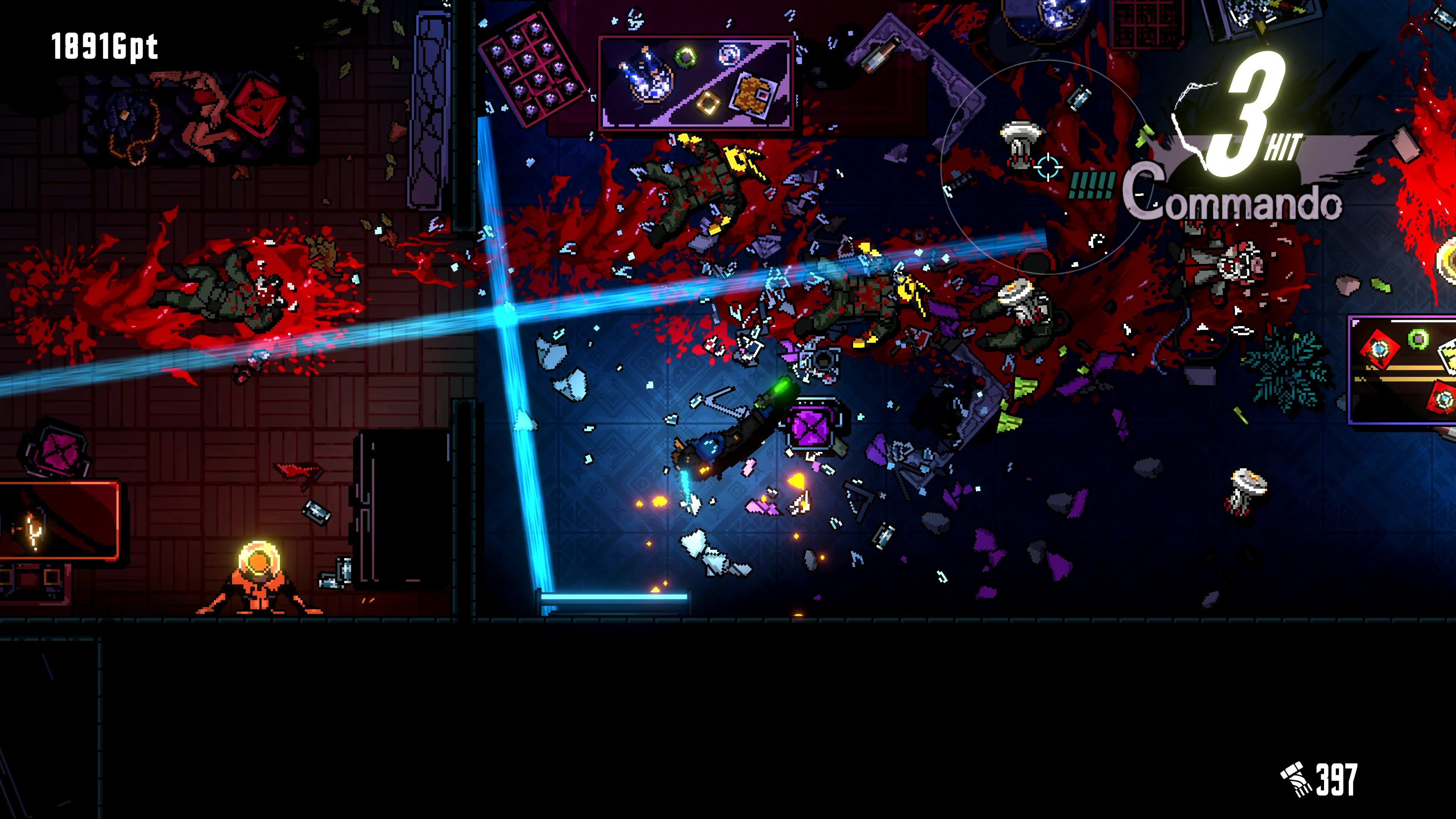
Even more impressive are the game’s animations. Take a look at how the main character opens the briefcase in the video below.
Instead of a simple vague interaction animation, he opens one lock at a time before flipping the briefcase open. This almost wasteful effort shows how much effort the developers put into the game. As another example, take a look at the car crash animation below and how detailed it is.
In contrast to the great visuals, the sound falls off. Both the music and the sound effects are nothing special. While they don’t detract from the full experience, they are far behind what similar games have to offer.
The game also features comic strips and uses them to tell most of its story. Naturally, these are also crafted with great care and are great to look at.
And the story? Well, it’s functional but didn’t exactly grab me. I much preferred Hotline Miami’s or Ghostrunner’s plots. However, it also doesn’t get in the way, and that’s enough for me.
Kusan is a good game, and you should give it a try if you like the genre. The game could do with a little more tweaking, both in terms of difficulty level and to iron out some minor bugs. It’s also rather short: it took me about six hours to finish it.
After playing both Slaughter Void and Kusan back-to-back, I’m not sure which game I like more. Slaughter Void has a better flow, while Kusan is the much more polished game and pretty instead of ugly. I need to think about this a bit more. In any case, it’s a good thing that we get two good Miami-Likes in a single year.
Thanks for reading. Please consider subscribing to the Substack. Also, please share it with a friend. You can do both with these handy buttons below.
Comments
Nothing yet. Say the first thing.
Sign in to join the conversation.