
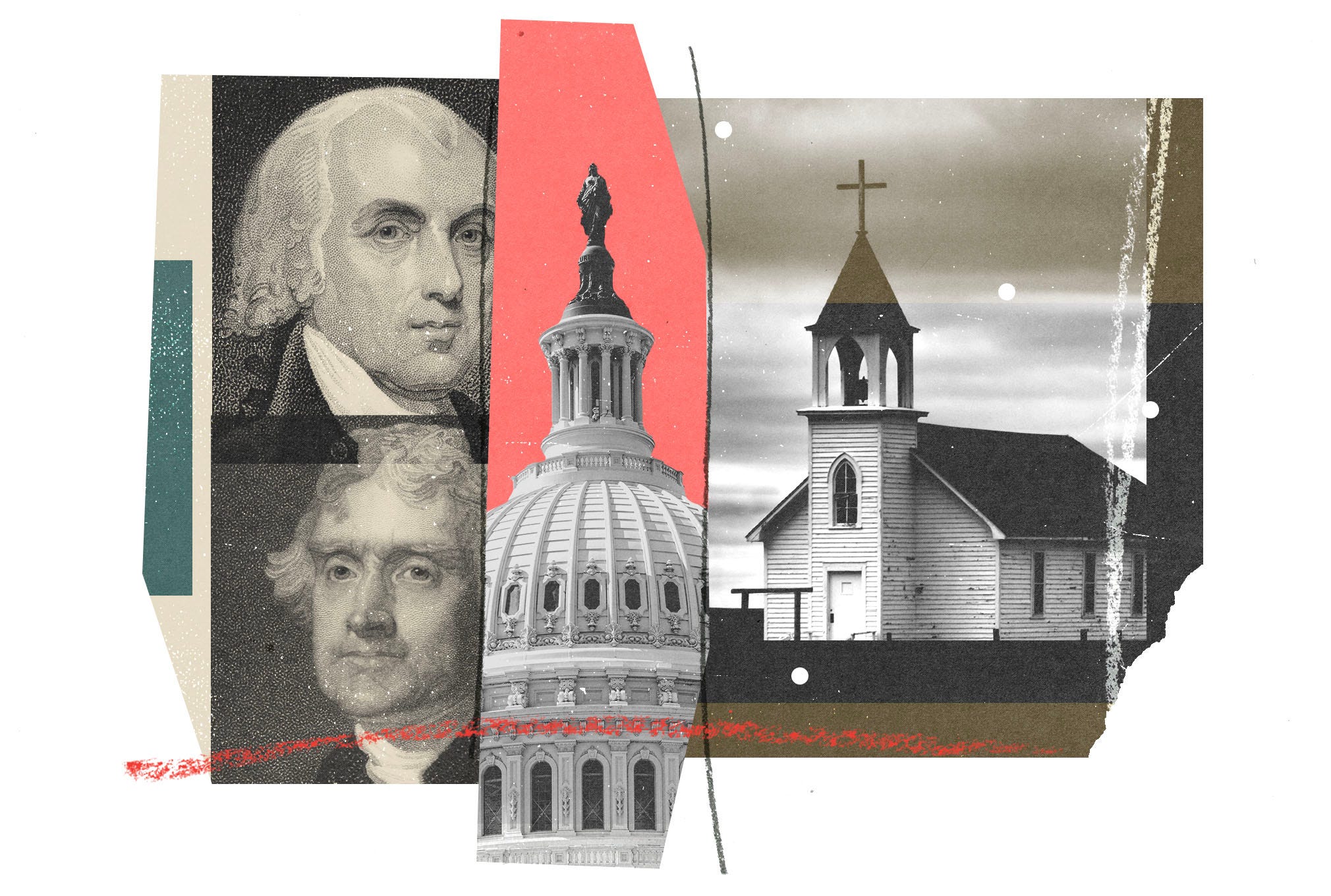
The First Amendment starts with just ten words: " Congress shall make no law respecting an establishment of religion." That's the Establishment Clause, and it's one of the most misunderstood parts of the Constitution. People sometimes hear separation of church and state and assume that means religion has no place in public life or that the Constitution is hostile to religion. It doesn't mean that at all. You are free to practice your religion, talk about it, vote according to your beliefs, bring those beliefs into public life, or practice no religion at all. What the government cannot do is decide that one of those beliefs deserves its support over the others.
The Founders understood the danger because they knew what happened when church and state became intertwined. In England, the Anglican Church was the established church, and people were required to support it whether they belonged to it or not. And here in Rhode Island, we have our own history with the separation of church and state. Reverend Roger Williams was banished from the Massachusetts Bay Colony in 1636 Because he challenged the Puritan government's authority to force their religious beliefs on others. He believed people had the right to choose their own religion and founded the colony of Rhode Island on that principle
"Congress shall make no law respecting an establishment of religion."
Writing ten words into the Constitution is one thing. Figuring out what those ten words mean in practice is another. The Supreme Court has spent decades trying to draw that line.
In Engel v. Vitale in 1962, the court ruled that public schools could not lead students in prayer. A few years later, in Lemon v. Kurtzman (1971), the court created what became known as the "Lemon Test." It asked three basic questions: Does the government have a reason unrelated to religion for doing this? Does it favor or discourage religion? And does it get the government too involved in religion? If a law or government action failed any one of those three tests, a court could strike it down as unconstitutional.
For decades, that was the basic framework. But in 2022, the Supreme Court changed the rules. In Kennedy v. Bremerton School District, the court sided with a public high school football coach whose post-game prayers had grown into gatherings with players joining him on the field. The school district was concerned that students could feel pressured to participate in prayer because they didn't want to offend their coach. While the coach, Kennedy, argued that he was simply exercising his own religious freedom. Unsurprisingly, this court sided with Kennedy, ruling that his prayers were protected personal religious expression.
The importance of that decision went well beyond this one football coach. The Supreme Court had already been moving away from the Lemon Test for years, but in Kennedy, they made it official. Instead of using those three questions, the court said judges should look to history to decide what crosses the line between church and state. Unlike the Lemon test, that leaves a lot more room for judges to decide which history matters and how they choose to interpret it.
Since then, we have watched state governments test just how far they can go. Oklahoma tried to create the first publicly funded religious charter school in the country, a public school that would teach Catholic doctrine as part of its curriculum. The Oklahoma Supreme Court blocked it.
When the case reached the United States Supreme Court in 2025, Justice Amy Coney Barrett, a practicing Catholic, recused herself, and the remaining justices' decision was split 4-4, which left the Oklahoma ruling in place. So the creation of that public Catholic school stayed blocked, but only because the court was tied. Four justices were willing to let a publicly funded religious school move forward, and that is crazy.
Louisiana and Texas have both passed laws requiring the Ten Commandments to be displayed in public school classrooms. I find that particularly disturbing at a time when states are restricting what students can learn about race, slavery, civil rights, gender, and LGBTQ+ history. Apparently, some subjects are too controversial for the classroom, but…government-mandated religion isn't?
At the same time, we've seen a significant shift inside the executive branch. The White House has worked with faith-based organizations since George W. Bush created an office for that purpose in 2001. Obama kept it and expanded it to include secular community groups, so non-religious groups. Trump has taken that office in a very different direction. He created a task force specifically to fight what he calls 'anti-Christian bias', along with a religious liberty commission that's pushing for more religion in public schools and other parts of government.
I think now's a good time to make sure we understand the difference between Christianity and Christian nationalism. Christianity is a religion. Christian nationalism is a political ideology that says Christianity should have a privileged place in American government and public life.
In June 2026, when Trump's Religious Liberty Commission delivered a draft of its report, Trump said, and I quote, " We're bringing back religion in our country, and we're bringing it back quickly and strongly." I find it ironic that Donald Trump has appointed himself the man who's going to 'bring religion' back to the United States, given how little his own public and private behavior reflects the Christian values he's claiming to be defending.
FYI, Donald, religion never went anywhere. Americans have always been free to go to church and pray, read the Bible or the Koran, send their children to religious schools, and practice their faith, any religion.
What Trump is talking about is bringing religion into government. The commission's recommendations show us what that looks like. The report actually argues that we should stop thinking about a wall between church and state, and start thinking about a bridge, where religion strengthens the government and government helps religion flourish. In practice, they're talking about more prayer and religious instruction in public schools, religious displays on government property, more public money going to religious schools and faith-based institutions. And repealing the Johnson Amendment, which restricts tax-exempt churches from participating in partisan political campaigns.
Helping religion flourish is not the government's job. The First Amendment does not give the government the power to promote religion or decide which religion deserves its support. The Establishment Clause exists specifically to prevent the government from doing that. And when we're talking about Christianity here, we're talking about their version of Christianity. One that bears strikingly little resemblance to Jesus's teachings. They're using Christianity to give their political agenda religious authority. Once government is allowed to decide that one particular version of a religion deserves special recognition, everyone else's religious freedom becomes conditional. It depends on who is in power and whether your beliefs happen to align with theirs.
Roger Williams understood this because he lived it almost 400 years ago. He was a Christian who was banished by other Christians because his beliefs did not conform to theirs. We're not gonna let that happen again. The government doesn't get to choose our religion, It doesn't get to tell us how to practice it, and it sure as hell doesn't get to tell us what we should believe.
No posts
Comments
Nothing yet. Say the first thing.
Sign in to join the conversation.