
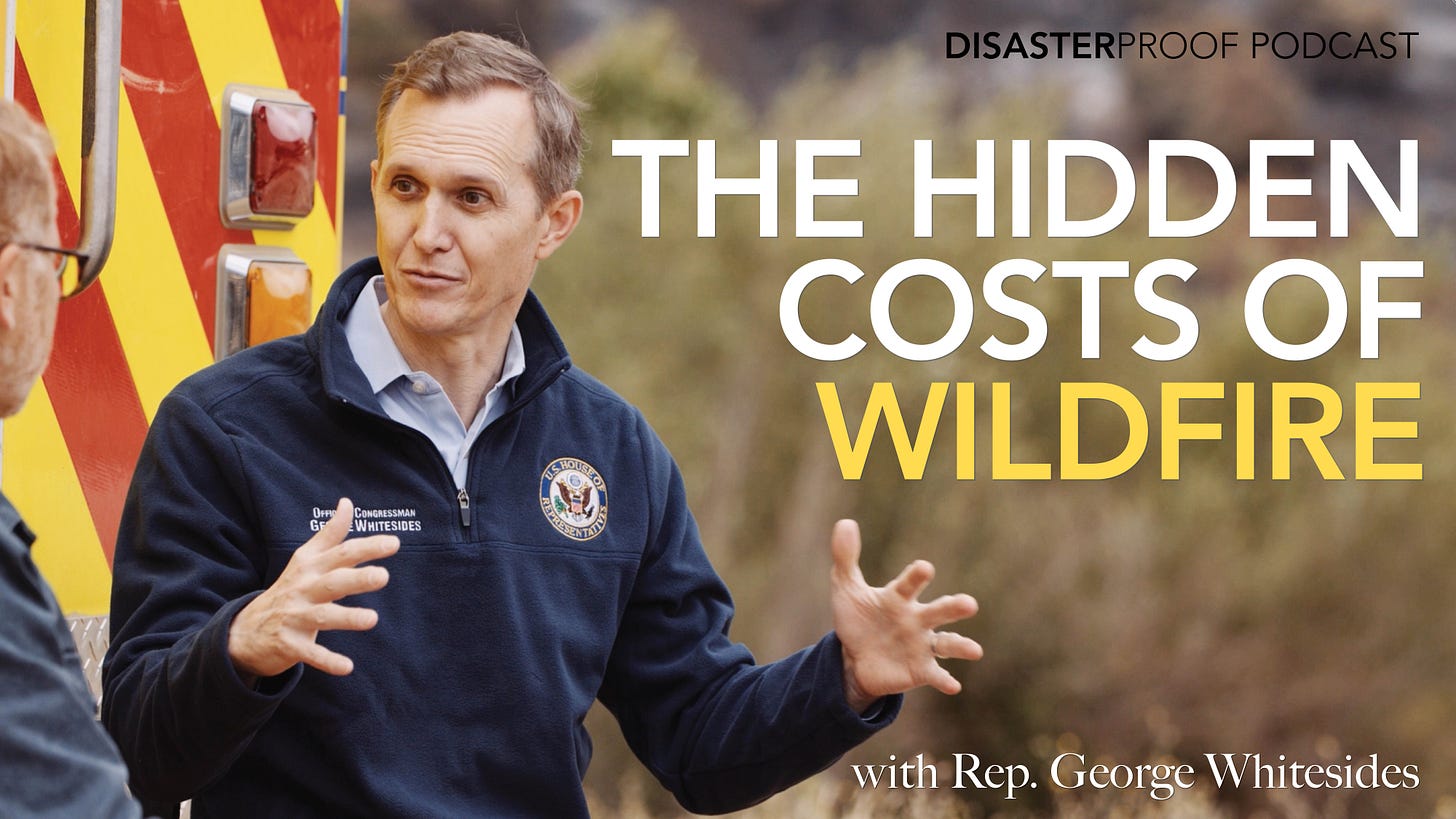
Eight days after the Sandy Fire tore through Simi Valley, we recorded this episode standing inside the burn scar.
More than 2,000 acres burned, nearly 10,000 homes were evacuated, but thanks to a remarkable response from the Ventura County Fire Department, only one home was lost.
It’s an unusual place to record a podcast, but being there made the conversation about wildfire feel a lot less theoretical.
Congressman George Whitesides joined us there. Before running for Congress, he was Chief of Staff at NASA, CEO of Virgin Galactic, and later co-founded Megafire Action. He’s spent much of his career thinking about complex systems, technology, and government, so I was curious how someone with his background thinks about wildfire from inside Congress.
The thing that surprised me most wasn’t anything he said about forests. It was what he said about affordability.
Wildfire isn’t just destroying specific communities. It’s making life more expensive for everyone.
Insurance premiums continue climbing — or they disappear altogether. Without insurance, buying or keeping a home becomes much harder. Utilities spend billions reducing wildfire risk, and those costs eventually show up on our electric bills. Even people hundreds of miles away pay through the health impacts of smoke.
Wildfire is an affordability issue, and if affordability is one of the defining political issues of our time, wildfire deserves a much bigger place in that conversation.
If wildfire is becoming one of our biggest affordability challenges, what can we do about it?
One line from the conversation stuck with me: “Wildfire is really the only natural disaster that you can get in the action loop of before it becomes catastrophic.”
You can’t stop a hurricane. You can’t stop an earthquake.
But you can detect a new ignition quickly. You can reduce fuels. You can harden communities. You can attack small fires before they become megafires.
As the Congressman put it: “We have human agency over this problem. And we should use that agency.”
Rep. Whitesides’ background in aerospace shaped the way he thinks about innovation.
I expected him to talk about satellites or AI, but he spent most of the conversation talking about procurement.
His argument is that America already has extraordinary entrepreneurs building wildfire technology, and the bottleneck isn’t a lack of ideas. It’s getting those ideas into the hands of firefighters.
The same changes that helped unlock commercial space — competition, faster procurement, better pathways for startups, and funding through the “valley of death” — could do the same for wildfire.
The lesson from space isn’t just better technology. It’s building better systems for getting technology into the hands of the people who need it.
Every year, disasters cost the United States hundreds of billions of dollars, and perhaps as much as $1 trillion.
Yet, we spend relatively little trying to reduce those losses before they happen.
Representative Whitesides’ vision is to create something like the Defense Innovation Unit for wildfire: a dedicated fund that helps get tech firefighters actually want into the field.
We know these losses are coming every year. The gap between what we spend responding and what we spend preventing is a choice.
The conversation also reminded me that wildfire remains one of the few issues where bipartisan cooperation still feels possible.
Rep. Whitesides talked about two pieces of legislation he’s helping advance: the ACERO Act, which expands NASA’s role in wildfire technology, and the Fix Our Forests Act, a bipartisan effort to speed fuels management, reduce permitting delays, and improve wildfire intelligence.
Whether you agree with every provision or not, wildfire is still one of the rare places where lawmakers seem more interested in solving problems than scoring political points.
Congressman Whitesides ended with a simple request: if this issue matters to you, tell your senators to support the Fix Our Forests Act.
Congressman Whitesides evacuated his own home during the January 2025 LA fires, just days after being sworn into Congress. He understands this issue as both a policymaker and someone who has lived through it.
When I think back on this conversation, I don’t think about a specific bill or policy proposal. I think about the fact that wildfire is one of the few disasters where we still have agency.
Wildfire risk is increasing. But unlike almost every other natural disaster, it’s one where our decisions still shape the outcome.
Watch the full conversation with Representative George Whitesides on YouTube, Spotify or Apple Podcasts
No posts
Comments
Nothing yet. Say the first thing.
Sign in to join the conversation.