
As you read this, more than 700,000 acres are burning across Nebraska. The Morrill Fire alone has already become the largest wildfire in state history. Towns are evacuating and a state of emergency has been declared.
This is becoming the rhythm of our fire seasons — and why we made this episode.
But for every fire that burns out of control, there are a handful of stories that show what’s possible when we plan ahead.
One of these stories starts in a small town in Texas. On a February morning in 2024, the Windy Deuce Fire tore across the Texas Panhandle. Within days it burned more than 140,000 acres and became part of the largest wildfire in Texas history.
The fire was headed straight for Borger, a town of about 3,000 people. Borger might have met the same fate as many of the towns that burned down around it, but something strange happened.
The flames reached the edge of town…and stopped. Why?
Months earlier, the Borger Fire Department deliberately set fire to the land surrounding the town. It was a prescribed burn, designed to remove the grass and brush that feed catastrophic fires. The burn stretched seven miles along a 250-foot wide ribbon of land on the edge of town, creating a black line of cleared earth between Borger and the wildfire bearing down on it.
They created a halo of protection around the city.
What happened in Borger isn’t a fluke. A 2024 analysis in Forest Ecology and Management found that prescribed burning reduces the severity of subsequent wildfires by 62–72%. When a wildfire hits land that’s already been cleared or burned, it burns far less intensely.
Sometimes the effect is cinematic. During the 2022 Midnight Fire, flame heights dropped from 200–300 feet to just 2–3 feet within minutes when the fire reached a previously burned area. The fire didn’t disappear. But it became manageable.
Nearly every acre of forest and grassland in the United States needs regular clearing — prescribed fire, thinning, or mechanical treatment — to reduce wildfire risk. The U.S. Forest Service says at least 63 million acres of national forest land face high wildfire risk, and they’re overdue for treatment. In a good year, we treat about 2–3 million acres with prescribed fire, and most of that happens in Florida, not in the Western states where it’s most needed.
At the current pace, it would take decades to catch up — and every year the backlog grows as vegetation accumulates.
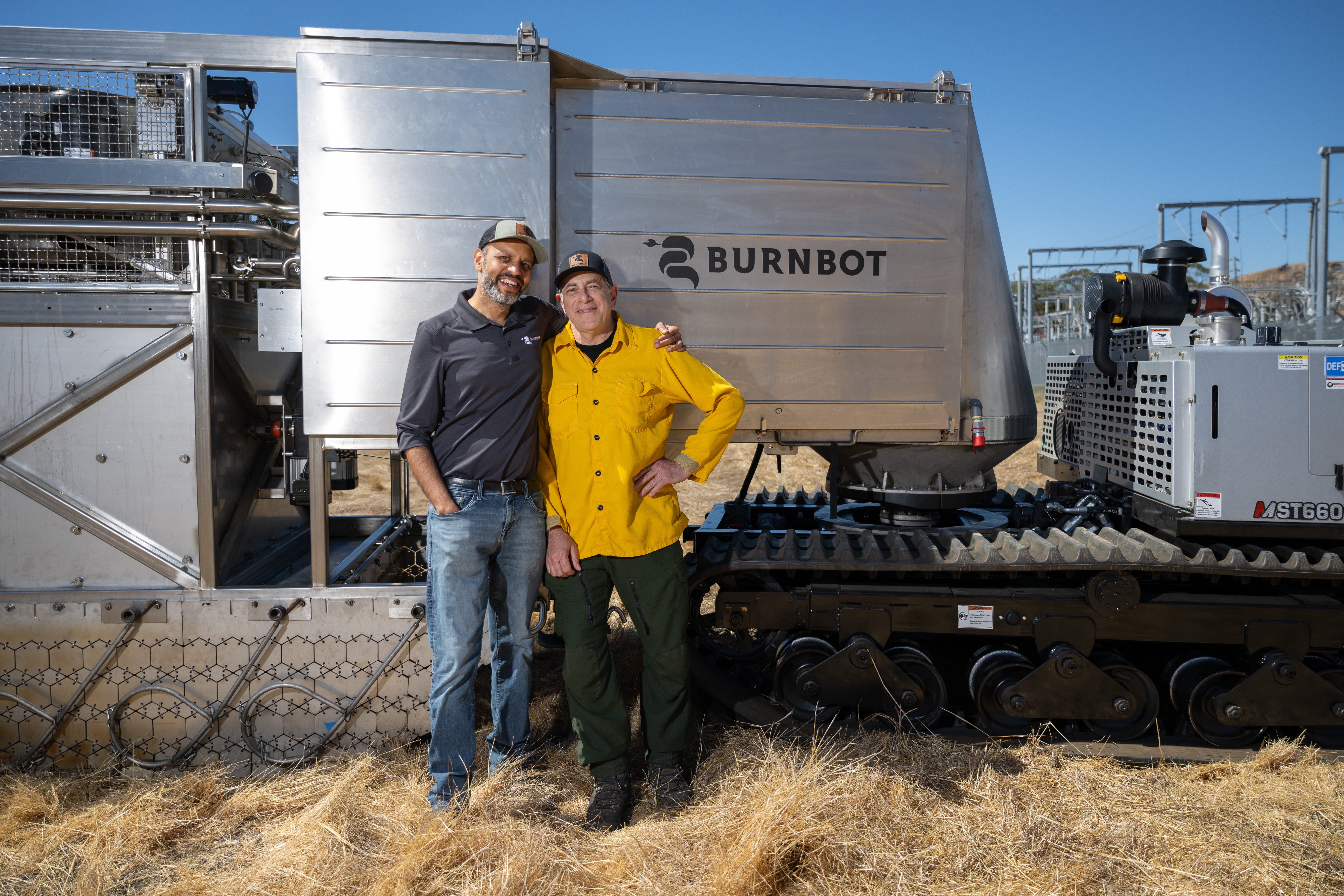
It’s why companies like BurnBot exist. BurnBot builds machines that automate prescribed burning — making it possible to treat land faster, more safely, and at a fraction of the traditional cost.
In this episode, we visit BurnBot’s factory to meet CEO Anukool Lakhina and see the machines — the RX2 and the Masticator. We also talk to Archie Stone, the Wildland Fire Coordinator for the Borger Fire Department.
Their work points toward a different future — one where communities are prepared, not just lucky.
If we get this right, wildfires will look very different.
Instead of seeing megafires tear through overgrown landscapes, we’ll see smaller, lower-intensity fires that firefighters can manage and communities can live alongside. The air will be clearer. Ecosystems will be healthier. And what happened in Borger won’t be an unusual story — it’ll just be what communities do.
Davis et al., 2024 — Prescribed burning reduces wildfire severity by 62–72%
https://www.sciencedirect.com/science/article/pii/S037811272400197XKelp et al., 2023 — Midnight Fire flame height reduction in previously burned areas https://agupubs.onlinelibrary.wiley.com/doi/10.1029/2022EF003468
No posts
Comments
Nothing yet. Say the first thing.
Sign in to join the conversation.