
In the last year, few industries have captured cultural, regulatory, and investor interest to the same degree as prediction markets. Platforms like Kalshi and Polymarket, which have millions of active users worldwide as of July 2026, facilitate peer-to-peer trading on future event outcomes for a small cut of contract winnings. These companies are now valued in the tens of billions of dollars and continue to expand across geographies and event categories, even as their regulatory status remains contested.
Such platforms are not built around fundamentally new ideas. Previous iterations of today’s prediction markets have included academic exercises, internal company markets, and commercial platform versions. All of them failed to gain traction with users and approval from regulators for decades. Understanding whether today’s prediction markets will succeed requires looking back at the history of such markets and evaluating the current evolving regulatory landscape and consumer appetite for gambling.
Specifically, it is critical to understand the differences between prediction markets and traditional sports betting, including the differences between the regulatory treatment and business model of each. Perhaps most important in this comparison is the dramatic skew in win distribution on prediction market platforms compared to sportsbooks. This skew largely governs user experience and long-term traction of the products compared to gambling-adjacent alternatives. In this piece, we break down the mechanics of prediction markets and the challenges companies face in building a product that consumers or regulators prefer over existing alternatives.
Prediction markets are peer-to-peer exchanges in which users can bet on the outcome of future events by buying or selling contracts. Each contract’s pricing reflects the market’s assessment of the probability of the event resolving with a particular outcome; an event that is likely to occur may have a contract selling for $0.90 to pay out $1.00 at resolution (roughly equating to a 90% probability of occurring according to the market), whereas an unlikely event may have a contract selling for $0.10 for the same payout (~10% probability).
As of July 2026, prediction markets are not legally considered betting or gambling markets in the United States. Companies that operate prediction markets frame themselves as fairer and more transparent than sportsbooks, which use models to set odds and actively bet against customers by acting as the “house”; in contrast, prediction markets claim to simply provide a marketplace for individuals to bet against one another with no incentives for markets to resolve to particular outcomes.
Public opinion on prediction markets has been mixed. A poll issued by Kalshi itself in September 2025 found that 70% of Americans believed people should be able to “invest” in specific event outcomes such as presidential elections or agricultural yields, and 89% viewed contracts in stocks, mutual funds, and commodities as “financial investments” rather than “gambling.” The survey did not mention sports among the event contracts it described, though sports contracts account for over 90% of trading on the platform. Adding further irony is the fact that the company has argued elsewhere that polls are not reliable.
Other polling from sources with less apparent bias has been far less favorable. A 2026 National Council on Problem Gambling (NCPG) survey found that nearly half of Americans consider prediction markets comparable to gambling, versus just 27% who liken them to investing. It also found broad support for guardrails: 84% believed prediction market platforms should be treated like gambling when it comes to consumer protections, and 82% said platforms where people risk money on future outcomes should be required to offer responsible-gaming tools such as deposit limits, cooling-off periods, and access to help resources.
While public interest in, and opinions on, prediction markets are relatively new, the concept has existed for decades in academic, corporate, and public arenas. Listed below, in chronological order, are the most significant projects in the prediction market space over the last several decades.
The Iowa Electronic Markets: Established in 1988, the Iowa Electronic Markets are collectively considered the first institutional prediction market. The IEM are a system of real-world event contracts traded for real money on an exchange operated by the University of Iowa Tippie College of Business as a non-profit academic data source. The IEM still operate today, but is not legally regulated due to the small volumes of most markets.
TradeSports / Intrade: Founded in 1999, TradeSports and Intrade were Ireland-based exchanges founded by John Delaney that specialized in sports wagering and non-sports event contracts, respectively. From 2002 onward, Intrade’s political contracts, especially on US elections, made up the majority of trading activity, and Intrade users earned a reputation for uncanny accuracy, correctly anticipating the capture of Saddam Hussein, the 2005 papal succession, and the electoral result in 49 of 50 states in 2012. Tradesports itself wound down in the late 2000s after the Unlawful Internet Gambling Enforcement Act of 2006 made it nearly impossible for American users (the bulk of the Tradesports customer base) to move money to online gambling sites, leaving only Intrade in operation. The CFTC sued Intrade in late 2012 over unregistered options trading, forcing the company to bar American traders and ultimately suspend trading entirely in March 2013.
NewsFutures: Founded in May 2000, NewsFutures was another early prediction market, which ran entirely on play money rather than cash. Operational for nearly a decade, NewsFutures listed contracts on more than 120K events across politics, finance, and sports. The platform also co-branded its sports and money markets with USA Today. NewsFutures lent credibility to the play-money model that many corporations would later adopt for internal forecasting, where cash betting is often prohibited, after 2003–2004 NFL season forecasts on NewsFutures were found to be equally accurate to the real-money predictions of another platform, TradeSports. Because NewsFutures was based on play money, it could also facilitate international betting, allowing users from different countries to trade with one another.
Policy Analysis Market: The largest-scale proposed public prediction market was the Policy Analysis Market, scoped in May 2001 by DARPA’s Information Awareness Office as part of the FutureMAP project. Designed with the San Diego research firm Net Exchange, it would have let regional experts trade futures contracts on political, economic, and military developments across the Middle East. Though its designers intended for the predictions to be used as a geopolitical stability gauge, several US senators denounced it as a market for betting on assassinations and terrorism, and the Pentagon scrapped it in August 2003 before a single trade was placed.
PredictIt: Founded in November 2014, PredictIt offered real-money political betting to American traders as a nonprofit educational project of New Zealand’s Victoria University of Wellington. Created by John Aristotle Phillips in partnership with the university, it operated under a CFTC no-action letter that allowed it to run without registering as a formal exchange, with an $850 ceiling per contract and a cap on how many traders each market could accommodate. Like the IEM, it positioned itself as a research tool and shared data with academics. As of July 2026, PredictIt is still in operation despite a multi-year legal battle after regulators moved to revoke its operating relief in 2022, the resolution of which raised its contract ceiling to $3.5K and removed the cap on traders per market.
Augur: Built on Ethereum in 2014, prediction market Augur was one of the first genuinely decentralized applications created on the blockchain. Funded by an ICO that raised roughly $5.5 million in 2015, Augur went live on Ethereum’s mainnet in July 2018. Whereas earlier platforms curated their own contracts, Augur let any user create a market on any question, a permissionless design that drew controversy over user-created “assassination markets.” The platform’s traction was limited from the outset, with daily users collapsing from about 270 at launch to under 30. The platform was relaunched in 2020 to migrate trades to the DAI stablecoin and add safeguards, but traction remained limited, and the project went largely dormant after 2021. As of July 2026, the Lituus Foundation and Ethereum contributor Micah Zoltu are leading a reboot of the platform, including a new protocol for dispute resolution.
Kalshi: Founded in 2018 by MIT graduates Tarek Mansour and Luana Lopes Lara, Kalshi has spent years and tens of millions in legal fees establishing that event contracts belong under commodities law rather than gambling statutes, and in November 2020, it became the first platform licensed by the CFTC as a designated market for such contracts. As of July 2026, Kalshi has millions of users and has been valued at over $20 billion. The platform provides probability data on global events to outlets like CNN and CNBC.
Polymarket: Launched in June 2020 by Shayne Coplan, Polymarket brought the blockchain model to the mass market, settling trades in the USDC stablecoin on the Polygon network. Polymarket claims to be the world’s largest prediction market, and has made waves with real-world marketing stunts, opening The Situation Room, a Washington, D.C. pop-up bar built for “monitoring the situation” with screens streaming live X feeds, flight radar, Bloomberg terminals, and Polymarket odds, after an earlier free grocery store pop-up called The Polymarket in New York City that gave away free groceries for several days. As of July 2026, Polymarket trading is now legal in some US states under the same CFTC governance as Kalshi.
In 2024, $3.6 billion was wagered on the US election Polymarket prediction market, which correctly signaled a Trump victory ahead of most pollsters and prompted the FBI to open a probe looking into the company as a facilitator of betting on election outcomes (which is illegal in over half of US states). Federal investigators dropped their probe in July 2025, shortly after which Polymarket acquired a CFTC-licensed exchange to secure a compliant path back into the United States, returning to American users at the end of 2025 alongside a multibillion-dollar investment from Intercontinental Exchange, the parent company of the New York Stock Exchange.
In addition to dedicated prediction market companies, established players across tech, crypto, finance, and sports betting have launched their own prediction market platforms in the last two years. Meta is reportedly building Arena (first reported in June 2026), a standalone, play-money prediction app personally directed by Mark Zuckerberg. Crypto exchange Crypto.com has been a CFTC-regulated prediction-markets pioneer since December 2024 and spun up its standalone prediction-markets platform, OG, in February 2026. Gemini, another crypto exchange, released US event contracts in December 2025 following CFTC approval. Traditional financial venues such as CME Group and Interactive Brokers opened their own CFTC-regulated prediction markets in 2022 and 2024, respectively. Finally, online sportsbook (OSB) operators opened prediction markets in late 2025, including DraftKings (December 2025), Underdog (September 2025), and PrizePicks (November 2025).
Prediction markets make money in different ways, like charging a fee on each contract (regardless of whether the contract ends up a winner or not), taking a cut of winning payouts, or collecting the spread between bid and ask prices by acting as a market maker on its own platform.
Kalshi makes money in three primary ways. The first is per-contract trading fees charged on nearly every trade, to both the contract maker (seller) and the taker (buyer). Rather than a flat rate, the fee follows a probability-weighted curve: highest on 50/50 contracts near $0.50 and shrinking toward zero as a contract approaches $0.01 or $0.99, peaking at about $0.0175 per contract, with makers paying meaningfully less (often rounded to zero on small orders), and no fee when a contract settles. Second, Kalshi also earns interest on the idle cash sitting in customer accounts, which are held in segregated regulated accounts. Finally, Kalshi offers streams of market data via API and partnerships, allowing partners like Bloomberg, the Fed, and equity analysts to access its markets’ predictions off-the-shelf.
Unlike Kalshi, Polymarket historically subsidized trading fees (which were as low as 0% on most markets) using venture funding, betting that volume growth would allow it to capture fees later. In March 2026, the company began taking fees on contract buyers, determined by a multiplier that varies across categories, from 0.07 on crypto, 0.03 on sports, 0.04 on finance/politics, 0.05 on culture / other, while geopolitics and world events stay fee-free, and makers pay zero. As of July 2026, these fees are used to compensate market makers, and Polymarket’s primary revenue source comes from investing users’ USDC collateral, paying users about 4% and keeping the marginal interest.
Polymarket also makes money selling real-time data feeds to hedge funds, news outlets like Bloomberg, and AI developers. Longer term, a planned POLY token would allow the company to force users to hold their account’s cash in such tokens and make money by taking a cut of each transaction in addition to a cut of deposit interest.
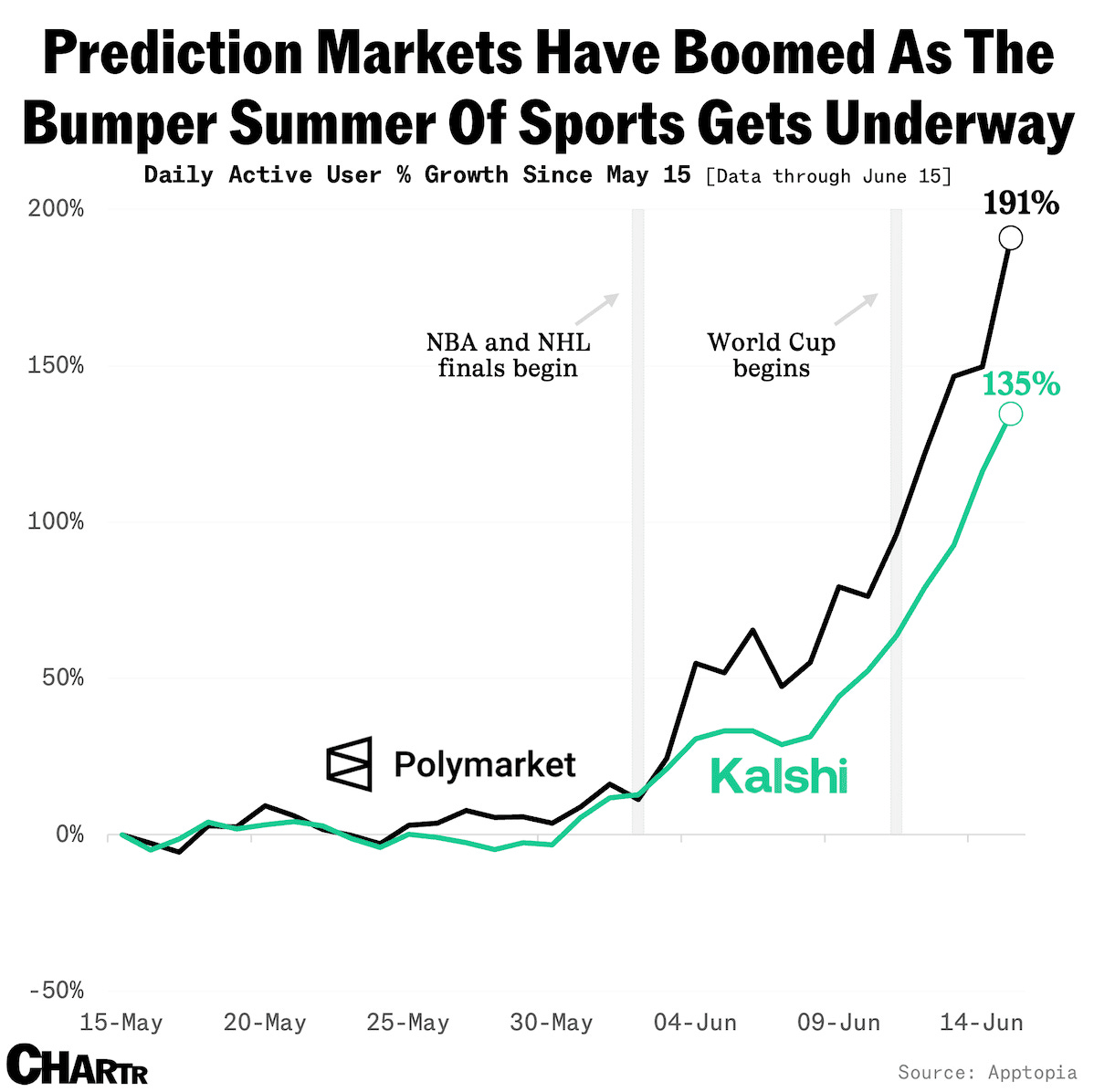
As of July 2026, Kalshi and Polymarket are the dominant prediction market platforms both in the US and globally. According to the companies, Kalshi has over 5 million active registered users, and Polymarket has 2.3 million, volumes that have more than doubled since May 15th, 2026, as NBA playoffs, NHL playoffs, and World Cup games have increased interest in wagering on sports event outcomes.
Source: Sherwood News
Analysts estimate that over 17 million individuals worldwide will use prediction markets in 2026, including prediction markets facilitated through traditional online sportsbooks. According to one study of prediction market users, 90% are male, a skew that prediction market advertisements are actively attempting to address.
In line with a growing user population, prediction market trading volume has increased over 5x in the last year and over 10x in the last two years. Combined monthly global trading volume on Kalshi and Polymarket rose from less than $5 billion in September 2025 to $24 billion in April 2026. The global market was estimated at $31.2 billion as of May 2026. Kalshi reportedly makes up 58% of that volume, and Polymarket 28%. This global total is comparable to the handle of regulated US sports betting, which reached $167 billion during 2025, or around $14 billion a month.
“Handle” is the total amount of money wagered at a sportsbook. The sportsbook only keeps a small slice of that pool, called the hold (revenue as a percent of handle): in the US in 2025, the hold averaged about 10.15%, so books kept roughly $10 of every $100 wagered. This means $167 billion in handle translates to about $17 billion in revenue. Prediction markets keep a far thinner slice of their overall trading volume, since they charge small exchange-style fees instead of a 10% hold, which is why Kalshi and Polymarket can post comparable trading volume yet report much lower revenue (Kalshi’s $2 billion ARR or Polymarket’s $1 billion ARR versus sportsbooks’ $17 billion).
The above is an excerpt from our new deep dive on the mechanics and challenges of prediction markets. See the full report here.
Comments
Nothing yet. Say the first thing.
Sign in to join the conversation.