In last week's post I explained the first principle of the Universal Moral Core (UMC) in greater detail. Today I want to investigate some of its implications for how we should behave. As a reminder, earlier in the series, I suggested that the goal of philosophy should be to help us answer the following question: How should we choose our actions in light of our understanding of reality and the…
A few years back we experienced the infamous vibecession. Kudos to Kyla Scanlon for this terrific term which captures a moment where the public feels bad about the economy at a moment where traditional economic indicators are not showing a recession. At the time there was a huge amount of commentary on where the “bad vibes” might be coming from. Lots of theories were advanced, but then, as is…
The first principle in my proposed Universal Moral Core (UMC) is as follows: Grow knowledge as the source of technological and moral progress. Before diving into all parts of this principle and its implications, let me relate it upfront to the Kantian separation between moral norms (values) and epistemic norms (knowledge). My principle is about a necessary condition for progress. This doesn’t mean…
Technological progress requires moral progress. The necessity of moral progress becomes obvious in the extreme, when capabilities arise that allow entire worlds to be destroyed with the push of a button. Science fiction presents us with many dramatic examples, such as the destruction of the planet Alderaan in Star Wars, or the shocking finale of the Three Body Problem. But even today, far from…
Richard Sutton recently quit Keen to pursue his own reinforcement learning startup. That reminded of his conversation with Dwarkesh Patel, in which Sutton argues forcefully against the usefulness of training on existing human knowledge. Even though we can apply a lot of compute to it and have done so, we will run out of knowledge and then what. Arguably we have already arrived at this point.…
To truly understand the world, we must bridge the gap between philosophy and physics. Recent breakthroughs in gravity and quantum theory are finally moving us past stagnant paradigms to make this possible.
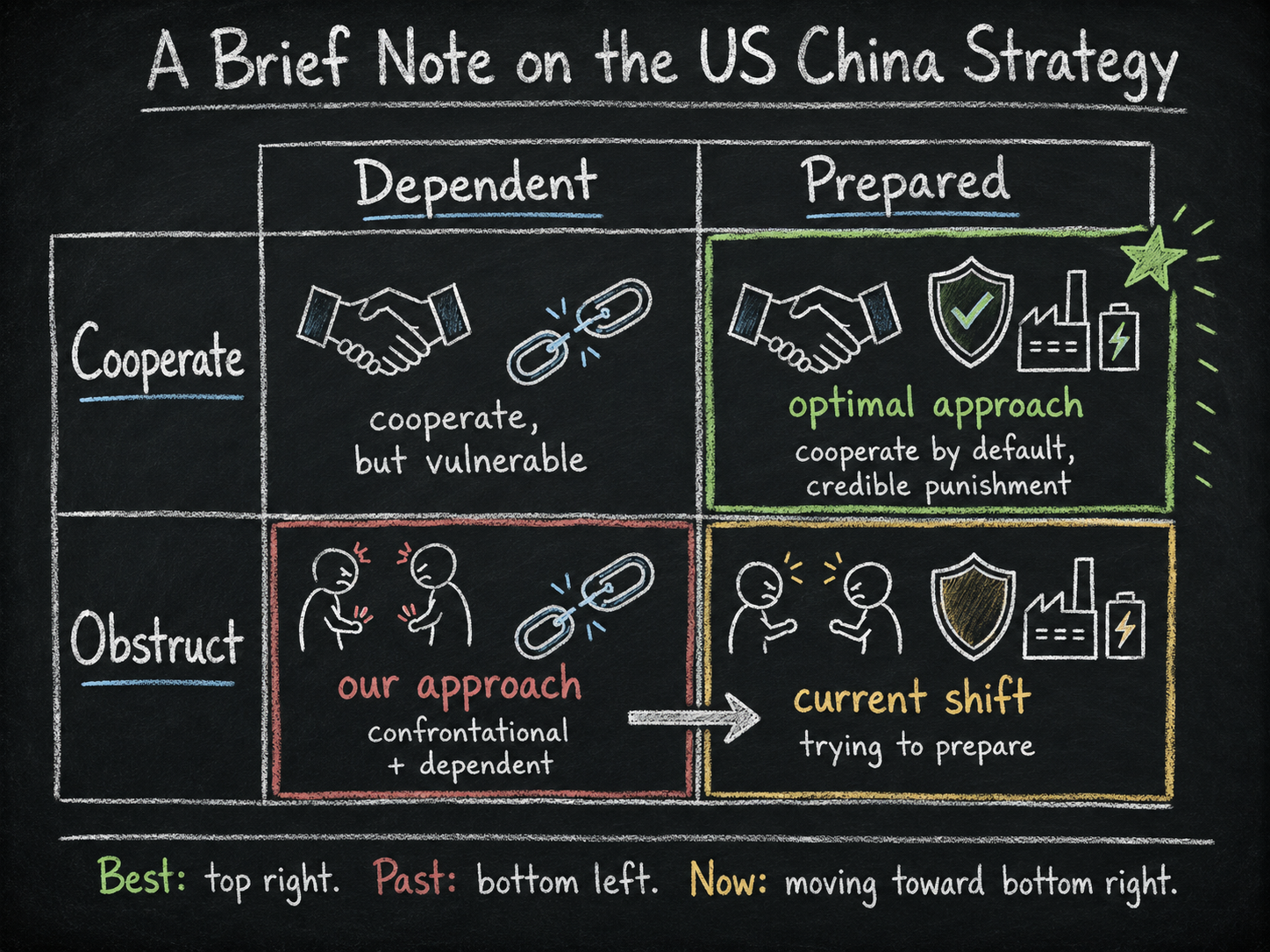
By confronting China politically while becoming economically dependent, the US violated basic game theory. To reach a stable multipolar world, we must build supply chain resilience.
Before coming to the US for the first time, I attended a long weekend orientation held by the organization that was arranging my stay. We were warned that we would feel homesick, and that we would experience culture shock. I arrived in Rochester, Minnesota in 1983 at age 16. The wonderful Williams family welcomed me into their home. Bob was an engineer working on the AS400 chip at IBM's Rochester…
There is a heated debate about what an AGI-level economy might look like. On one side are pessimists who foresee extreme wealth concentration and a permanent precariat: people with no meaningful economic role, dependent on whatever crumbs fall from the table of capital owners. On the other are optimists who argue that AI will make everything so cheap that people won't need much money to live in…
Are we in an AI bubble or not? As someone who lived through the dotcom bubble as an investor there are many parallels and also significant differences. By many metrics we are in obvious bubble territory with fantastically extended valuations and lots of roundtripping happening with NVIDIA at the center in a position similar to AOL. Yet there is also something truly different and novel: AI is the…
I love food and I love drink. Food and drink provide wonderful delights from delicious flavors and through jolly company. To my great fortune I never had any eating or drinking problems. Well all of that suddenly changed a few months ago. I went from no problems straight to intense chest pain and massive acid reflux. I consulted both AI and my generalist who both concluded that I had…
In the two prior posts in Philosophy Mondays I have argued for a universal moral core centered on knowledge. The first post shows how absorbing states curtail the growth of knowledge. The second post demonstrates the need for resources to further develop knowledge. To recap ever so briefly: knowledge is central to human affairs as it is the source of our power and responsibility. It is what…
I am an immigrant, which has given me a profound appreciation of the interplay between culture and immigration. My first time in the United States was as an exchange student in Rochester, Minnesota. I was a junior at John Marshall High School. Early into the school year, some students missed an exam and I was told they would be given the same exam as make-up a week later. I was flabbergasted.…
I learned how to code on a Texas Instruments TI-59 programmable calculator and then moved on to an Apple II. The calculator had a kind of assembly language and on the Apple I had access to Basic but still wrote a fair bit of assembly code. After a one year stay 1983-84 as a High School junior in the United States I returned to Germany determined to have my own income (as I had seen many other…
If you want inspiration for this moment in time I have two recommendations: watch Babylon Berlin and read the Foundation Trilogy. They are roadmaps for living a moral life in a time of profound regression. I am approaching this moment with the clarity that comes from recognizing that one has failed. Over a decade ago I started calling for dramatic changes to how we organize society. I gave talks,…
I wrote the following in April of 2025 and sent it to some friends in Europe. But now seems a good time to just publish it here as a provocation. Illustration by Gemini/Nano Banana Pro. European Federation Manifesto Europe needs to be strong – for itself and for the world. China has become a superpower and the United States is struggling with the accumulated debt of neoliberalism and global…
As introduced in the prior post, studying the interaction between “ought” and “is” permits a scientifically grounded approach to morality. Previously we looked at the importance of avoiding absorbing states. Today we will consider the mobilization of resources. We visited Luang Prabang in Lao as a family and observed monks in the ritual morning alms walking down the street with locals and some…
Invocations of the Lump of Labor Fallacy have recently been superseded by appeals to Jevons paradox in claiming that we shouldn’t worry about what AI progress will do to workers. As with the case of calling something a fallacy, a paradox also suggests that those who understand it are smarter and more sophisticated than those who don’t. Case in point is Einstein’s famous Twin paradox, which people…
In the Beginning was the Command Line is a famous essay by Neal Stephenson, in which he argues against the Disneyfication of computing represented by Graphical User Interfaces (GUIs). And I do have fond memories of programming using nothing but a text editor (VIM) and the command line. Over the years though Integrated Development Environments (IDEs) became more and more popular. And today most…
One common objection to my program for Philosophy Mondays is an appeal to Hume's famous dictum "you can't get to ought from is." I recently read Science and the Good, an entire book dedicated to debunking the idea that science can provide a foundation for morality. The authors appeal to Hume pretty much in every chapter. And yes many claims they push back against are in fact weak attempts to infer…