
To begin we must get two things clear. American culture produces immense waste to the detriment of the living world, land, soil, and water. People of this land haven’t always lived like this and we don’t have to go on this way.
We have come to use the term craft ecology to summarize the potential for craft as a practice to join a web of life relationships in ways that tend and care for our fraught ecosystems rather than further extract from them. The culture of the united states is fractured, one side filled with the eco-anxiety of a dying planet, the other in denial that anything is wrong. Much of the lamentation on the one hand creates a sense of powerlessness, the idea that humans can only bring harm to their environment as everything declines and natural disasters increase. The world may be burning, but a new world is emerging from the embers.
We have been students of indigenous and appalachian knowledge and know there are other paths forward beyond the dispossession of eco-anxiety. These are cultures who have moved forward in response to overwhelming histories of exploitation. In response to the cheapening of the materials of our lives, craft ecology, which is derived from indigenous knowledge and appalachian lifeways, may offer ways to engage outside of an economic system that remains extractive and disempowering. Instead of participation in craft as it is colloquially understood (ie. through craft stores, plastics, buying new materials, individually creating for the sake of pleasure), craft ecology encourages the responsible foraging of materials from the margins of our built environments, the places where plants still grow despite our overgrowth. We offer different frameworks for integrating into nature, as we once belonged there and remain in our belonging, even if out of reach.
None of this is new. It is, in artist-weaver Jessica Green’s words, “both remembering and trailblazing.” We have lived in this region, a strange outpost of Ohio, for three years now and feel deeply impacted by its history and culture. All around us in north central Appalachia, there are people who care for and live close to the land, people who use what they have and share what they can. Moving here has felt like coming home to a sense of place. It has enlivened and deepened our relationships with the materials we use in our own craft practices and allowed us to go to the root of those materials. The soil is what all life emerges from and returns to. Even when our materials are inorganic and plastic, they enter the soil and the water in harmful ways. We offer an alternative to this never ending barrage of new things, even materials and products that are marketed as good for the planet. Every inorganic object that has ever been made still exists. There is no new product that can change our course. There is only the work of building soil and tending to our neighbors, the Anishinaabe “all my relations.”
Enough, the World is Abundant
In the west, we often think of nature as something separate from human life. Typically in Indigenous languages, there are not separate words for nature from humanity. In our very language we have severed ourselves from the web of life, seeing the world as something we move through, seek control over, are separate from, and visit on occasion. Throughout the extraction, industrialism, and subsequent deindustrialization of the united states, people’s relationship with land and soil have been severed. Local identity and economies have been abandoned in favor of big industries and corporate interests which have poisoned the land, air, and water. We have lost sight of our dependency on the top six inches of topsoil and the fact that it rains.
Our relationship with material prior to the last few decades of our brief human history has been defined by scarcity. Now, even as millions of tons of waste materials are deposited in landfills in the united states and elsewhere, the sense of scarcity prevails, coercing people into consuming more and amassing impressive quantities of items. In fervent collection, our objects have lost usefulness and meaningful connections in their lack of longevity. It is beyond an unsatisfactory selection of products. Our wanting has become a void that cannot be filled.
We are living in the downfall of the economy as a driver of material relationships. The market economy, its invisible hand, and those who study it are interested in scarcity as a driver of human behavior, commodifying every object and interaction through a fickle language of money. Our attitude toward material have become irreverent. This attitude has seeped into every aspect of our daily lives: how we assign value to objects and materials, our hyper-individual attitudes about work and our frantic commercialism, our urge to gather things that are plastic, poorly made, and quickly discarded.
The word economy comes from the greek works oikos meaning house or dwelling and nemein meaning to manage. Oikos is the same root of ecosystem, a system of dwellings. We are much more interested in thinking of the human home as a node in a system and of managing systems between the human and more-than-human world, rather than mere commerce between homes and corporations. Like Robin Wall Kimmerer in her writing on the serviceberry, we are seeking a reprieve from an economy where everything must be valued according to monetary worth in a capitalist system. Such a system does not privilege sustainable work and growth. It does not value the slowness of tending a successional landscape, where each year the forest shifts, one year further into recovery. It also does not value the maker or the well made thing if that person doesn’t participate in the economy of excess, either through purchase or sale. Other economies, like the economy of the serviceberry, the gift economy, offer different ways to engage with the world around us. It assures us that there is enough for all.
It is a radical mindset shift to live with less and to recognize our abundance beyond that which is manufactured. Our cities and jobs do not often allow us this perspective. It is only when we escape from the noise, the scarcity and the excess where we realize how rich the land is and how much we can offer it in a mutual relationship. All around us are wild foods and landscapes that house millions of lifeforms. We may become part of that web again, all our relations. Kimmerer writes beautifully about reciprocity, Indigenous science, and land tending in her book Braiding Sweetgrass. Following her lead, we are focused on the reciprocal relationship between land and craft, the ways that people make place from the earth around them. This is a relationship as old as the hills where we write.
Land Relationships
As we trace the intertwining histories of material and land and advocate for intentional craft, we are seeking a way out of the quagmire of waste that has been dug for us. We take natural materials themselves as our guide. Gathering and processing of natural materials along with the gleaning and reuse of waste materials can be part of a vital ecosystem and local economy. These are skills which are cultivated, land intelligence and material intelligence. They are waning skills not entirely lost to us, available through intentional practices, connections to multigenerational community, conscious sourcing, reciprocal harvesting and patience.
In the west, we often think of nature as something separate from human life. Typically in Indigenous languages, there are not separate words that distinguish humanity from nature and the environment. In our western language we have severed ourselves from the web of life, seeing the world as something we move through, seek control over, extract material from, and are separated from, only visiting on occasion. Labor historian Chad Montrie writes in Making a Living: Work and Environment in the United States that, “People are part of nature, but nature is outside of humankind, too; and it is the object transformed to meet our most basic needs and accomplish all manner of other ends.” This book was influential to us as it traces attitudes toward the natural realm as people were pulled into industrial jobs. Our general attitude toward nature as a separate entity from humankind, an adversary even, is a hand-me-down from the european history of landscape, enclosure, and literature.
The spread of christianity in europe stigmatized many regional folk traditions and persecuted the practitioners. Where once european peasants had access to stories and seasonal rituals that connected them to nature, christians began to regard the earth as a holding place before eternity and emphasized seeking entry to the heavenly world. This value system laid the groundwork for the removal of people from land relationships and promoted of the individual purity of the soul. Instead of tending to the land as though it were already paradise, christians relied on the promise of heavenly paradise, a return to eden for their good behavior. Nature, since the expulsion from eden, has come to be described as an adversary throughout the history of western literature.
Much of our attitudes about land today are still influenced by european attitudes of control over the environment. The lawn is the most glaring example. We, the author, were taught conformity by the politics of the suburban lawn, the eradication of weeds, the planting of invasive street trees, and the control of common spaces. All around us, even in urban and suburban environments, there are old world plants that our european ancestors brought with them as seeds to sow in a new settlement. The dandelion is a common example but there are many others: bittercress, nettle, mullein, plantain, chicory, lamb’s quarters, red clover, wood sorrel, and purslane.
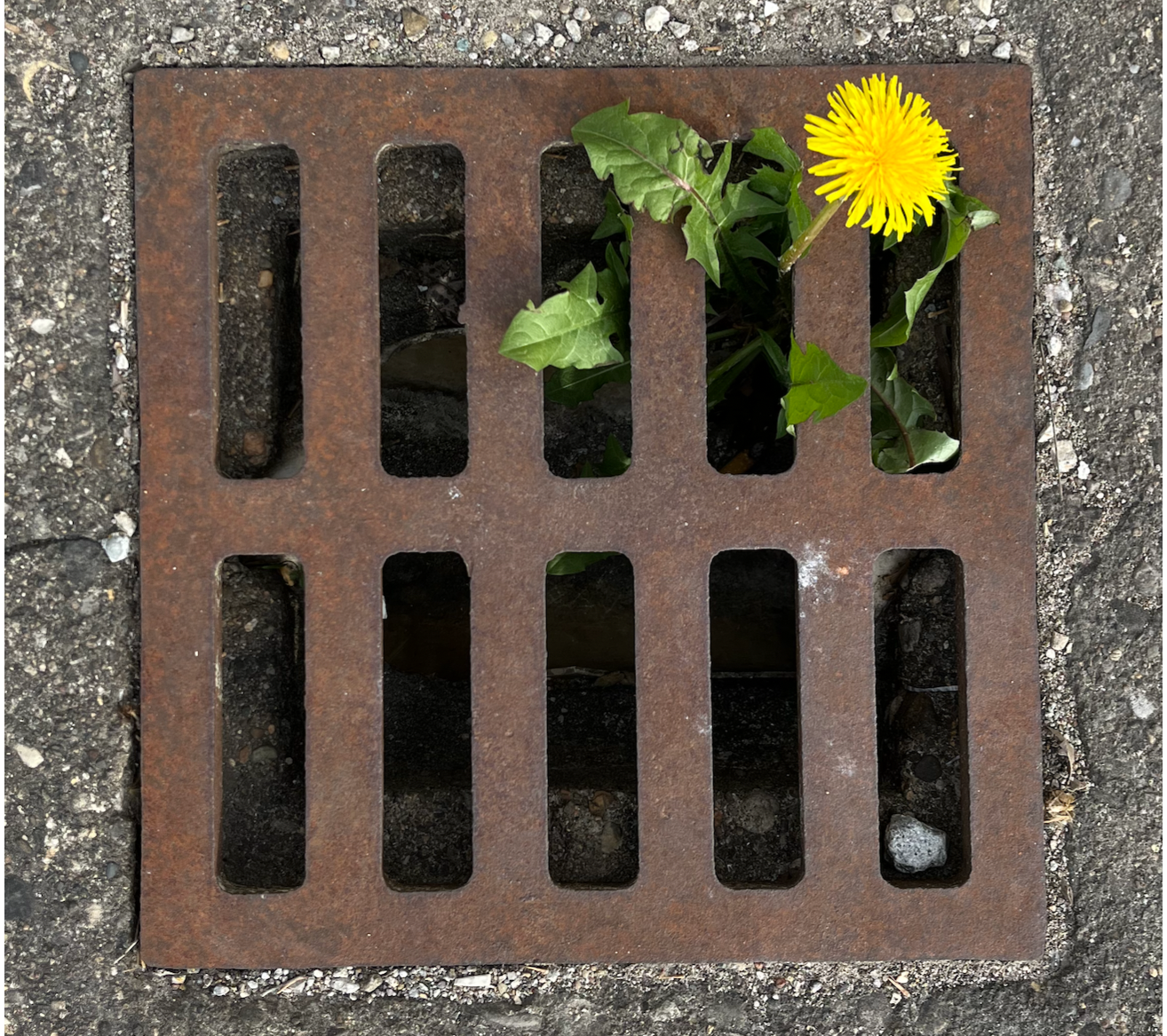
Becoming land aware is something that requires intention. If we learned about the water cycle and carbon cycles in our science classes they quickly became abstract concepts. The more one learns about ecology, the more strange and scary the environments people have made in this country seem. The better one understands the relation of all systems through roots and mycelial connection, the less a lone tree in a nutrient starved yard makes sense. The less ornamental gardens and non-native grasses make sense. Our lives are rarely structured with attention to the soil that feeds us and rain that falls, even though we owe our lives to these things. We’ve whittled down our natural abundance in service of industry and parking lots. And yet, we still have so much on the margins and in the cracks of our built world. And yet, our religion is in the soil, our prayer is spinning wool, our eden is found in the woods of our backyards, a burgeoning food forest.
The goal is not to mimic a bygone nature in the spirit of nostalgia and “simpler” time. There is no going backwards, no way to put progress back into pandora’s box. We live with the myth of progress, the result of industrial extraction. There is no going back, there is no restoration to a better time. Our goal is to tend to the barren lots of real estate developers, to prevent clear cutting land, to promote building practices that are less invasive, it is to care for the young woods on former coal mine land, it is to promote clean watersheds, it is to build the top soil, to prevent erosion and fires, it is to grow and harvest materials for our craft, to use what we have, to make things intentionally, to recognize our abundance. We are working with land that has been scarred through extraction. We can cultivate a way of making home, making things, and making food that benefits the land in reciprocity. We may only move forward with what is on hand, the mess, the webs, the imperfect solutions.
When we are aware, we may recognize our surroundings with reverence, and to know the names of our more-than-human neighbors. With our hands in the soil, pruning, harvesting, and observing, we may better understand the connections of plants, the soil, and how they become materials. We may enter into relationship with that allows us to deepen into a relationship with our place in the world and offer something in return. On reciprocity, Kimmerer offers,
What would it be like, I wondered to live with that heightened sensitivity to the lives given for ours? To consider the tree in the Kleenex, the algae in the toothpaste, the oaks in the floor, the grapes in the wine; to follow back the thread of life in everything and pay it respect? Once you start, it’s hard to stop, and you begin to feel yourself awash in gifts.
Before industrialism, people related to land and material through craft. Any object had some tether to the living world. This is still true, though the ways in which these organic compounds have been used are disguised through industrial processes. May we still give our attention to the vast web of life that brings comfort to our own.
The land provides vines and shoots to weave textiles, stems to ply into cordage, clay and stone to make vessels and tools. Wild food is abundant. Most people have not had the privilege of becoming land aware, learning the names of their neighbors, human and more-than-human. It takes guidance, a community, a cascading series of events to remind us that we are part of the ecosystem. May we feel gratitude for the abundance all around us.
Material Reverence
The objects in our lives rarely have relationship in their making to us. Most people no longer carry the skills of repair needed to maintenance well made items. Instead, our objects are designed to break and be replaced by better models. Our culture is fast moving, organized around convenience. We are coerced into a wasteful culture, it is marketed heavily to us. Trends and micro trends convince us that we are always out of fashion. Planned obsolescence keeps us in the cycle of purchase, of being obedient consumers. Craft historian Glenn Adamson writes about these issues in Fewer, Better Things, citing a lack of material intelligence as a component of our mindless consumption. Part of the way people gain material intelligence is through working with, repairing, and building objects in their lives.
Like our relationship to our environment, our relationship to material has become obfuscated through a series of mechanical and chemical processes. Our lives are dominated by plastic fabrics, materials, packaging, barriers, interiors and exteriors. Our knowledge of where these materials come from and how things are made has been greatly limited as manufacturing has been taken from the domestic sphere, slowly automated over time, and offshored to formerly colonized countries.
Material intelligence is a way to describe human knowledge of material properties and yet it does not fully describe the relationship between a person and a material. Within a material relationship, there is a process of discovery which may feel spiritual, guided by the autonomy of the material itself. In Centering: Poetry, Pottery and the Person, potter and writer MC Richards explored the relation of material to our process of discovery and spirituality. She writes, “Part of the training we enjoy is craftsman is to bring into our bodies the imagination and the will. We enact. The handcrafts stand to perpetuate the living experience of contact with natural elements—something primal, immediate, personal, material, a dialogue between our dreams and the forces of nature.” We seek a dialogue with the material and in that process, we find reverence. Our materials can be ordinary, grown in our gardens, dug from a park, cut from a downed tree, and still hold a portal for deeper understanding. Especially when our materials are made available to us by relationships with people around us, we may find a preciousness in them.
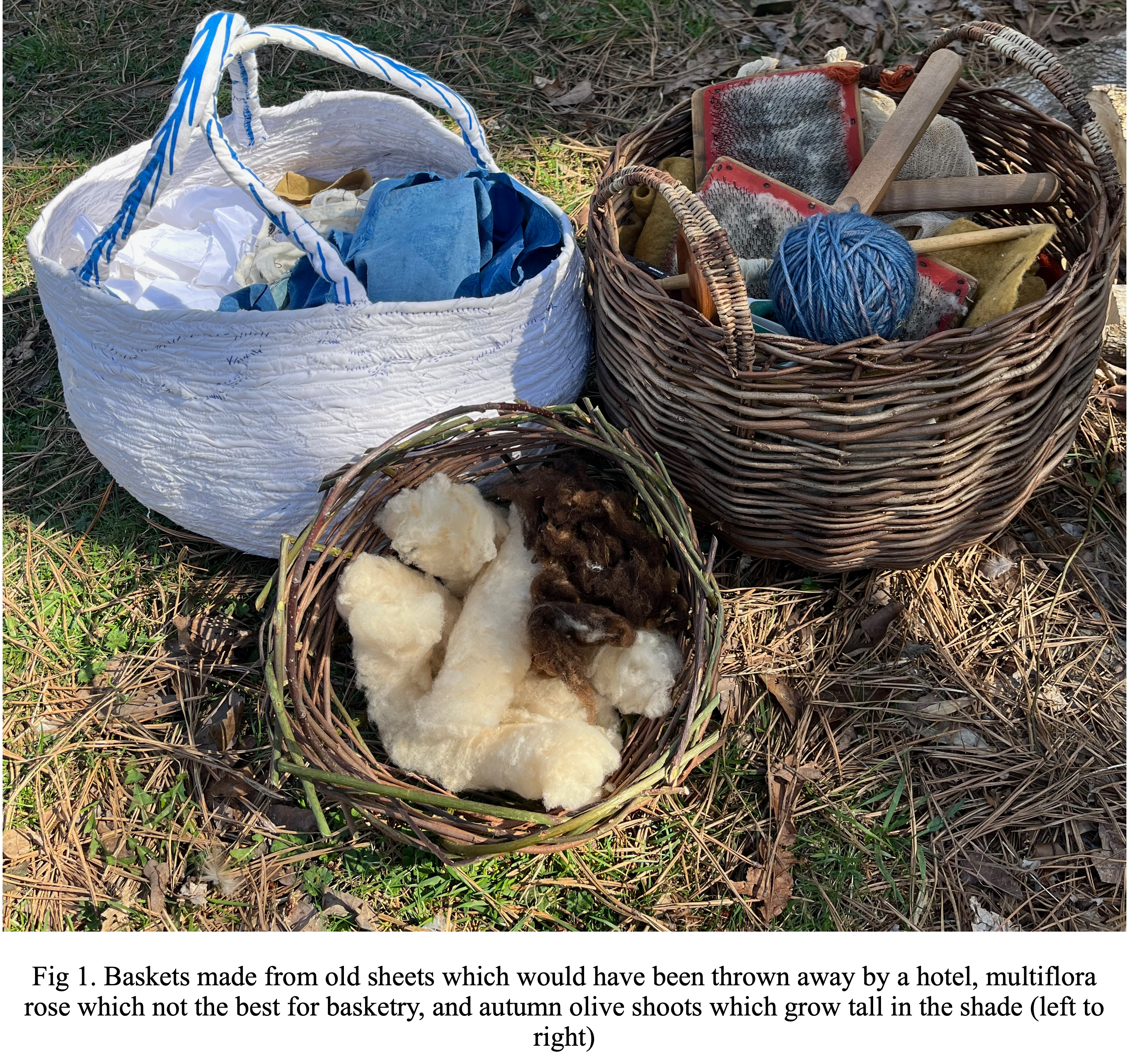
Material reverence is not hard to understand when you think of an heirloom, your daily coffee cup, a well worn sweater, a rock given to you by a lover, an object made for you by a parent. Preciousness may be imbued in common materials, not because they have monetary value but because they have soul, especially we when have direct relationships with their origins through harvest. When we harvest autumn olive shoots, not just to destroy them but to make baskets, we imbued them with spirit and help the land around the plant recover. We receive the shoots as a gift and are compelled to pass along the gift. As Kimmerer writes, “Here is where ecology, economics, and spirit are woven together. By using materials as if they were a gift, and returning that gift through worthy use, we find balance.”
All around us, there are opportunities to engage with our world with reverence. There are thickets filled with invasive vines and shoots, edible fruits, tannins and dye plants available on roadsides and in fields at no cost, if only one can recognize them. Fabrics and fibers of all kinds are available in vast quantities in second hand stores, warehouses, and landfills. Byproducts from our manufacturing and agricultural industries may also be gleaned from our waste streams. There is ample wool abandoned every year. There are trees that are downed along roadsides and building sites. There are huge, low or no-cost streams of material that lay rotting and fallow. They are hidden from us as we go about our busy lives.
We write of the baskets made from honeysuckle vine and autumn olive, mimosa and kudzu, salvage fabrics from decades of hyper production, cordage from nettles and other roadside plants. We write of building from fallen lumber, scales of work that in community networks can eliminate waste by collaboratively sharing materials. We write of hotel sheets which are frequently thrown away in vast quantities. The relationship between craft and nature is a longstanding tradition. We are gleaners on the margins of the plastic world and fragmented ecology, weaving with the abundant materials of our regions.
Chapter 2 is still cooking and will be available next week!

Thanks for reading Meaning/Making! Please share it with someone you think would enjoy!
No posts
Comments
Nothing yet. Say the first thing.
Sign in to join the conversation.