

Welcome to the January 2025 Edition of the ICRN Newsletter!
We are thrilled to share highlights from our recent activities, including the Contact Research Speed Dating session, updates on the Contact Colloquium series, and exciting news about our upcoming podcast launch. This issue also features announcements about events and job opportunities, spotlights recent achievements and publications by our members, and showcases the latest advances in intergroup contact research.
As our network continues to grow, with members from across the globe, we are delighted to keep you informed and connected through these termly updates. If you have any items or ideas for future newsletters, please don’t hesitate to reach out.
Feel free to forward this newsletter to anyone who may be interested in our growing network.
Happy reading!
We are excited to have launched the Contact Colloquium, a monthly event featuring a presentation, a discussant, and opportunities for Q&A and broader discussion. The colloquium is open to all and held on Teams. ICRN members will automatically receive the calendar invites, while non-members can register for individual sessions via this link.
So far, we’ve had three insightful sessions:
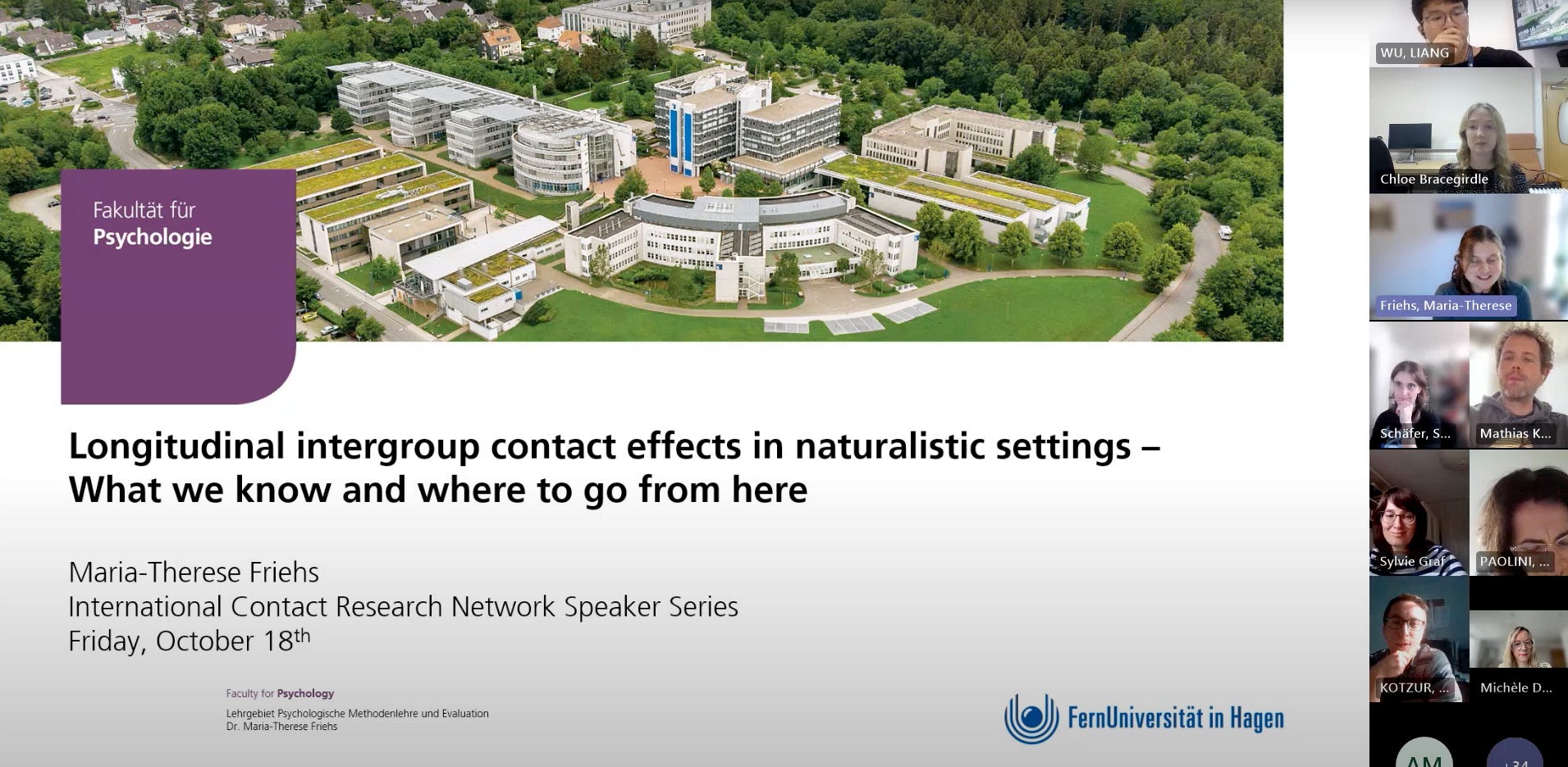
• Dr. Maria-Therese Friehs (FernUniversität Hagen): Longitudinal intergroup contact effects in naturalistic settings - what we know and where to go from here
• Dr. Danielle Blaylock (Queen’s University Belfast): The impact of large-scale contact interventions in post-conflict societies: Bridging applied research, evaluation, and policy
• Dr. Sarina Schäfer (FernUniversät Hagen): Using video-games to disentangle intergroup interactions and intergroup contact
Details, slides, and recordings of past colloquia, as well as information about upcoming sessions, can be found here: Contact Colloquium.
• Friday, 28 February
Dr. Tinghua Yu (Birkbeck University)
Moral communalism, ingroup favoritism, and conditional altruism
• Friday, 28 March
Dr. Julia Rohrer (University of Leipzig)
Using causal graphs to reason more clearly about correlation and causation
• Monday, 14 April
Prof. John Dixon (The Open University)
The human geography of contact and desegregation and why social psychologists should cultivate a spatial imagination
• Keynote at the Annual Contact Research Summit - 2 June
Prof. Stefania Paolini (Durham University)
A temporally integrated model of contact effects
• Friday, 27 June
Dr. Lukas Wallrich (Birkbeck University)
Digging deeper into the link between contact and attitudes by aggregating large-scale datasets: an intergroup contact mega-analysis
We held the Contact Research Speed Dating session on 25 November 2024. This event provided an engaging opportunity for network members to connect. Attendees were paired in dynamic, short conversations to discuss their research experiences, expertise, and interests, fostering reconnections and potential collaborations within the community.
Annual Research Summit 2025: Our next Annual Research Summit will take place on 2–3 June 2025 at a UK location (probably Oxford or Birkbeck). More details and a save-the-date will follow soon, but for now, please mark these dates in your calendar.
Podcast Launch: We are thrilled to announce the launch of our first podcast episode in February! In this episode, we will explore recent research on positive and negative intergroup contact. Emine Bilgen and Lukas Wallrich will interview Sarina Schäfer, Stefania Paolini, Jasper van Asche, and Giulia Rosa Policardo. Stay tuned for insightful discussions and new perspectives!
Dr. Tabea Hässler is looking for collaborators for a multinational initiative aimed at enhancing social inclusion and addressing health disparities within LGBTIQ+ communities globally.
“I am developing a proposal for a multinational initiative to enhance social inclusion and address health disparities within LGBTIQ+ communities globally, building on my past work, including the Zurich Intergroup Project and our collaborative JSI special issue on “Reimagining LGBTIQ+ Research.” This initiative aims to connect scholars from all continents interested in LGBTIQ+ research, fostering collaborative efforts on joint papers, while creating lasting partnerships that ultimately benefit these communities. The project will begin in 2026, and I plan to secure funding for at least two joint meetings to support scholars with fewer resources, with the first meeting focusing on team formation and joint questionnaire development, and the second for analyzing findings and preparing papers.
The project, titled “Understanding and Tackling Health Disparities in LGBTIQ+ Communities Across the Globe,” seeks to unite scholars from over 40 countries to explore the complex factors contributing to the health disparities faced by LGBTIQ+ individuals. These disparities stem from structural inequalities and societal discrimination, which affect health outcomes and a sense of belonging. By engaging a diverse group of researchers to investigate these issues globally, the project aims to identify both protective and harmful factors influencing health and social disparities within LGBTIQ+ communities. I aim to recruit 200 LGBTIQ+ individuals from each country, but I understand that this may be challenging in countries with restrictive legal environments, where we might need to adjust the numbers.
Write me an email (tabea.haessler@uzh.ch) if you are interested in joining the project! I also would appreciate any referrals to interested scholars, particularly in Asia, Africa, Latin America, as well as Eastern and Southern Europe.”

Lukas is a Lecturer in Organisational Psychology at Birkbeck Business School, University of London, and a co-founder of the ICRN.
1. What’s your #ContactStory?
Spending two years at Waterford Kamhlaba, the United World College of Southern Africa in eSwatini, gave me contact experiences aplenty, with fellow students from all over the world and a wide range of backgrounds. Inspired by that experience, I continued to organise international youth summer camps for UWC to promote intercultural understanding and became increasingly interested in how these encounters work. That led me to focus on intergroup contact in my PhD – and run some field experiments with the National Citizen Service. These days, my academic interests have shifted more towards methodological questions, but I continue to be involved with the design of these contact interventions.
2. What are you working on at the moment?
Much of my time is taken up with a British Academy-funded mega-analysis of intergroup contact. For that, we are trying to pull together all publicly available datasets that measure contact and attitudes, as well as those contributed by researchers, and to then run uniform analyses across all datasets – initially to test whether average effects differ from those found in meta-analyses, which may be more influenced by publication bias. More importantly, we will look at non-linear relationships, asymmetries and interactions that cannot be aggregated from reported test statistics.
Apart from that, I am very interested in meta-science and co-leading the FORRT Replication Hub, where we are building the largest replication database in the social and behavioural sciences.
3. What passions or hobbies do you pursue outside of your academic work?
I love traveling and being outdoors – particularly on the water, be that in a kayak or on a paddleboard. Therefore, outings on the Oslo fjord were among my 2024 highlights, and I can’t wait for a trip to Thailand in early 2025.
On the borderline between academia and free time, I am fascinated by the new AI tools, and by the R Open-Source community, so that I spend a fair bit of my time optimising my workflow and contributing to software development – e.g., with my timesaveR R-package that has by now cost me substantially more time than it saved.
4. What is your own favourite paper and why?
Wallrich, L., West, K., & Rutland, A. (2020). Painting all foreigners with one brush? How the salience of Muslims and refugees shapes judgements. Journal of Social and Political Psychology, 8(1), 246-265. (Open Access Link)
My first paper is still one of my favourites. Digging into the German General Social Survey (ALLBUS), we could show that people tend to think of very foreign foreigners (i.e. non-European Muslims) when asked about foreigners in Germany, and that their reported attitudes towards “foreigners” are thus unlikely to reflect their actual attitudes towards the foreigners they are likely to encounter. Building on easy-to-access secondary data made this a fairly quick paper to write, yet it continues to make me think about the importance of designing good survey measures, and of interpreting results carefully.
5. Contact Information
Email: l.wallrich@bbk.ac.uk
Web: https://www.linkedin.com/in/lukas-wallrich
https://www.lukaswallrich.coffee/
We will be regularly interviewing ICRN members. If you’d like to be interviewed, or know someone who should be interviewed, please get in touch.
Tabea Hässler, along with scholars from six continents, is organizing the LGBTIQ+ Pre-Conference for next year’s SPSP. The goal is to connect scholars across different continents and career stages. For more information click here.
The University of Groningen currently has an open position for an Assistant Professor in Behavioural and Social Sciences.
For more details and to apply, visit: Job Opportunity at University of Groningen.
Birkbeck College will soon be announcing a 3-year, 0.80, Post Doc position starting on 1 May 2025. The research project is focused on secondary transfer effects of workplace age-diverse contact and is funded by VW Foundation, Germany. An advert for the role will be released in January 2025 and interviews will take place in March/April. Please contact Dr Libby Drury for information in the meantime l.drury@bbk.ac.uk
We are conducting a pre-registered mega-analysis on intergroup contact and attitudes, funded by the British Academy. Unlike traditional meta-analyses, which focus on aggregated effect sizes, this project combines full datasets to address deeper questions, such as non-linearities in the contact-attitude relationship, interactions between positive and negative contact, and the moderation of contact effects by individual differences like prejudice-proneness. Our pilot efforts have revealed promising insights, and we are now seeking to expand this work by including contributions from researchers like you, alongside data from social surveys and research repositories.
We are particularly interested in datasets that include:
Measures of Intergroup Contact: Direct, synchronous interactions between members of distinct social groups, with data on quality, quantity, intensity, or frequency of contact.
Measures of Attitudes: Outcomes related to the contacted group, such as prejudice, bias, stereotyping, intergroup affect, or discrimination.
If you are open to contributing your data, we would love to hear from you (l.wallrich@bbk.ac.uk) – datasets that measure negative and positive contact separately are particularly helpful; data from student projects is very welcome. For more information, you can find our pre-registered protocol here: https://osf.io/b6fhe.
PS: For this project, we are also looking for collaborators/co-authors who want to help with coding and analysis. If that is you, please contact Lukas (l.wallrich@bbk.ac.uk).
Abstract Submission Deadline: March 31, 2025
Full Manuscript Submission Deadline: September 30, 2025
The BJSP Special Issue on Contact Seeking, Contact Avoidance, and the Enduring Challenge of Segregation is now open for submissions, with six ICRN members as Guest Editors. Abstracts are due by March 31, 2025, and full manuscripts by September 30, 2025. For details, click here.
An international meeting on Peacebuilding through Conflict Transformation: Intraindividual, Interpersonal, Intergroup, and Global Processes will take place on June 20-22, 2025, in Nonthaburi, Bangkok, Thailand, hosted by the International Institute for Peace and Development Studies. For details and to submit an Expression of Interest by February 14, click here.
To see more contact publications by ICRN members, please click here.
Acar, B., Van Assche, J., Ardaya Velarde, S., Gonzalez, R., Lay, S., Rao, S., & McKeown, S. (2024). R-E-S-P-E-C-T, find out what it means to mixing: Testing novel emotional mediators of intergroup contact effects. International Journal of Intercultural Relations, 103, 102070. https://doi.org/10.1016/j.ijintrel.2024.102070
Asimovic N, Ditlmann RK, Samii C. (2024). Estimating the effect of intergroup contact over years: evidence from a youth program in Israel. Political Science Research, 12(3), 475-493. https://doi.org/10.1017/psrm.2024.8
Borinca, I., Koc, Y., & Mustafa, S. (2024). Fostering Social Cohesion in Post‐Conflict Societies: The Power of Normative Apologies in Reducing Competitive Victimhood and Enhancing Reconciliation and Intergroup Negotiation. European Journal of Social Psychology. https://doi.org/10.1002/ejsp.3116
Drury, L., & Fasbender, U. (2024). Fostering intergenerational harmony: Can good quality contact between older and younger employees reduce workplace conflict? Journal of Occupational and Organizational Psychology, 97, 1789–1812. https://doi.org/10.1111/joop.12539
Pollmanns, C., & Van Assche, J. (2024). The extended contact asymmetry: Authoritarians benefit more from positive but do not suffer more from negative extended intergroup contact. Group Processes & Intergroup Relations, 0(0). https://doi.org/10.1177/13684302241249051
Shulman, D., Meleady, R., Hodson, G., & Crisp, R. J. (2024). Fluctuations in Prejudice Do Not Track Fluctuations in Ordinary Contact in Three 5-Wave “Shortitudinal” Studies Examining Daily, Weekly, or Monthly Intervals. Social Psychological and Personality Science. https://doi.org/10.1177/19485506241284079
Tassinari, M., Harjunen, V. J., Cocco, V. M., Vezzali, L., & Jasinskaja-Lahti, I. (2024). The virtual cure for real-world prejudice? Secondary transfer effects of intergroup contact in virtual reality. Journal of Community & Applied Social Psychology, 34(5), e2879. https://doi.org/10.1002/casp.2879
Tausch, N., Birtel, M.D., Górska, P. (2024) A post-Brexit intergroup contact intervention reduces affective polarization between Leavers and Remainers short-term. Communications Psychology, 2(1), 95 https://doi.org/10.1038/s44271-024-00146-w
To see more other publications by ICRN members, please click here.
ICRN members have contributed to chapters in the book Textbook Social Psychology: (link to book):
• Chapter 1: History and Research Methods – Stefania Paolini and colleagues
• Chapter 9: Prejudice – Shelley McKeown and colleagues
• Chapter 10: Intergroup and Intercultural Relations – Michèle Birtel
Congratulations to Matilde Tassinari for successfully defending her PhD in October 2024! Dr. Béatrice Hasler from the University of Liechtenstein served as the opponent. For more detailed information on the thesis, click here.

Congratulations to Chloe Bracegirdle (University of Oxford) and co-authors for winning the 2024 Gordon Allport Intergroup Relations Prize for their article:
The Socialization of Perceived Discrimination in Ethnic Minority Groups
Citation:
Bracegirdle, C., Reimer, N. K., Osborne, D., Sibley, C. G., Wölfer, R., & Sengupta, N. K. (2023). The socialization of perceived discrimination in ethnic minority groups. Journal of Personality and Social Psychology, 125(3), 571–589. https://doi.org/10.1037/pspi0000426
Summaries by Emine Bilgen.
Understanding Discrimination Through Socialization Processes
This research challenges previous findings on the relationship between intergroup contact and perceived discrimination among disadvantaged groups. While earlier studies suggested that contact with advantaged outgroups reduces perceived discrimination and contact with disadvantaged ingroups increases it, this study found no evidence that outgroup contact influences perceptions of discrimination. Instead, longitudinal analyses revealed that ingroup friendships play a key role in shaping perceptions through socialization. Members of disadvantaged groups align their perceptions of discrimination with those of their ingroup friends over time. These findings emphasize the role of social networks in shaping shared beliefs and perceptions about discrimination
Bracegirdle, C., Reimer, N. K., Osborne, D., Sibley, C. G., Wölfer, R., & Sengupta, N. K. (2023). The socialization of perceived discrimination in ethnic minority groups. Journal of Personality and Social Psychology, 125(3), 571–589.
Identity Salience and Intergroup Relations in Conflict Settings
This study investigates the impact of identity salience on intergroup attitudes, anxiety, and contact intentions in the politically divided context of Cyprus. Drawing on social identity theory and the common ingroup identity model, the research found that priming a superordinate identity (Cypriot, civic) reduced intergroup anxiety and increased future contact intentions compared to priming a subgroup identity (Turkish, ethnic). Furthermore, intergroup anxiety was shown to mediate the relationship between identity priming and both outgroup evaluations and contact intentions. These findings provide valuable insights into how identity dynamics can shape intergroup relations, particularly in conflict settings.
Yetkili, O., Agdelen, N., Vural, S., & Kostyuk, E. (2024). The effects of identity (subordinate vs. superordinate) salience on intergroup attitudes, anxiety, and contact intentions in North Cyprus.Peace and Conflict: Journal of Peace Psychology. https://doi.org/10.1037/pac0000747
Contact Interventions and Political Polarization in the Brexit Era
This study explores an intergroup contact intervention aimed at reducing affective polarization between Leavers and Remainers in the context of Brexit. Using a randomized controlled trial, 60 dyads of Leavers and Remainers participated in either a facilitated Brexit-related discussion or a control interaction unrelated to Brexit identities. Short-term results showed increased warmth toward the outgroup, reduced negative attributions about outgroup beliefs, and greater willingness to compromise. However, these effects were not sustained over time, and participants with more extreme baseline views were more likely to drop out of the study. The findings highlight the challenges of creating interventions that produce lasting changes in polarized settings and emphasize the importance of engaging individuals with extreme political views in such efforts.
Tausch, N., Birtel, M.D., Górska, P. (2024) A post-Brexit intergroup contact intervention reduces affective polarization between Leavers and Remainers short-term. Communications Psychology, 2(1), 95 https://doi.org/10.1038/s44271-024-00146-w
Do you have feedback on the newsletter, or anything you want to share? Email us: Michèle Birtel, Lukas Wallrich, Libby Drury, Emine Bilgen
Want to join the Network? Check our webpage
No posts
Comments
Nothing yet. Say the first thing.
Sign in to join the conversation.