

Welcome to the July 2026 Edition of the ICRN Newsletter!
In this issue, we recap our third annual Summit in Karlsruhe, celebrate our first-ever Early Career Researcher Awards, unveil our new ICRN logo, wrap up this season's Contact Colloquium series, congratulate Rita Guerra on her election to the EASP Executive Committee, and share some of the latest research from across the field.
Happy reading!
We had our third annual ICRN Summit this July, and it really was a wonderful few days. From July 5th–7th, we gathered at the FernUniversität Campus Centre in Karlsruhe, Germany. 53 researchers joined us in person and 20 more joined online, coming together from across the field to share ideas, data, and a lot of coffee. The Summit opened with an optional mentoring session, where more experienced researchers offered guidance and support to students and early-career members, and everyone had a chance to connect one-on-one before the formal programme began.
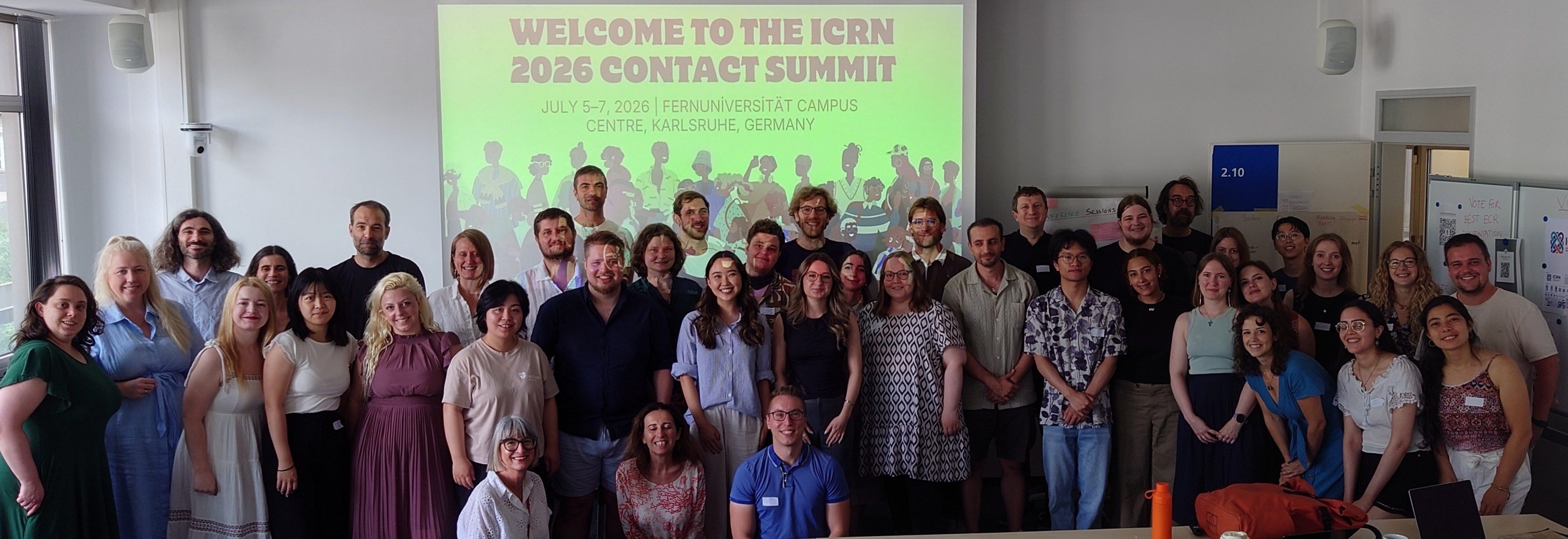
Over the three days, we hosted 24 research presentations covering everything from predictors of contact and contact willingness to contact dynamics over time and the effects of contact on outcomes beyond prejudice. We were lucky to have Cara McInnis deliver this year's keynote lecture, "Art Imitates Life: Reflexive Reflections on My Intergroup Contact Era," which set a thoughtful tone for the rest of the Summit. Slides from presenters who agreed to share are available on OSF.
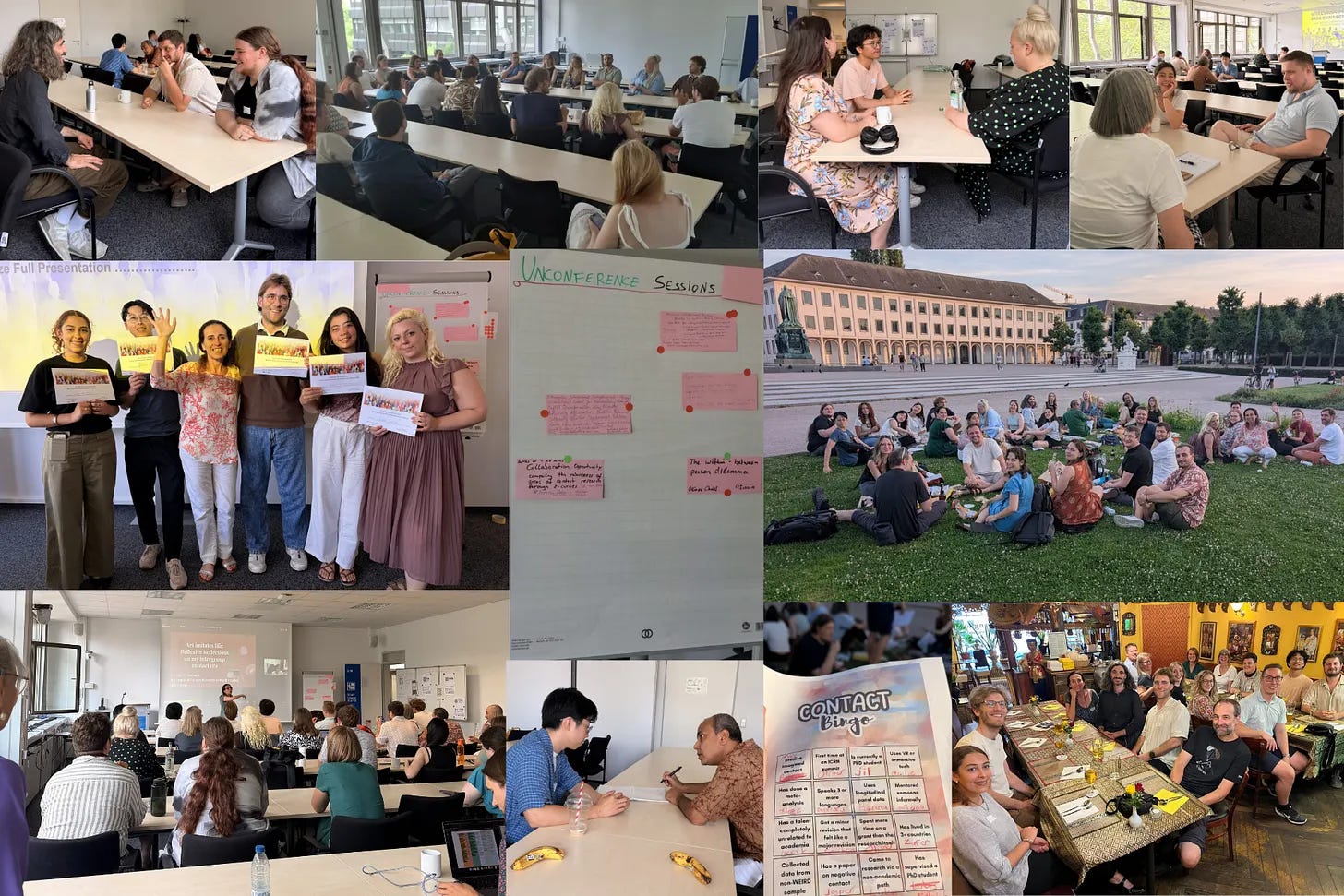
Alongside the formal talks, the Summit featured a poster session, open unconferencing discussions where participants shaped the agenda in real time, and open collaboration space for building new partnerships and research ideas. As always, the goal wasn't just to present finished work, but to spark the kind of conversations that lead to it.
This year, we also introduced our first-ever Early Career Researcher Awards. Matilde Tassinari won Best Blitz Presentation, with Mamoru Sakura as runner-up. Zaya Da Silva won Best Poster, and Aaron Lauterbach won Best Oral Presentation, with Marta Sih Wei Macaluso as runner-up. Congratulations to all five for such strong work!
Beyond the research, the Summit made plenty of room for connecting outside the sessions too. On the first evening, we headed to dinner together, and on the second day we swapped the conference room for a picnic in the Castle Gardens. We also introduced something new this year: Contact Bingo, a game we developed ourselves to get people talking, laughing, and making new connections across the group.
None of this happens without a lot of work behind the scenes. A special thank you to this year's organisers, Emine Bilgen, Maria-Therese Friehs, and Patrick Kotzur, for putting the Summit together, and to the wider committee and everyone who contributed along the way: Stefania Paolini, Lukas Wallrich, Libby Drury, Molly Adams, Rita Guerra, Jie Huang, Shelley McKeown Jones, Oliver Christ, Mathias Kauff, Sarina Schäfer, Jil Ullenboom, Lydia Tschekorsky Orloff, and Sebastian Emrys Kalkuhl.
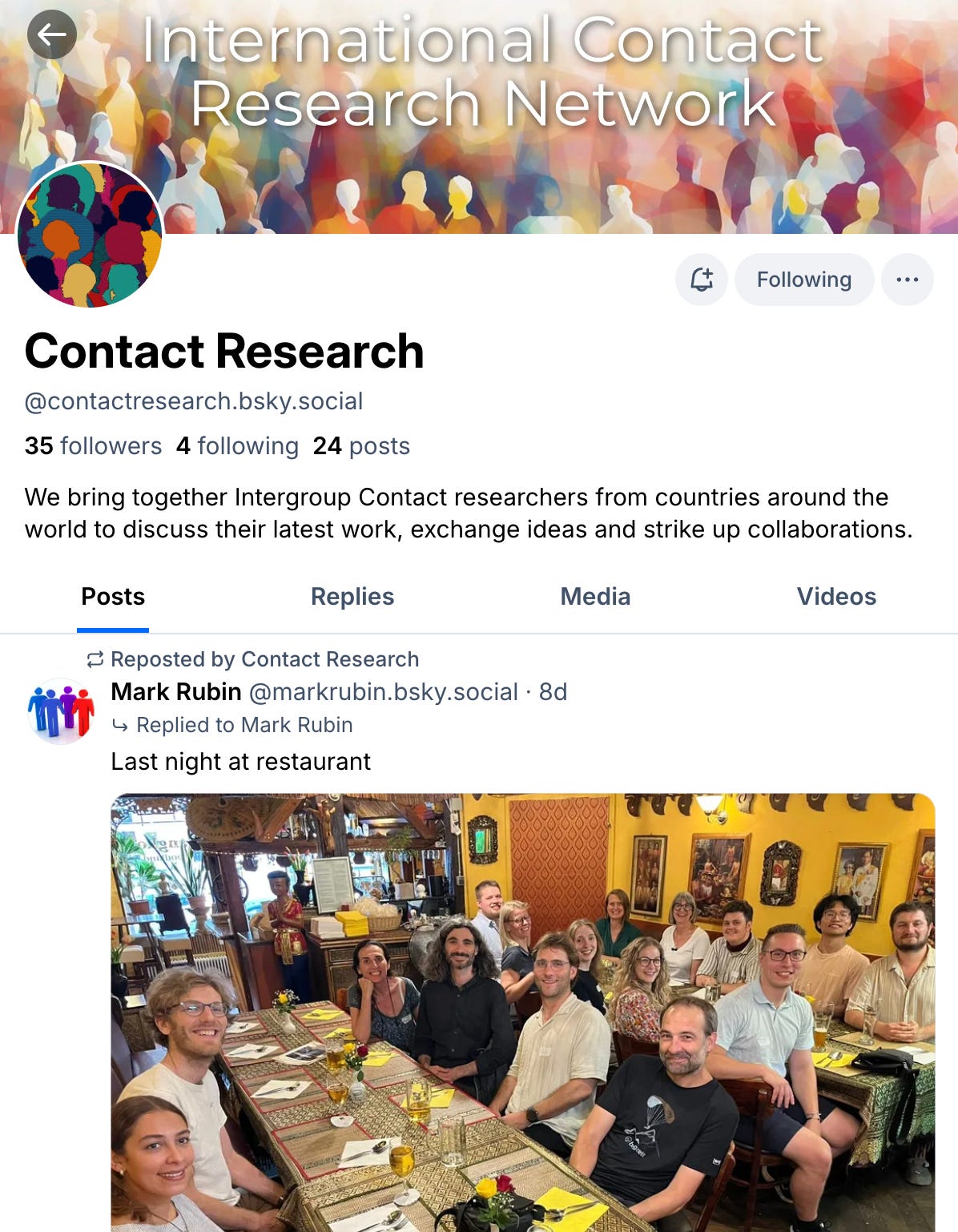
A big thank-you to Mark Rubin for sharing a lovely Bluesky thread capturing the atmosphere of the Summit — check it out here.
The Summit continues to grow each year, and we're already looking forward to seeing where the ICRN community takes it next.
As part of this year's Summit, we ran a logo competition among ICRN members, and we're excited to share the winning design as our new official logo! We'll be rolling it out across our website, social media, and other channels over the coming weeks, so keep an eye out for the fresh new look.

Since our season launch in October, we’ve had a full line-up of speakers: Prof. Jake Harwood, Dr. Negusu Akliku, Prof. Rose Meleady, Dr. Fiona Kazarovytska, and Max Primbs.
To close out the season, we had three more excellent talks:
Dr Chloe Bracegirdle (Oxford University)
Social network insights into intergroup contact in schools
Discussant: Prof Olivia Spiegler (Oxford University)Prof. Oliver Christ (FernUniversity of Hagen)
The Role of Tolerance in Intergroup Relations
Discussant: Dr Maria-Therese Friehs (FernUniversity in Hagen)Dr Lukas Wallrich (Birkbeck University of London)
From contact associations to contact effects: Conceptual puzzles in a maturing field
Discussant: Dr Nikhil Sengupta (University of Kent)
A big thank-you to Patrick Kotzur and Beatriz Casquinho for organising this year’s Colloquium series.
If you’d like to suggest a speaker or topic for next season’s Contact Colloquium, please reach out to Patrick or Beatriz directly.
You can find recordings of some past talks on our YouTube channel.
Registration details and information about upcoming Contact Colloquium sessions are available here.
Rita Guerra elected to the EASP Executive Committee
Huge congratulations to Rita Guerra, a member of our own ICRN Executive Committee, who has been elected as Meetings Officer on the EASP Executive Committee! We’re confident she’ll bring the same value and positive impact to EASP that she’s brought to ICRN, and we wish Rita all the best for her term.
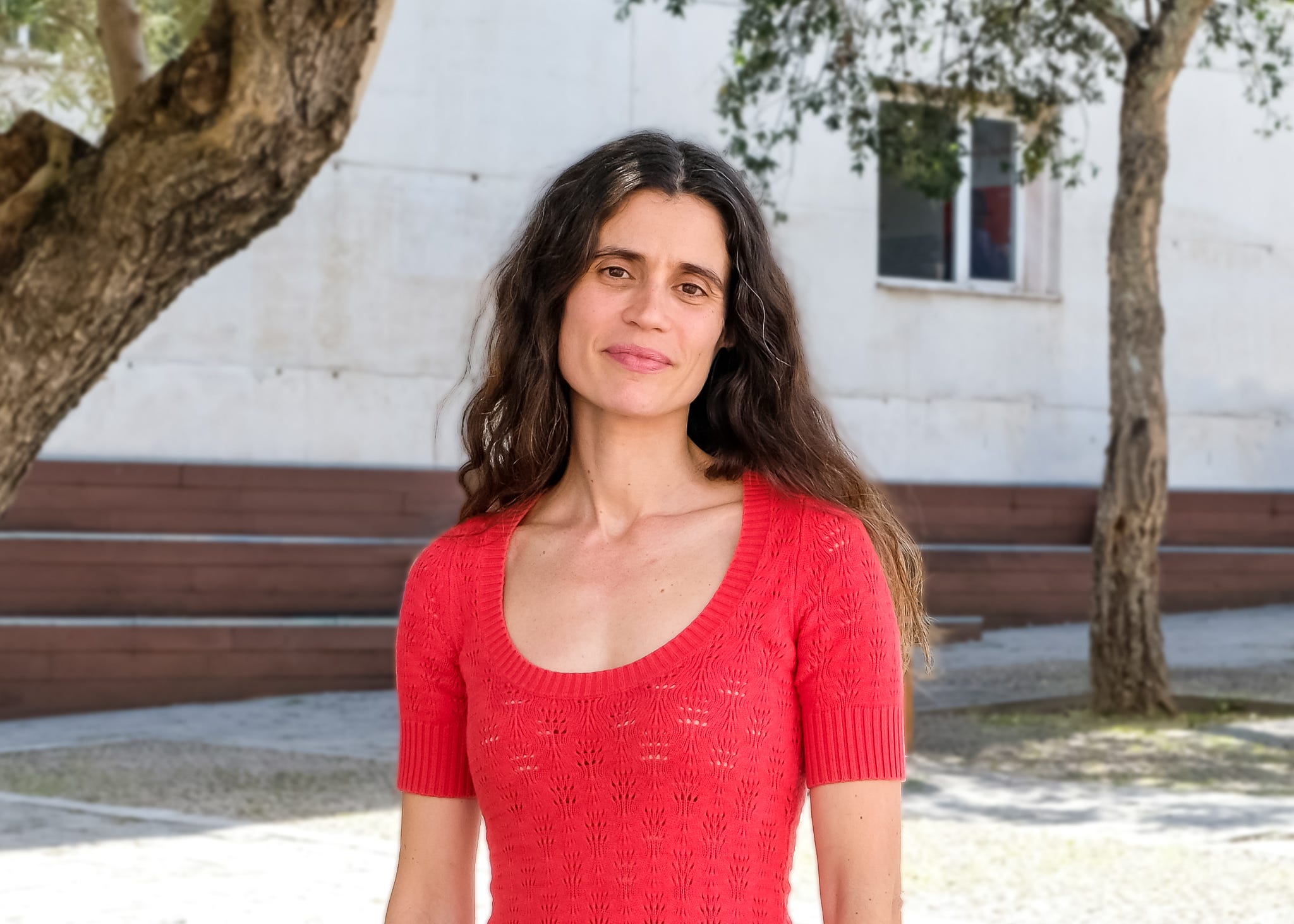
Rita Guerra is a tenured Senior Researcher and Social Psychologist at the Centre for Psychological Research and Social Intervention (CIS-Iscte) in Lisbon, Portugal. Rita has been serving as Secretary of the Executive Committee (EC) since 2025.
1. What’s your #ContactStory?
Growing up in a country with a long and violent colonial history, one that is often denied and narrated through the lens of exceptionalism and the myth of the “good colonizer”, shaped how I approach intergroup relations. It also sparked my enduring interest in power and status asymmetries and how they influence the effectiveness of different strategies for reducing prejudice. At school, having close, positive contact with a very diverse group of friends, alongside witnessing everyday examples of structural racism and inequality, fuelled a sense of injustice that I eventually channelled into scientific curiosity about prejudice reduction. In high school, I took a psychology course and vividly remember being fascinated by the social psychology module. That experience led me to pursue a bachelor’s degree in social psychology, where I fell in love with intergroup relations. Then, during one of my undergraduate classes, I attended a guest lecture on interventions to reduce racism in Portuguese elementary schools based on the contact hypothesis and the common ingroup identity model. At that moment, I knew this was the topic I wanted to dedicate my research and my PhD to.
2. What are you working on at the moment?
Too many things at once 😊. I always try to balance more conceptual, theory-driven questions with applied research that can make a tangible difference.
At the moment, I’m working with several civil society organisations on a large European project focused on preventing hate speech and hate crime. This builds on a recent line of research I developed with an interdisciplinary team of computational scientists and linguists, where we combined social psychological and linguistic approaches to better understand online hate speech. Together, we developed resources to raise awareness and empower civil society organisations to recognise the complex and multifaceted nature of hate speech.
On the more conceptual side, I’ve long been interested in how group status asymmetries fundamentally shape intergroup experiences. I’ve explored this through my own work on inclusive identities, alongside fantastic PhD candidates and many valued collaborators. This remains my most enduring research interest: bringing intergroup relations back into meaningful social contexts, with all the complexity, messiness, and “noise” that real-world settings introduce into our sometimes overly simplified research designs.
3. What passions or hobbies do you pursue outside of your academic work?
Exercise has always been an important part of my life; it keeps me balanced and focused. I love taking long walks around beautiful Lisbon with my partner and our dog, appreciating those small moments of awe that come from a sunset, a garden, or the everyday things we often overlook. I'm also an avid reader (and enthusiastic book buyer!). I enjoy good food, a glass of wine at the end of a long day, and the ongoing adventure of parenting two teenage boys.
4. What is your own favourite paper and why?
This is a difficult question, which is why I asked whether I could mention someone else’s work instead of my own! But if I had to choose, it would be a paper that grew out of what felt, at the time, like a simple yet deeply utopian idea during my PhD: bringing the lab into the field by testing a real intervention in a school setting.
Guerra, R., Rebelo, M., Monteiro, M.B. and Gaertner, S.L. (2013), Translating Recategorization Strategies Into an Antibias Educational Intervention. Journal of Applied Social Psychology, 43: 14-23. https://doi.org/10.1111/j.1559-1816.2012.00976.x
Without dedicated funding, we designed and implemented a small-scale intervention using a rigorous pre-test/post-test control group design. We adapted an experimental procedure originally developed by Sam and his lab at the University of Delaware in 1989 for use with children in Portuguese schools, spending a month running weekly sessions with 38 pupils. Of course, the study had major limitations, not least its small sample size. But, as we argued in the paper, one of its key strengths was extending previous research on anti-bias interventions by highlighting the importance of recognising the historical and cultural relationships between groups of different status. Those broader social contexts matter when we want to understand why different category-based interventions succeed or fail.
Ultimately, for me this was the materialization of Lewin’s inspiring quote “(…) the theorist does not look toward applied problems with highbrow aversion or with fear of social problems, and if the applied psychologist realizes that there is nothing so practical as a good theory.” (Lewin, 1951, p. 169)”
Drs Manon Schweinfurth, Sam Pehrson, and Anna Stefaniak at the School of Psychology and Neuroscience, University of St Andrews are looking for a part-time (50%) post-doctoral researcher to join their team for 1 year (12 months) to work on a project at the intersection of intergroup contact, mind perception, and animal behaviour. The planned research will test whether seeing animals express emotions, play, or interact positively with humans can increase empathy and concern for their welfare. By focusing on rats, an often misunderstood species, the project aims to challenge assumptions about what makes humans unique and encourage a more compassionate understanding of the many forms of intelligence found across the animal world.
Please note, this position is only for people who have the right to work in the UK. You can final details here.
ICRN members have continued to publish a wide range of exciting contact research. Below we highlight a few papers that caught our attention, to see more click here.
Abbott, N., He, J., & Macaulay, P. J. R. (2026). Late Adolescents’ Cyber-Upstanding Intentions towards Bias-Based Cyberbullying of Immigrants in the UK: Exploring the importance of Intergroup Contact. Journal of Community and Applied Psychology, 36, 1-12. https://doi.org/10.1002/casp.70248
Efthymiou, C., & Psaltis, C. (2026). Can a 10-minute intergroup contact intervention reduce prejudice among youth in a post-conflict setting? Group Processes & Intergroup Relations, 29(4), 644-663. https://doi.org/10.1177/13684302261419414
Friehs, M.-T., Schäfer, S. J., Wüst, K., Dürr, C., Engel-Wolters, L., Kalkuhl, S. E., Böttcher, T., Resch, G., Sander, B., Tschekorsky Orloff, L., Woltz, A., van Zalk, M. H. W., Bagci, S. C., Barlow, F., Bracegirdle, C., Cernat, V., Hässler, T., Jugert, P., Kotzur, P. F., . . . Christ, O. (in press). A comparative multi-method re-analysis of the longitudinal evidence for causal intergroup contact effects on attitudes. Communications Psychology.
Shi, E., White, F. A., & Pinkus, R. (2026). Mobilizing the majority: The role of intergroup contact and exposure to conceptualizations of racism in promoting intergroup solidarity. Group Processes & Intergroup Relations. Advance online publication. https://doi.org/10.1177/13684302261454838
Stelter, M., Essien, I., von Bargen, J. M., & Christ, O. (2026). Police officers' prejudice and distrust towards racialized groups is related to internal motivation to suppress prejudice and negative intergroup contact. British Journal of Social Psychology, 65, e70094. https://doi.org/10.1111/bjso.70094
António, R., Guerra, R., Cameron, L., & Moleiro, C. (2026). Who Stands Up?: Social Psychological Perspectives of Bias-Based Bullying among LGBTQ+ Youth: The Role of Bystanders. In Exploring Identity, Diversity and Stigma in LGBTQ+ Lives (pp. 93-119). Routledge.
We'd also like to welcome Molly Adams, who recently joined the ICRN team and is now leading our social media channels! Stay connected with ICRN between newsletters! Follow and tag us on our social media accounts to keep up with news, events, and community highlights:
LinkedIn: @International Contact Research Network
Bluesky: @contactresearch.bsky.social
Summaries by Emine Bilgen.
Having more chances for contact before the war makes post-war contact more effective.
Does contact work the same way for everyone after a conflict, or does it matter what your community looked like before the war even started? Using two studies from post-war Bosnia and Herzegovina, one conducted roughly 10 years after the war and one over 30 years later, the authors found that post-war contact was more strongly linked to contact willingness among people who, before the war, lived in areas with greater opportunity for contact with the outgroup. This moderating effect was clearest in the earlier study and appeared to fade, though not disappear entirely, over time. The findings highlight how the social context that existed before a conflict can continue to shape the power of contact to rebuild relations long after.
Afandiyev, Z., Penić, S., Khan, S., & Čehajić-Clancy, S. (2026). The enduring power of social context: Pre-war contact opportunity amplifies the effects of post-war contact. British Journal of Social Psychology, 65, e70096. https://doi.org/10.1111/bjso.70096
Why Contact “On Autopilot” Might Be Holding Us Back
We tend to assume that if people just had more contact with outgroup members, prejudice would naturally decline. This major new theoretical piece pushes back on that assumption. Everyday contact, they show, tends to settle into stable “contact habits”: pleasant encounters make us seek out more similar contact, unpleasant ones make us withdraw, and over time this compounds into self-segregated “contact bubbles.”
Their key proposal is a habit-rupture model: real change rarely happens gradually. It tends to occur around “ruptures”, major disruptions like moving house, changing jobs, or larger societal shocks such as COVID-19 or the fall of the Berlin Wall, that break established routines and open a window for new contact patterns to form.
It’s a useful reframe: alongside asking whether contact reduces prejudice, it may be just as valuable to ask what disrupts people’s contact habits in the first place, and how interventions can be designed around those windows of change.
Paolini, S., J. Dixon, P. F. Kotzur, M. Friehs, C. Bracegirdle, A. Lauterbach, J. Köbrich, S. Graf, M. Kauff, A. Stefaniak, S. C. Wright, F. K. Barlow, K. Luebbering, and J. Harwood. 2026. Towards a Habit-Rupture Model of Intergroup Contact in Everyday Settings. Nature Reviews Psychology. https://doi.org/10.1038/s44159-025-00523-0
Do you have feedback on the newsletter, or anything you want to share? Email us
Want to join the Network? Check our webpage
No posts
Comments
Nothing yet. Say the first thing.
Sign in to join the conversation.