
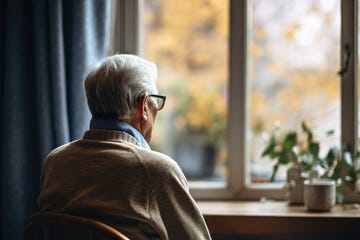
There are nearly 19,000 people in the UK in hospital but healthy enough to go home. Most are elderly. They are literally blocking beds. There are another 440,000 people living in care or nursing homes. Seventy percent are suffering from dementia. (See Newsletter #231 A Life Sentence).They could be suffering from too much treatment and not enough care. The danger is that patients’ problems are seen as disease, decline and disorientation. Instead, the institution should focus on alleviating loneliness, helplessness and boredom. These are the real threats to wellbeing.
A Five Minute Read
The Eden Model
I have been reading a book by Dr William Thomas. He has spent his whole professional life trying to change the US model of nursing homes. He has been promoting innovative models including his first – the Eden Alternative. His focus is on wellbeing rather than medicine.
His approach has been to unpick wellbeing. To try to define it in very actionable terms. Nursing homes sit in an awkward place. They are not “watered down” hospitals but are medical. They are also the homes of the patients. His approach and models however can fit all older people who need care, no matter where they live.
His arrival in the sector captures his mind-set. In 1991 he was working in accident and emergency at a local hospital. He was introduced to the local nursing home. It was institutionalized and, as he put it, a place full of people “cruising down life’s off ramp”. Despite this he was inspired and joined as the resident doctor.
He argued that no matter where we are on life’s journey we still need to care for something or someone. It is why so many retired people volunteer. We may be receiving care, but we also want to give it. On his first day he bought a parakeet for a patient and told them to take care of it. This motivated them, stimulated them and got them visiting other residents. The care home subsequently had eighty parakeets, ten finches, two love birds, plus a couple of dogs and cats. Over 90% of rooms had a birdcage, each placed so the resident could see the bird and talk to it.
Loneliness, Helplessness and Boredom
According to him, these are the three threats to wellbeing for the elderly. We can be lonely even when surrounded by other people. Even when we are regularly invited to social events every Tuesday! We do not belong.(See Newsletter #95 Loneliness.)
However hard professionals try to avoid it. Care homes of all kinds are institutions. They can so easily take control away.( See Newsletter #114 Taking Control of Life.) If meals are provided and delivered at a set time, they can destroy the joy that used to come from feeding people. From eating together. The result is what is called learned helplessness.
The human brain is designed to be stimulated. If life is totally predictable then the brain has nothing to do. It shuts down.
Efficiency versus Effectiveness
All services trade off costs against effectiveness. Individualized care costs money, it introduces uncertainty into the operation. The temptation is to think of a home resident as a set of medical symptoms. It is cheaper to “treat” people than to “care” for them. Once they have been diagnosed, they are defined by their diagnosis and treatment. They become a patient not a person. The progression from home to care home to nursing home and hospital reduces a person’s identity. It is stripped away, leaving them unknown and vulnerable.
Well-Being
What if the objective of care is not a healthy body? What if instead the objective is well-being? The Eden Alternative identifies seven dimensions of wellbeing. What if the institution is rebuilt around these seven?
If identity is to be preserved, then the individual needs autonomy and a special kind of security.(See Newsletter #271 To Old to Work and Too Young to Die. ) Autonomy means the absence of the arbitrary exercise of authority and loss of freedom. Experiments have shown that something as simple as allowing people to have breakfast when they want it, reduces learned helplessness. Instead of a “7.00am communal meal”. Choosing when your visitors can come has the same impact. Security means freedom from doubt and anxiety. That must be achieved whilst preserving privacy, dignity and respect. Some risk must remain.
Giving meaning and growth to a resident improves their wellbeing. The pets in that first nursing home gave the residents purpose. This reduces helplessness. This was followed with houseplants for residents. “The Maintenance Department” suggested using plastic plants! The residents wanted to see their impact on something that was living. Our need to develop, to grow and to learn lasts until the very end of our lives. Just because we move into a home does not mean that the urge disappears.
Leaving “home” breaks something. It breaks the connections with the community and the sense of being part of something bigger. That has to be rebuilt in a new home. The sense of belonging must be recreated.
The last part of their model is joy. That spontaneous happiness that lifts the spirits.
Making it Happen.
We cannot measure well-being. We cannot put it on a chart at the end of a resident’s bed. We cannot diagnose a decline and prescribe an extra dose of autonomy. We certainly cannot write a procedures manual in some central team. Thomas and his team insist that the only way is to imbue the ideas into the front-line carers. To let them understand the people they are caring for and then let them solve the problem themselves. This is the same strategy used by personalized services of all kinds.
Does it Work?
The Eden Alternative is still being rolled out around the world even after all this time. There are limited number of studies that have tried to evaluate the impact. Obviously, it is difficult. What do we make the comparison against? Researchers have chosen matched “traditional” nursing homes. The results however are positive. The Eden homes scored high in attacking loneliness, helplessness and boredom. Satisfaction was higher.
The original homes were funded by the New York State Department of Health. Their study showed a 50% reduction in infections, a 71% drop in daily prescription drug costs and a 26% reduction in staff turnover. The wrong metrics but the correct answer! You can have effectiveness and efficiency. Thomas went on to develop “Green Houses”. These are small nursing homes built around a family concept. Very similar to the Dementia Homes described in Newsletter #118 Hill Top Villages.
If you enjoy the Newsletter please recommend it to friends and send them to Substack to subscribe. It is free. Alternatively try the button below. All the Newsletters and lots more background is on my website thebusinessofage.com.
No posts
Comments
Nothing yet. Say the first thing.
Sign in to join the conversation.