
Yasmeen Lari was a famous Pakistani architect celebrated for her work in steel, cement, and glass. In her 60s, after a massive earthquake hit her country, she began to work with locals, building humble homes of adobe, mud, and bamboo. Painter Henri Matisse, debilitated by stomach cancer in his 70s, hung up his brushes and took up scissors to continue making art. And Disney illustrator Tyrus Wong waited until he was 90 years old to receive full credit for the revolutionary work he’d done on “Bambi.” Never say it’s too late to succeed!
Emmy winner Mo Rocca is a correspondent for CBS Sunday Morning and a frequent panelist on NPR’s hit weekly quiz show Wait, Wait…Don’t Tell Me! He spent four seasons as a correspondent on The Daily Show with Jon Stewart. He also created and hosted Cooking Channel’s My Grandmother’s Ravioli, in which he learned to cook from grandparents across America. Rocca began his career in TV as a writer and producer for the Emmy and Peabody Award–winning PBS children’s series Wishbone. Currently he hosts The Henry Ford’s Innovation Nation Saturday mornings on CBS, as well as the Mobituaries podcast. On stage, he starred on Broadway in The 25th Annual Putnam County Spelling Bee and as Doody in the Southeast Asian tour of the musical Grease. Rocca is the author of All the Presidents’ Pets, a historical novel about White House pets and their role in presidential decision-making, and co-author of Mobituaries: Great Lives Worth Reliving and Roctogenarians: Late in Life Debuts, Comebacks, and Triumphs.
Marcus Smith: I’m Marcus Smith, and this is Constant Wonder. Join me on a quest to find awe and wonder in all creation, human or wild, vast or small, spiritual encounters that move us beyond words.
Mo Rocca: The older you get, the less you care about what other people think of you. You’re not crowdsourcing your decisions. You’re not crowdsourcing who you are.
Marcus Smith: Here’s a big reason that I can relate to our guest in this episode, Mo Rocca. It’s not just his career in media, including radio, same as me. It’s not that he’s good-looking. I’ve got that too. It’s not that he had a spunky grandma who grew to a great age. I had one of those also. The thing that helps me really identify with Mo Rocca is that both he and I deeply admire well-seasoned, mature humans, really mature.
I’m talking about old folks. You know, when I was a kid, others my age would have raced off to play street ball when I was hanging back and listening to the gray set. My very own grandparents, if they were cleaning up after dinner, anonymous ladies sitting on a park bench pointing at a cat at a birdbath.
My neighbor, Mr. Bransford, he was a wiry old one-armed gardener and thought that smoking a pipe and growing watermelons was pretty much the only thing you really need to do in life. At church functions, I was the kid who listened raptly to old folks talking about Pearl Harbor or explaining why you need to keep potatoes in the dark.
Some of these people must have been seventy or eighty, maybe, maybe even close to a hundred. I remember one man, a Bataan Death March survivor, he’d been in a prisoner-of-war camp. He was regaling a woman of similar age with his sage advice about drinking cabbage juice to ward off cancer. Apparently, lots and lots of cabbage juice.
That was fabulous listening, and no other kid could have given me that. I really don’t know where this inclination came from, but I do confess it was kind of kooky for my age. Now, I’m not going to call Mo Rocca kooky, though being a humorist, that’s one of his hats. You likely already know him from his more than two decades on Wait Wait… Don’t Tell Me!, or maybe from his contributions to “CBS Sunday Morning.” It so happens that his fascination for the older set of humans has resulted in a couple of loving books about them. The first book, Mobituaries, subtitled Great Lives Worth Reliving… well, that book jumped out of its covers one bright morning and decided to become a podcast that he hosts.
The second book, just recently published, is titled Roctogenarians: Late in Life Debuts, Comebacks, and Triumphs.
In this episode of Constant Wonder, we’ll get to hear Mo Rocca make his case that there is awe to be had in our encounters with some old folk. We’re going to lean on a few biographical vignettes that we’ve drawn from his collection, Roctogenarians. And for our cast, we have chosen some people who happened to be amazing artists.
One of them, Mary Delany, did not enjoy much limelight for her artistic achievement before she died. One of them finally got his due belatedly in his final decades. And three of the stories we’ll tell are about people who reinvented themselves fairly radically and later in life because of circumstances beyond their control.
Now, let’s get these stories rolling with one of Mo’s roctogenarians, who actually added a couple decades to that moniker, living to the ripe old age of 106. You may never have heard of Tyrus Wong, but that doesn’t mean you’ve never seen the results of his beautiful, groundbreaking concept work on a movie with these unforgettable lines: “If you can’t say something nice, don’t say nothing at all,” spoken by a rabbit, “Your mother can’t be with you anymore,” said by the great prince of the forest, and of course, the lyrics, “Love is a song that never ends.”
If Tyrus Wong had not been working as a background painter for Walt Disney Studios at just the right time, Mo Rocca argues that the film Bambi might never have proved to be the artistically revolutionary film that it is.
Mo Rocca: What he did with Bambi, which apparently knocked Walt Disney himself off his socks, was he created an entirely different look than Disney had used for Snow White and the Seven Dwarves, which was their first big hit.
Snow White and the Seven Dwarves had, as many people will remember, had brighter colors, starker lines.
Marcus Smith: Tyrus Wong envisioned the moody, impressionistic, misty backgrounds that set Bambi apart from the cartoonishness of Snow White or Mickey Mouse. Yet he would not get recognition for his design until seventy years had gone by.
He almost slipped through history unnoticed. And given the circumstances of his birth, he was perhaps one of the very last people who might have been expected to knock the socks off Walt Disney, given the fact that he came from a very humble family background in China.
Mo Rocca: They were desperately poor living in southwestern China. They had to hang slaughtered chickens from ropes so that they wouldn’t be on the ground where rats could get them. He and his father emigrated together when he was a boy of eight or nine. They couldn’t bring the rest of the family with them. It was the last time he would see his mother. And they were processed through Angel Island off the coast of California.
And he was separated from his father during the processing for about a month, which must have been traumatizing.
Marcus Smith: Imagine, nine years old, not able to speak the language, separated first from his mother, and then from his father. Angel Island, as we’ve described in a previous episode, was no heavenly place.
Because he was young and nimble, he could climb, and so Tyrus was given a bed on the top bunk, which was hot and uncomfortable. He was the only child held there during his stay, and the boy Tyrus recalled that it was just like jail. Some people there were so despondent that they took their own lives.
Mercifully, the separation of father and son was temporary, as was their detention on Angel Island.
Mo Rocca: And when they reconnected, thank goodness, the father went to work, of course, incredibly hard working…
Marcus Smith: …doing everything possible to become established with his son as immigrants now in a place vastly different from their homeland.
Tyrus, for his part, struggled to pay attention in school, and like many a distracted student, he doodled a lot, but he was much better than many a doodler, because what he drew caught the eye of a junior high school teacher who ultimately recommended him to the Otis Art Institute in Pasadena. According to an account in a published collection of family histories from Angel Island, Tyrus’s father, who was a watercolorist himself, had taught his son to paint and had him practice nightly before bedtime.
He scraped together the funds to send his son, now a teenager, to the Art Institute, and that’s where Tyrus buckled down to the work at hand.
Mo Rocca: He took it quite seriously, young Tyrus. He loved what he was doing, but he also recognized the sacrifice, this huge sacrifice that his father was making. And pretty early on, he was recognized for his talent.
As a young man, he was exhibited at the Art Institute of Chicago. But what he was doing was studying the traditional paintings of the Song dynasty, the traditional Chinese paintings, and learning the calligraphy and brushwork that came with that, but also studying the Impressionists and the European masters.
Marcus Smith: There’s common ground between the work of the European Impressionist painters and earlier paintings from the time of the Song dynasty of China, even though the Impressionists came a full six centuries later. The similarities of style and technique include atmospheric renderings of misty mountains and lush vegetation, and a focus on nature that minimizes the presence of human structures.
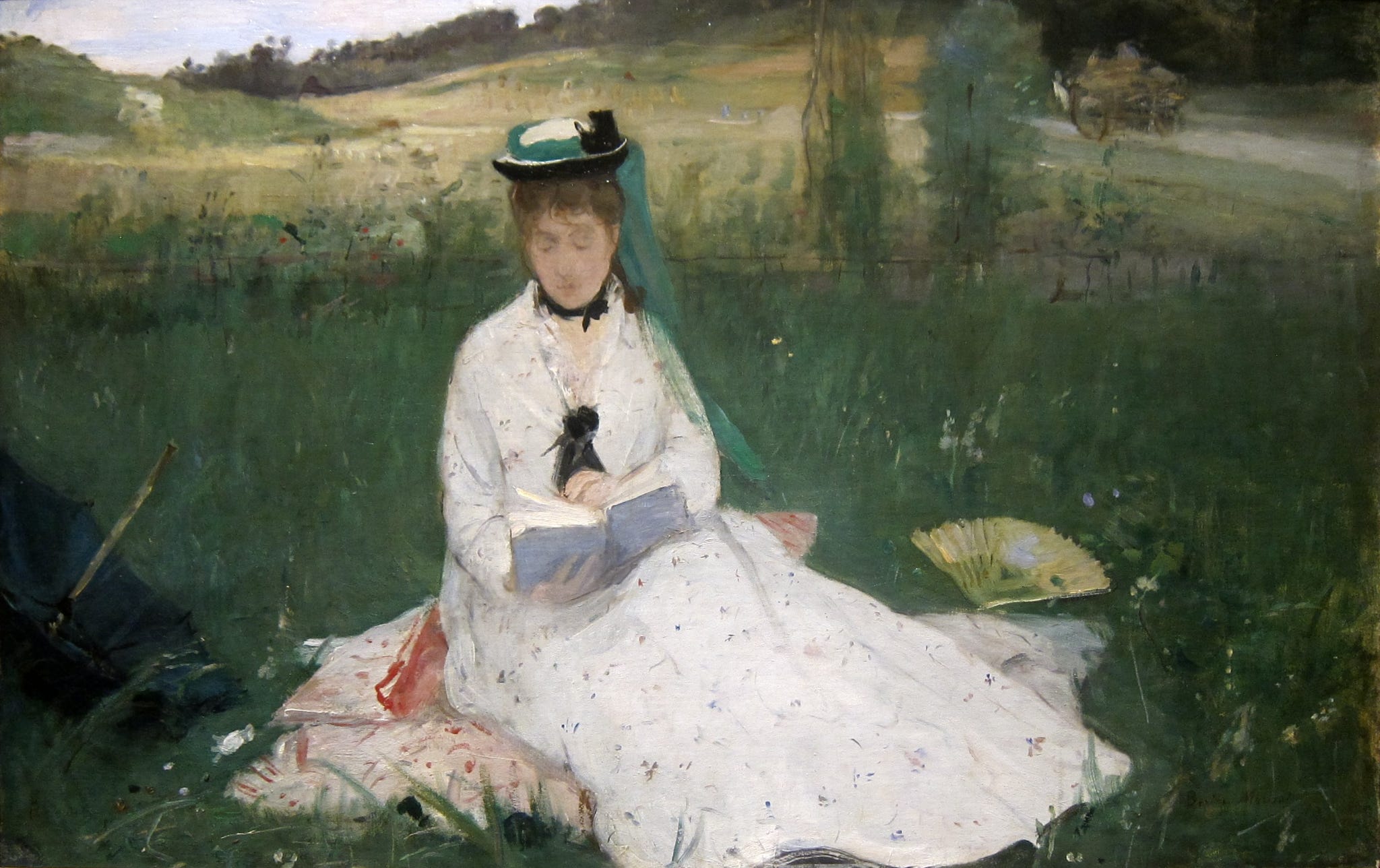
Berthe Morisot, Reading (1873)
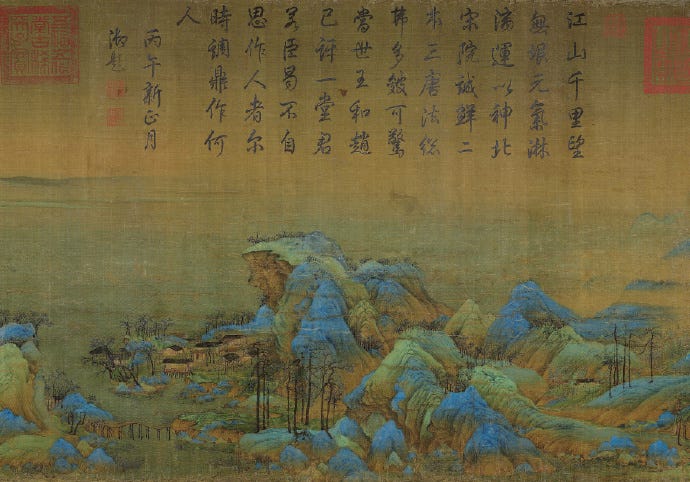
Wang Ximeng, a section of A Thousand Li of Rivers and Mountains, (1113)
The influence of both schools of painting would come into play when Tyrus Wong landed at Disney. Before arriving there, though, his work had been accepted for an important art exhibition in Chicago, right alongside pieces by Pablo Picasso, Henri Matisse, and Paul Klee. I mentioned to Mo Rocca this promising beginning for Tyrus.
Mo Rocca: It is promising, but it’s also… I mean, a career in the arts, and maybe a career in anything, is comprised of building blocks. So I love a story about a prodigy, someone who shows extraordinary talent from an early age. There are several people in the book like that. But that’s only a piece of it. You have to keep going. And in his case, you have to keep going through all sorts of barriers as well.
Marcus Smith: To get a sense of the social barriers that a Chinese immigrant would have faced, even if you were a promising young artist, just bear in mind that these were the years of the Chinese Exclusion Act. With United States immigration laws crafted to keep Chinese people out, Tyrus and his father had resorted to using fake names to enter the country, pretending they were relatives of immigrants already living here.
And even Chinese immigrants who succeeded in finding a place to establish themselves, well, they were not always afforded equal treatment or opportunity in society.
Mo Rocca: Many in the audience may already know discrimination against Chinese was legal. It was codified, and that’s really the only immigrant group for which that happened.
I did a Mobituary podcast episode on Anna May Wong. I mean, this was a woman who was a star. At the same time that she was a star in Hollywood, she couldn’t buy a home in certain parts of Beverly Hills. And when she and Tyrus had the means, traveled overseas, or even to Alaska, right, which was a US territory but not a state yet, they needed to essentially reapply for entry because their passports looked different.
So they were truly second-class citizens, and Tyrus as a young man recognized this when he tried to go to a movie with a friend of his and was forced to sit in the balcony.
Marcus Smith: On top of Tyrus’s treatment as a second-class citizen, he learned soon enough that the art world is a competitive place for anyone, even if you had the honor of exhibiting in Chicago alongside Picasso.
Mo Rocca: So I’m not sure that when he showed up to Disney they cared that he had been exhibited. He had to prove himself again.
Marcus Smith: Did he show up at Disney just sort of doing grunt work? I mean, what was the point of entry for him?
Mo Rocca: I don’t know exactly what the point of entry was for him at Disney, but he was pretty soon doing background painting.
Marcus Smith: He was tasked with painting background scenes during the development of the Bambi movie project, so he eagerly worked up some watercolor and pastel sketches of deer in soft, filtered light of the forest. Also, some vibrant, raw, emotional depictions of wildfire. He took these to the film’s artistic director.
Mo Rocca: He brought the brushwork that he had learned from the Impressionists and from the Song dynasty painters into play to create something that was much more Impressionistic with much more muted colors. The forests in Bambi that he painted were so evocative. They just seemed misty and moist. And Disney, whom Tyrus never actually met, was apparently enthralled, and credit goes to Disney there himself for recognizing that this was so bold, so innovative, something that had never been seen in feature-length animation.
Marcus Smith: As soon as you said misty and moist, I just started thinking about the “April Showers” song, and you have the little raindrops coming down. I mean, I haven’t seen Bambi for years, but I haven’t forgotten that scene either. And so what you’re talking about is sort of an atmospheric, impressionistic kind of style, that he’s the guy who brought that to Bambi?
Mo Rocca: He’s the guy who brought it to Bambi, and he is credited indeed. He’s in the credits as one of the background animators, but he really was responsible for that look. And that was the look that Walt Disney said is going to be the style for this movie. And again, it couldn’t be more different than Snow White.
And look, Hollywood is very much a creature of habit. If it ain’t broke, don’t fix it. And so for the studio to change so radically said something significant about Tyrus’ vision and his talent.
Marcus Smith: But before Bambi ever bounded into theaters, Tyrus Wong got laid off. It happened after an artist’s strike, in which he, ironically, hadn’t even participated. So he turned to other occupations where he could use his skills. He made greeting cards for Hallmark. You can see examples of his elegant Christmas cards on eBay.
He painted pottery, and eventually he landed at Warner Brothers, where he worked as an illustrator for over 20 years. Then, when Warner Brothers was sold, he was laid off once again. This is when he taught himself a new skill: kite making. His intricate kites became a fixture on the beaches of Santa Monica.
Mo Rocca says he held his craft to an exacting standard. And so when he created a butterfly, it had to move in the wind like a butterfly with flapping wings. I asked Mo if Tyrus Wong was bitter at the way he had been treated by Hollywood.
Mo Rocca: You know, if you look at pictures of him, and we have two in the book, one as a young man and one much older, he exudes contentment and happiness.
His daughters attest to his happiness. And he, like the other two people in this section of the book, Carmen Herrera and John Goodenough (she’s an abstract expressionist, he’s one of, if not the oldest Nobel laureate ever), all had one thing in common. They had very long-lasting marriages. He was married to his wife for about 60 years before she died.
And he credited her with certainly being the most important person in his life, but pushing him through whatever down times he might have had. And the pattern is so striking and so unmistakable among these three people. You know, it’s hard not to lapse into cliche. She was the woman behind the man. The stability of his life, the nurturing he got from his wife and from his daughters was no small thing.
You know, in learning his story, it’s hard to believe he could have persisted that way or been that happy or frankly lived that long without that support network.
Marcus Smith: Here’s why Mo Rocca included Tyrus Wong in his collection Roctogenarians, specifically in a section that’s titled It’s About Time. In 2001, when Tyrus Wong was 90 years old, he finally got the credit he deserved.
Mo Rocca: A few things happened at the end of his life, and really the kickoff was that Disney made him a Disney legend. They named him a legend. There were a few different factors, but there were people, there were students of animation that knew how special he was and how important he was.
Marcus Smith: When Tyrus Wong was 105, he got even more publicity from a filmmaker named Pamela Tom.
Mo Rocca: And she was inspired by the fact that she was watching Bambi with one of her children and noticed this name at the end, this Chinese name, and thought, what’s that about? Who is this person? And so then she looked into him and did a wonderful documentary.
Marcus Smith: Despite his advanced age, Tyrus Wong was able to be interviewed for both Pamela Tom’s documentary and the “CBS Sunday Morning” profile that followed.
Mo Rocca: And I oftentimes think about the what-ifs and how ephemeral these things are, that had Tyrus Wong not had a mentor that believed in his artistic talent, what we would have been robbed of, and obviously what he would have been robbed of, had he not had a father that loved him so selflessly, then Tyrus might have ended up like a lot of other immigrants, understandably, doing less artistic labor, more of a survival job.
He was blessed with a father with such foresight, as well as being blessed with talent and with mentors.
Marcus Smith: Mo Rocca’s interest in the later years of people’s lives, famous people, not so famous people, and unknowns, well, it really started morphing into an obsession after he himself was schooled by a much younger man on the set of a popular radio program.
Mo Rocca: For over 20 years, I’ve been a panelist on NPR’s news comedy quiz show, Wait Wait… Don’t Tell Me!, and in 2015, we did an episode where the guest was Chance the Rapper, who at that moment had just become very, very hot and broken out into the mainstream. I think those in the know, which don’t include me, already knew who he was. And we did this out, instead of in our usual smallish studio, we taped this episode in Chicago’s Millennium Park outdoors.
And so thousands of people showed up, and people were screaming. I mean, they were screaming, the fans, and these were fans, with all due respect, that were much younger than the typical NPR Wait Wait… Don’t Tell Me! fans. I like to say maybe people scream for Ina Garten, but that’s about it. Like, these kids were going bananas, and some were actually trying to climb onto stage.
And at one point, we on the panel were asking Chance the Rapper about how he writes his lyrics, and I thought, “Well, this will be an easy joke, kind of a hacky joke, but an easy laugh.” So I said, “Hey, I’m 46. Is it too late for me to become a rapper?” People laughed, gave it the tepid laugh it deserved, because it was just too easy a jokey question.
But he said to me—without skipping a beat, and in dead seriousness—he said, “I don’t know. Some people might say it’s too soon for you to become a rapper.” People laughed. The conversation moved on. But I was really kind of thunderstruck, because even in a jokey exchange, there’s meaning behind what people say.
And I think my question, I’m embarrassed to admit, and I was right away, revealed a kind of sense that I had internalized this idea that at 46 I was over the hill. I mean, I was— I really did. I was making a joke, but I think on some level, I’d actually come to believe that I was too old to do a whole lot of things.
And Chance hit back at me and basically made the point behind his jokey response that, you know, if you want to be a successful rapper, you need to have something to say. And for some people, that takes time. And there was real truth there, and people listening might say, “Well, what? You think you’re going to become a rapper? I’m 55 now.”
No, I do not believe that that’s going to happen, but I do believe that as I get older, that I will have more of substance to say, I will have more wisdom, and in whatever medium I choose to use, that hopefully will be reflected if I stick with it. So I think there was a real… there was a lesson in the exchange and really a lesson to myself that I had fallen into a trap.
Marcus Smith: This kind of gets to maybe a philosophy you have. Not a philosophy, but at least a perspective, that the more mature people in our human society have got some real heft to what they know and what they can do and what they can contribute. Is this just a simple ageism problem that we’re talking about here?
Mo Rocca: Well, I think ageism is real. I think it’s really stupid, because I think there’s just so much great human capital, which itself sounds kind of cold to put it that way, but there’s so much talent, there’s so much experience, there’s so much wisdom that many people wholesale dismiss, and it’s just really… it’s not just stupid, it’s wrong.
And I don’t think it’s a coincidence that we could fill a book with people accomplishing great things late in life. Because in my experience, and I’ve interviewed a lot of people that are older through the years, not just from “CBS Sunday Morning” for 17 years, but I created and hosted a cooking show where I went around the country cooking with grandmothers and grandfathers in their kitchens.
You know, I’ve done a lot of work that involves interacting with older people. And what I learned—it’s a generality—but what I’ve learned is that the older you get, in general, the less you care about what other people think of you. You’re not crowdsourcing your decisions. You’re not crowdsourcing who you are.
You just know the two or three things that matter to you, and you act on those. So your mind tends to be a lot less cluttered. You might forget proper names more often, but that’s a small downside in comparison with what you gain.
Marcus Smith: You clearly admire that, but do you also find it more interesting?
Mo Rocca: I do find it more interesting because I feel like I’m speaking to people with more authority. Authority in terms of what they’ve experienced, but it just sounds a little woo-woo or something, more emotional authority because they know how they feel about things. They’re comfortable in their skin, and what they say tends to be more felt.
So there’s less hyperbole, there’s less performance. I guess you’d just say there’s more realness. There’s also an interesting thing that happens unless someone’s actually just trying to sell something. But even when they are, older interviewees tend to make me come to them. They’re not playing up to me, and that makes my job more interesting because I have to discover who they are.
They’re not sitting across from me going, “Who does he want me to be?” And younger people do that.
Marcus Smith: Tyrus Wong had to wait nearly three quarters of a century to be named a legend. Whereas the French visual artist Henri Matisse was well known primarily as a modernist painter during most of his working life. However, a debilitating abdominal cancer struck him in his early 70s, leading him to hang up his brushes.
But it was only painting that he left behind. He did not give up on art. The story of Matisse’s self-reinvention in the last decades of his life is well worth hearing, and a perfect fit for Mo’s book. In just a moment, our conversation with Mo continues with Matisse’s makeover. Mo Rocca is author of Roctogenarians: Late-in-Life Debuts, Comebacks, and Triumphs.
I’m Marcus Smith, and you’re listening to Constant Wonder.
Mo Rocca was just admiring the kind of liberation that becomes noticeable in many older people when there’s more realness to them, as Mo says, when life for them is no longer a social performance. That sense of freedom is palpable in the later work of Henri Matisse during his cutout period. It’s the chapter of his artistic life that began after he had to undergo abdominal surgery for cancer.
Matisse had long been famous, known for his use of saturated colors in his modernist paintings of the human form, often set in landscapes or in domestic scenes, all the while incorporating elements of abstraction. His human figures are far more realistic, however, than the abstract figures so characteristic of his contemporary Picasso.
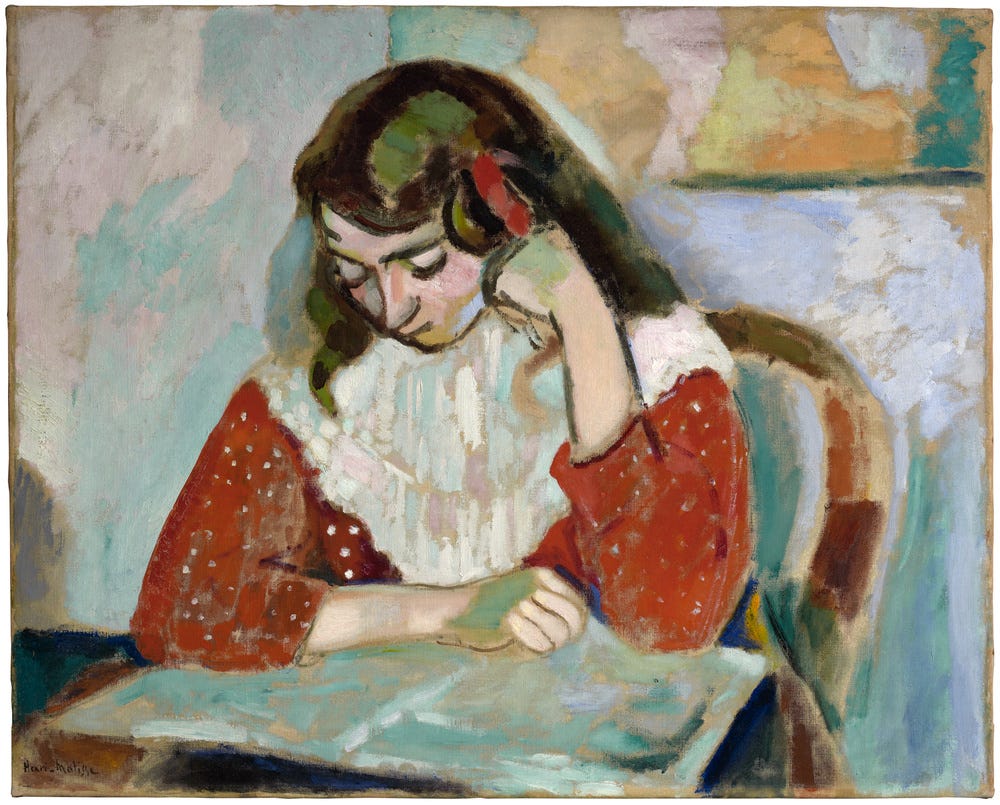
Henri Matisse, Margaret Reading (1906)
Matisse usually worked in contrasting colors, which makes his subjects jump off the canvas, whether they be goldfish or a woman in a purple coat. He was both a rival and a lifelong friend of Picasso, and the two painters are considered the vanguard of the modernist movement.
Mo Rocca: Matisse had already been celebrated as a great modernist by the middle of his life, but in his 70s, stomach cancer robbed him of the ability to really sit upright and paint.
He had to be reclined in a wheelchair because of his health or just lying in a bed. He then just instinctually—it wasn’t on the advice of others—he just instinctually traded in the paintbrush for a giant pair of scissors and began cutting out paper. He had his assistants still. They were painting the paper and then he would cut it and they would pin it to the walls.
Marcus Smith: The Museum of Modern Art in New York City, the MoMA, has mounted the paper cutout installation known as The Swimming Pool. Ultramarine blue human figures and sea creatures splash and dive across the walls.
Mo Rocca: The story goes that Matisse went to a pool one day, but it was way too hot. So he wanted to leave and come back home.
And he decided, you know what? I’m going to create my own swimming pool. And that’s what he did with the colored paper and the giant pair of scissors. And who doesn’t love a climate controlled indoor pool?
Marcus Smith: Matisse’s artistic engagement here reveals a personality with strong intentions. He’s possessed of a will to make or remake the world according to his own vision.
His take charge approach is also evident from the way he went about things during the original mounting of the swimming pool figures on the walls of his dining room. If you were to visit the space as it’s been recreated for the MoMA permanent exhibit, you might notice this about the cutouts.
Mo Rocca: There are lots of tiny holes in it, pinholes, because he was constantly having them switch the position.
So he was still the meticulous Matisse, but the medium was so different. And there are a couple of things that I love about this story. And I should also say by way of introduction here, the paper cutouts went on to comprise their own brilliant chapter of his career. Whether he viewed this as play, which he did in certain ways, this was not just a kind of sideline.
It became, as far as the art world’s concerned, an epoch, a major period for him, and rightly celebrated.
And there are a couple things that intrigued me about the story, one of which is it’s in a section called Loss into Gain, about people who view endings as beginnings. The end of his ability to paint wasn’t the end of his artistic career. It was the beginning of a new artistic career, in this case, paper cutouts, but which is certainly inspiring, I think.
But there’s something also that’s about a return to childhood, which I find really compelling. The paper cutouts aren’t childish by any means, but there is something childlike, because these are bold colors, big shapes. There’s something, and he said it himself, that’s very unfettered about these designs, about these works.
He called it a second life, but part of what he said he loved about doing the paper cutouts was a lack of complication, that he came to view some of his earlier work, as celebrated as it was, as labored in comparison. And there was just something very free about this, and I love that. Again, not childish, but childlike in its freedom, and maybe even in its purity and its impulsivity.
And that to me is really beautiful. He had experimented with cutouts earlier, mainly as a way of doing a rough draft of larger paintings he was going to do. So this wasn’t entirely new to him, but he’d always used paper cutouts in a more practical way before.
Marcus Smith: One day, Picasso and a companion showed up to visit.
They had brought along a magician to entertain Matisse. Perhaps in the spirit of friendly rivalry, Matisse responded to the magician’s performance with an impromptu session of painting with scissors, as he liked to call it. On the spot, he produced cutout portraits of all three: Picasso, his companion, and even the magician.
Mo Rocca: Picasso and his companion just marvel at the freedom they feel emanating from him. This is a man who’s not well, but seems utterly content.
Marcus Smith: One more aspect of this story is really interesting, and it has to do with a nurse who was tending him when he had his cancer. And then that comes around again where she reenters the story in some kind of an invitation, “Come over here. We have this convent or monastery, and we’ve got a new chapel. You could be the artist for this place.”
Mo Rocca: Yeah, this was a woman who had been one of his nurses, and then took her vows as a sister, as a nun, and then asked him to come and help with the chapel that was being constructed. And at first, he was only going to help in a limited way.
He was not a religious man. He had been very skeptical of religion, but he threw himself into it.
Marcus Smith: The space feels bright and airy with warm white walls and ceiling. The chapel’s floors are white as well, made of marble, and in this space, Matisse brought out that same ultramarine blue that he would later use in the swimming pool cutouts.
But in the chapel, there’s also a rich sunshine yellow and a vibrant green, three colors repeated throughout. The panes of stained glass windows mimic the abstract yet organic shapes of fronds or ferns that he returned to over and over again in so many of his paper cutouts. He also designed priestly vestments of silk and satin to be used in this chapel.
These came in an array of rich, saturated reds, yellows, pinks, with abstract forms and crosses on them, utterly unique religious attire. Paul Reymond, who consecrated the chapel in his role as the Bishop of Nice, quoted Matisse as having said, “I started with the secular, and now in the evening of my life, I naturally end with the divine.”
Mo Rocca: He viewed it as the apex of his artistic career, and I think as a deeply spiritual experience for him.
Marcus Smith: Would you tell me just a little bit about how everything comes to a conclusion for him? Do you think… again, it’s the happiness question. There’s a sense of real fulfillment, and maybe even a deeper fulfillment than in his earlier years pre-cancer.
Mo Rocca: Well, I think the chapel was a big part of that, as a way of giving thanks to someone who had helped him through his convalescence. I think it’s a beautiful thing, and probably no coincidence that this would be a house of worship. I think to end his life, and I keep coming back to this word, in such an unfettered way, I know that’s the dream I have for myself, for the chains to be broken in that way, and to feel that kind of freedom and flight at the end of your life is a pretty beautiful thing.
Marcus Smith: One of the stories you tell, and I couldn’t help but see some connection there, is the story decades, many decades before Matisse even lived, of one Mary Delany. And the bridge here really is that she was also working with scissors and paper. It has been rediscovered in recent years.
Mo Rocca: We had to include a section on widows.
And most of the widows in the section, like Mary Delany, and there’s one other, Madame Cliquot, is put in the same category, were women who lived at a time when they had fewer rights when they were married than they would as widows. And so Mary Delany’s first marriage was a real bummer of a marriage.
She was married off to a man who was much older, who then died. Her second marriage was a much happier one, where she got to know the leading botanists and writers of the age. And then in her 70s, once she was widowed again, she began doing these elaborate works of decoupage. These are works of art that both belong in museums and in science books as well.
Marcus Smith: Mary Delany mounted her cut paper specimens. That’s a word I’m eager to use here, because these collages that she made are so incredibly precise and lifelike. Well, anyway, she mounted these specimens, these creations, with their vivid colors, on backgrounds of solid black. And according to the British Museum, she may have used 200 cut paper pieces on the petals for just one flower.
The images have depth, and shadow, and color, vibrance, texture. Look up Mary Delany online. In just half a second, you’re going to be looking at image after beautiful image of her creations. And you really can’t tell that they’ve been produced from delicate paper cutouts rather than colored pencil or paint.
My personal favorite is a passion flower, with its wispy, tendril-like purple petals.
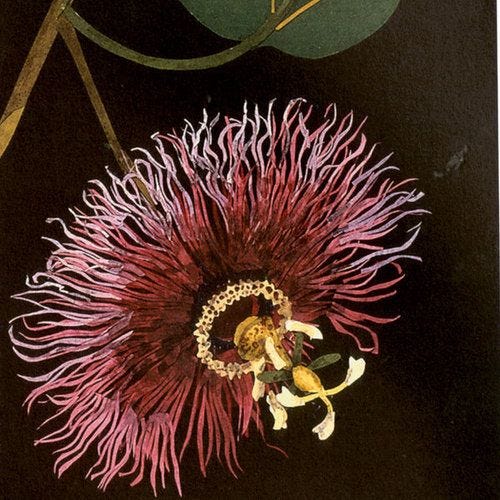
Mary Delany, Passiflora laurifolia L. (1777)
Mo Rocca: The specificity with which she created these works with the paper cutouts is so fine, very different than the Matisse work. And I believe she had to use tweezers because they’re just tiny, tiny little pieces when you look at them.
And they reemerged over the years as patterns for china and for clothing. They’re beloved pieces of art. But I think really what I love about the story is… and I think there is something slightly funny about this because I think of my grandmother. You know, you can have a good marriage and you can be really sad when your spouse dies, and you can also be liberated and be a little bit relieved, and the two can coexist, the two feelings.
And so my grandmother worked full-time at a Washington, DC department store, in fact, in the china and crystal department until she was 87, and I would say the best decade of her life was between the ages of 77 when my grandfather died… she loved my grandfather. I loved my grandfather. But between the ages of 77 and 87, she went to work with far fewer worries.
She loved having, as she put it, the girls from the store come over for dinners to drink some wine. It was the best decade of her life.
Marcus Smith: The final story we’re going to hear in this small sampler from Mo Rocca’s book. Roctogenarians involves an architect who in her 60s radically reinvented herself, her artistic aspirations, aims, ambitions. And the big personal makeover that she went through was actually for the benefit of an entire country, Pakistan.
This was following a devastating earthquake there that registered 7.6 on the Richter scale. If the artists we’ve been learning about so far have made great contributions to society by creating beautiful works, well, she is one who has saved lives.
We’re visiting with author Mo Rocca. He’s also host of the podcast Mobituaries. He’s also on Wait, Wait… Don’t Tell Me!, a correspondent for “CBS News Sunday Morning,” host and creator of My Grandmother’s Ravioli on the Cooking Channel, and that’s just a small peek at his resume. So we’re just lucky we caught up with him. I’m Marcus Smith, and you’re listening to Constant Wonder.
There is an architect in Pakistan, a, a woman by the name of Yasmeen Lari, and this big event in her life that shifted for her was an earthquake a seismic change—literally—in life, where in her art as an architect, she moved away from using big panes of glass and polished granite and started working with adobe and mud and bamboo as her medium.
Mo Rocca: What I think is so particularly interesting about Yasmeen Lari, who was the first professional female architect in Pakistan, who was celebrated as, as one of three leading South Asian architects at an exhibit in MoMA when she was in her 40s, is that she was a ‘starchitect,’ as they say. And as you’ve already pointed out, one of her great creations was the Taj Mahal Hotel in Karachi.

But she did, I think, what a lot of people fantasize about, and for some reason don’t do. I find this in particular with lawyers, people who say, “You know, I’m going to make all this money, and then I’m going to go, and I’m going to give back, and I’m going to do something that I really care about.” I’m not beating up on lawyers.
I just happen to hear this a lot from lawyers. And something keeps them from doing that. And I don’t think it’s just greed. In some cases it may be. I think it’s fear. I’m not sure of what. But Yasmeen Lari actually walked the walk. She did what I think she had wanted to do for a while, but the real inciting event here was indeed the 2005 earthquake in Kashmir, which killed 80,000 people and left half a million families homeless, displaced.
And she had already been working in preservation in Pakistan, helping to preserve a couple UNESCO World Heritage sites. So she was already well-versed and interested in traditional materials and techniques. But after that earthquake, she decided enough with the corporate lifestyle and the corporate commissions.
She had done enough of that, and now she was really going to give back, and she was going to help families live in sustainable, disaster-proof (because Pakistan’s prone to a lot of floods as well) housing. It’s something that she calls ‘barefoot social architecture,’ where, as you point out, you’re using traditional materials like lime, mud, bamboo, but also insisting that the people who end up living in these homes participate in the building of them so that there’s some investment in them.
And tens of thousands of people have homes because of her. But I think what’s so compelling about it is, again, there are so many people out there who want to make a switch and give their lives more meaning, and something stops them from doing it. She’s a great inspiration because she did it in her 60s. She made the switch.
Marcus Smith: She even says that she’s kind of atoning for her past sins of being the wrong kind of, I don’t know, artist and/or person.
Mo Rocca: And person, exactly right, because she said she was unforgiving, that if something was off by a millimeter, now of course, you want to be safe when it’s architecture, but that with underlings, with associates, that she could be egotistical, and that she’s had to learn to be just a much nicer person.
And that if things aren’t perfect, well, they’re good enough, because we’re talking about people surviving, and as many people as possible.
Marcus Smith: I’d really like to tuck in something here that you wrote for Mobituaries. You were defining that term, and you wrote, “Not everyone has gotten the send-off they were due. A mobituary is an appreciation for someone who didn’t get the love she or he deserved the first time around.”
And in that spirit, I think Roctogenarians, while this is not you moving in a whole new direction, I think you’re still celebrating the contributions of people, be they known or unknown, famous or not, just people who we’ve got to revisit their stories. We’ve got to revisit them.
Mo Rocca: Marcus, it’s also pleading. I learned early on when I was working on the Mobituaries podcast how quickly people are forgotten. I was working with very young, very talented people. This was only a few years after the writer-director Nora Ephron had died, and they didn’t know who she was, and these were smart, with-it kids.
And there was something… I’m not criticizing them for not knowing, and I bring up her name because she herself, in an interview on “CBS Sunday Morning,” when asked how she’d like to be remembered, she said, “Remembered? People aren’t going to remember me.” And at the time, I thought, “Oh, that’s silly.” And then here we were a few years after she died, very educated, hip 30-year-olds didn’t know who she was.
My hope is if we can just hang on to some of these stories just a little bit longer, it’s something. How much would I love it to know that in 100 years, somebody stumbled on my Sammy Davis Jr. mobituary? That would make me very happy. Sammy Davis Jr. doesn’t need my mobituary. Those in the know will know who he is in 100 years.
But in all seriousness, I think a lot of it is me saying, “Here’s a story. Let’s just hold onto it for a little bit longer.”
Marcus Smith: And yet there’s something more to this collection of human interest profiles that Mo has put together. Seems to me that there was just something about these people, people who had received recognition maybe later in life, or reinvented themselves in their golden years, didn’t settle into a comfortable, easy retirement, or choose convalescence once pain had become a constant in their lives.
Seems like life didn’t just happen to them. And so I asked Mo Rocca what it is about these people that he’s in awe of.
Mo Rocca: What awes me about these people, if there’s a thread that runs among them, I think it’s fearlessness. I think that they all came to a place late in life where they were not beset by fears and restraints.
There was a kind of contentment, a lack of fretting. This is not what I expected. I thought a book about people, even high achievers late in life, that a link would be people who felt a sense of urgency and that speed it up because they needed to establish their legacies. What awes me is that they lived in the present, and they created and did something in the moment, and I’ve used it already a couple of times.
There’s something very beautiful, unfettered, and free about that, and that’s the part that awes me.
Marcus Smith: Our thanks to Mo Rocca. He is author of Roctogenarians: Late in Life Debuts, Comebacks, and Triumphs. He’s host of the podcast Mobituaries, and the book that preceded it by the same title. This episode of Constant Wonder was produced by Tennery Taylor with help from Audrey Hughes and Holly Gerber.
Sound design by Josh Fouts. I’m Marcus Smith. If you like what you’re hearing, please leave us a five-star rating on your favorite podcast platform, or a review on Apple Podcasts letting us know what you love. It helps so much to get the word out. I’m Marcus Smith. Constant Wonder is a production of BYUradio.
Comments
Nothing yet. Say the first thing.
Sign in to join the conversation.